

Misreading a single line in a cleaning proposal can cost your facility thousands. When a vendor quotes a "production rate" that sounds reasonable but is based on ideal lab conditions, your actual staffing and budget will fall short fast. When a disinfectant is applied and wiped off too soon because no one understood "dwell time," your building fails its own health standards. These aren't rare edge cases. They happen in commercial facilities across the country every time property managers and vendors operate with different definitions of the same words. This guide breaks down the most critical commercial cleaning industry terms, backed by real data, so you can evaluate bids, manage vendors, and protect your facility with confidence.
Table of Contents
- The backbone terms: Production rates, dwell time, and cleaning frequencies
- Workloading and methodologies: Zone versus team cleaning and their implications
- Critical benchmarking: ISSA cleaning times and real-world variance
- Quality and compliance: CIMS standards, Power Clean, and regulatory language
- Market terms shaping decisions: Industry statistics and financial benchmarks
- Why real-world context is the missing link in cleaning industry terminology
- Clarify terms and secure quality cleaning with Sparklepro
- Frequently asked questions
Key Takeaways
| Point | Details |
|---|---|
| Define key cleaning terms | Clarify terms like production rates, dwell time, and ISSA times to avoid costly misunderstandings. |
| Workloading impacts outcomes | Choosing between zone and team cleaning directly affects costs, accountability, and service quality. |
| Benchmark wisely | Always compare vendor proposals against both industry standards and your actual facility’s needs. |
| Compliance matters more than ever | Certifications and regulatory language help manage liability and ensure cleaning quality. |
| Use real data for real decisions | Rely on up-to-date market terms and your facility's specifics to make the best cleaning choices. |
The backbone terms: Production rates, dwell time, and cleaning frequencies
Every cleaning program is built on a foundation of three core concepts. Get these right and everything else falls into place. Get them wrong and you'll overpay, underperform, or both.
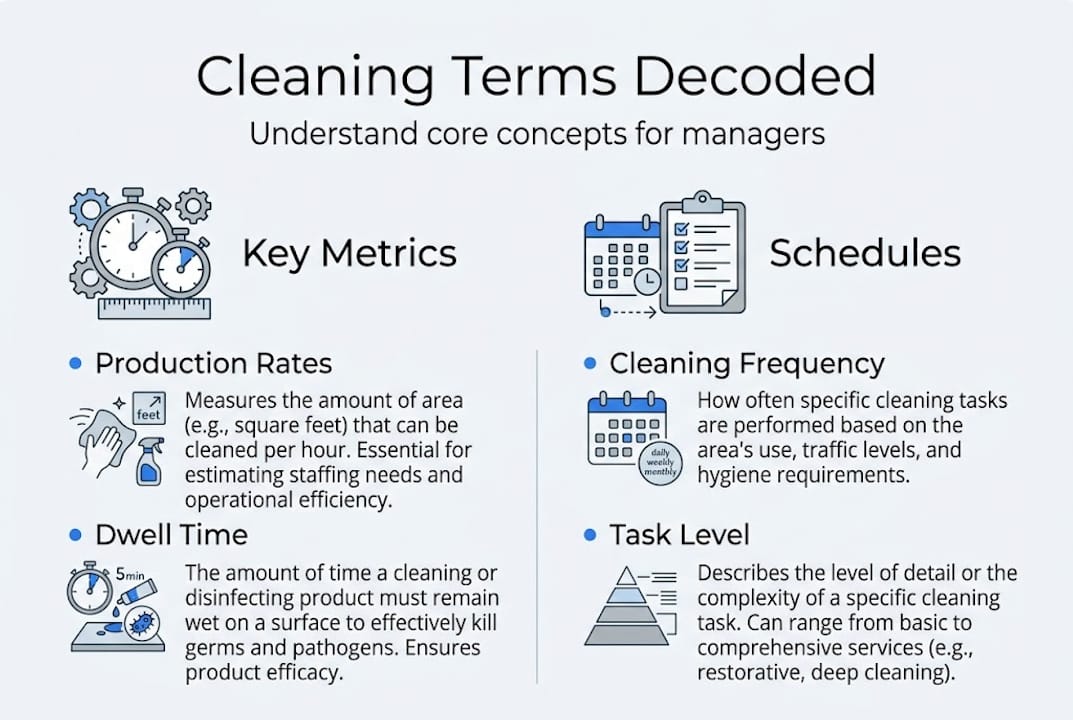
Production rates measure how much space or how many tasks a cleaner can complete in a given time. As production rates measure square feet per hour or time per task, they are the engine behind every bid and staffing calculation. A restroom, for example, typically takes 15 to 20 minutes to clean properly. Vacuuming open office space runs around 3,000 to 5,000 square feet per hour depending on furniture density. Mopping a hard floor corridor averages 2,500 to 3,500 square feet per hour. When vendors use inflated production rates to win a low bid, you end up with rushed cleaning and missed tasks.
Understanding cleaning production rates at the task level helps you push back on unrealistic proposals before you sign anything.
Dwell time is the amount of time a disinfectant must stay wet on a surface to kill the pathogens listed on its label. Most people assume spraying and wiping is enough. It is not. Dwell time is essential for disinfectants, and skipping it means you're just spreading a wet surface, not actually disinfecting. EPA-registered disinfectants list required contact times ranging from 30 seconds to 10 minutes depending on the pathogen.
Cleaning frequency refers to how often a task is performed: daily, weekly, monthly, or on a periodic schedule. Frequency directly affects labor hours and cost. Restrooms in high-traffic buildings may need cleaning three times per day, while a low-traffic storage corridor may only need weekly attention.
| Task | Typical production rate | Common frequency |
|---|---|---|
| Restroom cleaning | 15 to 20 min per restroom | Daily to 3x daily |
| Vacuuming (open office) | 3,000 to 5,000 sq ft/hr | Daily to weekly |
| Hard floor mopping | 2,500 to 3,500 sq ft/hr | Daily to weekly |
| Disinfecting surfaces | 1,500 to 2,500 sq ft/hr | Daily |
Pro Tip: Always ask vendors to show you the production rates they used to build your bid. If they can't produce that breakdown, the numbers may not be grounded in your facility's actual layout.
- Confirm dwell times match EPA label requirements for each disinfectant used
- Request task-level frequency charts, not just a general "daily cleaning" promise
- Verify production rates are adjusted for your floor plan, not generic benchmarks
Workloading and methodologies: Zone versus team cleaning and their implications
Once you understand the core metrics, the next step is knowing how cleaning labor gets organized in your building. Two primary systems dominate the industry, and mixing them up leads to staffing gaps and accountability problems.
Zone cleaning details show one approach: a single cleaner is responsible for every task within a defined area. They vacuum, empty trash, clean restrooms, and wipe surfaces all within their assigned zone. Team cleaning works differently. Specialists move through the entire building, each focused on one task type. One person vacuums everything. Another empties all trash. A third handles all restroom cleaning.
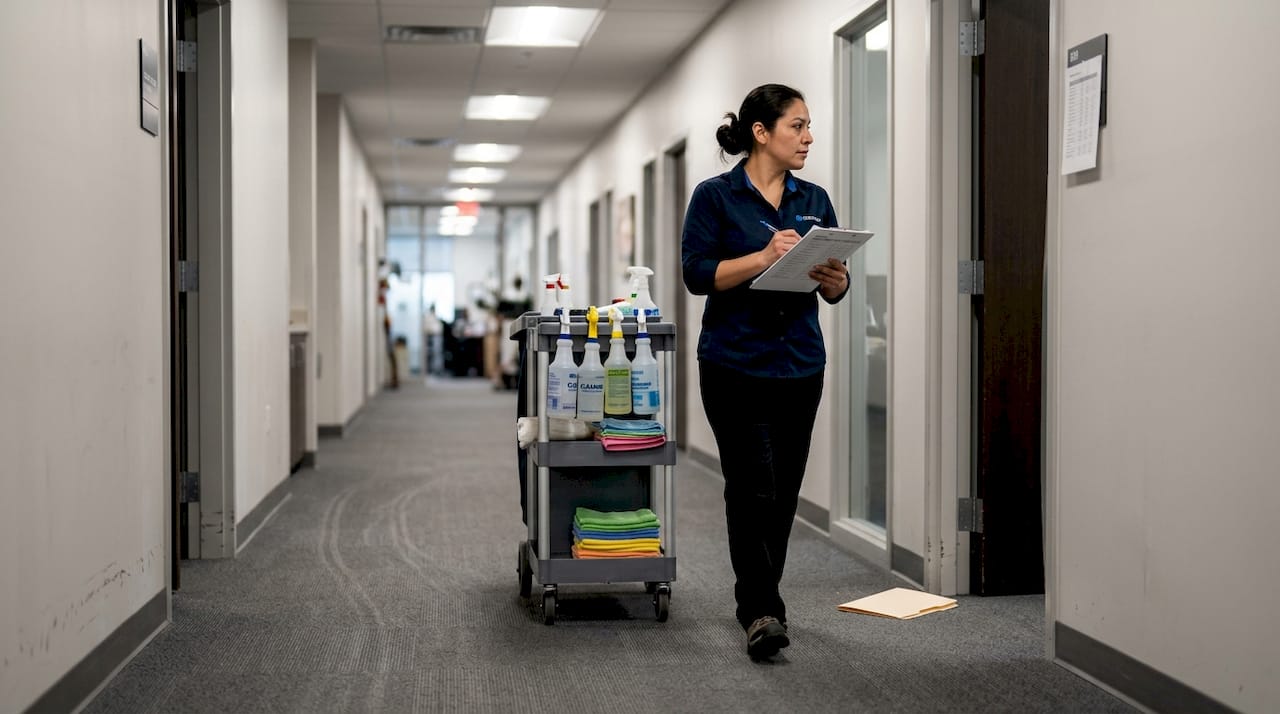
As zone cleaning assigns one individual all tasks in their area while team cleaning deploys specialists per task, both systems have real trade-offs.
| Factor | Zone cleaning | Team cleaning |
|---|---|---|
| Accountability | High (one person owns the zone) | Shared (task-based, not area-based) |
| Training needs | Broad skill set required | Narrower, task-specific training |
| Efficiency | Slower per task | Faster for repetitive tasks |
| Best for | Smaller buildings, sensitive areas | Large open facilities, high volume |
- Ask vendors which system they use and why it fits your facility.
- Request a workloading breakdown showing how hours are distributed.
- Confirm who is accountable when a specific area is missed.
- Clarify how the system handles after-hours or emergency cleaning needs.
"The method a vendor uses to organize labor is just as important as the number of hours they quote. A 40-hour proposal using team cleaning in a medical office building can produce worse outcomes than a 32-hour zone cleaning program designed for that space."
Neither system is universally better. The right choice depends on your building's layout, traffic patterns, and sensitivity requirements. What matters most is that your vendor can clearly explain their choice and tie it back to your specific facility.
Critical benchmarking: ISSA cleaning times and real-world variance
With a workloading system in place, the next question is how long each task should actually take. That's where ISSA cleaning times come in.
The ISSA Cleaning Times guide (also known as the 612 guide) provides task-level production rates that the industry uses as standard benchmarks. These figures cover hundreds of tasks, from wiping a desk to scrubbing a tile floor, and are widely used by vendors to calculate labor hours and build proposals.
The problem is that ISSA benchmarks are averages. They work well for typical office buildings with standard layouts. They become misleading in edge cases. Shopping malls with heavy foot traffic, medical facilities with strict protocol requirements, and dense urban buildings with elevator constraints all require more time than the standard ISSA figures suggest.
In fact, ISSA rates underestimate labor time in high-density venues, with empirical time-motion studies showing gaps of over 200 minutes per shift in some facilities. That's more than three hours of unaccounted labor per worker per day. If your vendor is bidding solely on ISSA benchmarks without adjusting for your facility, you are almost certainly underfunded.
Pro Tip: Ask your vendor whether they've conducted a time-motion study or site walk for your specific building. Any reputable contractor should adjust ISSA benchmarks based on observed conditions, not just apply them wholesale.
- ISSA times are accurate for standard commercial environments
- They often undercount time in high-traffic, multi-floor, or specialized facilities
- Medical, food service, and industrial spaces need custom time assessments
- Site-specific walkthroughs should always precede final labor estimates
The ISSA cleaning standards framework is a starting point, not a final answer. Treat it as a baseline and require your vendor to explain every deviation from it.
Quality and compliance: CIMS standards, Power Clean, and regulatory language
Benchmarking tells you how long tasks take. Compliance language tells you what standard those tasks must meet. This is where many property managers get lost in acronyms.
CIMS stands for Cleaning Industry Management Standard. It is a certification program developed by ISSA that evaluates cleaning companies on quality systems, service delivery, human resources, and health and safety. CIMS certification is required by many institutional clients as a baseline for quality management. If a vendor claims CIMS certification, ask to see their current certificate and what scope it covers.
Power Clean Standards, also developed by ISSA, define performance expectations for specific cleaning tasks and environments. As CIMS certification is required by many clients for quality management, Power Clean goes a step further by setting measurable outcome benchmarks. These terms are increasingly appearing in commercial contracts and RFPs.
Frequency charts are documents that list every cleaning task alongside how often it must be performed. They serve as the backbone of service verification and dispute resolution. If something wasn't cleaned, the frequency chart is your first reference point.
Here's what to look for when these terms appear in proposals:
- Does the vendor hold current CIMS certification, and at what level?
- Are Power Clean benchmarks referenced for specific task types?
- Is a frequency chart included as an exhibit in the contract?
- How are deviations from the frequency chart documented and corrected?
- Does the contract tie compliance failures to service credits or remediation timelines?
Pro Tip: Require that frequency charts be attached as a formal contract exhibit, not just referenced verbally. This protects both parties and makes quality audits straightforward.
Compliance language in cleaning contracts is no longer just for hospitals and government buildings. Office parks, retail centers, and multi-tenant commercial properties are all seeing more structured service agreements. Know what these terms mean before you sign.
Market terms shaping decisions: Industry statistics and financial benchmarks
Beyond technical vocabulary, property managers need to understand the financial language of the industry. This helps you recognize whether a bid is realistic or whether something is off.
The US janitorial market reached $97.6 billion in 2023, growing at a 3.1% compound annual growth rate. The industry employs millions of workers, with a median wage of $15.68 per hour nationally. Profit margins for commercial cleaning companies typically range from 10% to 28% depending on service mix, geography, and overhead structure.
| Benchmark | Figure |
|---|---|
| US janitorial market size (2023) | $97.6 billion |
| Market growth rate (CAGR) | 3.1% |
| Median hourly wage | $15.68/hr |
| Typical profit margin range | 10% to 28% |
"A bid that prices labor below $14 per hour in most US markets is almost certainly cutting corners somewhere, whether on wages, insurance, or cleaning time."
Use janitorial industry benchmarks to pressure-test proposals. If a vendor is bidding 40% below market rates, ask how. The answer usually involves reduced cleaning frequencies, lower-paid labor, or missing scope items.
Red flags to watch for in proposals:
- Hourly labor rates significantly below the local median wage
- Profit margins implied by the bid that fall below 10%
- No breakdown of labor hours versus supply costs
- Vague scope descriptions that don't tie to specific tasks or frequencies
Understanding these numbers doesn't make you an accountant. It makes you a smarter buyer who can tell when a proposal is built on wishful thinking rather than operational reality.
Why real-world context is the missing link in cleaning industry terminology
Here's a hard truth we've seen play out repeatedly: knowing the right terms is not the same as applying them correctly. Property managers who master the vocabulary but skip the facility-specific conversation still end up with underperforming contracts.
The industry loves benchmarks because they make selling easier. A vendor can quote ISSA times and CIMS certification and sound authoritative. But benchmarks are built on averages, and your building is not average. It has its own traffic patterns, floor materials, occupancy quirks, and compliance requirements.
The most effective property managers we've worked with do one thing differently. They ask vendors to translate every term into a specific, observable outcome for their facility. Not "we use zone cleaning" but "here is how zone cleaning works in your three-story building with two restrooms per floor." Not "we follow ISSA benchmarks" but "here is how we adjusted those benchmarks after walking your space."
Our cleaning expertise is built on exactly that principle. Terminology is a starting point. Real performance comes from applying those terms to your specific environment with transparency and accountability. Demand that from every vendor you evaluate.
Clarify terms and secure quality cleaning with Sparklepro
If reading through these definitions made you realize your current contract is light on specifics, you're not alone. Most commercial cleaning agreements leave too much open to interpretation, and that gap is where service quality slips.
At Sparklepro, we build every proposal around clear, documented terms. We explain production rates, dwell times, frequency charts, and compliance standards in plain language before you sign anything. Whether you manage a single office building or a portfolio of commercial properties, our teams serving commercial cleaning in Massachusetts, New York cleaning experts, and facilities nationwide bring the same standard of transparency to every engagement. Visit our full service overview to request a consultation or get a proposal built around your facility's actual needs.
Frequently asked questions
What are commercial cleaning production rates?
Production rates measure square feet per hour or time per task, making them essential benchmarks for accurate bidding and staffing decisions. Without them, labor estimates are guesswork.
How do ISSA cleaning times apply to my facility?
ISSA Cleaning Times provide standard task durations as a starting point, but real-world conditions like traffic density and floor layout often require custom adjustments specific to your building.
Why is dwell time important for disinfectants?
Dwell time is essential because a disinfectant must remain wet on a surface for a defined period to kill pathogens effectively. Wiping too soon renders the product ineffective regardless of brand or concentration.
What's the difference between zone cleaning and team cleaning?
Zone cleaning assigns one person all tasks within a defined area, while team cleaning sends task-specific specialists across the entire facility. The right choice depends on your building's size and complexity.
Why do commercial cleaning bids vary so much?
Bids reflect local labor costs, cleaning frequencies, compliance requirements, and service scope. The US janitorial market median wage of $15.68 per hour and margins of 10% to 28% mean outlier bids almost always signal missing scope or unrealistic pricing.