

Choosing the wrong janitorial service doesn't just mean a dusty lobby. It means tenant complaints, failed inspections, and a building reputation that takes months to rebuild. Property managers across the U.S. face real pressure to find partners who can meet operational benchmarks, satisfy diverse tenant expectations, and stay compliant with facility-specific regulations. The challenge is that no two buildings are the same. An office tower has entirely different needs than a medical clinic or a busy retail center. This article breaks down real service examples, proven methods, and practical guidance to help you match the right janitorial solution to your specific facility type.
Table of Contents
- How to evaluate janitorial services for your facility
- Office janitorial service examples and best practices
- Healthcare and specialized facility janitorial services
- Retail and shared public space janitorial solutions
- A practical take: What actually works (and what doesn't) when hiring janitorial services-when-hiring-janitorial-services)
- Explore reliable commercial janitorial services
- Frequently asked questions
Key Takeaways
| Point | Details |
|---|---|
| Define your needs first | Know your facility’s unique cleaning challenges before choosing a service. |
| Method matters | Select providers who match their methods—like team or zone cleaning—to your environment. |
| Demand standardization | Ask for detailed SOPs, checklists, and audit protocols to ensure quality. |
| Benchmarks drive value | Top providers reference industry benchmarks for square footage and cost efficiency. |
How to evaluate janitorial services for your facility
With the need for high standards clear, let's break down what to look for first. The U.S. janitorial industry is enormous. The market exceeds $112 billion with over one million businesses competing for contracts, and service costs typically run between $0.12 and $0.35 per square foot monthly. That range tells you something important: price alone is a poor filter. What separates a reliable provider from a risky one is how they operate, not just what they charge.
Before signing any contract, evaluate providers across these core criteria:
- Compliance awareness: Does the provider understand OSHA, EPA, and state-level requirements relevant to your facility type?
- Service scope: Can they handle everything your property needs, from daily cleaning to periodic deep services?
- Relevant experience: Have they worked in environments similar to yours, whether office, healthcare, or retail?
- Scalability: Can they expand services as your portfolio grows or your needs shift seasonally?
- Documented SOPs: Do they use Standard Operating Procedures (SOPs), meaning written step-by-step instructions that every crew member follows consistently?
SOPs, checklists, and regular audits are what turn a verbal promise into a delivered result. Without them, quality depends entirely on whoever shows up that day. Digital management tools, including mobile audit apps and real-time reporting dashboards, give property managers visibility into what's actually happening on the ground. Familiarizing yourself with cleaning terminology for managers will also help you ask sharper questions during the vetting process.
Pro Tip: Always ask a prospective provider to share a sample SOP or cleaning checklist. If they can't produce one quickly, that's a red flag about their operational maturity.
Office janitorial service examples and best practices
With a framework for evaluation, here are the most common and effective services for offices. Standard office janitorial programs typically include:
- Daily dusting of desks, shelves, and horizontal surfaces
- Restroom cleaning and restocking (soap, paper products, sanitizer)
- Floor care: vacuuming carpet, mopping hard floors, spot-cleaning high-traffic areas
- Break room sanitation: appliance wipe-downs, sink cleaning, trash removal
- Touchpoint disinfection: door handles, elevator buttons, light switches, shared equipment
- Trash and recycling removal from all workstations and common areas
The method matters as much as the task list. Team cleaning vs. zone cleaning represents the two dominant approaches, and each has a distinct fit.
| Factor | Team cleaning | Zone cleaning |
|---|---|---|
| How it works | Crews specialize by task (one person vacuums all floors, another handles restrooms) | One cleaner handles all tasks in an assigned area |
| Best for | Large offices, multi-floor buildings | Smaller offices, detail-focused environments |
| Efficiency | High, task repetition builds speed | Moderate, more flexibility per cleaner |
| Accountability | Shared across crew | Individual cleaner owns their zone |
| Consistency | Very high with strong SOPs | Varies by individual performance |
For large office buildings, team cleaning consistently outperforms zone cleaning on speed and repeatability. For boutique offices where personal attention matters, zone cleaning gives you a dedicated cleaner who knows every corner of the space.
Productivity benchmarks from ISSA 612 standards set general office cleaning at 3,500 to 5,000 square feet per hour. That number helps you reality-check bids. If a provider quotes a crew that would need to cover 8,000 square feet per hour to hit their price, the math doesn't work and quality will suffer.
"The best office cleaning programs aren't just about what gets cleaned. They're about when, how often, and whether there's a system to verify it happened."
Pro Tip: Schedule deep cleaning tasks like carpet extraction and hard floor buffing during off-hours or weekends. Aligning cleaning schedules to office occupancy patterns reduces disruption and improves results.
For detailed guidance on maintaining floors across surface types, the floor cleaning SOPs resource is worth reviewing before finalizing your service scope.
Healthcare and specialized facility janitorial services
Let's see how services adapt when compliance and patient health are on the line. Healthcare environments operate under a completely different set of rules. A missed touchpoint in a medical office isn't just a cleanliness issue. It's a potential infection risk and a regulatory liability.
Core janitorial services in healthcare facilities include:
- High-touch disinfection: exam tables, bed rails, call buttons, door handles, and shared equipment
- Regulated waste segregation: proper handling and disposal of biohazardous materials per OSHA standards
- Specialized floor care: no-wax floor maintenance, antimicrobial treatments in patient areas
- Terminal cleaning: deep disinfection of rooms after patient discharge, following documented protocols
- Restroom sanitation: more frequent cycles than standard commercial spaces
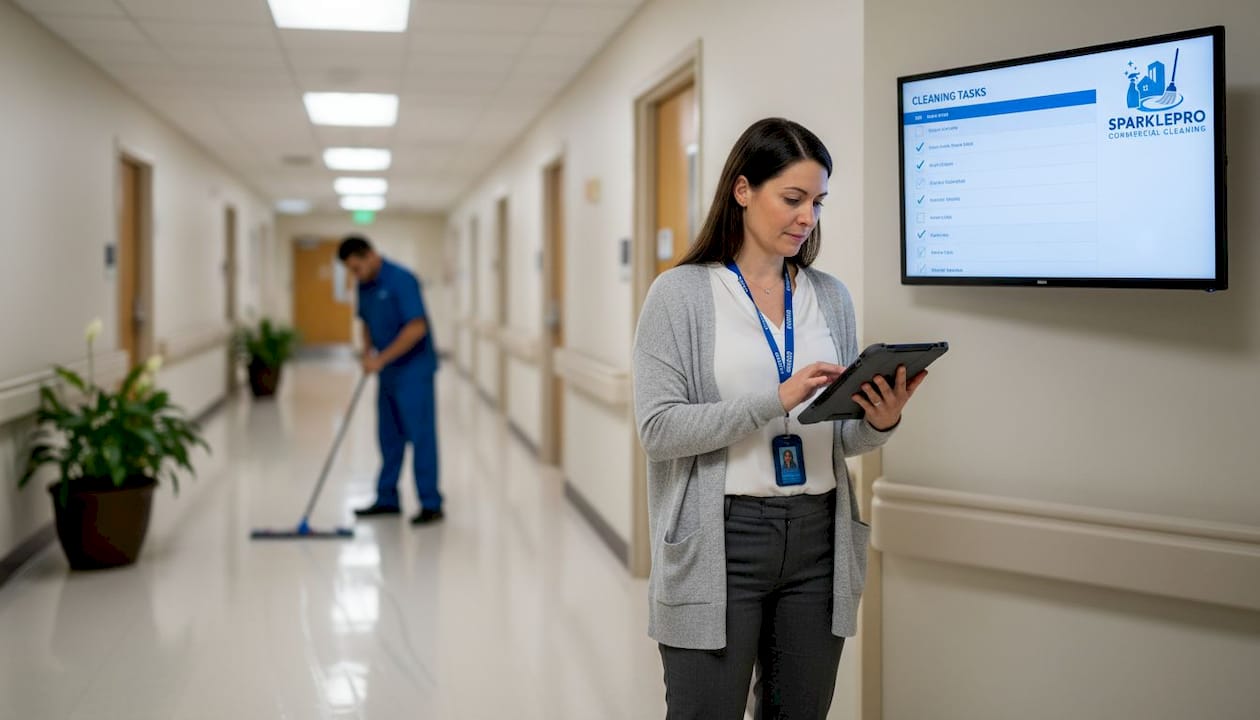
A typical daily healthcare janitorial checklist follows a structured sequence:
- Don personal protective equipment (PPE) before entering any patient area
- Remove and bag biohazardous waste first, before any surface cleaning
- Disinfect high-touch surfaces using EPA-registered disinfectants with correct dwell time
- Clean floors using a two-bucket or microfiber flat-mop system to prevent cross-contamination
- Restock supplies and document task completion with a time-stamped log
ISSA productivity benchmarks for medical environments set the rate at 1,800 to 2,500 square feet per hour, significantly slower than office spaces. That slower pace reflects the precision required. Rushing a healthcare clean is not an option.
"Standardized SOPs and checklists are not optional in medical environments. They are the mechanism that keeps variability out of a process where variability causes harm."
Standardizing processes across crews through digital audit tools gives multi-site property managers real-time visibility into whether protocols are being followed at every location, not just the ones they visit in person. Reviewing floor cleaning SOPs specific to healthcare surfaces is a smart starting point when building your service requirements.
Retail and shared public space janitorial solutions
Now, moving into spaces with maximum visibility and public access. Retail environments and shared public spaces like lobbies and transit areas present a unique challenge: cleaning must happen continuously, often while customers are present, without disrupting the shopping or visitor experience.
Essential services for retail and high-traffic public spaces include:
- Glass and mirror cleaning: storefronts, display cases, entrance doors (often multiple times daily)
- Floor and carpet care: high-frequency vacuuming, spot-cleaning, and periodic deep extraction
- Waste management: frequent bin emptying in high-traffic zones to prevent overflow
- Restroom sanitization: rapid-cycle cleaning with documented frequency logs
- Entrance and lobby maintenance: mat cleaning, hard floor buffing, and spill response
ISSA benchmarks for retail environments show restroom cleaning at 800 to 1,200 square feet per hour and lobby cleaning at 5,000 to 6,000 square feet per hour. That speed difference reflects the intensity of restroom work versus open floor sweeping.
| Area | Recommended cleaning frequency |
|---|---|
| Restrooms | Every 1 to 2 hours during peak traffic |
| Entrances and vestibules | 2 to 3 times daily minimum |
| Public seating areas | After each use or every 2 hours |
| Hard flooring | Daily mop, weekly buff or polish |
| Carpeted areas | Daily vacuum, monthly extraction |
"A clean restroom tells a customer you care about the details. A dirty one tells them everything they need to know about how you run your business."
Understanding industry cleaning terms like dwell time, sanitization vs. disinfection, and soil load will help you write better service agreements and hold retail cleaning vendors accountable to real standards.
A practical take: What actually works (and what doesn't) when hiring janitorial services
After these detailed examples, here's a straight-talking perspective on what truly matters. Most property managers focus heavily on price during procurement. That's understandable. Budgets are real. But price without a clear understanding of the provider's methods, benchmarks, and accountability systems is just a guess at value.
The managers who get the best results invest time in relationship and alignment before the contract starts. They walk the facility with the provider. They review sample checklists. They ask how audits are conducted and what happens when a task is missed. Why SOPs aren't optional becomes obvious the first time a crew changes and quality drops overnight.
Switching providers too often is also a hidden cost. Every transition means retraining, re-scoping, and a period of inconsistent results. The best janitorial partnerships are built over time, with feedback loops and continuous improvement baked in. Checklists and audits are the difference between what a provider promises in a sales meeting and what actually gets delivered on a Tuesday night.
Explore reliable commercial janitorial services
If you're looking to apply these insights with a trusted provider, here's where to start. Sparklepro Commercial Cleaning specializes in office, healthcare, and retail environments with flexible, scalable solutions built for property managers who need consistent results across multiple locations.
Whether you manage a single office building or a portfolio of mixed-use properties, Sparklepro Commercial Cleaning offers documented processes, trained crews, and real accountability at every service visit. Explore California janitorial services or New York janitorial services to find regional coverage near you. As a nationwide cleaning partner, Sparklepro Commercial Cleaning is ready to match the right service model to your property. Request a free consultation to get started.
Frequently asked questions
What are the main types of janitorial services for commercial buildings?
The main types include daily office cleaning, restroom sanitization, floor care, waste removal, and specialized disinfection for healthcare or retail spaces. Service categories and benchmarks vary widely based on facility type and compliance requirements.
How do team cleaning and zone cleaning differ?
Team cleaning uses specialized crews for specific tasks across the entire facility, while zone cleaning assigns one cleaner to handle all tasks within a defined area. Team vs. zone cleaning each suit different building sizes and management priorities.
What should property managers ask before hiring a janitorial service?
Ask about standard operating procedures, benchmarking data, technology use, and staff training or certifications. SOPs and standardization are the clearest indicators of a provider's operational discipline.
How much do commercial janitorial services cost?
Service costs typically range from $0.12 to $0.35 per square foot monthly, depending on facility type, service frequency, and regional labor rates.