
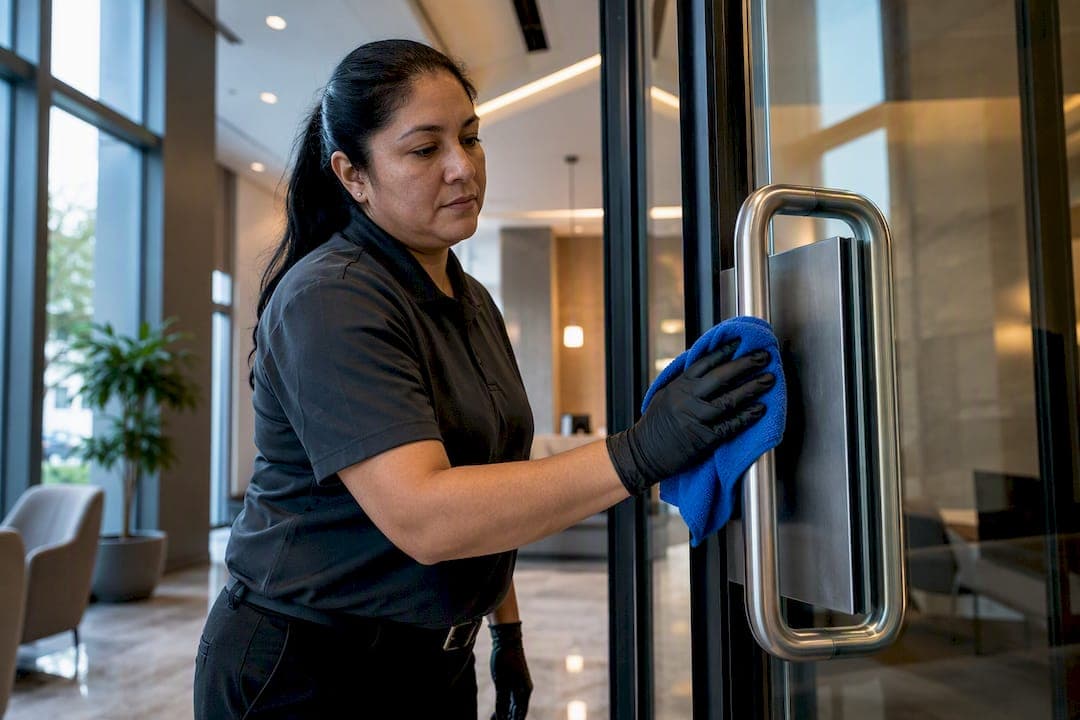
Most offices don't need to disinfect every day. The CDC's core recommendation is simple: clean high-touch surfaces at least once daily, and reserve disinfection for after someone gets sick or when transmission risk is elevated. Clean first, always, then disinfect if the situation calls for it. Choose EPA-registered products, respect label contact times, and protect the staff doing the work with proper PPE and ventilation.
TL;DR:
- Routine cleaning of high-touch surfaces once daily is sufficient in most office settings, while disinfection is only necessary after confirmed illness or high transmission risk.
- Proper cleaning before disinfecting is essential; skipping this step reduces chemical effectiveness and leaves germs behind.
- Use EPA-registered disinfectants, verify contact times, and store labels visibly to ensure correct disinfection procedures.
- Targeted cleaning of areas touched by sick individuals within 24 hours is more effective than broad, facility-wide disinfection.
- Overreacting with excessive disinfection and frequency can waste resources, increase chemical exposure, and provide no additional safety benefit.
Table of Contents
- What the CDC Office Cleaning Guidelines Mean for Your Building
- Cleaning vs. Sanitizing vs. Disinfecting: Get the Terms Right
- Routine Cleaning: What to Wipe Down and How Often
- When Someone Is Sick: The 24-Hour and 72-Hour Rules
- Choosing the Right Disinfectant and Using It Correctly
- Keeping Your Cleaning Staff Safe
- Building a Daily and Weekly Cleaning Workflow
- Where to Verify the Official CDC and EPA Rules
- Why Most Offices Overreact to Cleaning Guidance
- Sources
- FAQ
What the CDC Office Cleaning Guidelines Mean for Your Building
Here's the immediate action list. Post it by the supply closet.
- Wipe high-touch surfaces daily: doorknobs, light switches, elevator buttons, shared keyboards, and breakroom handles.
- If someone is sick: close off the space they used, wait as long as practical, then clean before disinfecting.
- Check your supply closet: you need an EPA List N disinfectant, a bleach or 70% alcohol backup, and gloves at minimum.
- Verify products against the label, not habit. Concentration and contact time on the bottle override whatever your crew has always done.
Pro Tip: Keep a printed copy of your disinfectant's label taped inside the supply cabinet. When contact time or dilution ratios are memorized wrong, the product fails even though someone "cleaned."
The CDC notes that in office and community settings, routine cleaning of high-touch surfaces at least once a day is usually sufficient, with disinfection reserved for illness or elevated risk, not daily maintenance.
Cleaning vs. Sanitizing vs. Disinfecting: Get the Terms Right
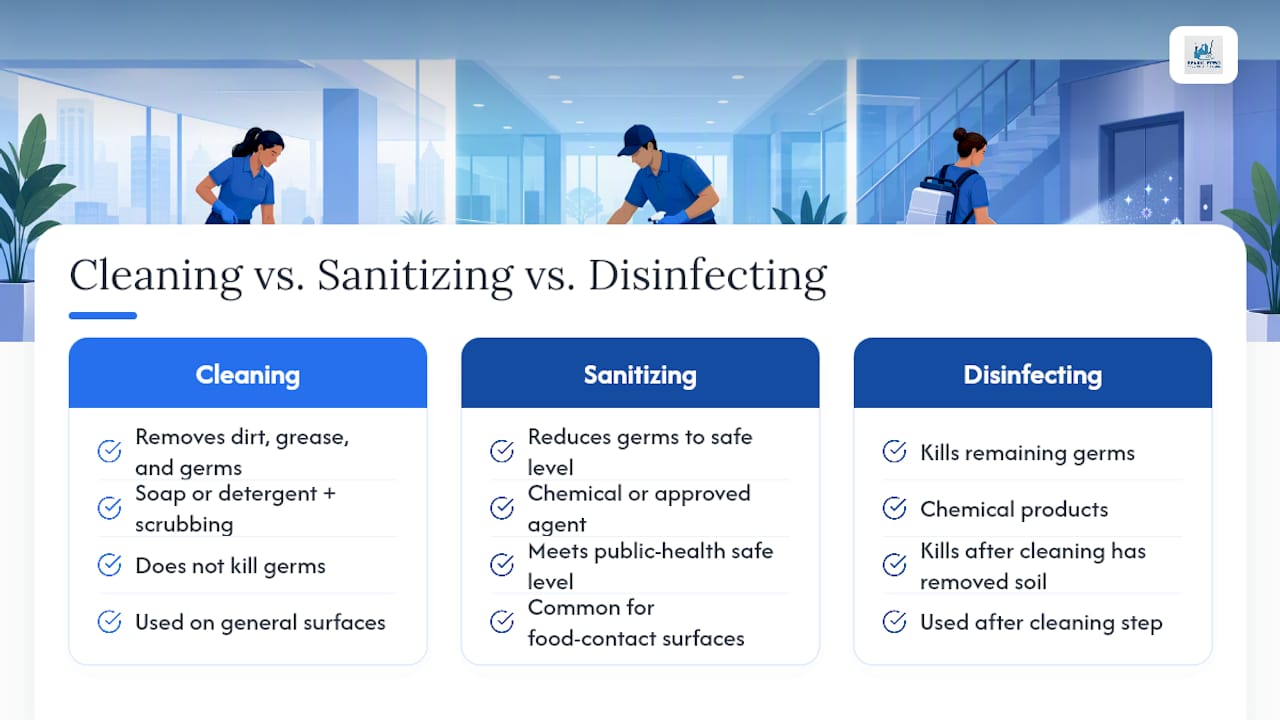
These three words get used interchangeably in break room conversations, and that's where compliance problems start. Cleaning means removing dirt, grease, and germs from a surface using soap or detergent and physical scrubbing. It doesn't kill anything. It just takes the germs off the surface and down the drain.
Disinfecting is the chemical step that follows. The CDC defines cleaning as removing soil while disinfecting kills remaining germs with chemical products, and cleaning always has to happen first. Skip the cleaning step and you're disinfecting through a layer of grime, which blocks the chemical from reaching germs at all.
Sanitizing sits in between: it reduces germs to a level public health codes consider safe, commonly used for food-contact surfaces rather than office desks.
One more thing worth flagging: this guidance is written for community and office settings. Healthcare facilities operate under separate, stricter standards, and the CDC is explicit that its general guidance isn't a substitute for healthcare-specific protocols. If your building includes an on-site clinic or medical suite, that space needs its own protocol.
Routine Cleaning: What to Wipe Down and How Often
Daily cleaning covers the surfaces hands touch repeatedly throughout the day. Skipping visible dirt and jumping straight to a disinfectant wipe is a common shortcut that doesn't actually work; the CDC's own procedure calls for soap and scrubbing on anything visibly soiled before a disinfectant ever touches it.
Prioritize these areas every day, or more often in high-traffic zones:
- Door handles, push plates, and stairwell railings
- Elevator buttons and call panels
- Shared keyboards, mice, and phone handsets
- Conference room tables and shared remote controls
- Breakroom counters, microwave handles, and refrigerator doors
- Restroom fixtures and faucet handles
Lobbies, shared kitchens, and restrooms used by hundreds of people daily need more frequent attention than a rarely visited storage room. Adjust frequency upward when your building has vulnerable occupants, like an on-site daycare or a workforce with higher rates of chronic illness.
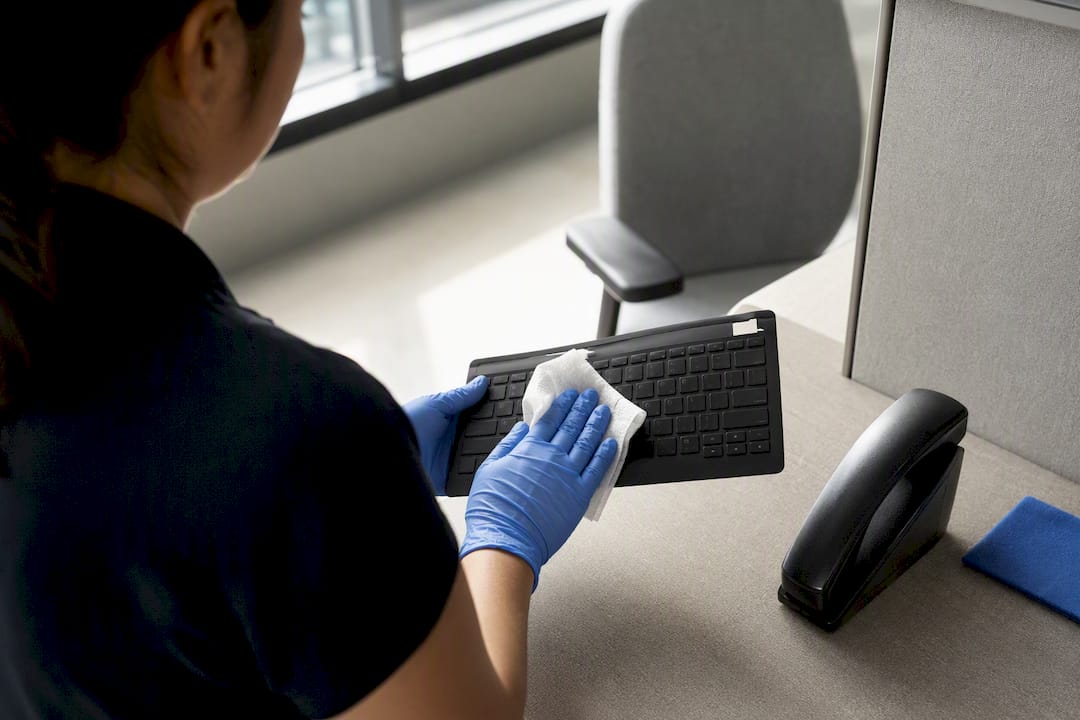
Electronics need a different approach. Skip liquid cleaners on keyboards and phones. Use wipeable keyboard covers where possible and disinfectant wipes rated safe for electronics. Soft and porous items, chair fabric, cubicle partitions, area rugs, either get laundered on the hottest safe setting or vacuumed; they generally can't be disinfected the way a hard surface can.
When Someone Is Sick: The 24-Hour and 72-Hour Rules
The timeline matters more than most facility teams realize, and the CDC's decision rules are more forgiving than the panic-driven deep cleans many offices ran during 2020.
- Within 24 hours of exposure: close off the space the sick person occupied if you can. When practical, wait before entering, then clean and disinfect the areas they used, not the whole floor.
- Between 24 and 72 hours: routine cleaning is often enough on its own. Some facilities still choose to disinfect the immediate workstation as an added precaution, and that's a defensible call, not a requirement.
- Past 72 hours: routine cleaning covers it. No special disinfection step is needed at this point.
- Target the actual footprint: the desk, chair, shared equipment, and door handles that person touched, not adjacent cubicles they never used.
- Use a HEPA vacuum on soft flooring or fabric in that footprint if visible soil is present, and adjust HVAC settings to bring in outside air rather than recirculating a closed room's air during and right after cleaning.
Wide-area fogging or electrostatic spraying might sound thorough, but targeted manual cleaning of the specific surfaces that person touched produces better results per hour of labor and skips the respiratory risk that comes with aerosolized chemicals.
Choosing the Right Disinfectant and Using It Correctly
Reach for a product on the EPA's List N of registered disinfectants first. Every product on that list carries an EPA registration number printed on the label, usually a string of numbers separated by a dash. Cross-check that number against the EPA database before you buy in bulk, since off-brand products sometimes borrow legitimate-sounding names without the registration to back them up.
When a List N product isn't available, the CDC outlines two dependable substitutes:
- Bleach dilution: 1/3 cup of regular household bleach per gallon of water for most hard, nonporous surfaces.
- Alcohol solutions: at least 70% alcohol content, better suited to electronics and small items than bleach.
Never mix bleach with ammonia or other household cleaners. The combination produces toxic fumes, and it's one of the more common accidental hazards in office breakrooms where multiple cleaning products get stored side by side.
Pro Tip: Contact time is the step everyone skips. If the label says the surface needs to stay visibly wet for four minutes, wipe once, then leave it alone. Wiping it dry after thirty seconds because it "looks clean" means the product never had time to work.
Store diluted solutions in labeled, opaque containers dated with the mixing day. Bleach dilutions lose potency within about 24 hours of mixing.
Keeping Your Cleaning Staff Safe
Gloves are the floor, not the ceiling, for PPE during cleaning tasks. The CDC recommends wearing gloves for all cleaning tasks and washing hands for 20 seconds after cleaning and after glove removal, with additional protection layered on for disinfecting specifically.
- Gloves for every task, cleaning or disinfecting, no exceptions.
- Add eye protection and a gown when there's splash risk from spray bottles or when mixing concentrated solutions.
- Ventilate the space before and during disinfectant use. Opening windows, running fans, or adjusting HVAC to pull in outside air meaningfully cuts staff exposure to fumes.
- Train staff on label reading and SDS sheets before handing them a new product, not after an incident.
- Flag chemical sensitivities and asthma during onboarding so those staff members can be assigned different tasks or given respiratory protection.
Ventilation isn't optional politeness here. It's a repeatedly cited mitigation step because chemical fume exposure in enclosed breakrooms and small offices is a real, documented risk for cleaning crews who work with the same products daily.
Building a Daily and Weekly Cleaning Workflow
Turning CDC guidance into something a cleaning crew actually follows means writing it down as a schedule, not a memory.
Daily tasks: wipe high-touch surfaces, empty trash, spot-check restrooms and breakrooms, confirm disinfectant and PPE stock levels haven't run low.
Weekly or monthly tasks: deeper carpet and upholstery cleaning, disinfecting light switches and vents that don't get daily attention, and a full stock audit of EPA-listed products against your current inventory.
Triggers for targeted disinfection outside the schedule: a confirmed illness, a spill involving bodily fluids, or a visitor reporting symptoms after using a specific conference room.
Recordkeeping ties it together. Logs should capture the date, time, staff initials, area cleaned, product used including EPA registration or bleach dilution ratio, and confirmation that contact time was met. These logs matter for more than compliance optics; they're what a facility manager hands over during an insurance review or a lease dispute over maintenance responsibility.
| Workflow element | Internal team handles | Contracted provider handles |
|---|---|---|
| Daily high-touch wiping | Often, front desk or in-house janitorial | Sometimes bundled into janitorial contracts |
| Post-illness disinfection | Rarely trained for this | Typically, specialized disinfecting services |
| Deep cleaning (carpets, upholstery) | Occasionally, with rented equipment | Usually, scheduled quarterly or as needed |
| Compliance documentation | Sometimes informal | Usually itemized in service reports |
A workflow template built around daily and weekly checklists makes it easier to split these responsibilities cleanly instead of assuming someone else covered the disinfecting step.
Where to Verify the Official CDC and EPA Rules
Skip the secondhand summaries when a decision has real liability attached. Go to the source.
- Cleaning and Disinfecting | CDC for the current baseline recommendations.
- When and How to Clean and Disinfect a Facility | CDC for the step-by-step procedure and the 24-hour decision rules.
- Selected EPA-registered disinfectants to check a product's registration number against List N before you buy.
Bookmark these three pages. Guidance updates periodically, and a printed handout from a 2021 training session is not a reliable source three years later.
Why Most Offices Overreact to Cleaning Guidance
The biggest mistake facility managers make isn't under-cleaning. It's treating every guideline as if it demands the maximum response, disinfecting daily when routine cleaning would do, fogging a whole floor when one workstation needed attention. That instinct comes from good intentions, but it burns budget, exposes cleaning staff to unnecessary chemical load, and doesn't actually reduce risk more than a targeted approach would.
The CDC's own framework is more restrained than the pandemic-era habits many buildings never dropped. Clean daily. Disinfect when there's an actual reason. Match the response to the timeline, not the anxiety in the room. That's the part conventional office wisdom keeps missing: more chemicals and more frequency aren't the same thing as more effective.
If you're deciding where to put your first dollar of improvement, put it into documentation and training, not into a bigger disinfectant budget. A crew that reads labels correctly and tracks contact time will outperform a crew with better products and worse habits every time. And if your internal team is stretched thin, a contracted disinfecting service can absorb the specialized post-illness work while your staff keeps up with daily routine cleaning. That division of labor, not blanket disinfection, is what actually holds up under scrutiny.
— Sales
This article is general information, not a substitute for advice from a qualified doctor. Consult a qualified healthcare professional about your own circumstances before acting on anything here.
Sources
- Cleaning and Disinfecting | CDC
- When and How to Clean and Disinfect a Facility | CDC
- Cleaning and Disinfecting Your Facility (CDC PDF)
- Selected EPA-registered disinfectants
FAQ
What Are the CDC Cleaning Guidelines for Offices?
The CDC recommends routine cleaning of high-touch surfaces at least once a day in office and community settings, with disinfection reserved for after illness or elevated transmission risk. Clean with soap and scrubbing before applying any disinfectant.
What Is the CDC's Definition of Cleaning?
Cleaning is the physical removal of dirt, germs, and impurities from a surface using water, soap or detergent, and scrubbing. It doesn't necessarily kill germs, it removes them, which is why the CDC requires cleaning before disinfecting rather than treating the two as interchangeable steps.
What Are the Recommended Cleaning Guidelines in General?
Clean visibly dirty surfaces with soap and water first, then disinfect only when needed, such as after someone is sick or during periods of higher illness risk. Choose EPA List N products when available, and always follow the label's contact time and dilution instructions.
What Are the Recommended Cleaning Guidelines for Healthcare Facilities?
Healthcare settings follow separate, stricter protocols than general offices, since CDC community guidance explicitly isn't a substitute for healthcare-specific cleaning standards. Facility managers with an on-site clinic or medical suite should apply healthcare-grade protocols to that space rather than standard office guidance.
How Long After Someone Is Sick Should You Disinfect an Office?
If exposure happened within the last 24 hours, close off the area if possible and clean then disinfect the space that person occupied. Between 24 and 72 hours, routine cleaning is typically sufficient, and past 72 hours, no special disinfection step is needed at all.