
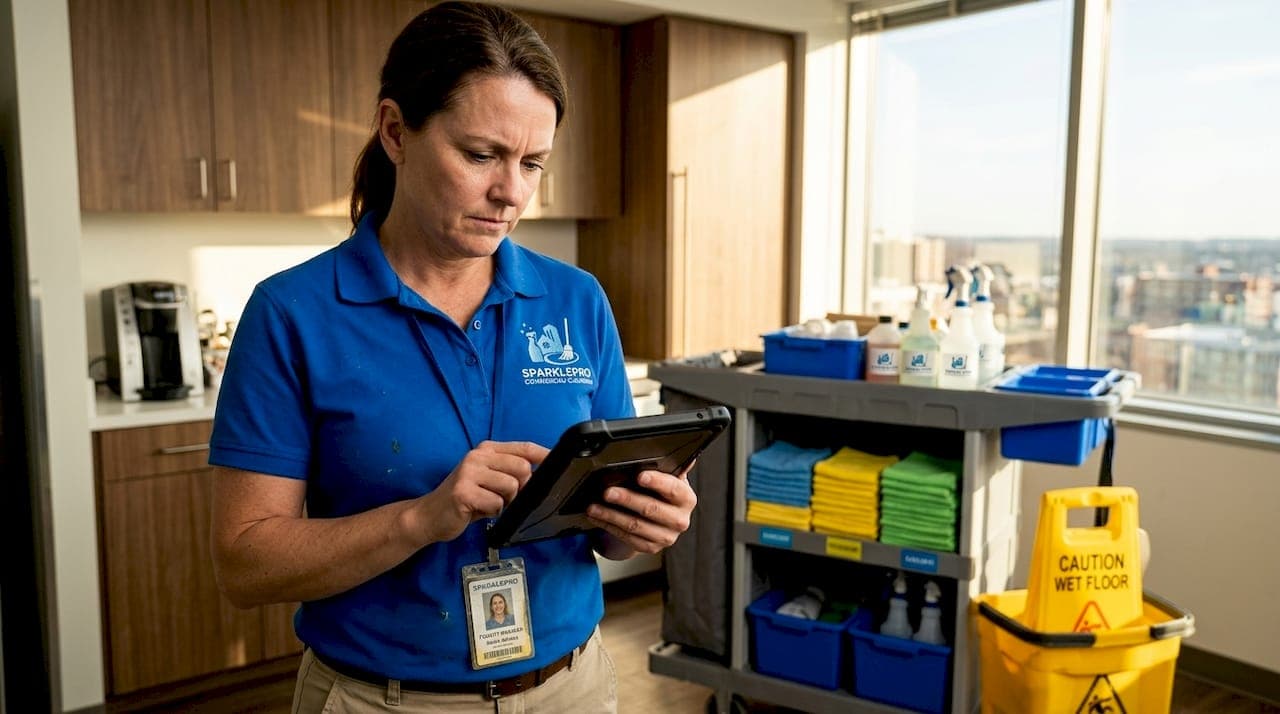
An office cleaning workflow guide is the structured plan that defines what to clean, when, how often, and how to verify completion to maintain a safe, hygienic commercial workspace. Property managers and facility directors who operate without one face inconsistent results, compliance gaps, and the kind of visible neglect that drives tenant complaints. The CDC recommends prioritizing high-touch surfaces like keyboards, doorknobs, and shared contact points as the foundation of any office hygiene program. A well-built workflow reduces sick days, satisfies health and safety audits, and gives your cleaning team a repeatable system rather than a guessing game.
What does an effective office cleaning workflow guide require?
Before you assign a single task, you need the right tools, the right zones, and a digital system to track both. The industry term for this structured approach is a cleaning procedures manual, and it covers supplies, equipment, zone maps, and verification in one document. Skipping the setup phase is the most common reason cleaning programs fail within the first 90 days.
Core supplies and equipment
Color-coded microfiber cloths are the single most important physical tool in any commercial cleaning program. Assign red cloths to restrooms, blue to general office surfaces, green to break rooms, and yellow to glass. This one practice alone prevents cross-contamination without requiring staff to memorize complex rules. Pair these with EPA-registered disinfectants, HEPA-filter vacuums, and a mop system that uses separate buckets per zone.
Digital management tools
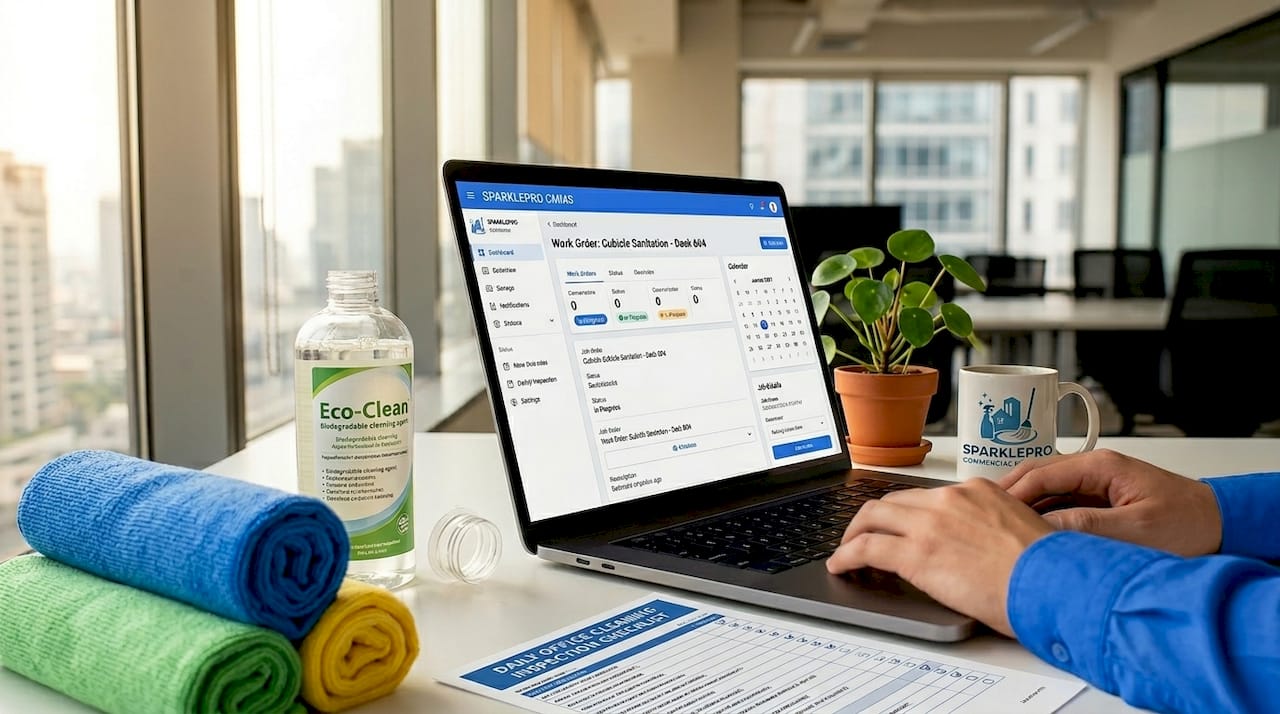
A Computerized Maintenance Management System (CMMS) or a work order app replaces paper checklists with timestamped, attributed records. Digital task tracking improves labor allocation and gives facility directors real-time visibility into what was completed, by whom, and when. Platforms like ServiceChannel, eMaint, or even a structured Google Forms workflow can serve this function depending on your budget.
| Tool | Purpose |
|---|---|
| Color-coded microfiber cloths | Zone-specific surface cleaning to prevent cross-contamination |
| EPA-registered disinfectants | Kill pathogens on high-touch and restroom surfaces |
| HEPA-filter vacuum | Capture fine particles and allergens from carpets and floors |
| CMMS or work order app | Track task completion, assign ownership, and generate audit records |
| Inspection scoring software | Measure cleanliness quality beyond simple task completion |
Pro Tip: Select cleaning agents that carry both EPA registration and Green Seal or EcoLogo certification. These products meet disinfection standards without introducing volatile organic compounds that degrade indoor air quality in sealed office environments.
How to organize cleaning tasks by zones and frequencies
The most practical office cleaning checklist workflow divides the building into risk zones, then assigns task frequencies based on how often each zone is used and what pathogens it is likely to harbor. A reception desk touched by 200 visitors per day carries a fundamentally different risk profile than a private executive office.
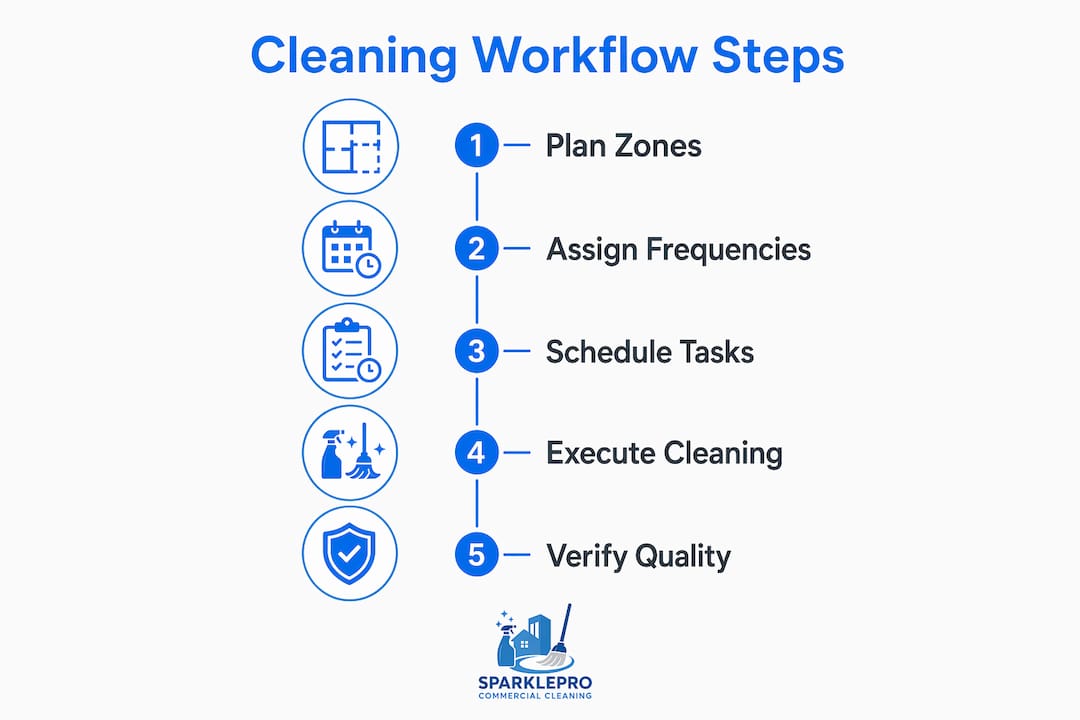
Zone categories for most commercial offices break down into four tiers: restrooms and break rooms (highest risk), reception and conference rooms (high traffic), open office floors (moderate), and storage or server rooms (low use). Each tier demands a different cleaning frequency and a different level of disinfection intensity.
| Zone | Daily Tasks | Weekly Tasks | Monthly Tasks |
|---|---|---|---|
| Restrooms | Disinfect fixtures, restock supplies, mop floors | Deep scrub grout, clean vents | Inspect caulking, sanitize drains |
| Break rooms | Wipe counters, clean appliance exteriors, empty trash | Clean inside microwave and refrigerator | Degrease range hood, sanitize storage |
| Reception and conference rooms | Disinfect high-touch surfaces, vacuum | Dust light fixtures, clean glass | Shampoo upholstery, clean baseboards |
| Open office floors | Empty trash, wipe shared surfaces | Vacuum carpets, mop hard floors | Deep carpet cleaning |
| Storage and server rooms | Visual check | Dust shelving and equipment | Full wipe-down, check for pests |
Office cleaning checklists should separate appearance tasks from hygiene tasks. Vacuuming for appearance is not the same as disinfecting for health, and conflating the two leads to missed hygiene steps during busy periods.
Assign each task to a specific shift window. Night cleaning crews handle deep work after occupancy. Day porters manage restroom restocking, spill response, and high-touch surface wipes during business hours. Splitting ownership this way prevents tasks from falling through the cracks when shift handoffs are unclear.
Pro Tip: Map your cleaning schedule against building access card data or occupancy sensors. If the third-floor conference rooms are only used Tuesday through Thursday, reallocating deep cleaning resources to those days cuts labor hours without reducing cleanliness standards.
What is the recommended cleaning sequence to prevent cross-contamination?
The correct workflow sequence starts in low-use private areas, moves through open office floors and conference rooms, and finishes with restrooms and break rooms. Cleaning from low-use to high-traffic areas prevents pathogens from being carried back into clean zones on equipment or clothing. Many facility teams reverse this order by accident, starting with visible high-traffic areas and unknowingly contaminating spaces they already cleaned.
Here is the recommended sequence for a standard commercial office floor:
- Enter storage rooms and server rooms first. Dust and wipe surfaces with the yellow-coded cloth set.
- Move to private offices. Use blue cloths for desks, phones, and light switches. Empty trash bins.
- Clean open office workstations. Disinfect shared keyboards, mice, and desk phones. Replace blue cloths if visibly soiled.
- Service conference rooms and reception. Disinfect table surfaces, chair arms, and AV equipment.
- Clean break rooms with green-coded cloths and a dedicated mop bucket. Disinfect counters, appliance handles, and sink fixtures.
- Finish with restrooms using red-coded cloths exclusively. Disinfect toilets, sinks, door handles, and dispensers. Mop floors last with a separate mop head.
- Dispose of single-use items, bag all trash, and return equipment to the designated storage area.
Proper protocol discipline and tool segregation prevent contamination backtracking, which is the primary failure mode in commercial facilities that skip color-coding. Floors deserve particular attention in this sequence. Tracked dirt from restrooms or break rooms spreads pathogens across the entire floor plan if mopping order is not enforced.
How do you verify cleaning quality beyond task completion?
Schedule completion and cleaning quality are not the same measurement. A technician can check every box on a paper log and still leave a restroom with visible grime on the fixtures. Digital inspection scoring catches hygiene failures three times earlier than schedule completion monitoring alone and can increase cleanliness scores by 25%. That gap between claimed completion and actual quality is where most facility cleaning programs lose credibility with tenants and auditors.
A structured inspection scoring system works as follows:
- Assign each zone a numeric score from 1 to 5 based on defined criteria: surface cleanliness, odor, restocking levels, and floor condition.
- Set a corrective action trigger at any score below 3. This generates an automatic work order for re-service within four hours.
- Conduct formal audits weekly for restrooms and break rooms, biweekly for open office zones, and monthly for low-use areas.
- Log all scores with timestamps, zone identifiers, and the name of the inspector.
Completion logs with timestamps and technician attribution uncover discrepancies between scheduled and actual cleaning faster than any manual review process. Digital tools like Swept, Janitorial Manager, or ServiceChannel's inspection module replace paper logs with audit-ready records that you can share directly with tenants or compliance reviewers.
Pro Tip: Feed monthly inspection scores into your vendor performance reviews. A cleaning contractor whose scores trend downward over three consecutive months needs a corrective action plan, not just a verbal reminder.
What common challenges arise in office cleaning workflows?
The most frequent failure in a cleaning routine for offices is inconsistent execution caused by unclear ownership. When no one is specifically accountable for a task, it gets skipped during busy periods and no one notices until a tenant complains. The fix is not more supervision. It is a workflow design that makes skipping a task visible immediately.
Other common challenges and their direct solutions:
- Missed tasks during shift handoffs. Use a CMMS with mandatory sign-off fields so each technician confirms task completion before the next shift begins.
- Communication gaps between day porters and night crews. Maintain a shared digital log with a notes field. A day porter who spots a broken soap dispenser can flag it for the night crew without a phone call.
- Resource shortages during peak periods. Build a critical supplies register with reorder triggers. Running out of disinfectant wipes on a Monday morning is a workflow failure, not a supply chain problem.
- Workflow disruption from office renovations or new tenants. Treat any layout change as a trigger to re-map zones and re-assign task ownership before the change takes effect.
- Staff turnover degrading protocol quality. Document your cleaning procedures manual with photos and video walkthroughs, not just text checklists. New staff trained on visual protocols reach competency faster and make fewer sequencing errors.
Adapting your workspace sanitization guide to seasonal changes also matters. Flu season and high-occupancy periods like Q4 budget reviews justify temporarily increasing high-touch surface disinfection from once to twice daily. Build these escalation triggers into your procedures manual so the decision to increase frequency is automatic, not reactive.
Key takeaways
A structured office cleaning workflow guide built on zones, frequencies, sequencing, and digital verification is the only reliable method for maintaining consistent hygiene in commercial office spaces.
| Point | Details |
|---|---|
| Zone-based task assignment | Divide the office into risk tiers and assign cleaning frequencies based on usage and pathogen risk. |
| Color-coded tool segregation | Use distinct cloth and mop colors per zone to prevent cross-contamination between restrooms and office areas. |
| Correct cleaning sequence | Always progress from low-use private areas to high-traffic zones and finish with restrooms. |
| Digital inspection scoring | Score cleanliness by zone on a numeric scale and trigger corrective work orders for any score below threshold. |
| Documented ownership | Assign every task to a named role and shift window so missed work is visible immediately, not after a complaint. |
What I've learned from building cleaning workflows in commercial properties
After working with property managers across dozens of commercial buildings, the pattern I see most often is this: the workflow exists on paper, but no one has tested whether it actually fits the building. A cleaning procedures manual written for a 10,000-square-foot single-tenant office does not translate to a 40,000-square-foot multi-tenant building with staggered occupancy. The zone maps are wrong, the frequencies are borrowed from a template, and the inspection process is a paper log that no one reviews.
The single investment that pays back fastest is spending two hours walking the building with your cleaning lead before writing a single task. Map every zone, note every high-touch surface, and time how long each area actually takes to clean properly. That walk changes everything about how you structure the workflow.
Digital tools have made accountability far easier than it was five years ago. Mobile proof-of-work apps let technicians photograph completed tasks in real time, which removes the ambiguity from shift handoffs and gives facility directors evidence they can use in vendor reviews. The technology is not expensive. The barrier is discipline in setup.
The future of office cleaning management points toward sensor-driven demand scheduling, where occupancy data triggers cleaning tasks rather than a fixed clock. A few large commercial property groups are already piloting this. For most facility directors today, the priority is getting the fundamentals right: clear zones, enforced sequencing, and inspection scoring that catches failures before tenants do. Get those three things working, and you have a program that holds up under scrutiny.
— Sales
How Sparkleprocommercialcleaning supports your facility's cleaning program
Property managers who need a cleaning program that goes beyond a paper checklist should look at what Sparkleprocommercialcleaning delivers across its nationwide portfolio. Every engagement starts with a site assessment that maps your specific zones, traffic patterns, and compliance requirements before a single task is scheduled.
Sparkleprocommercialcleaning integrates digital proof-of-work documentation and structured inspection scoring into every service contract, giving facility directors the audit-ready records they need for tenant reporting and regulatory compliance. For property managers in the Mid-Atlantic region, the Delaware commercial cleaning services page outlines how tailored workflow programs are structured for office buildings of all sizes. Request a consultation to get a workflow-specific cleaning plan built around your facility's actual needs, not a generic template.
FAQ
What is an office cleaning workflow guide?
An office cleaning workflow guide is a structured document that defines cleaning zones, task frequencies, staff assignments, sequencing protocols, and verification methods for a commercial office. It functions as the operational backbone of any facility cleaning program.
How often should high-touch surfaces be cleaned in an office?
The CDC recommends cleaning and disinfecting high-touch surfaces like doorknobs, keyboards, and shared equipment at least once daily, with additional wipe-downs during high-occupancy periods or flu season.
What is the correct order for cleaning an office floor?
Start with low-use private areas like storage rooms and private offices, move through open office floors and conference rooms, then clean break rooms, and finish with restrooms. This sequence prevents pathogens from being carried back into already-cleaned zones.
How does inspection scoring differ from task completion tracking?
Task completion tracking confirms that a cleaning activity was performed. Inspection scoring measures whether the result meets a defined cleanliness standard. Structured inspection scoring catches hygiene failures three times earlier than completion monitoring alone.
What digital tools work best for managing office cleaning workflows?
CMMS platforms like ServiceChannel or eMaint, and janitorial-specific apps like Swept or Janitorial Manager, provide task assignment, timestamped completion logging, and inspection scoring in one system. These tools replace paper logs with audit-ready records that support vendor reviews and compliance reporting.