

Keeping a commercial facility clean is not just about appearances. Daily commercial cleaning routines determine whether your building stays compliant with OSHA sanitation standards, whether your staff stays healthy, and whether inspectors find violations or nothing worth noting. Property managers and facility directors face a real operational challenge: cleaning must happen thoroughly, consistently, and without disrupting the workday. This article breaks down the criteria, tasks, methods, and strategies that make the difference between a cleaning program that holds up under scrutiny and one that creates liability.
Table of Contents
- Key takeaways
- Key criteria for daily commercial cleaning routines
- 7 daily commercial cleaning tasks every facility needs
- Comparing disinfectants and cleaning methods
- Strategies for staff adherence and workflow optimization
- How to customize routines based on facility type
- My honest take on why most cleaning routines fail
- Let Sparkleprocommercialcleaning handle the complexity
- FAQ
Key takeaways
| Point | Details |
|---|---|
| Compliance is non-negotiable | OSHA's 29 CFR 1910.141 mandates daily restroom maintenance including soap and hand drying supplies. |
| Dwell time determines effectiveness | Wiping a disinfectant too early renders it ineffective; contact times range from 3 to 10 minutes depending on the product. |
| Prioritize high-touch surfaces | Daily disinfection of doorknobs, light switches, and shared appliances reduces pathogen spread significantly. |
| Bleach solutions expire fast | Diluted bleach loses potency within 24 hours and must be remade fresh each day. |
| Workflow design beats training alone | Building dwell time into task sequences is more reliable than relying on staff memory during busy shifts. |
Key criteria for daily commercial cleaning routines
Before you assign tasks or buy supplies, you need a framework. Effective daily cleaning routines are built on six criteria that keep your facility compliant, safe, and efficient.
Regulatory compliance. OSHA's sanitation standard under 29 CFR 1910.141 specifies minimum requirements for restroom maintenance, including soap availability and hand drying supplies. These are not suggestions. Common OSHA citations for sanitation violations include poorly maintained toilet facilities and missing handwashing supplies. Your cleaning schedule must address these requirements daily, not weekly.
Disinfectant effectiveness. Not all cleaning products work the same way. The active ingredient, dilution ratio, and surface type all affect kill rates. More on this in the comparison section below, but the short version is: choose products appropriate for your surfaces and verify their contact time requirements before building them into your schedule.
Workflow integration. Cleaning staff work under time pressure. A commercial cleaning schedule that ignores workflow realities will fail in practice. Tasks need to be sequenced logically so staff can move efficiently through a space without doubling back or skipping steps.
High-touch and high-traffic prioritization. Not every surface in your building carries equal risk. Restrooms, reception desks, elevator buttons, and breakroom appliances see the most contact and require the most attention. Your daily cleaning tasks should reflect that hierarchy.
Task specificity by space. A restroom cleaning protocol looks nothing like an office cleaning protocol. Each space type needs its own task list with defined frequencies, products, and methods.
Chemical safety. Staff must understand dilution ratios, personal protective equipment requirements, and proper storage. This protects both your employees and your surfaces.
Pro Tip: When building your commercial cleaning schedule, start with your highest-risk spaces and work outward. Compliance failures almost always trace back to restrooms and kitchens, not conference rooms.
7 daily commercial cleaning tasks every facility needs
A well-structured day starts with knowing exactly what gets done, in what order, and to what standard. Here are the seven daily cleaning tasks that form the backbone of any effective commercial cleaning program.
-
Restroom sanitation and supply checks. Restrooms require multiple checks throughout the day, not just one morning clean. OSHA mandates that soap, paper towels, and toilet paper remain available at all times. Assign a mid-shift check in addition to opening and closing cleans. Scrub toilets and sinks, disinfect fixtures, and document each check.
-
High-touch surface disinfection. Doorknobs, light switches, elevator buttons, shared keyboards, and copier panels need daily disinfection. High-touch surface disinfection reduces pathogen spread significantly, especially during illness outbreaks. Apply disinfectant and allow full contact time before wiping. Do not rush this step.
-
Floor sweeping, mopping, and spot cleaning. Hard floors collect debris, dust, and tracked-in contaminants throughout the day. Sweep or vacuum before mopping to avoid spreading soil. For effective floor cleaning, use a two-bucket mopping system to avoid recontaminating clean areas, and address spills immediately rather than waiting for the next scheduled clean.
-
Trash removal and waste disposal. Full trash cans create odors, attract pests, and present hygiene hazards. Empty all bins daily, replace liners, and wipe down bin interiors weekly. In food service or healthcare-adjacent spaces, remove waste more frequently and follow any applicable disposal regulations for specific waste types.
-
Reception and office area cleaning. Desks, phones, and shared workstations need daily wiping. The office cleaning checklist for property managers covers task sequencing and frequency in detail. Dust horizontal surfaces, sanitize phones and keyboards, and vacuum or spot-clean upholstered furniture as needed.
-
Kitchen and breakroom sanitation. Breakrooms are high-risk zones for cross-contamination. Wipe down counters, appliance exteriors, and sink areas with an appropriate disinfectant daily. Clean the inside of microwaves and refrigerator handles. Empty dish drainers and address any standing water. The goal is pathogen control, not just visual cleanliness.
-
Cleaning supply and PPE inventory check. A cleaning routine fails the moment staff run out of disinfectant or gloves mid-shift. Build a daily supply check into your opening or closing protocol. Track your commercial cleaning supplies inventory systematically to avoid shortfalls.
Pro Tip: Sequence your tasks so staff apply disinfectant to surfaces first, then move on to other tasks in the same area. When they return, the contact time has elapsed naturally. This is how you build dwell time compliance into the workflow without adding time.
Comparing disinfectants and cleaning methods
Choosing the right disinfectant is one of the most consequential decisions in your cleaning program. The wrong product, or the right product used incorrectly, gives you the appearance of cleanliness without the reality.
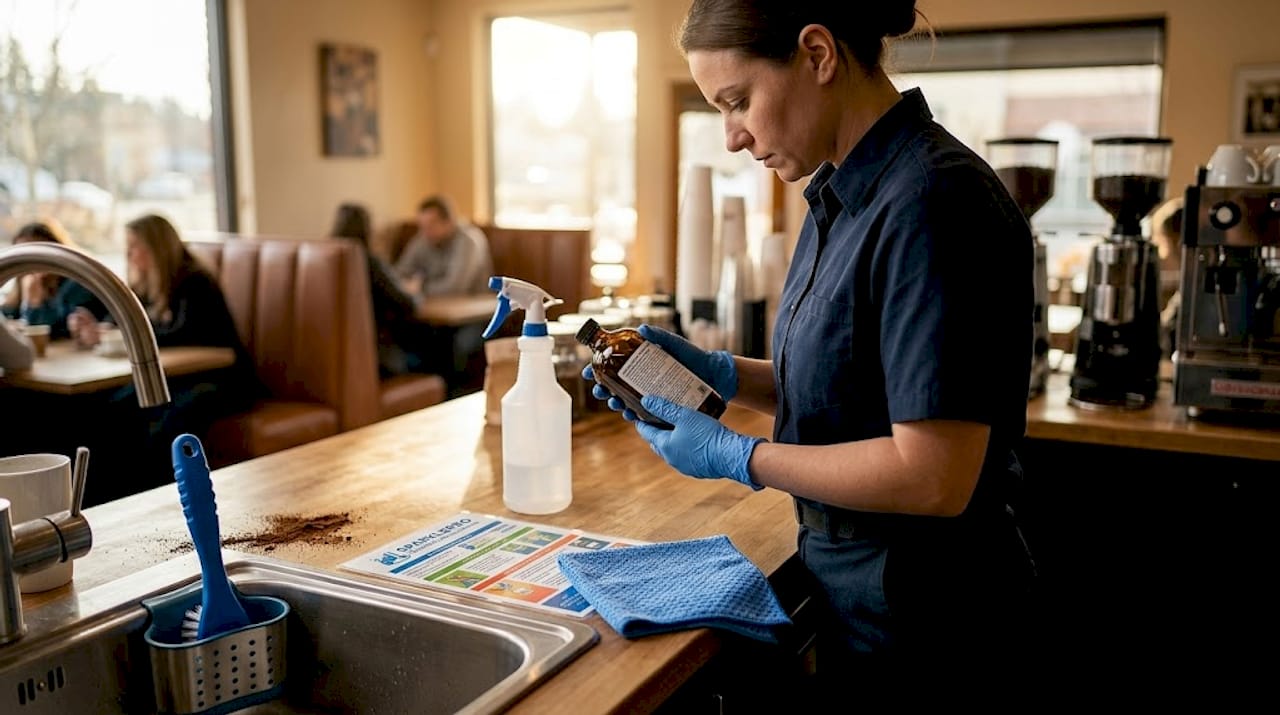
The concept of contact time, also called dwell time, is where most facilities fall short. Contact times vary from 3 to 10 minutes depending on the product, and wiping a surface before that time has elapsed compromises kill rates. This is not a technicality. It is the difference between a disinfected surface and a surface that just looks clean.
Here is how the most common commercial disinfectants compare:
| Disinfectant | Contact time | Surface compatibility | Key consideration |
|---|---|---|---|
| Bleach (sodium hypochlorite) | 1 to 10 minutes | Non-porous, hard surfaces | Diluted bleach expires within 24 hours; must be remade daily |
| Quaternary ammonium (quats) | 3 to 10 minutes | Broad surface compatibility | Residue buildup on floors; requires periodic rinsing |
| Hydrogen peroxide | 1 to 5 minutes | Most hard surfaces | Degrades quickly; check expiration and storage conditions |
| Accelerated hydrogen peroxide | 30 seconds to 5 minutes | Broad, including sensitive surfaces | Higher cost but shorter contact time improves compliance |
A few additional points worth knowing:
- CDC guidance recommends focusing on cleaning in healthy environments and reserving disinfection for high-risk areas and illness outbreak situations. Disinfecting every surface every day in a low-risk office is not only unnecessary but increases staff chemical exposure.
- Dilution accuracy matters as much as product choice. Too concentrated wastes product and damages surfaces. Too dilute reduces efficacy. Use measured dispensing systems rather than eyeballing ratios.
- Surface compatibility is a real concern. Bleach can corrode metal fixtures and damage certain floor finishes over time. Match your product to your surfaces.
- Shelf life varies by product. Concentrated bleach loses effectiveness at roughly 20% per year even when stored properly. Diluted solutions must be remade every day.
Strategies for staff adherence and workflow optimization
Even the best cleaning protocol breaks down when staff are rushed, undertrained, or working without clear accountability. Here is what actually moves the needle on consistent compliance.
Build dwell time into the task sequence. The most reliable approach is structural. Sequencing surface wiping before other tasks in the same zone naturally builds contact time into the workflow without requiring staff to watch a clock. Apply disinfectant, move to the next surface or task, return to wipe. The time passes without anyone having to think about it.
Use point-of-use reminders. Contact time reminders posted at supply stations and on cleaning carts significantly improve frontline compliance. A laminated card showing product name, contact time, and dilution ratio takes minutes to create and reduces errors consistently.
Implement checklists with sign-off requirements. Verbal instructions fade. Written checklists with staff initials and timestamps create accountability and give you documentation for compliance audits. Digital checklists on a shared tablet work well in larger facilities.
Additional practices that improve consistency:
- Conduct weekly spot audits of high-risk areas to catch gaps before they become patterns
- Train staff on disinfectant labels directly. Joint Commission accreditation requires training that includes contact time adherence and label instructions
- Schedule micro-cleanups throughout the day for breakrooms and restrooms rather than relying solely on morning and evening cleans
- Rotate staff assignments periodically to prevent complacency in familiar areas
Pro Tip: When you procure disinfectants, prioritize products with contact times your staff can realistically achieve during a normal shift. A product with a 30-second contact time will be used correctly far more often than one requiring 10 minutes.
How to customize routines based on facility type
A general framework gets you started, but your facility has specific characteristics that require adjustments. Here is how to tailor your daily cleaning tasks to your actual environment.
By facility type:
- Office buildings: Focus on workstations, shared equipment, restrooms, and lobbies. Frequency can be once daily for most areas with mid-day restroom checks.
- Retail spaces: Entrances, fitting rooms, and checkout counters need multiple cleanings per day. Cart and basket handles are often overlooked high-touch surfaces.
- Healthcare-adjacent facilities: Apply stricter disinfection protocols and use EPA-registered hospital-grade disinfectants. Frequency increases and documentation becomes critical.
- Industrial or manufacturing spaces: Floor cleaning and chemical spill protocols take priority. Cleaning in contractor-adjacent environments requires attention to debris types and surface materials.
Adjusting for illness risk periods. During flu season or local outbreak events, increase disinfection frequency for high-touch surfaces and add restroom checks. This is also when switching from routine cleaning to targeted disinfection protocols makes the most sense.
Budget and scheduling tools. Facility management software can automate scheduling, track task completion, and flag supply shortfalls. Even a shared spreadsheet with assigned tasks and completion timestamps outperforms verbal coordination.
| Facility type | Daily cleaning focus | Escalation trigger |
|---|---|---|
| Office | Workstations, restrooms, lobbies | Illness reports, inspection prep |
| Retail | Entrances, checkout, fitting rooms | High foot traffic days, illness season |
| Healthcare-adjacent | All surfaces, strict dwell time | Any confirmed illness, regulatory review |
| Industrial | Floors, spill zones, equipment | Shift changes, material handling incidents |
Use feedback from staff and occupants to identify recurring problem areas. A monthly review of your cleaning log and any complaint or inspection records gives you the data to refine your routine continuously.
My honest take on why most cleaning routines fail
I have worked with enough facility managers to see a consistent pattern. The protocols look solid on paper. The supply closet is stocked. Staff have been trained. And yet, compliance gaps keep showing up in audits and inspection reports.
The failure point is almost never the protocol itself. It is the gap between what the protocol says and what actually happens during a busy Tuesday afternoon when two staff members called out and the building has a full occupancy event. Real cleaning programs are designed for real conditions, not ideal ones.
What I have found actually works is this: stop treating dwell time as a training problem and start treating it as a workflow design problem. If your staff have to remember to wait before wiping, they will forget. If the task sequence makes waiting automatic, they will not have to remember.
The other thing I push back on is the instinct to disinfect everything, everywhere, every day. That approach increases chemical exposure, accelerates surface wear, and burns through budget without proportional benefit. Target your disinfection where the risk is real: restrooms, kitchens, high-touch surfaces, and any area where illness has been reported.
The facilities that maintain the cleanest, most compliant environments are not the ones with the most aggressive protocols. They are the ones with the most consistent ones.
— Sales
Let Sparkleprocommercialcleaning handle the complexity
Running daily commercial cleaning routines across a large or multi-use facility is a full-time operational responsibility. Sparkleprocommercialcleaning works with property managers, facility directors, and building owners across the country to design and execute cleaning programs that meet OSHA standards, pass inspections, and hold up day after day.
Whether you need to supplement your in-house team or hand off the entire program, Sparkleprocommercialcleaning offers customizable schedules, trained staff, and documented compliance support. If you manage commercial properties in the Northeast or Mid-Atlantic, explore commercial cleaning in Massachusetts or cleaning services in New Jersey to get a quote and schedule a site visit. The process is straightforward: quote, site visit, scheduled cleaning, and your approval.
FAQ
What are daily commercial cleaning routines?
Daily commercial cleaning routines are structured task sequences performed every business day to maintain hygiene, safety, and regulatory compliance in commercial facilities. They typically cover restrooms, high-touch surfaces, floors, trash removal, and kitchen or breakroom areas.
How often should restrooms be checked during the day?
OSHA's 29 CFR 1910.141 requires that restrooms remain sanitary and stocked with soap and hand drying supplies at all times, which means at minimum a morning clean and a mid-shift check are necessary for most commercial facilities.
What is disinfectant contact time and why does it matter?
Contact time is the minimum period a disinfectant must remain wet on a surface to achieve its rated kill rate. Wiping too early compromises effectiveness, with contact times ranging from 3 to 10 minutes depending on the product.
How do you maintain a clean office consistently?
Consistent office cleanliness requires a written commercial cleaning schedule with assigned tasks, staff accountability through sign-off checklists, and regular audits of high-touch and high-traffic areas to catch gaps before they compound.
When should you escalate from daily cleaning to deep cleaning?
Escalate to deep cleaning protocols when illness is reported among occupants, before or after high-occupancy events, during seasonal illness peaks, or when a routine inspection or audit is scheduled.