

The air inside your commercial building is likely far more polluted than the air outside. According to the EPA, indoor air is 2 to 5 times more contaminated than outdoor air, largely because allergens, volatile organic compounds (VOCs), and pathogens accumulate in enclosed spaces. For property managers and building owners, this is not a housekeeping footnote. It is a strategic risk. Cleaning, done right, is one of the most powerful tools you have to protect tenant health, extend asset lifespan, reduce operating costs, and drive the kind of first impressions that retain tenants and attract new ones.
Table of Contents
- Why cleaning goes beyond appearances in commercial properties
- Standardization and quality: SOPs as the backbone of consistent results
- Surface-specific strategies: Floors, carpets, and air quality
- Selecting and benchmarking cleaning vendors for maximum facility value
- The strategic lens: Cleaning as an investment, not a cost
- Connect with Sparklepro for industry-leading cleaning services
- Frequently asked questions
Key Takeaways
| Point | Details |
|---|---|
| Strategic health impact | Routine cleaning greatly improves indoor air quality and reduces health risks. |
| Asset longevity | Surface-specific cleaning methods help extend the life of carpets, floors, and HVAC systems. |
| Consistent results | Standardized procedures (SOPs, certifications) deliver quality and reliability every time. |
| Vendor selection | Choose cleaning partners with industry certifications and documented standards. |
| Operational cost savings | Cleaning programs can yield measurable energy and maintenance savings. |
Why cleaning goes beyond appearances in commercial properties
Most property managers understand that a clean facility looks professional. What fewer recognize is how deeply routine cleaning affects the financial and operational health of a building. The difference between a well-maintained facility and a neglected one shows up in energy bills, tenant renewal rates, and capital expenditure timelines.
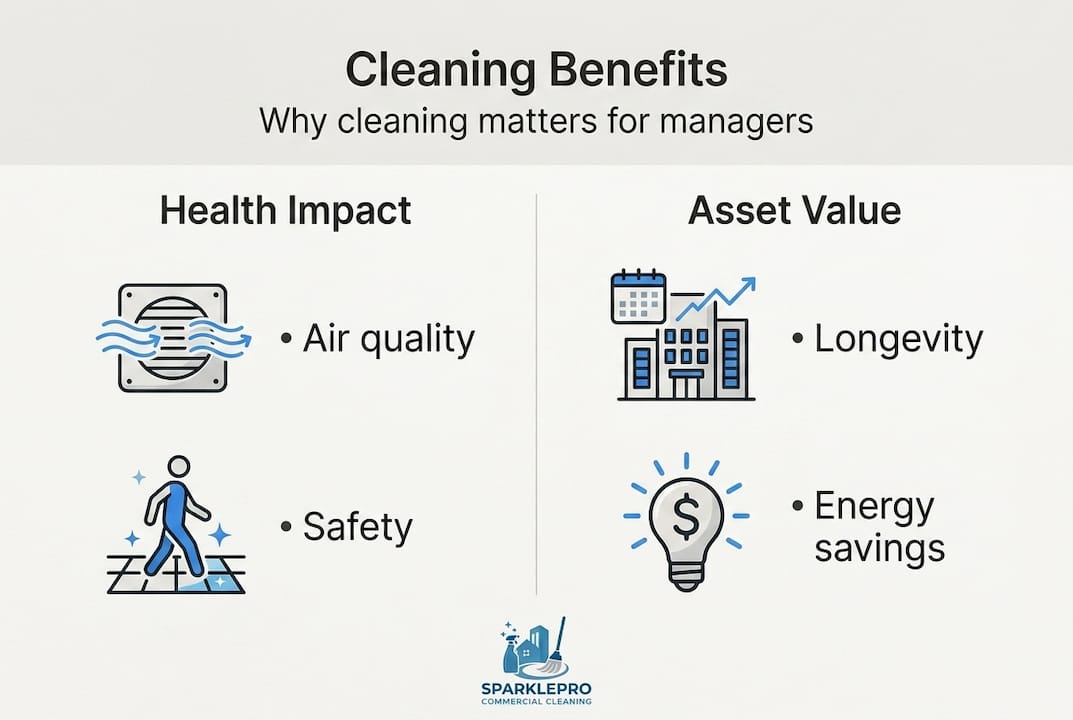
Health and safety are the most immediate benefits. Dust, mold spores, and airborne bacteria settle into carpets, upholstery, and HVAC systems. Regular cleaning removes these contaminants before they trigger respiratory issues, allergies, or absenteeism among building occupants. Benchmarks from ISSA and CIMS (Cleaning Industry Management Standard) help property managers quantify these improvements and track IAQ improvement and energy savings against measurable targets.
Asset longevity is where cleaning really pays off financially. Consider commercial carpeting. Research shows that carpet lifespan nearly doubles with consistent maintenance, extending from roughly five years without care to ten years with it. That difference in replacement cycles represents tens of thousands of dollars in deferred capital expenditure for a mid-sized office floor.
Energy efficiency is another major, often overlooked, win. Dirty HVAC systems work harder to move air through clogged filters and coils, consuming more electricity. One office tower case study documented a 28% HVAC energy reduction worth $392,000 annually after prioritizing system cleaning and optimization. That kind of return is not a rounding error. It is a line item that changes budget conversations.
First impressions and tenant satisfaction close the loop. Building occupants form opinions about a facility within seconds of walking through the door. A spotless lobby signals that management is attentive, organized, and serious about the property. Tenants who feel cared for renew leases. Prospective tenants choose maintained buildings over neglected ones, even when lease rates are comparable.
"A facility's cleanliness is not just a hygiene metric. It is a reflection of management quality, operational discipline, and long-term investment vision."
Here is a quick summary of the core benefits:
- Reduced allergen and pathogen load, supporting healthier occupants
- Extended lifespan of flooring, carpets, fixtures, and finishes
- Lower HVAC energy consumption through clean system components
- Stronger tenant retention and faster lease-up cycles
- Regulatory compliance support in healthcare, food service, and industrial settings
For a full breakdown of what these programs look like across different facility types, the janitorial service examples resource is worth reviewing alongside any facility maintenance checklist you already use.
Standardization and quality: SOPs as the backbone of consistent results
Reliable cleaning is not about effort. It is about process. Without documented Standard Operating Procedures (SOPs), cleaning quality depends entirely on the individual technician's habits on any given day. That inconsistency is exactly what erodes tenant trust and causes building managers to cycle through vendor after vendor.
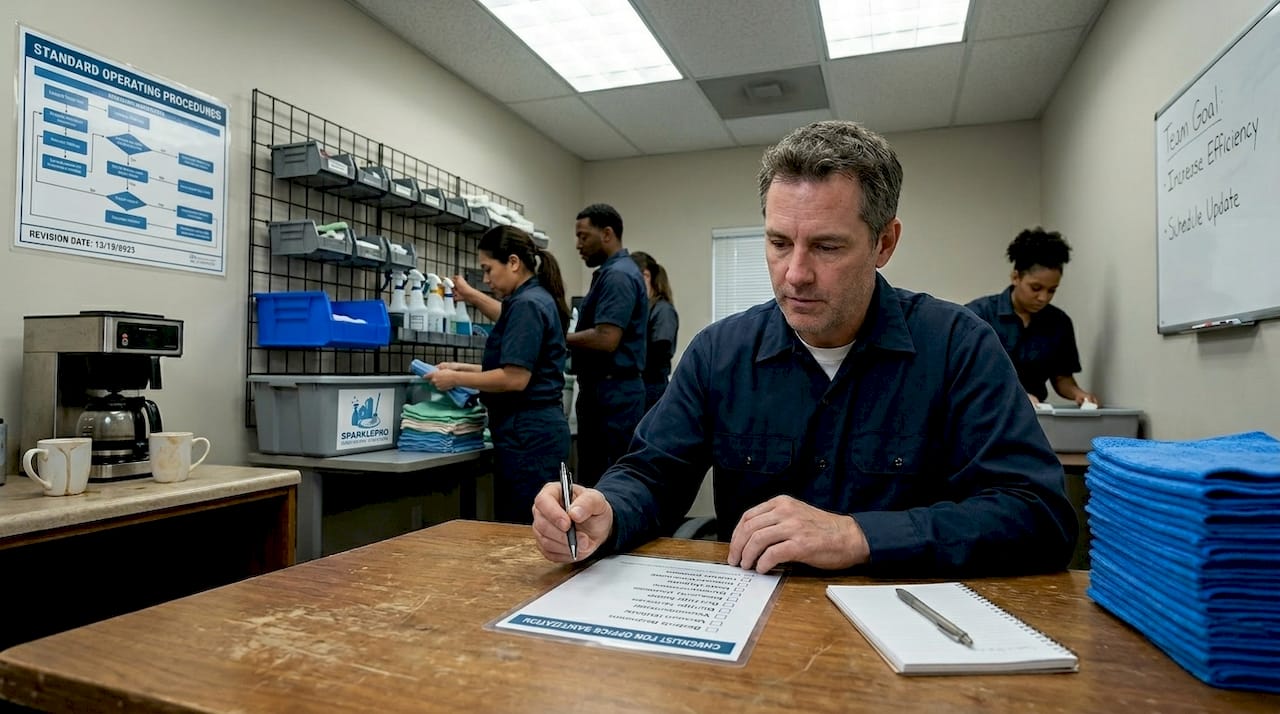
Well-designed SOPs specify sequences like top-to-bottom cleaning (so dust falls onto surfaces that have not yet been cleaned), correct disinfectant dwell times (the amount of time a product must stay wet on a surface to kill pathogens), surface-specific product selection, and post-task quality inspections. Each of these details matters. Using the wrong product on a polished concrete floor, for example, can etch the surface permanently. Skipping dwell time on a restroom fixture means the disinfectant does not actually work.
Certifications raise the bar. The International Sanitary Supply Association (ISSA) offers CIMS certification, which benchmarks a cleaning company's quality systems, staff training, customer satisfaction protocols, and sustainability practices. CIMS-GB extends those benchmarks specifically to green building practices. When you are evaluating vendors, CIMS certification is one of the fastest ways to distinguish operators with real systems from those operating on informal routines.
Here is a comparison of what you should expect from certified versus non-certified vendors:
| Criteria | CIMS-Certified vendor | Non-certified vendor |
|---|---|---|
| Documented SOPs | Required and audited | Often informal or absent |
| Staff training | Structured and ongoing | Variable, often on-the-job only |
| Quality inspections | Regular and reported | Inconsistent |
| Sustainability practices | Benchmarked (CIMS-GB) | Undocumented |
| Accountability | Third-party validated | Self-reported |
The numbered process for evaluating SOP quality in a vendor proposal looks like this:
- Request a sample SOP document for a specific task, such as restroom sanitation
- Confirm that dwell times and product names are explicitly specified
- Ask how quality inspections are scheduled and how findings are communicated to clients
- Verify training records for technicians who will work in your facility
- Confirm that the SOP is updated when new products or regulations apply
Pro Tip: When reviewing a vendor's SOP documentation, look for version numbers and revision dates. A document that has never been updated is a red flag, because best practices evolve and vendors who do not update their SOPs are not keeping pace.
For more on the process side of floor care specifically, the resource on streamlining floor cleaning covers how SOPs apply to one of the most maintenance-intensive assets in any facility. If industry terminology feels unfamiliar, the guide to cleaning industry terms is a practical reference.
Surface-specific strategies: Floors, carpets, and air quality
Not all surfaces are created equal, and treating them as if they are is one of the most expensive mistakes a property manager can make. Each flooring type has specific requirements, and using the wrong method either fails to clean adequately or actively damages the surface.
Vinyl composition tile (VCT), common in schools, healthcare facilities, and retail spaces, requires a three-step process: stripping old finish layers, neutralizing the floor (removing chemical residue that would prevent new finish from bonding), and applying fresh wax coats. VCT and tile cleaning also includes grout scrubbing for tile surfaces, where dirt accumulates in the porous grout lines and creates both hygiene and aesthetic problems. Hardwood floors in lobbies or executive spaces need low-moisture methods because excess water warps wood fibers and destroys the finish bond.
For large facilities, autoscrubbers (self-propelled machines that apply solution and vacuum it up simultaneously) dramatically improve efficiency compared to mop-and-bucket methods. They also deliver more consistent results because they apply controlled amounts of water and solution, removing the human variable from the process.
Here is a quick reference for surface-specific cleaning requirements:
| Surface type | Primary method | Key risk to avoid |
|---|---|---|
| VCT | Strip, neutralize, wax | Skipping neutralization causes finish failure |
| Ceramic tile | Grout scrubbing, pH-neutral cleaner | Acid damage to grout from wrong products |
| Hardwood | Low-moisture damp mop | Warping and delamination from excess water |
| Polished concrete | Autoscrubber, pH-neutral solution | Etching from acidic cleaners |
| Commercial carpet | Hot water extraction, encapsulation | Over-wetting causes mold growth beneath fibers |
Carpet maintenance deserves particular attention because carpet is simultaneously one of the most expensive assets in a commercial space and one of the most neglected. Properly maintained carpet can serve a facility for a decade. Neglected carpet requires replacement in five years or fewer. That five-year difference, multiplied across thousands of square feet, is a capital expenditure that often blindsides property managers who did not prioritize routine extraction cleaning.
HVAC cleaning sits at the intersection of air quality and energy savings. When coils and ducts accumulate dust and biofilm, the system works against itself. Air cannot move efficiently, which forces the system to run longer cycles. Longer cycles mean higher energy bills and accelerated wear on mechanical components. Routine cleaning of these systems is one of the highest-ROI maintenance activities in a commercial building. For additional perspective on how surface coatings and treatments interact with longevity, the coating longevity insight resource adds useful context.
Pro Tip: Schedule routine walk-throughs of high-traffic areas at least monthly. Catching a worn carpet edge, a scuffed VCT section, or a grout line darkening with mold early costs a fraction of what full replacement or remediation will cost later. These inspections also give you documentation to hold vendors accountable to their SOPs.
For support with asset longevity strategies across your full facility portfolio, the right vendor partner can turn these inspections into structured reporting cycles.
Selecting and benchmarking cleaning vendors for maximum facility value
Choosing a cleaning vendor is one of the most consequential decisions a property manager makes. The wrong choice means inconsistent results, potential liability, and accelerated asset degradation. The right choice means predictable quality, documented accountability, and real financial returns.
Here is what to demand from any vendor before signing a contract:
- Proof of CIMS or equivalent certification. ISSA's CIMS certification is a third-party validated signal that a company operates quality management systems, not just a crew with cleaning supplies. Ask for the certificate number and verify it directly with ISSA.
- Written SOPs for your specific facility type. A vendor who cannot produce written procedures for restroom sanitation, floor care, and high-touch surface disinfection is operating informally. That is a risk.
- Regular quality audit reports. Competent vendors inspect their own work and share findings with clients. Ask how often audits happen, who conducts them, and what the reporting format looks like.
- Sustainability documentation. Green cleaning products and practices are increasingly required by building certifications like LEED. Ask vendors to document their product selection and disposal practices.
- Insurance and licensing verification. Fully licensed and insured vendors protect you from liability. Always request current certificates of insurance and confirm coverage amounts are appropriate for your facility size.
Sustainability is not just a marketing term. It affects your building's certification status, tenant attraction (particularly among corporate tenants with ESG commitments), and regulatory compliance in certain jurisdictions. Vendors with CIMS-GB certification have had their green practices independently verified.
Pro Tip: Insist on monthly or quarterly performance reports that document inspection scores, complaint resolution timelines, and any product or procedure changes. A vendor who resists reporting transparency is a vendor who is not confident in their own consistency.
For deeper insight into how reliable SOPs translate to consistent floor cleaning outcomes, the process guide is a practical benchmark tool. Property managers in the Northeast can also review regional vendor reliability benchmarks in New York for local context.
The strategic lens: Cleaning as an investment, not a cost
Here is the uncomfortable truth that most cleaning articles dance around: property managers who treat cleaning as a line item to minimize are making a financially irrational decision. The real cost of underfunding cleaning is not paid in the cleaning budget. It is paid in premature carpet replacement, HVAC repairs, tenant churn, and code compliance remediation.
We have watched facilities cut cleaning frequency from five days a week to three to save $2,000 a month. Within two years, those same facilities were spending $40,000 on carpet replacement that could have been deferred by three to five years with consistent maintenance. That is not an anecdote. It is a pattern we see repeatedly, and it is entirely preventable.
The mindset shift is straightforward but powerful: cleaning is not an operational expense in the same category as office supplies or utilities. It is a scheduled maintenance activity that protects capital assets, supports regulatory compliance, and directly influences occupancy rates. When ISSA and CIMS position cleaning as strategic, they are describing exactly this relationship between routine cleaning investment and long-term asset value.
The other misconception worth challenging is that all cleaning vendors are interchangeable. They are not. A vendor operating with documented SOPs, certified training programs, and third-party quality audits delivers fundamentally different results than one operating informally. The strategic janitorial service examples across different facility types show clearly how the right program scales to match the complexity of any commercial environment.
Budget cleaning as you budget HVAC maintenance or roof inspections: as a non-negotiable investment in asset health, not a discretionary expense you adjust when margins tighten.
Connect with Sparklepro for industry-leading cleaning services
If the frameworks in this article align with how you think about your facility, Sparklepro Commercial Cleaning is built to match that standard.
Sparklepro serves property managers and building owners nationwide with SOP-backed cleaning programs designed for large-scale facilities. Whether you manage office towers, retail centers, healthcare spaces, or industrial properties, our teams combine regional expertise with documented quality systems and full licensing and insurance. Regional service teams are available for property managers in California, New York, and Delaware, each equipped with local operational knowledge and the same nationwide quality standards. Reach out for a tailored proposal that connects your cleaning program to your asset longevity and occupancy goals.
Frequently asked questions
How does cleaning impact indoor air quality in commercial buildings?
Proper cleaning reduces airborne pollutants, allergens, and VOCs that accumulate in commercial spaces, directly improving indoor air quality for tenants and visitors. This is especially important in sealed buildings where air exchange is limited.
What certifications should cleaning vendors have?
ISSA's CIMS certification is the strongest signal of a vendor's commitment to quality management, staff training, and sustainable practices. CIMS-GB adds a verified green building component for facilities pursuing LEED or similar certifications.
How does floor cleaning vary by surface type?
Each surface demands a specific approach: VCT requires stripping and waxing, tile needs targeted grout scrubbing, and hardwood requires low-moisture methods to prevent warping. Using the wrong method can cause permanent surface damage.
Can cleaning save energy costs in commercial properties?
Yes. Documented case studies show that consistent HVAC and carpet cleaning can deliver significant energy savings, with one office tower achieving a 28% reduction worth nearly $400,000 annually. Clean systems simply operate more efficiently.
What should property managers look for when selecting a cleaning service?
Prioritize vendors with written SOPs and quality inspections, verified certifications like CIMS, full insurance coverage, and a willingness to provide regular performance reports. These factors separate accountable vendors from informal operators.