
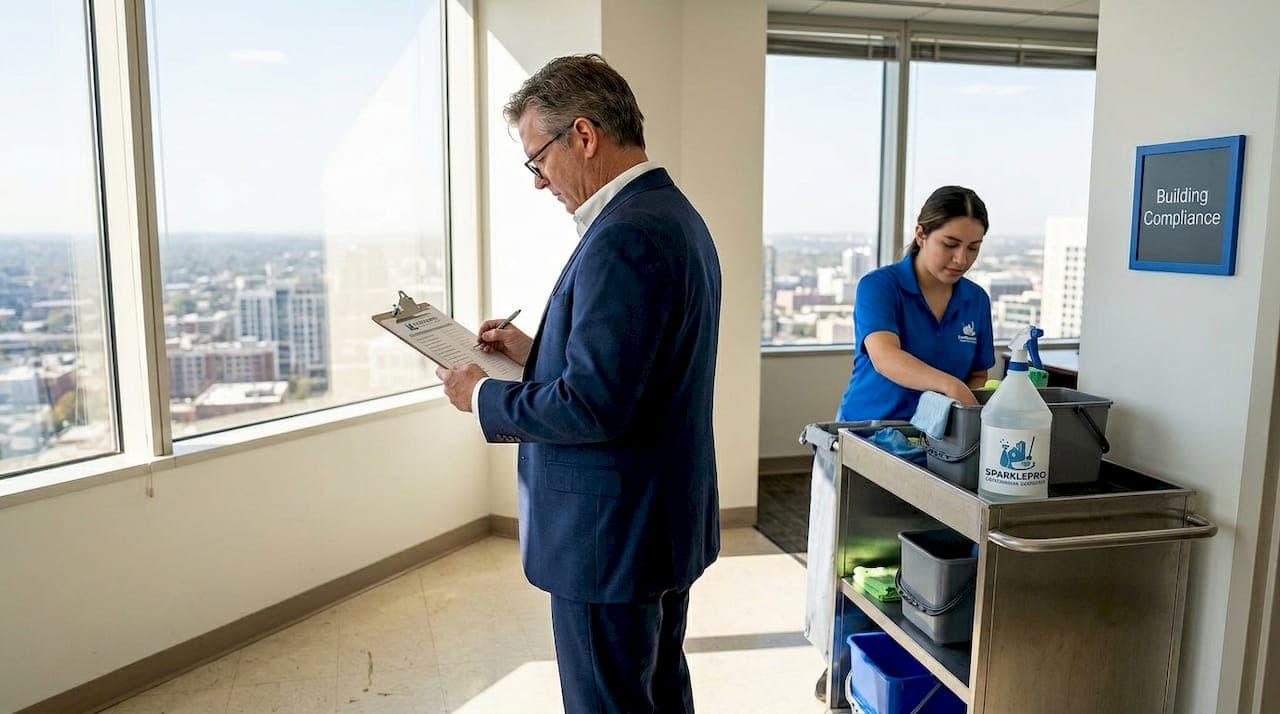
Property managers frequently assume that any vendor calling themselves a "commercial cleaner" operates to the same baseline. That assumption costs money, creates liability, and in some cases, fails health inspections. True industry standards for commercial cleaning are defined by credentialing bodies, backed by documented methodology, and verified through measurable results, not just a mop and a signature on a service contract. This guide breaks down who sets the standards, what a compliant cleaning program looks like, how to evaluate bids intelligently, and why sustainability has moved from a nice-to-have to a baseline expectation across the industry.
Table of Contents
- What are industry standards for commercial cleaning?
- Structuring a compliant cleaning program: Key components
- Choosing the right cleaning methodology: Zone vs. team cleaning
- Costing and bidding: What do industry standards mean for your budget?
- Green cleaning and sustainability: The new industry baseline
- An industry insider's perspective: What most cleaning standards miss
- Get expert cleaning aligned with industry standards
- Frequently asked questions
Key Takeaways
| Point | Details |
|---|---|
| ISSA and CIMS set the rules | Follow guidelines from major associations like ISSA, BSCAI, and CIMS to ensure cleaning quality and compliance. |
| SOPs and verification matter | Documented processes and objective testing are critical for meeting industry standards and occupant safety. |
| Choose methods that fit your site | Zone or team cleaning can be tailored to each facility’s needs for efficiency and accountability. |
| Pricing reflects quality and scope | Understand standard cleaning rates and be wary of low bids that skip essential steps. |
| Sustainability is now the baseline | Green practices and certifications are becoming standard for health, tenant satisfaction, and modern property value. |
What are industry standards for commercial cleaning?
Not every cleaning practice carries equal weight. When a vendor says they follow "best practices," that phrase means almost nothing unless it ties back to a recognized framework. Two organizations lead the way in defining those frameworks: the ISSA (Worldwide Cleaning Industry Association) and the BSCAI (Building Service Contractors Association International). These are not just trade groups. They publish structured standards, offer professional certifications, and provide benchmarks for everything from chemical dilution ratios to staff training requirements.
The ISSA Power Clean Standards define structured cleaning expectations including how tasks are performed, tools and chemicals used, frequencies, and sequences for safety and efficiency. That last point matters. Cleaning in the wrong sequence, say mopping before dusting high surfaces, undermines the entire effort and can spread contamination rather than reduce it.
On the certification side, the CIMS (Cleaning Industry Management Standard) is ISSA's flagship credential for cleaning organizations. CIMS Sustainability certifies management systems for quality, human resources, safety, and service delivery. It also includes CIMS-GB, which addresses green practices, and a sustainability track that governs overall operational impact.
Here is what industry standards typically address:
- Cleaning frequencies: How often surfaces, restrooms, common areas, and specialized zones should be serviced based on traffic and use type
- Approved methods: The correct tools, application techniques, and sequencing for each task
- Chemical specifications: Concentration ratios, approved product lists, and proper handling protocols
- Safety requirements: Personal protective equipment, Material Safety Data Sheet access, and spill procedures
- Quality verification: Documented inspection systems and measurable cleanliness benchmarks
It is worth noting the distinction between informal practices and true standards. Informal practices are what a vendor has always done. Standards are defined, documented, and verifiable. You can learn more about cleaning industry terminology to better parse the difference when reviewing vendor proposals.
"A cleaning standard is not a suggestion. It is a codified process that, when followed correctly, produces predictable, repeatable results regardless of who performs the task."
Understanding this framework before you sign any service contract is foundational. The janitorial service standards applicable to your specific facility type will vary, but the credentialing framework gives you a consistent way to evaluate any vendor.
Structuring a compliant cleaning program: Key components
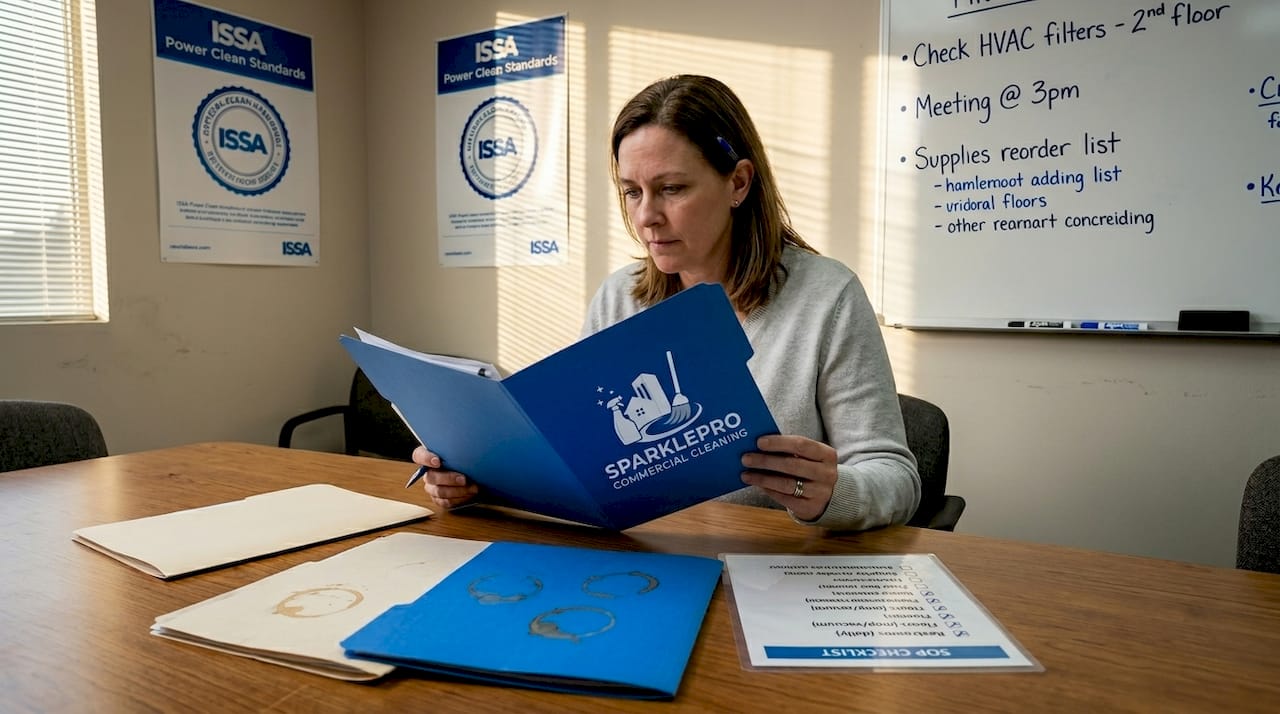
Knowing what standards exist is the starting point. Building a program that actually reflects them is where most facilities fall short. A compliant cleaning program is not a checklist on a clipboard. It is a documented system with clear ownership, defined methods, and verifiable outcomes.
Here are the core components every compliant program must include:
- Written standard operating procedures (SOPs): Every task should have a documented procedure. SOPs must specify top-to-bottom sequences, correct dwell times for disinfectants, surface-specific products, and equipment maintenance schedules. Dwell time, the period a disinfectant must remain wet on a surface to kill pathogens, is one of the most commonly skipped steps in practice.
- Pre-cleaning before disinfecting: Disinfectants do not work effectively on soiled surfaces. Organic matter like soil, grease, and residue must be removed first. Skipping this step is the single most common compliance failure in facility cleaning.
- Color-coded tool systems: Using a red microfiber cloth in a restroom and then the same cloth in a break room is a cross-contamination risk. A formal color-coding system assigns specific colors to specific zones, making contamination prevention visual and simple to enforce.
- ATP testing protocols: Visual inspection tells you a surface looks clean. ATP (adenosine triphosphate) testing tells you whether microbial contamination is actually below a safe threshold. This is particularly critical in healthcare settings, food service areas, and shared high-touch surfaces.
- Equipment maintenance logs: Dirty equipment spreads contamination. Vacuum filters, mop heads, squeegee blades, and floor machine pads must be tracked, cleaned, and replaced on defined schedules.
"Compliance is not about what you intend to do. It is about what you can prove you did."
Pro Tip: Ask any prospective cleaning vendor to produce their SOP documentation before you sign. If they cannot hand you a written procedure for restroom cleaning that includes dwell times and color-coding protocols, their process is not standards-based.
Maintaining your hard surface areas as part of a broader SOP framework is addressed in detail in our guide on commercial floor maintenance. Floor care is one of the highest-visibility cleaning categories and one of the most frequently under-documented in SOPs.
Choosing the right cleaning methodology: Zone vs. team cleaning
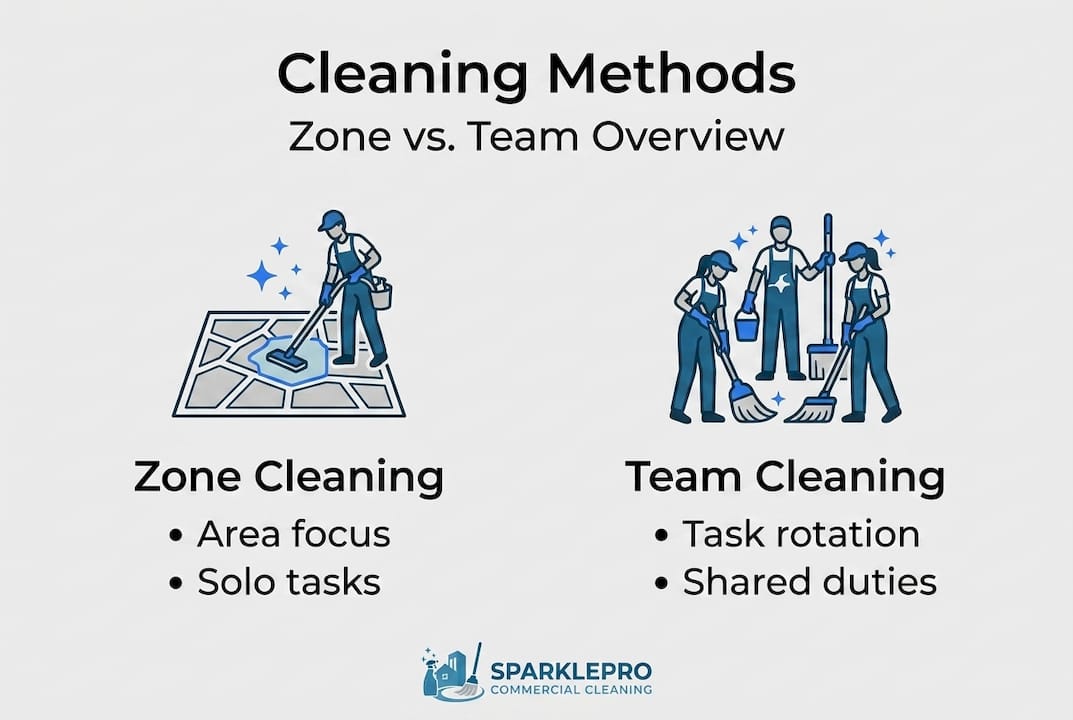
Structuring your program sets the foundation, but choosing the right execution method is just as important. The two primary methodologies in commercial cleaning are zone cleaning and team cleaning, and choosing incorrectly for your building type can result in inefficiency, accountability gaps, and uneven results.
| Factor | Zone cleaning | Team cleaning |
|---|---|---|
| Definition | One worker covers all tasks in an assigned area | Specialists rotate through the building by task type |
| Best for | Mid-size offices, schools, smaller buildings | Large facilities, hospitals, high-volume spaces |
| Accountability | High, one person owns the zone | Moderate, task accountability can diffuse |
| Training requirements | Broader skill set per worker | Deeper specialization per task |
| Personalization | Easier to customize by area | Harder to adapt per zone |
| Efficiency at scale | Moderate | High |
BSCAI promotes zone vs. team cleaning methodologies alongside proper floor care practices that prevent slips, extend surface life, and rely on sustainable low-VOC methods. Both methodologies are valid. The choice depends on your building's size, occupancy patterns, and cleaning frequency requirements.
Key considerations when selecting a methodology:
- Zone cleaning works well when tenant satisfaction and personalized service matter. A single cleaner familiar with a specific office suite builds accountability and consistency.
- Team cleaning works better for large footprints where specialized crews, such as floor care teams or restroom specialists, can work faster and more effectively than generalists.
- Daily vs. periodic cleaning may warrant different methodologies. Many facilities use zone cleaning for daily maintenance and team-based approaches for periodic deep cleaning.
Pro Tip: For multi-tenant commercial buildings, zone cleaning often reduces tenant complaints because it creates a clear point of contact for issues. One worker, one zone, one accountable person.
Whether you choose zone or team cleaning, the floor cleaning best practices you apply within either system will significantly affect both aesthetics and safety outcomes. Slip-and-fall liability alone makes floor care methodology worth documenting carefully.
Costing and bidding: What do industry standards mean for your budget?
A cleaning plan is not complete without understanding how compliance impacts your budget and how to recognize fair, standards-based pricing. The most common mistake property managers make when reviewing bids is comparing line items without understanding what compliance actually costs to deliver.
Commercial cleaning rates range $0.05 to $0.25 per square foot in the United States, varying by facility type, frequency, and location. Square foot pricing is preferred by ISSA and BSCAI because it creates a transparent, scalable baseline for comparison. A medical office building will sit closer to the high end of that range. A light industrial facility with simple janitorial needs may land at the lower end.
| Variable | Impact on cost |
|---|---|
| Cleaning frequency | Daily service costs more than weekly, but reduces deep-cleaning costs |
| Facility type | Healthcare and food service carry higher compliance costs |
| Regional labor rates | Costs in New York and California exceed the national average |
| Specialized services | Floor stripping, power washing, or electrostatic disinfection add to base rates |
| Certification requirements | CIMS-certified vendors may carry a slight cost premium |
Here is the important counterintuitive reality: compliant cleaning programs often cost less over time, even if they cost more per visit upfront. Standards-based programs extend the useful life of flooring, fixtures, and equipment by using correct chemicals and methods. They reduce liability exposure by documenting every cleaning event. They lower the risk of OSHA violations or health inspection failures that carry fines far exceeding any cleaning cost savings.
When evaluating bids through factors influencing cleaning bids, a non-compliant bid that undercuts a standards-based bid by 20% is not a deal. It is a liability waiting to be triggered. Ask every vendor to produce proof of insurance, documented SOPs, and certification status before you compare price.
Stat to remember: A single slip-and-fall incident in a commercial building costs an average of $20,000 to $40,000 in liability, far exceeding years of compliant floor care costs.
Green cleaning and sustainability: The new industry baseline
With cost and compliance covered, it is worth addressing the growing shift toward sustainability as the new industry baseline, not a premium add-on. This shift is happening at every level of the commercial real estate sector, driven by tenant expectations, LEED certification requirements, and evolving local regulations.
The CIMS Sustainability framework certifies management systems for quality, human resources, safety, and service delivery, and includes CIMS-GB for green practices as well as a sustainability track for overall operational performance. Achieving CIMS-GB means a cleaning provider has verified systems for selecting environmentally preferable products, reducing water and energy use, and minimizing waste.
Why this matters for you as a property manager:
- LEED credits: Tenant improvement projects and building recertification efforts increasingly require documented green cleaning programs as part of indoor environmental quality credits.
- Occupant health outcomes: Low-VOC (volatile organic compound) cleaning chemicals reduce respiratory irritation, headaches, and sick-day rates for building occupants. Healthier occupants mean better retention and fewer complaints.
- Cost reduction over time: Concentrated green cleaning products, microfiber systems that reduce chemical volume, and efficient equipment like auto-scrubbers use significantly less water and chemical per square foot than conventional methods.
- Tenant and investor expectations: A growing segment of commercial tenants, especially in corporate, healthcare, and tech sectors, now require proof of green cleaning practices as part of lease compliance.
- Regulatory momentum: Several states and municipalities are moving toward mandating low-VOC products in commercial facilities. Getting ahead of that curve now reduces compliance disruption later.
Green cleaning is not simply a marketing label. When backed by CIMS-GB certification, it represents a verified management commitment to operational sustainability that you can document and report to stakeholders.
An industry insider's perspective: What most cleaning standards miss
After working with property managers across all building types, the pattern we see most often is this: the documentation is excellent, and the execution is inconsistent. Organizations invest in writing SOPs, earn certifications, and sign contracts with certified vendors, then assume the work is done. It is not.
The real gap in most commercial cleaning programs is not the standard itself. It is the ongoing monitoring of adherence to that standard. Color-coding tools, for example, is a simple, effective system that virtually every compliant SOP includes. Yet in practice, tools end up in wrong zones within weeks of a new hire starting. ATP testing is supposed to provide objective verification of cleanliness, but many facilities that claim to use it actually conduct tests only during vendor audits, not during routine operations.
Understanding cleaning industry terminology is part of the solution, because it gives you the language to ask the right questions during inspections and vendor reviews. The harder part is building a verification culture, one where your team asks for ATP logs, reviews inspection reports, and treats a positive visual check as the beginning of verification, not the end.
The phrase "clean looks" is not the same as "safe." We see this distinction most urgently in facilities with vulnerable populations, but it applies anywhere shared surfaces exist. Trust your standards-based vendor, but build your own verification into the process. That combination is where real compliance lives.
Get expert cleaning aligned with industry standards
If you are ready to apply industry standards without second-guessing compliance, Sparklepro's commercial cleaning services are structured to meet ISSA and CIMS frameworks from day one. We bring documented SOPs, verified staff training, and sustainable product protocols to every facility we service.
Whether you manage a single office building or a multi-property portfolio, our nationwide services scale to meet your cleaning frequency, compliance, and green building requirements. We provide regional coverage with local operational knowledge, including specialized services across California commercial cleaning and New York facility cleaning markets. Contact us today for a detailed site assessment and a compliant cleaning proposal tailored to your building's specific requirements.
Frequently asked questions
What organizations set industry standards for commercial cleaning?
The ISSA and BSCAI set widely recognized commercial cleaning standards in the United States, with ISSA's Power Clean Standards defining structured expectations for task performance, chemical use, frequencies, and safety sequences.
How can I tell if a cleaning company follows industry standards?
Look for ISSA CIMS or CIMS-GB certification and ask to review their documented SOPs, staff training records, and quality verification processes before signing any service agreement.
What is the standard commercial cleaning rate per square foot?
Rates typically range from $0.05 to $0.25 per square foot depending on building type, cleaning frequency, and regional labor costs, with ISSA and BSCAI recommending square foot pricing as the standard calculation model.
Are green cleaning standards mandatory or optional?
Green cleaning is not universally mandatory, but CIMS-GB certification is increasingly required for LEED compliance and tenant contractual requirements, making it a practical necessity for competitive commercial properties.
What is the biggest mistake facilities make around cleaning standards?
Most facilities rely on visual inspection instead of verifiable ATP testing and skip ongoing staff retraining, which means documented standards exist on paper without consistent enforcement in practice.