

Using the wrong cleaning service for your commercial property is not just an inconvenience. It can trigger health code violations, spike your liability exposure, and leave your tenants or customers in an environment that looks cleaned but is not actually sanitized to code. Property managers often assume that any experienced cleaning crew will do, especially when the price is lower. But commercial and residential cleaning differ in almost every meaningful way: equipment scale, chemical strength, regulatory requirements, and workforce training. This guide breaks down those differences clearly so you can make the right call for your building, your budget, and your compliance obligations.
Table of Contents
- Core differences between commercial and residential cleaning
- Equipment, chemicals, and processes: What sets commercial apart
- Scheduling, compliance, and quality benchmarks
- Specialized services and training: Beyond basic cleaning
- Why cutting corners with commercial cleaning rarely pays off
- Choose the right commercial cleaning partner
- Frequently asked questions
Key Takeaways
| Point | Details |
|---|---|
| Compliance is critical | Commercial spaces face strict regulatory and sanitation requirements that residential cleaners usually cannot meet. |
| Industrial equipment required | Commercial cleaning relies on high-grade tools and chemicals not used in residential cleaning. |
| Specialization matters | Tasks like medical, industrial, and post-construction cleaning require advanced training and certifications. |
| Quality monitoring | Standardized benchmarks and checklists ensure reliability and consistency in commercial cleaning. |
| Risks of the wrong fit | Using residential services for commercial properties leads to compliance gaps and potential liability. |
Core differences between commercial and residential cleaning
The gap between commercial and residential cleaning is wider than most property managers expect when they first start comparing quotes. On the surface, both services send workers with mops, vacuums, and cleaning supplies. Below the surface, they operate in completely different categories.
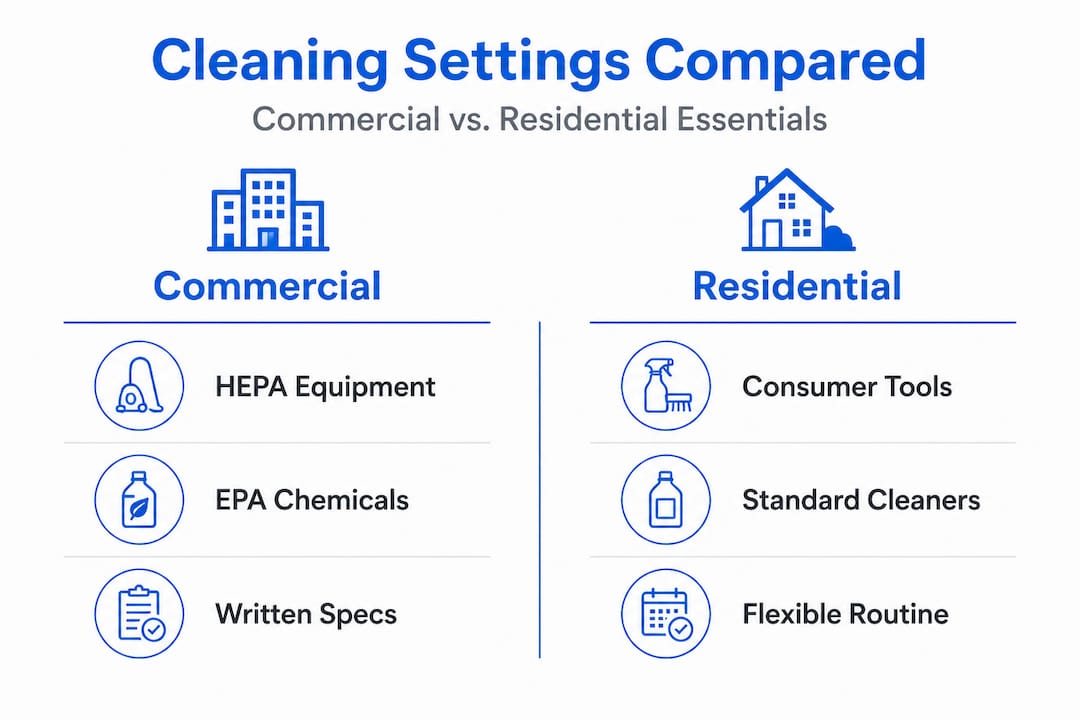
Commercial cleaning uses industrial-grade equipment, while residential cleaning relies on consumer-grade tools. That difference is not just about size. Industrial machines are built for repeated, high-frequency use across thousands of square feet without overheating or losing suction. Consumer equipment is designed for weekly home use, not the daily or nightly demands of an office tower or retail center.
On the chemical side, commercial cleaning requires EPA-registered disinfectants capable of killing a broader spectrum of pathogens, while residential services use gentler, often eco-friendly products suited for families and pets. This is a critical distinction in healthcare, food service, or high-traffic environments where surface contamination is a real risk.
Here is a quick comparison of the two service types:
| Factor | Commercial cleaning | Residential cleaning |
|---|---|---|
| Equipment | Industrial-grade, high-capacity | Consumer-grade, lighter use |
| Chemicals | EPA-registered disinfectants | Eco-friendly, family-safe |
| Scope | Large square footage, diverse surfaces | Rooms, home-scale areas |
| Frequency | Daily to multiple times per week | Weekly, bi-weekly, monthly |
| Regulation | OSHA, EPA, HIPAA compliance | Customer preference |
| Workforce training | Certified, specialty-trained | General cleaning skills |
Key operational differences that matter to property managers include:
- Scale: Commercial crews handle tens of thousands of square feet per shift
- Accountability: Commercial contracts include service level agreements (SLAs) and checklists
- Liability coverage: Commercial cleaning companies carry commercial insurance policies
- Scheduling: After-hours service is standard to avoid disrupting operations
- Specialization: Medical, industrial, and post-construction cleaning require dedicated protocols
Understanding this baseline helps you ask the right questions when evaluating cleaning vendors.
Equipment, chemicals, and processes: What sets commercial apart
With the broad differences in context, it is worth getting into the specifics of what commercial-grade equipment and chemicals actually look like in practice, and why the gap matters for your facility.
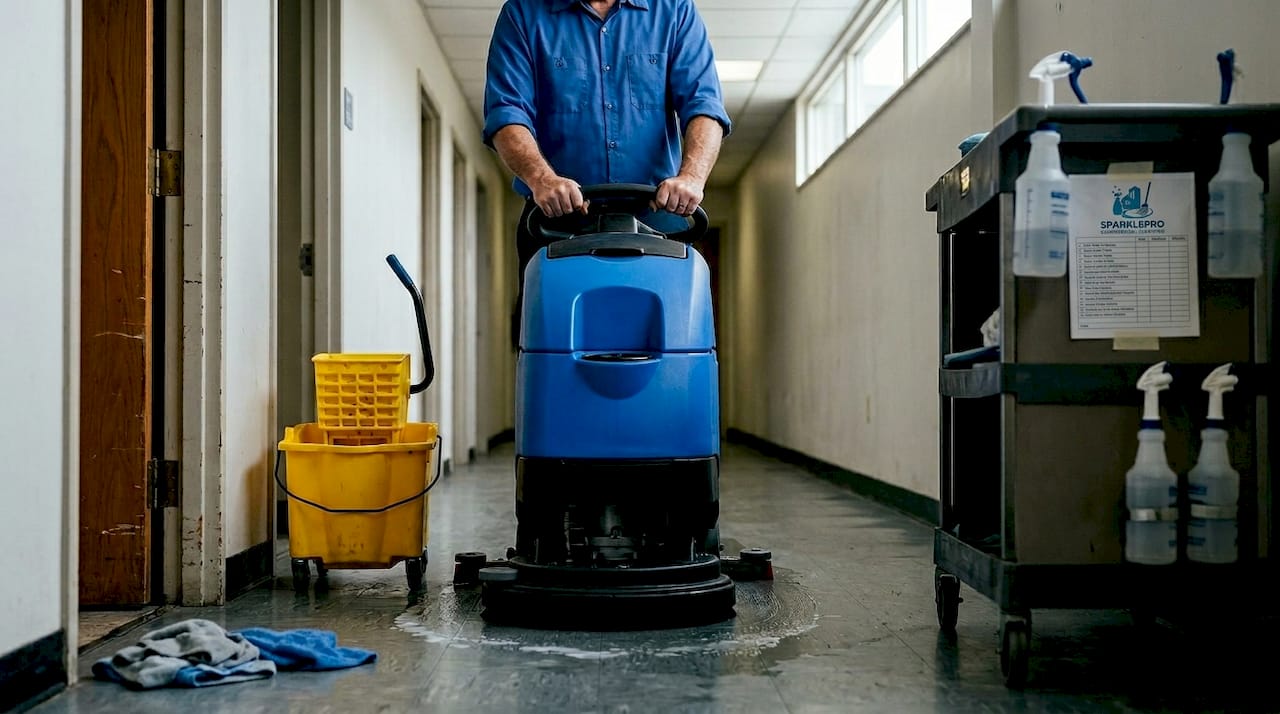
Commercial cleaning relies on HEPA vacuums, floor scrubbers, and high-pressure washers, while residential cleaning uses basic vacuums and mops. HEPA filtration matters in commercial settings because it captures fine particles including allergens, bacteria, and construction dust that standard consumer vacuum bags simply release back into the air. Floor scrubbers cover large surface areas efficiently and leave floors genuinely clean rather than just surface-damp. High-pressure washers handle loading docks, parking structures, and entryways that a residential team would not even attempt.
The chemical distinction is equally significant. EPA-registered disinfectants required for commercial settings are formulated to meet specific kill claims against bacteria, viruses, and fungi. These products undergo rigorous federal testing and have defined contact times and dilution ratios that cleaning teams must follow correctly. A team that is not trained in these protocols can either under-dilute (creating toxic residue) or over-dilute (rendering the disinfectant ineffective). Both outcomes are bad for your building occupants and your liability exposure.
If you are not familiar with the terminology around commercial-grade products and processes, reviewing cleaning industry terms is a smart first step before you start comparing vendors.
"The tools and chemicals a cleaning company uses tell you almost everything about whether they are operating at commercial standards or just mimicking them."
Here is a breakdown of common commercial equipment and what it handles:
| Equipment | Application | Residential equivalent |
|---|---|---|
| HEPA vacuum | Fine particulate removal, air quality | Standard bag vacuum |
| Auto floor scrubber | Tile, concrete, epoxy floors at scale | Mop and bucket |
| High-pressure washer | Exteriors, loading docks, entryways | Garden hose |
| Carpet extractor | Deep-clean carpeted commercial spaces | Rental steam cleaner |
| Microfiber flat mop system | Infection control, hospital-grade surfaces | Traditional string mop |
Pro Tip: When evaluating a commercial cleaning vendor, ask specifically what EPA registration numbers appear on their primary disinfectants. A legitimate commercial cleaner should be able to produce that information without hesitation. If they cannot, treat it as a red flag.
The procedural side of commercial cleaning also differs significantly. Commercial teams follow written work specifications, room-by-room task sequences, and dilution control systems for chemicals. Color-coded microfiber systems prevent cross-contamination between restrooms and food prep areas. These are not optional best practices. In regulated environments like healthcare or food processing, they are compliance requirements.
Scheduling, compliance, and quality benchmarks
After understanding the tools and chemicals, the next question for property managers is when cleaning happens and to what measurable standard. Both of those answers differ sharply between commercial and residential services.
Commercial cleaning typically occurs daily or multiple times per week, often after hours, to minimize disruption to business operations. Residential cleaning is far more flexible, often happening during daytime hours with schedules set around homeowner convenience. For a property manager running an office building, retail center, or healthcare facility, after-hours cleaning is not a preference but a requirement. Daytime cleaning creates noise, wet floors, and chemical odors that interfere with occupants.
Compliance is the bigger issue. Commercial cleaning services must meet health and safety standards including OSHA, EPA, and in healthcare settings, HIPAA. Residential services are not designed around any of these frameworks. OSHA standards govern how cleaning chemicals are stored, labeled, and handled on commercial premises. A residential cleaner working in your building who does not follow OSHA-compliant chemical handling puts you at risk for a workplace safety violation, even if you are not the one handling the chemicals.
Quality benchmarks provide a measurable way to hold commercial cleaners accountable. APPA CAPE scores of 85 or higher and ISSA 612 production rates for tasks like vacuuming give property managers objective benchmarks to include in contracts and audits. These standards are the difference between vague "clean to satisfaction" language and enforceable service levels. Referencing cleaning standards for managers can help you build those benchmarks into your vendor agreements.
Here is a step-by-step approach to managing commercial cleaning compliance:
- Define your regulatory environment. Know which agencies govern your facility. Healthcare has HIPAA and CDC guidance. Food service follows FDA and local health codes. Office buildings follow OSHA.
- Request proof of chemical compliance. Ask for Safety Data Sheets (SDS) for all primary cleaning products used in your facility.
- Establish a cleaning frequency schedule. Document which areas are cleaned daily, weekly, or monthly with specifics.
- Set APPA or ISSA benchmarks in your contract. Include objective scoring criteria, not subjective satisfaction language.
- Schedule regular quality audits. Monthly walkthroughs with a checklist tied to your SLA keep vendors accountable.
- Review incident reporting protocols. Your commercial cleaning company should have a documented process for reporting spills, damage, or hazards.
Pro Tip: Build a 90-day quality audit cycle into your initial cleaning contract. This creates a structured review window without making it feel adversarial. Most commercial cleaning companies will welcome the transparency because it protects them too.
A well-structured commercial cleaning contract protects your property, your tenants, and your insurance position. Verbal agreements and informal arrangements common in residential cleaning create gaps that surface during inspections, incidents, or insurance claims.
Specialized services and training: Beyond basic cleaning
Quality and consistency in commercial cleaning depend heavily on the specialization of the workforce and the scope of services offered. This is where the gap between commercial and residential providers becomes almost impossible to bridge.
Commercial cleaners receive training in industry standards including ISSA CIMS, IICRC, and GBAC protocols, along with safety procedures that residential cleaners are not required to complete. CIMS (Cleaning Industry Management Standard) focuses on organizational management and quality systems. IICRC covers restoration and cleaning science. GBAC (Global Biorisk Advisory Council) certification, which gained prominence during the COVID-19 pandemic, focuses on infection prevention and biorisk mitigation. These are not decorative credentials. They represent documented training that translates into safer, more effective cleaning in regulated environments.
Commercial services extend well beyond routine janitorial work to include floor buffing and refinishing, exterior window cleaning, post-construction cleanup, pressure washing, and cleaning for medical and industrial facilities. A residential cleaning company cannot responsibly take on post-construction cleanup because it involves removing construction dust, debris, and potentially hazardous materials in a sequence that requires specific processes and equipment.
The edge cases matter most for managers overseeing mixed-use or specialized properties. Medical cleaning protocols address bloodborne pathogens, while industrial cleaning requires OSHA and HACCP compliance. HACCP (Hazard Analysis and Critical Control Points) is a food safety framework that governs cleaning in food production environments. A residential cleaner in a commercial kitchen or medical exam room is not just underprepared. They represent an active compliance risk for your facility.
Here is what to look for in specialized commercial cleaning capabilities:
- Certifications on file: ISSA CIMS, IICRC, or GBAC accreditation with verification available
- Specialty service capacity: Documented ability to perform floor refinishing, post-construction cleanup, or disinfection services
- Healthcare protocol training: Bloodborne pathogen training and proper PPE use for medical environments
- Industrial compliance knowledge: Familiarity with OSHA standards and HACCP requirements for food or manufacturing spaces
- Insurance coverage specificity: Commercial general liability policies that cover specialized cleaning tasks
Review your vendor's manager's cleaning standards documentation before signing any service agreement. Experienced commercial property managers know that certifications and insurance specifics belong in the due diligence process, not as an afterthought.
Pro Tip: Ask prospective vendors for a copy of their training curriculum or certification records for lead technicians. Companies that invest in worker training also tend to have lower turnover, which means more consistency for your facility over time.
Why cutting corners with commercial cleaning rarely pays off
Here is a perspective most vendors will not offer directly: the temptation to use residential cleaning services in commercial spaces almost always comes down to price. And we understand that pressure. Cleaning budgets are real constraints. But the math on this shortcut rarely works out the way property managers hope.
Using residential cleaners in commercial spaces risks non-compliance, inadequate sanitation, and liability exposure that most residential cleaning contracts simply do not account for. When a health inspector cites your facility for inadequate sanitation, they do not care that you were trying to save $500 a month. When a tenant slips on a wet floor that was not properly signed or dried by an undertrained crew, your liability is not reduced because the cleaner worked cheaply.
The accountability gap is the most dangerous part. Residential cleaning agreements are built on goodwill and customer satisfaction. Commercial cleaning agreements should be built on documented SLAs, measurable performance benchmarks, verified certifications, and insurance certificates that your legal team can actually review. That accountability infrastructure does not exist in the residential cleaning market because residential clients do not need it.
Property managers who have managed large portfolios know that the cost of a compliance incident, a tenant complaint cycle, or an insurance claim always exceeds the savings from undercutting on cleaning quality. The KPIs and checklists that come standard with a professional commercial cleaning contract are not bureaucratic overhead. They are your protection when something goes wrong. And in facilities with high occupancy, high traffic, or regulated environments, something eventually goes wrong.
Demand certifications. Demand objective inspection checklists. Demand an SLA with clear remediation procedures. These are not unreasonable asks. They are the baseline for any commercial cleaning relationship that is worth your building's reputation.
Choose the right commercial cleaning partner
The differences between commercial and residential cleaning add up fast when you start mapping them against your actual facility requirements. Equipment, chemicals, training, compliance frameworks, and specialty capabilities all point in the same direction: your building needs a partner with documented commercial cleaning expertise.
Sparkle Pro Commercial Cleaning provides certified, fully insured commercial cleaning services across multiple states, including California commercial cleaning, New York commercial cleaning, and Wisconsin commercial cleaning. Our service model is built around transparent SLAs, regular quality reporting, and teams trained in OSHA-compliant processes for offices, healthcare facilities, retail centers, and post-construction environments. Whether you need routine janitorial services or specialized disinfection for a regulated space, we offer tailored packages with the accountability infrastructure your property demands. Contact us to schedule a quality audit or request a quote for your facility.
Frequently asked questions
What happens if I use a residential cleaner in my commercial building?
You risk non-compliance with health and safety regulations, inadequate sanitation for your occupant volume, and increased liability if an incident occurs. Residential cleaners lack the equipment, training, and insurance required to reliably serve commercial environments like offices or healthcare facilities.
How often do commercial spaces need professional cleaning?
Most commercial facilities require cleaning daily or multiple times per week, typically scheduled after hours to avoid disrupting building operations and occupants.
Are there specific certifications or standards for commercial cleaning companies?
Yes. Look for companies with ISSA CIMS, IICRC, or GBAC accreditation, which demonstrate documented training in cleaning science, quality management, and infection prevention.
Do residential cleaning products meet commercial safety or sanitation needs?
No. Commercial facilities require EPA-registered disinfectants formulated for high-traffic environments and regulatory compliance. Residential products are designed for home use and do not meet commercial sanitation requirements.
Why are medical and industrial spaces considered edge cases?
They operate under stricter regulatory frameworks than standard commercial facilities. Medical cleaning addresses bloodborne pathogens and sterile field requirements, while industrial spaces must comply with OSHA safety standards and HACCP food safety protocols, both of which go far beyond general commercial cleaning scope.
Recommended
- Commercial cleaning standards: A property manager's guide
- Decode commercial cleaning terms: guide for managers
- Streamline Your Commercial Floor Cleaning Process
- Top 5 Sparkleprocleaning.co Alternatives 2026
- Professional cleaning explained: A facility manager's guide | Ozifresh
- Commercial Drain Cleaning: Protecting London Businesses