

Signing a cleaning contract without reading the fine print is one of the most expensive mistakes a property manager can make. You agree to a flat monthly fee, the crew shows up inconsistently, and six months later you're fielding tenant complaints while locked into a two-year agreement. This scenario plays out across commercial properties every day. The good news is that a structured evaluation process, covering scope, pricing, compliance, and contractor track record, puts you firmly in control before you sign anything. This guide walks you through exactly what to look for, what to avoid, and how to hold any cleaning vendor accountable from day one.
Table of Contents
- Understand contract essentials and requirements
- Compare pricing and performance metrics
- Check quality assurance and compliance provisions
- Evaluate contractor track record and references
- Why performance-based contracts are the new standard
- Find trusted cleaning contract solutions
- Frequently asked questions
Key Takeaways
| Point | Details |
|---|---|
| Clarify contract essentials | Always define scope, pricing, and compliance before signing any cleaning contract. |
| Prioritize performance metrics | Performance-based contracts ensure accountability and high service standards. |
| Vet contractor reputation | Check references and past performance to avoid unreliable providers. |
| Negotiate quality and penalties | Include inspection routines and service penalties to safeguard property interests. |
Understand contract essentials and requirements
Every cleaning contract is a legal and operational document. Treating it like a simple service agreement is where most property managers go wrong. Before you compare bids or negotiate rates, you need to confirm that the contract covers three foundational areas: scope of work, pricing structure, and compliance obligations.
Scope of work is the most important element. It should specify the exact square footage being serviced, the areas included (restrooms, lobbies, stairwells, parking structures), the cleaning frequency for each area, and the type of cleaning required. "General cleaning" is not a scope. Detailed line items are. If a contract says "clean restrooms daily" without defining what that means, you have no basis for a complaint when standards slip.
Pricing models vary widely, and each carries different risk. Here is a quick breakdown:
| Pricing model | How it works | Best for |
|---|---|---|
| Flat monthly fee | Fixed cost regardless of output | Predictable budgets, low-complexity spaces |
| Hourly rate | Billed by labor hours logged | Variable-scope or smaller facilities |
| Per sq ft rate | Cost tied to total area serviced | Mid-size to large commercial buildings |
| Performance-based | Payment tied to measurable service outcomes | Facilities requiring strict accountability |
As the cleaning contract terms for commercial properties become more standardized,
are gaining traction because they tie payment to results rather than effort, reducing the risk of paying full price for substandard service.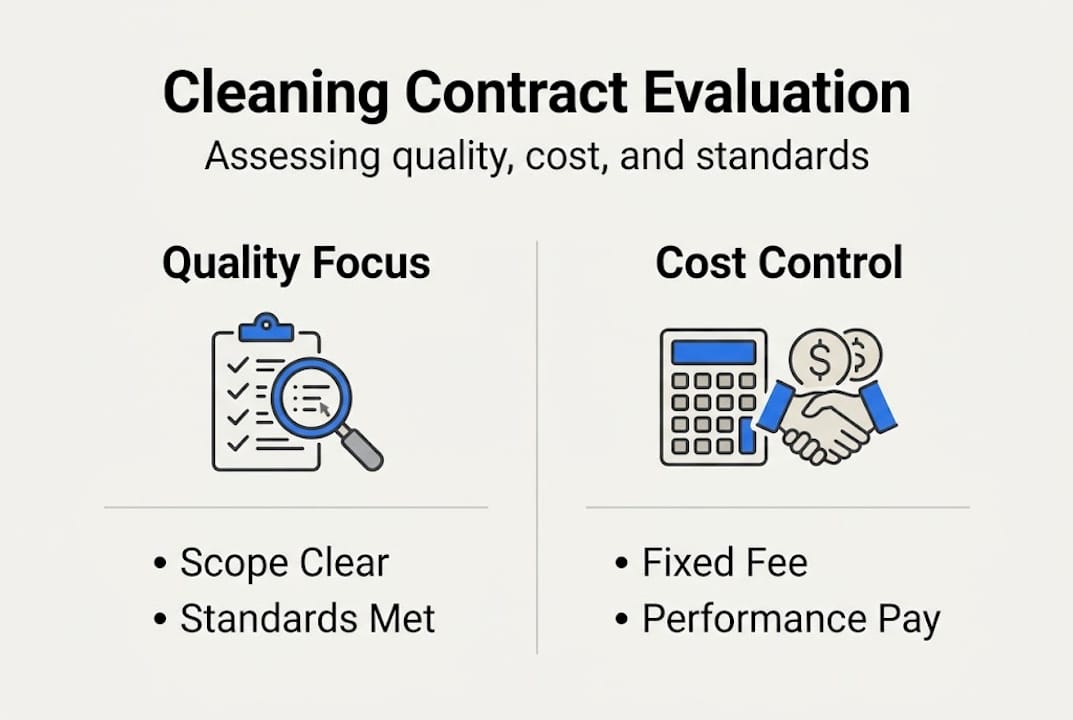
Compliance and liability clauses protect your property and your tenants. The contract should confirm that the vendor carries general liability insurance, workers' compensation, and bonding. It should also specify who is responsible if a cleaning crew member causes property damage or injury on site.
Pro Tip: Always request a fully itemized service and cost breakdown before signing. Line-item pricing makes it far easier to identify inflated charges, compare competing bids accurately, and renegotiate specific services without reopening the entire contract.
- Confirm insurance certificates are current and name your property as an additional insured
- Require written confirmation of background checks for all on-site staff
- Verify that subcontractors, if used, are covered under the same terms
- Ask for a sample contract from a comparable property the vendor currently services
Compare pricing and performance metrics
With the contract essentials mapped out, the next step is understanding how pricing structure directly affects service accountability. This is where many property managers focus too narrowly on cost per square foot and miss the bigger picture.
Hourly and per-square-foot rates can both be accurate, but they measure input rather than output. A crew can log four hours and still leave a facility in poor condition. Performance-based contracts shift the focus from time spent to results delivered, which is why they are increasingly preferred by facility directors managing high-traffic or regulated environments.
Here is how the three most common pricing models compare on key performance factors:
| Factor | Hourly | Per sq ft | Performance-based |
|---|---|---|---|
| Cost predictability | Low | Medium | Medium to high |
| Accountability for quality | Low | Low | High |
| Flexibility for scope changes | High | Medium | Medium |
| Best fit | Small offices | Large open spaces | Healthcare, retail, Class A office |
When evaluating bids, use this numbered checklist to assess performance metrics in any proposal:
- Cleaning frequency per zone: Is each area assigned a specific schedule, or is it grouped under a vague "as needed" clause?
- Quality inspection schedule: How often does the vendor conduct formal quality checks, and who documents them?
- Incident response time: What is the guaranteed response window for urgent cleaning needs or complaints?
- Customer satisfaction tracking: Does the vendor use any scoring system, such as a post-service survey or app-based rating?
- Escalation process: Is there a defined path for unresolved complaints, including timelines and remedies?
A well-structured floor cleaning process, for example, should include documented pre-inspection, product application standards, and post-service sign-off. If a vendor cannot describe their process in writing, that is a red flag.
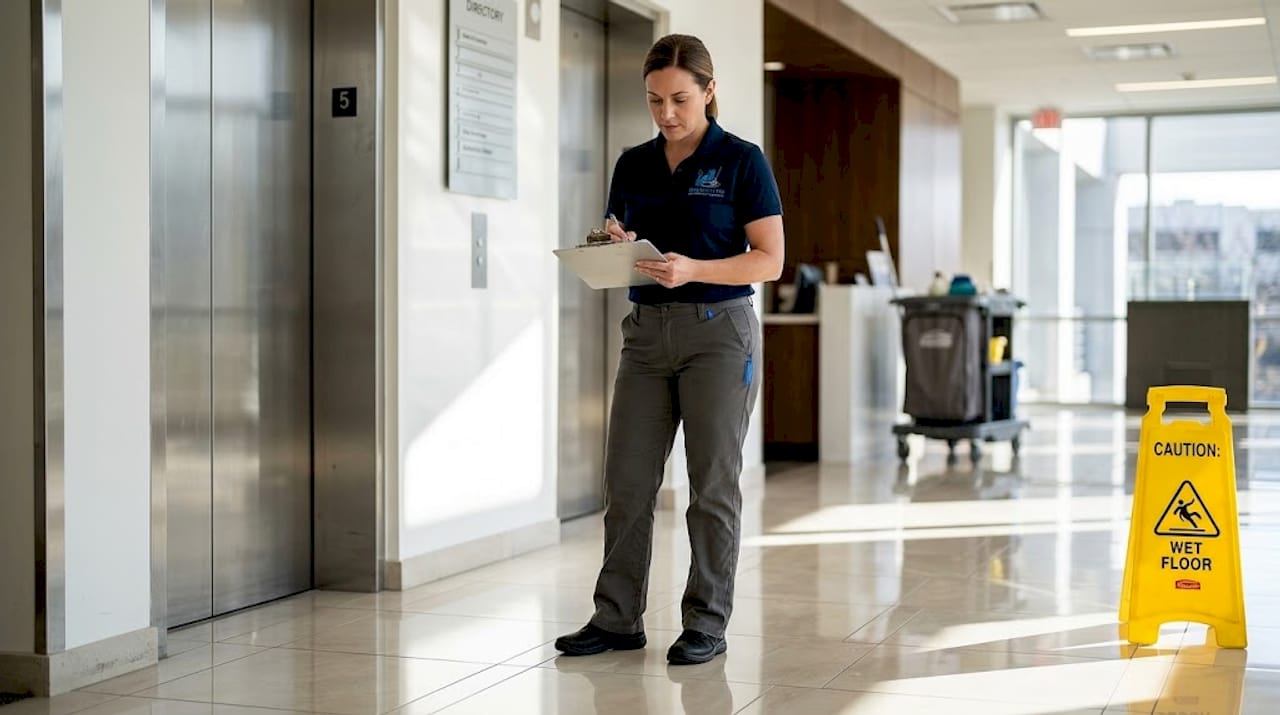
Industry data shows that fewer than 30% of commercial cleaning contracts currently include formal performance metrics, which means most property managers have no objective basis for disputing poor service. Locking in KPIs (key performance indicators, meaning measurable targets) at the contract stage is one of the highest-leverage moves you can make.
Check quality assurance and compliance provisions
After comparing pricing, the contract's quality assurance and compliance language deserves its own focused review. This section of the contract is often buried in boilerplate, but it is where your real protections live.
Quality assurance provisions should include:
- Scheduled routine inspections, with documented results shared with the property manager
- Written service guarantees that specify what happens if a standard is missed
- A clear process for logging, escalating, and resolving service complaints
- Photographic or digital documentation of completed work for high-priority areas
Compliance requirements are non-negotiable for any commercial property. The contract should explicitly reference OSHA standards for cleaning chemical handling, confirm that all staff have passed background checks, and verify that the vendor's insurance is active and adequate for your property type.
Pro Tip: Before signing, ask the vendor to provide a sample inspection report or audit template from a current client. A vendor who conducts real quality audits will have these documents ready. One who hesitates or offers a generic checklist may not be performing them at all.
For facilities like healthcare buildings or food-adjacent retail, compliance goes further. You need confirmation that the vendor's staff is trained in infection control protocols, that cleaning products meet EPA or OSHA standards for your environment, and that documentation is available for regulatory review if needed.
"A contract without quality clauses is just a price agreement. Real protection comes from written standards, documented audits, and defined remedies for non-compliance."
Reviewing janitorial service examples across different facility types can help you benchmark what quality provisions look like in practice and identify gaps in the contracts you are evaluating.
Evaluate contractor track record and references
Once you have reviewed the contract content itself, the final step is verifying that the vendor can actually deliver what the document promises. A well-written contract means nothing if the company behind it has a history of missed services and unanswered complaints.
Here is a step-by-step process for vetting any cleaning contractor:
- Request three to five references from properties similar to yours in size, type, and service scope. A vendor who services Class A office buildings should be able to connect you with current clients in that category.
- Ask references specific questions: How often did service fall short? How quickly did the vendor respond to complaints? Would you renew the contract?
- Review online ratings and complaint history: Check Google reviews, the Better Business Bureau, and any state contractor licensing databases relevant to your location.
- Ask for case studies or before-and-after documentation: Reputable vendors often have documented examples of problem-solving on complex accounts.
- Confirm license and insurance status independently: Do not rely solely on documents the vendor provides. Verify directly with the issuing authority.
Positive indicators to look for:
- Long-term client relationships (three or more years with the same accounts)
- Proactive communication style and a dedicated account manager
- Documented quality improvement over the contract term
- Willingness to include performance penalties in the agreement
Red flags to watch for:
- Reluctance to provide references or vague, unverifiable testimonials
- No formal quality assurance process or inspection documentation
- High staff turnover, which often signals poor management and inconsistent service
- Contracts that prohibit you from terminating for poor performance
Contractor reliability is directly tied to client outcomes, and properties that vet contractors thoroughly before signing report significantly higher satisfaction rates. Reviewing facility cleaning examples from comparable buildings can also help you set realistic expectations for what a strong vendor relationship looks like.
Why performance-based contracts are the new standard
Here is an uncomfortable truth: most cleaning contracts are written to protect the vendor, not the property manager. Flat fees with no performance clauses give vendors every incentive to minimize labor and every protection against accountability. You pay the same whether the building is spotless or falling short.
Industry experts increasingly favor performance-based contracts because they realign incentives. When a vendor's revenue depends on meeting measurable standards, quality stops being optional. This is not a niche approach anymore. It is becoming the baseline expectation for any serious commercial cleaning relationship.
The pushback we hear most often is that performance contracts are harder to negotiate. That is true. But the alternative is signing a vague agreement and hoping the vendor shows up motivated. Hope is not a contract term. Understanding commercial cleaning contract terms in detail gives you the language to negotiate from a position of knowledge rather than assumption.
Pro Tip: Negotiate KPIs and service penalties before you sign, not after a problem occurs. Define what "acceptable" looks like in writing, and attach a financial consequence to falling below that standard. Vendors who resist this conversation are telling you something important.
Find trusted cleaning contract solutions
You now have a clear framework for evaluating any commercial cleaning contract, from scope and pricing to compliance and contractor vetting. The next step is finding a vendor who can meet those standards consistently.
At Sparklepro Commercial Cleaning, we work with property managers and building owners across the country to deliver fully documented, performance-backed cleaning programs. Whether you manage properties in Massachusetts cleaning contracts, need California cleaning services for a large portfolio, or are looking for New York cleaning contract solutions, our regional teams bring local knowledge and national standards to every engagement. We are licensed, insured, and ready to walk you through a contract that protects your property from day one.
Frequently asked questions
What should I look for in a commercial cleaning contract?
Focus on service scope, pricing structure, quality assurance clauses, and compliance with relevant regulations. Performance-based contracts provide better accuracy and accountability than flat-fee agreements.
How do I compare cleaning contract bids effectively?
Benchmark pricing models side by side, itemize all services, review what performance metrics each vendor includes, and verify contractor references before making a decision.
Can I negotiate penalties for missed service levels?
Yes, and you should. Negotiating KPIs and financial penalties for non-compliance is increasingly standard practice, especially in performance-based contracts favored by industry experts.
What are some red flags to watch for in cleaning contracts?
Vague scope of work, missing quality assurance provisions, no compliance language, and a vendor who cannot provide verifiable references are all warning signs worth taking seriously.