
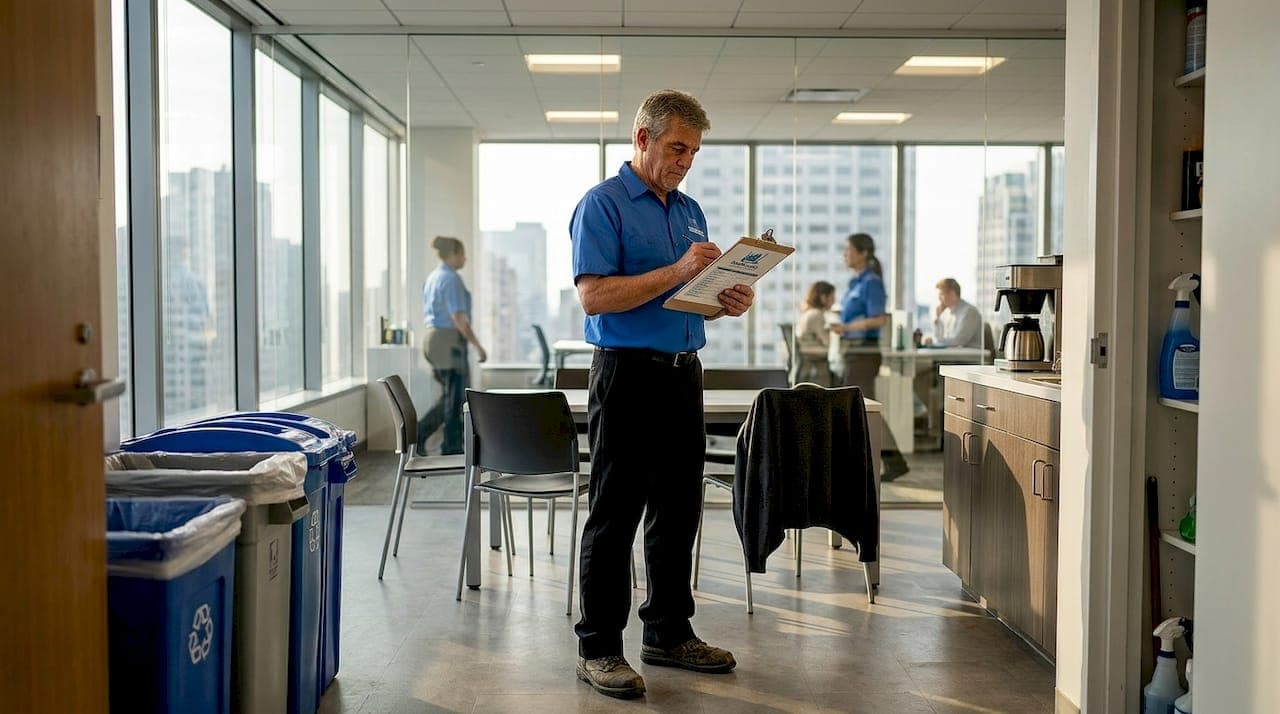
Walking into a poorly maintained office sends a message to every tenant, client, and employee who sets foot in it. Inconsistent cleaning doesn't just create complaints — it drives up absenteeism, accelerates surface wear, and puts your liability exposure at risk every single day. Property managers and facility directors who rely on ad-hoc cleaning arrangements consistently deal with the same cycle: missed tasks, tenant friction, and emergency fixes that cost far more than a structured routine would have. This guide walks you through the core components of a reliable office janitorial process, from setting up solid procedures to verifying quality and troubleshooting the gaps that most cleaning programs quietly ignore.
Table of Contents
- What makes an office janitorial process effective?
- Key tools, supplies, and preparation checklist
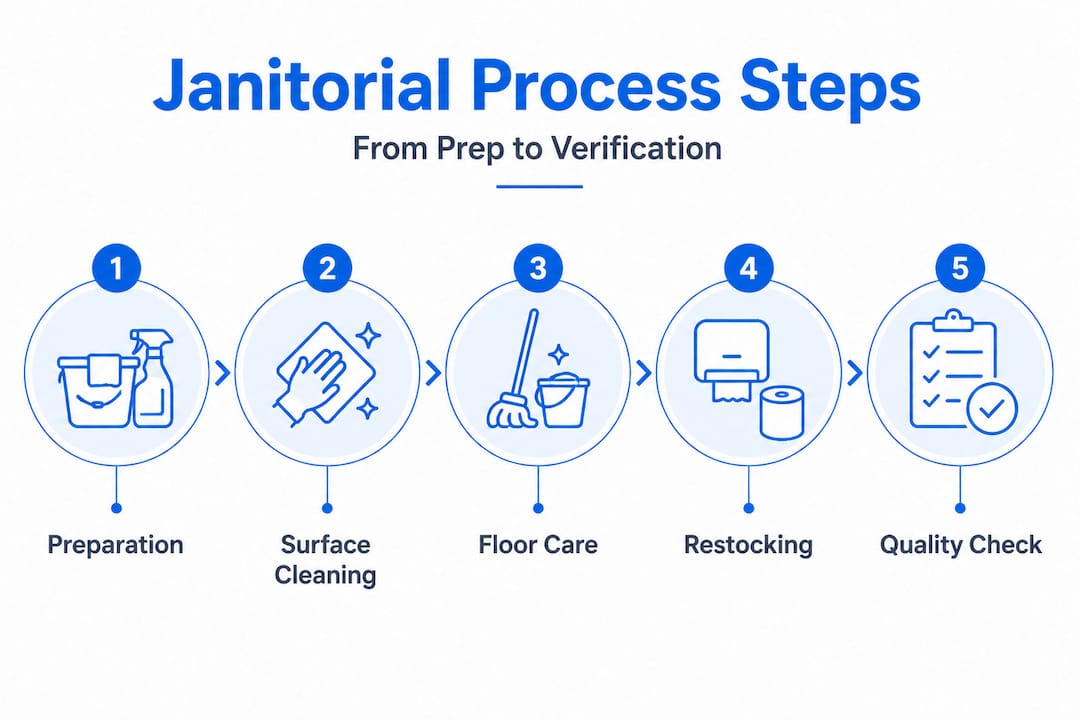
- Step-by-step office janitorial process
- Verification and quality assurance methods
- Common challenges and troubleshooting tips
- A professional perspective: What most guides get wrong about office cleaning
- Streamline your office janitorial process with Sparklepro
- Frequently asked questions
Key Takeaways
| Point | Details |
|---|---|
| Standardize with SOPs | Written procedures for cleaning tasks and safety help ensure consistent, high-quality results. |
| Prepare the right tools | Having the correct materials on hand streamlines workflow and reduces errors. |
| Follow logical steps | Workflows like top-to-bottom cleaning and proper dwell times boost effectiveness and safety. |
| Verify and adapt | Routine walk-throughs and feedback allow for continuous improvement so quality never slips. |
| Expect challenges | Be ready to address issues like staff turnover, injuries, and time estimates with proactive solutions. |
What makes an office janitorial process effective?
Having established the value of a reliable system, it's crucial to define what an effective janitorial process actually looks like in practice.
The foundation of any high-performing office janitorial program is a set of written standard operating procedures (SOPs). Commercial cleaning SOPs ensure consistent quality by defining daily, weekly, and monthly tasks, chemical dilutions, PPE requirements, and sequences like top-to-bottom cleaning and proper disinfectant dwell times for restrooms and high-touch surfaces. Without SOPs, cleaning quality depends entirely on individual memory and habit — both of which are unreliable over time, especially with staff changes.
Effective SOPs answer three specific questions: what gets cleaned, how often, and with what materials. A restroom SOP, for example, should specify which disinfectant to use, how long it needs to dwell on surfaces before wiping, what PPE is required, and the exact order in which fixtures are addressed. Ambiguity in any of those steps creates room for shortcuts.
Reviewing a janitorial terminology guide helps managers and vendors speak the same language when reviewing scope and performance expectations. It also prevents misunderstandings about terms like "sanitize" versus "disinfect," which carry different compliance implications in commercial settings.
Cross-contamination prevention deserves special attention. Color-coded microfiber cloths — one color per zone, such as red for restrooms and blue for desks — are a simple, low-cost control measure that dramatically reduces the risk of spreading bacteria between spaces. Safety measures also include proper chemical storage, correct dilution ratios, and clear protocols for handling spills.
Here's a quick breakdown of what a well-structured SOP should cover:
- Daily tasks: Trash removal, surface wiping, restroom disinfection, floor care, and high-touch point attention
- Weekly tasks: Interior glass cleaning, vent dusting, chair and desk undersides
- Monthly tasks: Upholstery cleaning, deep floor care, behind and under equipment
- Safety standards: PPE requirements, chemical handling, and spill response
- Documentation: Log sheets, issue flags, and inspection sign-offs
Looking at janitorial service examples across different facility types helps clarify how scope varies depending on whether you're managing a medical office, a corporate tower, or a mixed-use retail center.
| SOP Element | Without It | With It |
|---|---|---|
| Task sequencing | Random order, missed spots | Predictable, thorough results |
| Chemical dilution | Risk of surface damage or under-disinfection | Safe, effective application |
| PPE requirements | Increased injury and liability | Worker safety and compliance |
| Documentation | No record for disputes | Auditable trail for quality |
"A well-written SOP isn't a constraint — it's a performance guarantee. It protects your team, your tenants, and your reputation."
Key tools, supplies, and preparation checklist
Once the core process is understood, assembling the right tools and supplies makes execution efficient and consistent.
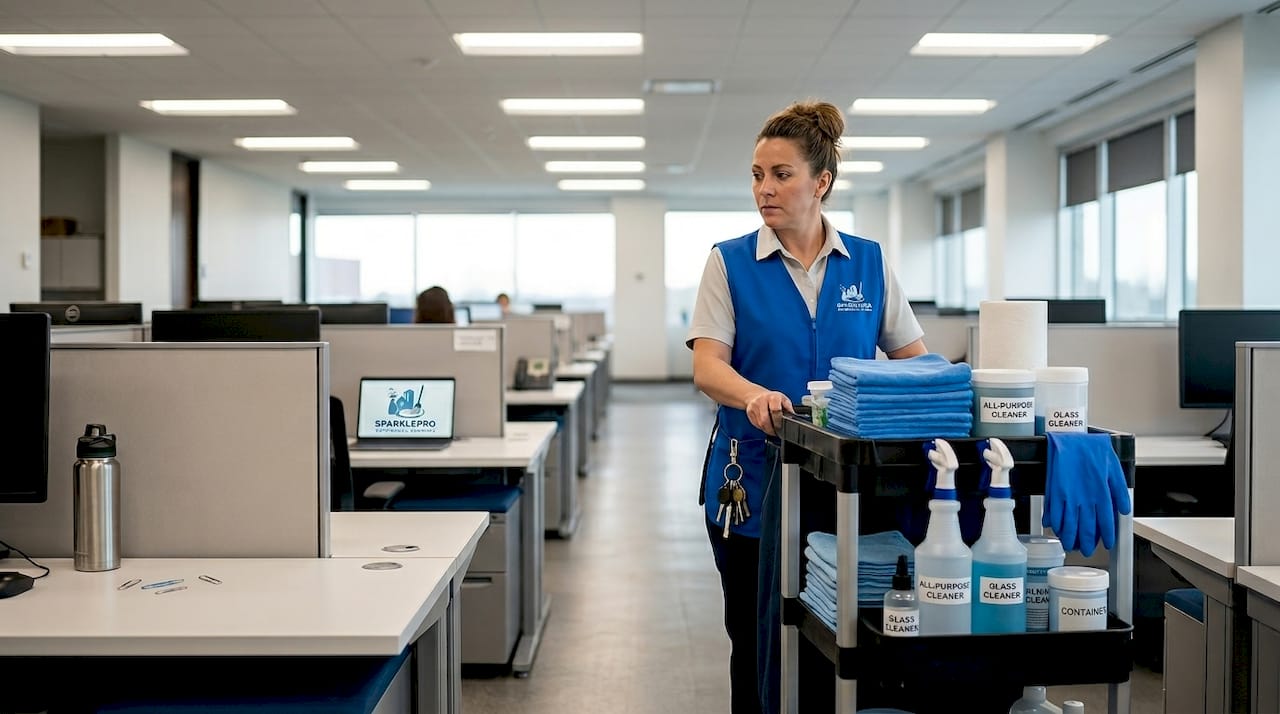
No amount of planning compensates for missing or damaged equipment on a job. Every janitorial team working in commercial office environments needs a standardized toolkit. Commercial cleaning SOPs define chemical dilutions, PPE, and cleaning sequences, all of which depend on having the right materials on hand, in the right quantities, at the start of every shift.
Here's a baseline equipment list every office janitorial program should maintain:
- HEPA-filter vacuum cleaners for carpeted and hard-surface areas, particularly important in allergy-sensitive environments
- Color-coded microfiber cloths to prevent cross-contamination between restrooms, kitchens, and workspaces
- Flat mop systems for hard floors, with clean mop heads available per floor or zone
- Personal protective equipment (PPE): nitrile gloves, safety glasses, and non-slip footwear
- Properly labeled chemical bottles with correct dilution ratios already measured
- Fully stocked janitorial carts organized by task category for fast, efficient movement through the building
Understanding the commercial floor cleaning process is especially important when selecting mop systems, floor cleaners, and pads appropriate for the surface types in your building.
| Supply | Purpose | Restock Frequency |
|---|---|---|
| Microfiber cloths | Surface wiping, cross-contamination control | Weekly or per shift |
| HEPA vacuum bags/filters | Airborne particle capture | Monthly or per manufacturer spec |
| Disinfectant solution | High-touch and restroom disinfection | Daily, mixed fresh per SOP |
| Trash can liners | Waste containment | Daily |
| Flat mop heads | Hard floor cleaning | Per floor zone or bi-weekly |
| Nitrile gloves | Worker safety, chemical handling | Per shift |
Before any shift begins, preparation steps should follow a consistent pattern. First, complete a quick walk-through of the space to identify high-priority areas or reported issues. Second, restock the janitorial cart based on the night's scope. Third, run a safety check: verify all chemical bottles are correctly labeled, PPE is available, and equipment is functioning properly.
Pro Tip: Standardize janitorial cart kits for each shift or floor. When every cart is stocked and organized the same way, your team wastes zero time searching for supplies and is far less likely to skip steps simply because something wasn't available.
Step-by-step office janitorial process
With materials prepped, here's a step-by-step framework for consistent, thorough results across daily, weekly, and monthly cycles.
- Remove all trash and recycling from desks, common areas, break rooms, and restrooms. Replace liners and check for any hazardous materials or sharps that require special handling.
- Dust all horizontal surfaces from top to bottom — overhead light fixtures, shelving, monitors, desks, and baseboards. Working top-to-bottom prevents redistributing dust onto already-cleaned surfaces.
- Clean and disinfect restrooms following SOP: apply disinfectant to toilets, sinks, and fixtures and allow the required dwell time before wiping. Commercial cleaning SOPs specify cleaning sequences and proper disinfectant dwell times to ensure full effectiveness.
- Disinfect high-touch points throughout the office: door handles, light switches, elevator buttons, copy machine panels, and break room appliance handles.
- Sweep and mop or vacuum all floors, working from the farthest point in the room toward the exit to avoid re-contaminating clean areas.
- Spot-clean interior glass on doors and partitions if included in daily scope.
For weekly tasks, add:
- Full interior glass cleaning on conference room panels and entryways
- Air vent and return grille dusting
- Under-desk and chair base cleaning
- Wipe-down of cabinet faces and breakroom appliance exteriors
For monthly deep cleans, add:
- Upholstery vacuuming and spot treatment on chairs and sofas
- Cleaning behind and under heavy furniture or equipment
- Detail work on baseboards, door frames, and window sills
- Carpet spotting or interim carpet care
ISSA times often underestimate actual time needed per shift. In some facilities like malls, shifts can extend to 225 minutes, and high workloads are linked to musculoskeletal disorders (MSDs). This makes realistic scheduling and adequate staffing a genuine occupational health concern, not just a logistics issue.
Maintaining clean office floors consistently requires matching the right equipment and methods to your floor type — hard floors, carpet tiles, and polished concrete all need different approaches.
Safety note: Always ensure adequate ventilation when applying disinfectants or floor chemicals. Workers must wear appropriate PPE for each chemical class. Never mix cleaning agents, especially products containing bleach with ammonia-based solutions. Exposure risks are real and preventable.
Pro Tip: Schedule the majority of janitorial work during low-traffic hours — early morning or after-hours — to reduce slip hazards, minimize interruptions, and give disinfectants uninterrupted dwell time.
Verification and quality assurance methods
A solid workflow isn't enough without reliable verification. Here's how to check and maintain quality every time.
Quality assurance (QA) in office janitorial services means more than a supervisor doing a quick scan at the end of the night. Commercial cleaning SOPs ensure consistent quality by defining tasks and monitoring processes, but someone has to close the loop and confirm the work was done correctly.
Structured walk-throughs should happen at the end of every shift, using a zone-based checklist that mirrors the SOP. Supervisors sign off on each area, flag incomplete or substandard work immediately, and log the findings digitally. Digital logs, whether through a cleaning management app or a shared spreadsheet, create an auditable record that protects you in disputes with tenants or vendors.
When complaints arrive — and they will — the response process matters as much as the fix itself. Address the specific missed item within 24 hours, document what was missed and why, and use it as a training moment. Repeated failures in the same area typically signal a process gap, not just an individual performance issue.
Understanding the service scope for different facilities helps you set realistic expectations in your QA checklists, since a medical office requires more stringent verification than a standard corporate space.
| QA Method | Frequency | Responsible Party |
|---|---|---|
| Supervisor zone walk-through | Daily/per shift | Cleaning supervisor |
| Digital task log review | Daily | Facility manager |
| Tenant satisfaction check-in | Monthly | Property manager |
| Full SOP audit | Quarterly | Operations lead |
| Complaint response and retraining | As needed | Supervisor and cleaner |
Key behaviors that strengthen QA outcomes include:
- Using photo documentation for flagged issues
- Setting response time standards for complaints (24 hours is a solid baseline)
- Including tenant feedback in quarterly performance reviews
- Tying QA results directly to contract renewals or vendor evaluations
Common challenges and troubleshooting tips
Even with great routines, real-world variables create challenges. Here's how to stay ahead of the most common issues.
High staff turnover is one of the most disruptive forces in commercial janitorial operations. Franchised janitorial firms have higher injury and turnover rates. Daytime cleaning improves worker visibility and conditions but requires clear boundaries with building occupants. Production rates also vary widely by task and space type, which means rigid scheduling often sets teams up to fail.
Here's how to proactively manage the most common janitorial pitfalls:
- High turnover: Document your SOPs thoroughly so new staff can onboard quickly without losing quality. Pair new hires with experienced team members for at least the first two weeks.
- Injury risk: Prioritize ergonomic tools, proper training on lifting and repetitive motion, and PPE availability. Don't let staffing pressure push workers into skipping safety steps.
- Insufficient disinfectant dwell time: This is one of the most commonly missed steps. Make dwell time a visible, non-negotiable part of restroom and high-touch cleaning checklists.
- Daytime cleaning friction: When building occupants are present, cleaners need clear communication protocols. Simple signage, scheduled zone access, and a point of contact for occupant concerns reduce tension significantly.
- Task time variability: Don't rely solely on industry production rate estimates. Time actual tasks in your specific building and use that data to build realistic schedules.
Pro Tip: Invest in detailed scope-of-work documents for every contract, and build in brief weekly team check-ins to surface problems early. Most cleaning failures are predictable and preventable with open communication.
A professional perspective: What most guides get wrong about office cleaning
Most articles on office janitorial processes treat the SOP as the end goal. It isn't. It's the starting point.
In practice, we've seen well-written checklists fail in buildings where no one adapted them to how the space actually operates. A corporate office with open-plan seating and evening events needs a fundamentally different routine than a traditional office with private suites and a 5 p.m. lockout. Following real-world cleaning best practices means treating the SOP as a living document, not a set of rules handed down from a binder.
The other gap most guides ignore is the communication piece. The single highest-impact change a facility manager can make isn't buying better equipment or switching products. It's creating a reliable daily feedback loop between the cleaning team and building management. When cleaners can flag a broken dispenser, a flooded floor drain, or a consistently trashed breakroom directly to a manager who responds fast, the entire program improves. When they can't, small issues compound into big complaints.
Occupant satisfaction is the real benchmark. Not checkbox compliance. Not inspection scores. The question that actually matters is whether the people working in that building feel confident that their environment is clean and safe. That outcome requires flexibility, communication, and a willingness to customize the routine beyond what any generic checklist provides.
Streamline your office janitorial process with Sparklepro
Ready to take the next step toward a spotless, worry-free workspace? Here's how Sparklepro can help.
At Sparklepro Commercial Cleaning, we don't hand you a generic cleaning plan and call it a day. Every facility we service gets a customized scope of work built around your building's layout, occupancy patterns, and compliance requirements.
Our nationwide team brings local operational knowledge to every engagement, whether you manage a single corporate campus or a portfolio of mixed-use properties. We handle the SOPs, the scheduling, the verification, and the accountability so you don't have to. If you're ready to stop managing cleaning complaints and start trusting the process, reach out today for a site visit and custom quote. Let's build a janitorial program your tenants will actually notice.
Frequently asked questions
What are SOPs in office janitorial services?
SOPs are written instructions detailing cleaning tasks, schedules, safety protocols, and materials to ensure consistent quality across every shift. Commercial cleaning SOPs ensure consistent quality by defining daily, weekly, and monthly tasks, chemical dilutions, PPE, and cleaning sequences.
How much time should office janitorial cleaning take per night?
Actual cleaning time varies significantly by building size and scope. Industry estimates often fall short, with real shifts running up to 225 minutes in larger commercial spaces like malls, underscoring the need for realistic scheduling.
What is the most common mistake in office cleaning routines?
Skipping disinfectant dwell times is one of the most frequent and consequential errors. Commercial cleaning SOPs specify cleaning sequences and required dwell times to ensure disinfectants actually work before surfaces are wiped.
How can managers reduce janitorial staff injury and turnover?
Setting clear workload boundaries, scheduling daytime cleaning with proper occupant communication, and providing adequate safety equipment all reduce risk. Franchised firms with higher injury and turnover often lack these structural supports, making them a useful cautionary comparison.