
Most property managers assume that as long as a cleaning crew shows up regularly, the job is done right. That assumption is costing facilities money, creating liability gaps, and leaving occupant satisfaction on the table. The reality is that office cleaning is a precision operation shaped by square footage, occupancy patterns, specialized zones, and service frequency — and managing it well requires real benchmarks, not guesswork. ISSA 612 production rates give facility directors measurable standards to work from, covering everything from general office spaces at 4,200 sq ft/hour to heavy-soil restrooms at 1,000 sq ft/hour. This guide breaks down everything you need to know to manage cleaning intelligently.
Table of Contents
- Demystifying cleaning benchmarks and standards
- Understanding commercial cleaning cost structures
- Choosing the right cleaning schedule for your facility
- Quality control: Ensuring reliable and measurable results
- Why flexible contracts and measurable standards matter most
- Connect with trusted office cleaning partners
- Frequently asked questions
Key Takeaways
| Point | Details |
|---|---|
| Benchmarks drive quality | Using ISSA production rates ensures accurate staffing and measurable cleaning results. |
| Flexible contracts are best | Performance-based agreements adapt to dynamic occupancy and prevent service gaps. |
| Schedule for your needs | Tailor cleaning plans to facility type, occupancy patterns, and high-use areas for maximum reliability. |
| Quality checks prevent errors | Implement audits with ISSA Clean Levels to avoid under or over-servicing and maintain standards. |
Demystifying cleaning benchmarks and standards
Cleaning standards aren't just for vendors. They're one of the most practical tools property managers have to set expectations, verify outcomes, and control costs without micromanaging every mop stroke.
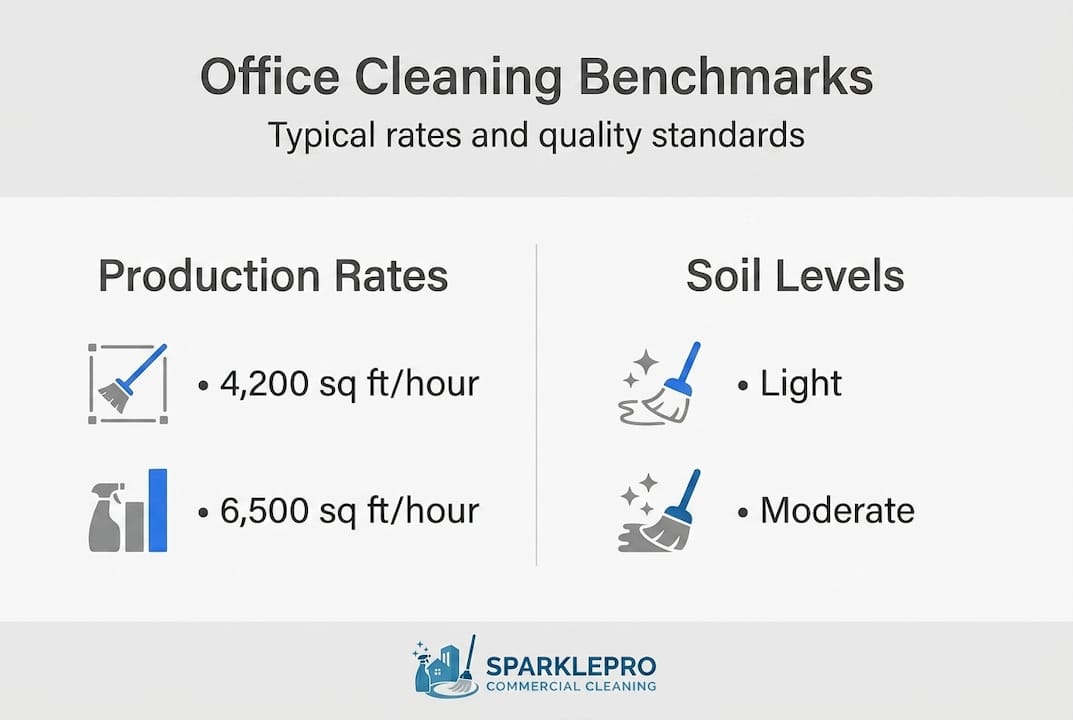
A production rate is simply the speed at which a trained cleaning professional can complete a specific task in a defined space. These rates vary significantly based on soil level, furniture density, and the type of surfaces involved. The ISSA 612 standard — developed by the International Sanitary Supply Association — compiles validated production rates across dozens of task categories. These rates are widely used in commercial cleaning contracts for staffing calculations, bid accuracy, and quality audits.
Here's a snapshot of common production rate benchmarks you'll want to reference when reviewing vendor bids:
| Cleaning area | Production rate (sq ft/hour) | Soil level |
|---|---|---|
| General office | 4,200 | Light to moderate |
| Restrooms | 1,000 | Heavy |
| Lobbies and common areas | 5,500 | Light |
| Corridors | 9,000 | Light |
| Conference rooms | 3,500 | Moderate |
These numbers matter because they directly influence how many labor hours a cleaning contractor should bill per square foot. If a vendor bids a 50,000 sq ft office building at rates that don't align with realistic production speeds, you're either overpaying or setting yourself up for under-serviced spaces.
Beyond production rates, the ISSA also defines Clean Levels — a scale from Level 1 (Orderly Spotlessness) to Level 5 (Unkempt Neglect). Most Class A office buildings should be maintained at Level 2, which is often described as "ordinary tidiness." Medical offices or facilities with high-profile client traffic may require Level 1.
Understanding cleaning terms for managers before you sign a contract gives you real negotiating power. Here's why these benchmarks prevent the two most common problems in facility management:
- Under-servicing happens when vendors submit low bids based on unrealistic production rates, then cut corners to stay profitable. You don't see it until occupant complaints start piling up.
- Over-servicing happens when a facility pays for more cleaning hours than the building actually needs, inflating costs without improving outcomes.
Pro Tip: When reviewing vendor proposals, ask them to show their labor hour calculations based on ISSA 612 benchmarks. If they can't, that's a red flag worth acting on.
Specifying ISSA Clean Levels in your service contract transforms cleaning quality from a subjective conversation into an auditable deliverable. It gives both parties a shared language and a clear line in the sand.
Understanding commercial cleaning cost structures
With standards set, managers also need clarity on how cleaning services are priced and contracted. The numbers can look confusing at first glance, but they follow a consistent logic once you understand what's driving them.

Commercial cleaning rates for general office spaces typically fall between $0.09 and $0.17 per square foot, depending on service frequency and building complexity. A 100,000 sq ft office tower cleaned five days a week will land near the lower end of that range due to economies of scale. A smaller, more complex facility with medical-grade requirements or specialty flooring will push toward the upper end.
Here's how most vendors calculate their pricing:
- Calculate total cleanable square footage. This excludes mechanical rooms, storage areas, and spaces that are cleaned less frequently.
- Assign production rates to each zone. Restrooms, lobbies, and open offices all move at different speeds.
- Estimate total labor hours per visit. Divide each zone's square footage by the applicable production rate.
- Apply labor cost. Multiply hours by local labor rates, including benefits and overhead (typically 30 to 40% above base wage).
- Add materials, equipment, and profit margin. Industry margins in commercial cleaning range from 10 to 15% for competitive markets.
Understanding this formula lets you evaluate whether a bid reflects genuine cost-of-service or whether someone is gaming the numbers. It also helps you use a solid commercial floor cleaning guide when factoring in specialty floor care costs.
The contract model you choose has a significant impact on your total cost and service flexibility. Here's a practical comparison:
| Contract model | How it works | Best for | Risk to watch |
|---|---|---|---|
| Fixed-price | Flat monthly fee for defined scope | Predictable budgets, stable occupancy | Vendor may cut effort to protect margin |
| Cost-plus | Manager pays labor and materials plus a fee | Transparent cost visibility | Can lead to billing creep if not monitored |
| Performance-based | Payment tied to measurable quality outcomes | Dynamic or hybrid-work environments | Requires strong audit processes |
Fixed-price contracts offer the most budget predictability. The downside is that the vendor's incentive to maximize profit can quietly erode service quality over time. Cost-plus contracts give you full visibility into what you're paying for, but they require active invoice review. Performance-based contracts align the vendor's financial interests with your quality expectations — they get paid when results meet standards.
For large multi-tenant office buildings or campuses with variable occupancy, performance-based contracts are increasingly the right call. Hybrid work patterns mean some floors are fully occupied Monday through Wednesday and ghost towns on Friday. A fixed-price contract doesn't account for that reality.
Choosing the right cleaning schedule for your facility
Pricing isn't the only variable — scheduling adapts to modern occupancy trends and facility needs in ways that most standard service agreements still haven't caught up with.
Effective cleaning schedules are not built around a calendar. They're built around your building's actual use patterns. The factors that should drive your schedule include:
- Occupancy levels. A 500-person headquarters needs different treatment than a 60-person satellite office.
- Building type. Healthcare, professional services, and corporate offices each carry different contamination risk profiles.
- High-use zones. Restrooms, break rooms, elevator banks, and reception areas accumulate soil faster than private offices.
- Climate and season. Buildings in rainy climates deal with floor contamination from tracked-in moisture that dry-climate facilities simply don't face.
The four main schedule types property managers should know:
- Static schedules. Fixed days and times, regardless of occupancy. Simple to manage but often wasteful or insufficient.
- Dynamic schedules. Cleaning frequency adjusts based on actual occupancy or sensor data. Common in smart buildings.
- Seasonal adaptation. Increased frequency during flu season, allergy season, or after weather events like heavy rain.
- Special disinfection cycles. Triggered by illness outbreaks, high-profile events, or regulatory requirements.
"Edge cases require real flexibility: hybrid work environments need dynamic scheduling rather than static day-based plans; high-traffic and medical facilities often require daily multi-cycle disinfection; buildings in rainy climates need frequent entry matting refreshes and floor drying protocols; and restrooms in high-use facilities typically require deep cleaning at least twice per week."
The best janitorial services examples show how facility type dictates scheduling far more than square footage alone. A 30,000 sq ft urgent care clinic needs more daily touchpoints than a 100,000 sq ft law firm occupied 9 to 5 on weekdays.
Pro Tip: If your building operates on a hybrid work model, negotiate a performance-based cleaning contract with flexible scheduling built in. Require that your vendor uses actual occupancy data, not just default day-of-week assumptions, to trigger cleaning visits. This alone can reduce unnecessary cleaning costs by 15 to 20% in low-occupancy periods.
The most overlooked scheduling mistake is treating all floors equally. High-traffic ground-floor lobbies may need twice-daily attention while upper-floor executive suites need only a thorough evening clean. Stratifying your schedule by zone is smarter, more cost-effective, and results in more consistent occupant satisfaction scores.
Quality control: Ensuring reliable and measurable results
Even with scheduling and pricing in place, quality assurance is essential to protect your reputation and your facility's health. A cleaning contract is only as good as the system you use to verify that the work is actually being done to standard.
Here's a practical, step-by-step quality control process that facility directors should implement:
- Define clean levels in the contract. Use ISSA Clean Level definitions so both parties know exactly what "clean" means.
- Conduct a baseline audit. Before service begins, document current conditions in each zone with photos and written notes.
- Schedule unannounced inspections. Regular surprise checks are the single most effective deterrent to performance drift.
- Use a standardized inspection checklist. Every zone, every task, scored consistently. This removes subjectivity from the conversation.
- Review inspection data monthly. Look for trends, not just incidents. A restroom that consistently scores lower on Thursday afternoons tells you something specific about occupancy timing.
- Hold quarterly performance reviews. Sit down with your vendor to discuss data, address gaps, and adjust the service plan as needed.
Specifying ISSA Clean Levels in your contract is the foundation of everything above. Without a shared standard, every quality conversation becomes a debate about subjective impressions.
Common pitfalls that trip up even experienced facility managers:
- Relying on complaint-based feedback. Most occupants don't report cleaning issues; they just form a negative impression of the building.
- Accepting the same scope for years without review. Building occupancy and use patterns change, and your cleaning scope should change with them.
- Skipping the baseline audit. Without documentation of starting conditions, it's nearly impossible to prove performance degradation over time.
- Using vague contract language. Terms like "clean restrooms daily" are unenforceable. "Maintain restrooms at ISSA Clean Level 2, including surface disinfection of all touchpoints, by 8:00 AM daily" is auditable.
- Not tracking labor hours against benchmarks. If your vendor is delivering 30% fewer labor hours than the ISSA 612 staffing benchmarks suggest for your facility, quality gaps are almost certainly present.
Pro Tip: Build a simple digital dashboard — even a shared spreadsheet works — that tracks inspection scores by zone over time. Patterns in the data will tell you exactly where and when service is slipping before occupants start to notice.
Quality control in cleaning is not about catching vendors doing something wrong. It's about building a system where doing the right thing consistently is the path of least resistance for everyone involved.
Why flexible contracts and measurable standards matter most
Here's the perspective that most facility management guides leave out: fixed-price cleaning contracts were designed for a world where offices were fully occupied Monday through Friday, 8 to 5, fifty weeks a year. That world is gone for most urban office markets.
Hybrid occupancy patterns have fundamentally changed the cost-benefit calculation for fixed-price agreements. When a vendor locks in a flat monthly rate against a scope built for full occupancy, and then your actual headcount drops 40% on Tuesdays and Fridays, you're paying full price for a fraction of the need. The vendor pockets the margin. Your budget absorbs the waste.
Performance-based contracts flip this dynamic. They're not perfect — they require more administrative overhead and a strong audit process. But they create a structure where the vendor's financial outcome is tied to measurable results, not just showing up. ISSA standards make this possible because they convert cleaning quality from a feeling into a number. A facility maintained at Level 2 across all audits is a verifiable, contractually enforceable fact.
The managers who get the best long-term results from their cleaning vendors are the ones who treat the relationship as a data-driven partnership, not a commodity transaction. Vendors who are held to ISSA benchmarks, inspected regularly, and included in quarterly planning conversations almost always outperform vendors who are simply told to "keep the place clean."
This is the practical foundation that protects your facility, your budget, and your professional standing.
Connect with trusted office cleaning partners
Ready to apply your knowledge? Finding professional partners who deliver on these cleaning standards makes all the difference for complex facilities.
At Sparkle Pro Commercial Cleaning, we work with property managers and facility directors who expect results they can measure. Our teams understand ISSA production benchmarks, offer flexible contract structures, and serve facilities across the country with regional expertise. Whether you're managing a multi-tenant office tower in California or a corporate campus in New York, we build cleaning programs around your actual occupancy patterns, not a generic template. Reach out for a site visit and customized scope — you'll walk away with a cleaning plan grounded in the same benchmarks and standards outlined in this guide.
Frequently asked questions
How often should offices be deep cleaned?
High-traffic offices typically need deep cleaning at least twice a week, but your facility's specific occupancy profile and zone usage patterns will determine whether more frequent cycles are warranted.
What is a production rate in commercial cleaning?
A production rate is the average speed at which a cleaning crew completes a specific task, such as cleaning 4,200 sq ft per hour in a general office environment, and it forms the basis for accurate labor hour and bid calculations.
How are cleaning rates calculated for offices?
Rates are typically calculated per square foot and determined by frequency, building complexity, and service specifics, with general office rates generally falling between $0.09 and $0.17 per square foot.
What does a performance-based cleaning contract mean?
A performance-based contract ties vendor payment to measurable cleaning outcomes rather than just task completion, making it ideal for facilities with dynamic hybrid occupancy that can't be served well by static fixed-price agreements.
What are ISSA Clean Levels and why should they be included in contracts?
ISSA Clean Levels are standardized quality metrics — ranging from orderly spotlessness to unkempt neglect — that give property managers auditable cleaning standards to include in contracts, turning subjective expectations into enforceable, measurable deliverables.