
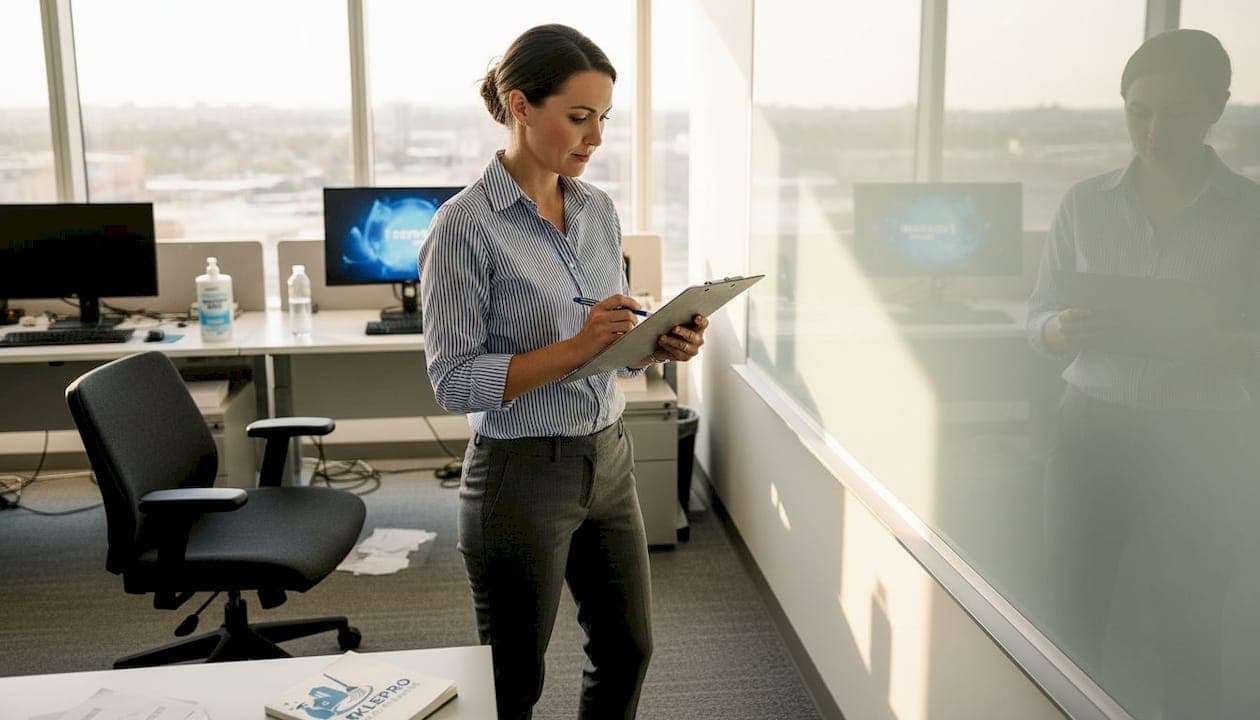
Choosing the wrong disinfecting service for your building is not just a hygiene problem. It is a liability. Facility directors managing office towers, healthcare clinics, or industrial plants face a fragmented market full of vendors making big promises and limited proof. With occupant health, regulatory compliance, and operational continuity all at stake, the decision deserves more than a quick price comparison. This guide walks you through a practical, evidence-backed framework for evaluating your options. From manual surface methods to advanced UV-C technology and team-based models, you will leave knowing exactly how to match a service to your facility's specific needs.
Table of Contents
- How to evaluate disinfecting services for commercial spaces
- Manual surface disinfection: Wipes, sprays, and fogging
- UV-C light, electrostatic spraying, and advanced methods
- Team cleaning and process-driven services for large facilities
- Which disinfecting service is right for your facility?
- What most guides miss about effective disinfecting services
- Connect with proven commercial disinfecting experts
- Frequently asked questions
Key Takeaways
| Point | Details |
|---|---|
| Match service to facility | The right disinfecting method depends on your building's function, size, and risk profile. |
| Check for EPA compliance | Always confirm your provider uses EPA-registered products and follows safety rules. |
| Technology brings value | Advanced methods like UV-C or electrostatic spraying can boost coverage but must fit your use case. |
| Team approach matters | Process-driven, team-based cleaning models deliver the most consistent results for large spaces. |
| Consult the experts | Partner with providers who guide, train, and adapt to your operational needs for maximum impact. |
How to evaluate disinfecting services for commercial spaces
Before you compare vendors or request proposals, you need a clear set of criteria. Not all disinfecting services deliver equal results, and a method that works for a corporate lobby may fail entirely in a sterile medical procedure room.
The most important baseline is regulatory compliance. EPA-registered disinfectants such as quats, bleach, hydrogen peroxide, and alcohol must be applied according to label-specified contact times to be effective. A vendor who rushes application or ignores dwell time is not providing disinfection. They are providing the appearance of it.
Beyond chemistry, you need to evaluate how a service fits into your operations. Downtime, staff exposure, and surface compatibility all matter just as much as kill claims on a spec sheet.
Here are the core factors to assess when evaluating any disinfecting service:
- EPA registration and label compliance for target pathogens
- Surface compatibility to prevent material damage over repeated applications
- Dwell or contact time required and whether your schedule supports it
- Occupant and staff safety profile, including ventilation needs
- Alignment with facility operations, including after-hours access or shift timing
- OSHA compliance for worker exposure to chemical agents
Once you understand compliant disinfectants and what those labels actually require, you will be better positioned to hold vendors accountable.
Pro Tip: Always request Safety Data Sheets (SDS) from any provider before signing a contract. If they hesitate, that hesitation tells you something important.
These criteria will shape every comparison you make going forward. Keep them as your filter as we work through each service type.
Manual surface disinfection: Wipes, sprays, and fogging
Manual disinfection remains the most widely used approach across commercial facilities, and for good reason. It is flexible, accessible, and produces visible results that staff and inspectors can confirm on-site.
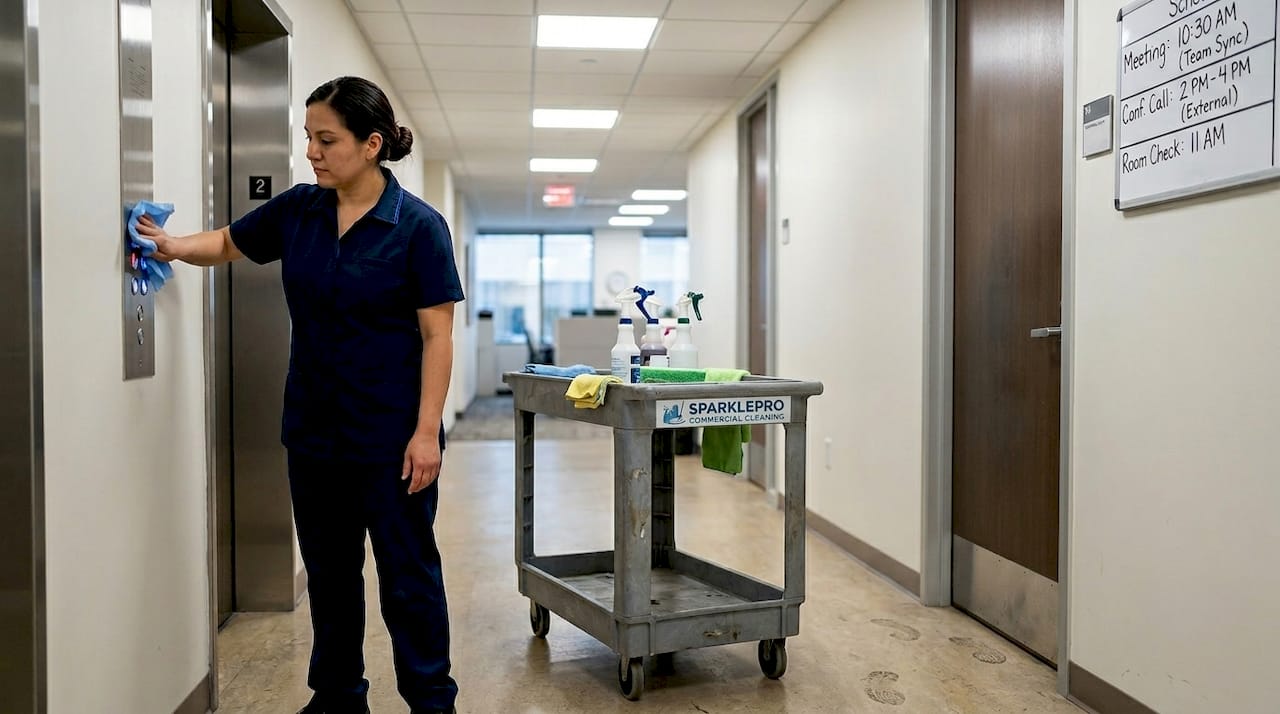
Wipes and sprays are best suited for targeted, high-touch surfaces: doorknobs, elevator buttons, shared keyboards, conference room tables, and restroom fixtures. They allow workers to control exactly where the product goes, which matters in spaces with sensitive equipment or mixed surface materials. For most office environments, a consistent wipe-down protocol using EPA-registered products covers the bulk of daily infection risk.
Fogging systems apply disinfectant as a fine mist across an entire room, reaching surfaces that manual wiping misses. However, fogging is less effective if there is visible soil or organic debris present. It should always follow a standard cleaning step, not replace it. Think of fogging as a finishing layer, not a standalone solution.
Hydrogen peroxide and alcohol are considered safer options and require one to ten minutes of contact time, making them realistic choices for facilities that need to minimize chemical exposure during occupied hours.
Comparison of common manual disinfectants:
| Disinfectant | Contact time | Surface compatibility | Safety profile |
|---|---|---|---|
| Quaternary ammonium (quats) | 1-10 min | Broad, avoid porous materials | Low toxicity, widely used |
| Bleach (sodium hypochlorite) | 1-10 min | Hard, non-porous surfaces only | Corrosive, ventilation required |
| Hydrogen peroxide | 1-10 min | Most hard surfaces | Low irritation, safe for most settings |
| Isopropyl alcohol | 30 sec - 3 min | Electronics, glass, metal | Flammable, avoid open flames |
Pros and cons of manual disinfection:
- Pros: Accessible tools, visual confirmation of coverage, lower cost, operator adaptability
- Cons: Labor-intensive at scale, prone to operator error, inconsistent dwell time compliance
Pro Tip: Always check that the disinfectant label specifically lists your target pathogen and the surface material you are treating. A product registered for hard surfaces will not perform the same on carpet or fabric.
For facilities that also manage hard floor maintenance, the discipline around commercial floor cleaning applies similar chemistry-to-surface matching logic and is worth reviewing alongside your disinfection protocol.
UV-C light, electrostatic spraying, and advanced methods
Technology-enabled disinfection methods have grown significantly in commercial use over the last several years. They offer coverage and speed advantages that manual methods cannot match at scale, but they come with tradeoffs worth understanding before you invest.
Electrostatic sprayers apply a charged mist that wraps around surfaces for uniform coverage, including undersides and curved areas. They reduce application time and chemical use compared to manual spraying, which makes them attractive for large open-plan offices or industrial facilities.
UV-C robots and portable units use ultraviolet light in the C spectrum to inactivate pathogens on surfaces and in air. They work best as a supplement to chemical disinfection, particularly in healthcare settings. However, UV-C for spores like C. difficile is inconsistent unless paired with bleach, and far-UVC technology is emerging as a safer option for use in occupied spaces.
"Far-UVC addresses the core limitation of conventional UV-C by operating at a wavelength that inactivates pathogens without penetrating human skin or eyes, making it viable for continuous use in occupied rooms."
Benefits and challenges of advanced disinfection methods:
- Benefits: Broad surface coverage, faster turnaround, minimal wet chemical residue, repeatable consistency
- Challenges: Higher equipment cost, staff training required, UV-C requires clear line of sight to be effective, some units still need rooms to be vacated
Comparison of disinfection methods:
| Method | Efficacy | Cost | Downtime needed | Best for |
|---|---|---|---|---|
| Manual spray/wipe | Targeted, operator-dependent | Low | Minimal | Offices, retail |
| Fogging | Broad, surface-dependent | Low-mid | Some ventilation time | Post-cleaning finishing |
| Electrostatic spray | Broad, consistent | Mid | Minimal | Large open spaces, industrial |
| UV-C light | High for bacteria/viruses | High | Full room vacancy | Healthcare, labs |
Team cleaning and process-driven services for large facilities
When your facility spans multiple floors, serves high daily traffic, or operates continuously across shifts, individual vendor visits are not enough. You need a structured, team-based service model with documented procedures and accountability built in.
Process-driven disinfection relies on standard operating procedures (SOPs), trained crews, and clearly defined zone assignments. Rather than one person cleaning everything, each crew member owns a specific task or area. This reduces overlap, eliminates gaps, and creates a traceable record of what was done and when.
Team-based cleaning with standardized times boosts efficiency in large facilities, which is why hospitals, schools, and high-traffic commercial spaces consistently default to this model over general janitorial contracts.
Typical stages in a process-driven disinfection service:
- Plan: Map zones, assign roles, confirm product and equipment readiness
- Assign: Brief each team member on their specific scope and SOP
- Execute: Apply disinfection according to dwell time and coverage requirements
- Validate: Conduct visual or ATP (adenosine triphosphate) testing to confirm surface cleanliness
Documentation at each stage is not optional. If a compliance audit occurs, your provider should be able to produce service logs, SDS records, and training certifications without delay.
"Standardized task assignment in team cleaning directly reduces error rates and creates measurable accountability across large building portfolios."
Building disinfecting steps into shift hand-offs is one of the most overlooked improvements a facility director can make. It ensures no surface in a high-risk zone goes unaddressed during transitions.
Pro Tip: Ask prospective providers for a sample zone assignment sheet and SOP before your first service. It reveals how organized and experienced the team actually is.
For facilities that also need guidance on larger-scale floor maintenance within team cleaning workflows, reviewing efficient team cleaning processes provides a useful reference.
Which disinfecting service is right for your facility?
With the main methods now clear, the next step is matching the right approach to your specific facility profile. No single method wins across all scenarios.
Quick-reference comparison by facility type:
| Method | Cost level | Speed | Safety | Best for |
|---|---|---|---|---|
| Manual wipe/spray | Low | Moderate | High | Offices, small retail |
| Fogging | Low-mid | Fast | Moderate | Post-cleaning, vacant spaces |
| Electrostatic spray | Mid | Fast | High | Open warehouses, large offices |
| UV-C light | High | Fast | Moderate (vacant rooms) | Healthcare, labs, isolation rooms |
| Team-based process | Variable | Scalable | High | Hospitals, schools, multi-floor buildings |
Scenario-based recommendations:
- Office buildings: Manual spray and wipe protocols for daily coverage, fogging for end-of-week deep disinfection
- Healthcare facilities: Combine UV-C with chemical disinfection and team-based documentation for regulatory compliance
- Industrial spaces: Electrostatic spraying works well for large machinery-heavy floor areas with minimal downtime
Signs your current service may need an upgrade:
- Staff or occupant complaints about odor, residue, or incomplete coverage
- Recent illness clusters traced to shared surfaces or HVAC-exposed areas
- Audit findings citing improper dwell time or missing SDS documentation
- Your facility has grown or changed use but your cleaning contract has not
Understanding industry cleaning terms will also help you evaluate contracts with more precision and catch vague language that leaves your facility underprotected.
Remember: the right chemistry is only half the equation. The process, training, and oversight behind it determine whether that chemistry actually works.
What most guides miss about effective disinfecting services
Most comparison guides focus entirely on products: which disinfectant kills which pathogen at what concentration. That is useful information, but it misses the real source of failure in most commercial disinfection programs.
In practice, the biggest risks are communication gaps and poor oversight, not chemical selection. A facility manager can specify a premium EPA-registered product and still see outbreaks because the vendor's crew skipped a zone, misread a dwell time, or was never retrained after staff turnover.
The providers who deliver consistent results over years are the ones who treat your facility as a partnership rather than a service ticket. They send trained supervisors, not just workers. They adapt protocols when your occupancy changes. They flag problems before you notice them.
Long-term disinfection reliability is built on communication, documentation, and mutual accountability. A contract that spells out exactly what gets done, when, and by whom is worth more than any product claim. When evaluating vendors, spend as much time reviewing their training programs and reporting structure as you do their chemical list.
Connect with proven commercial disinfecting experts
Implementing the right disinfection strategy for your facility does not have to be complicated, but it does require a partner who understands both the science and the operational realities of large-scale commercial environments.
Whether you manage a multi-floor office complex, a healthcare facility, or an industrial site, Sparkle Pro Commercial Cleaning provides fully licensed and insured disinfecting services built around your specific compliance and coverage needs. Our teams operate across the country, with dedicated service coverage for California disinfecting services and New York disinfecting services. Wherever your properties are located, our nationwide commercial cleaning platform connects you with experienced crews who document every service and adapt to your schedule.
Frequently asked questions
What is the safest disinfectant for offices?
Hydrogen peroxide and alcohol based EPA-registered disinfectants are considered among the safest options and remain effective with a contact time of one to ten minutes, making them practical for occupied office settings.
Is UV-C light reliable for disinfecting healthcare spaces?
UV-C can significantly reduce microbial load, but UV-C for spores such as C. difficile is inconsistent unless combined with bleach, and far-UVC is the safer choice for rooms that cannot be fully vacated.
How do team cleaning services improve facility hygiene?
Team-based cleaning uses standardized times and task-specific role assignments to increase efficiency and eliminate coverage gaps, especially in large or multi-zone commercial buildings.
What factors should I consider when selecting a disinfecting service?
Prioritize EPA registration, occupant safety, application methods suited to your surfaces, realistic turnaround time, and the provider's documentation of OSHA compliance.
How often should commercial spaces be disinfected?
Frequency depends on occupancy and risk level, but high-touch surfaces in active commercial spaces should receive disinfection daily, and high-traffic healthcare or industrial zones may require between-shift protocols.