
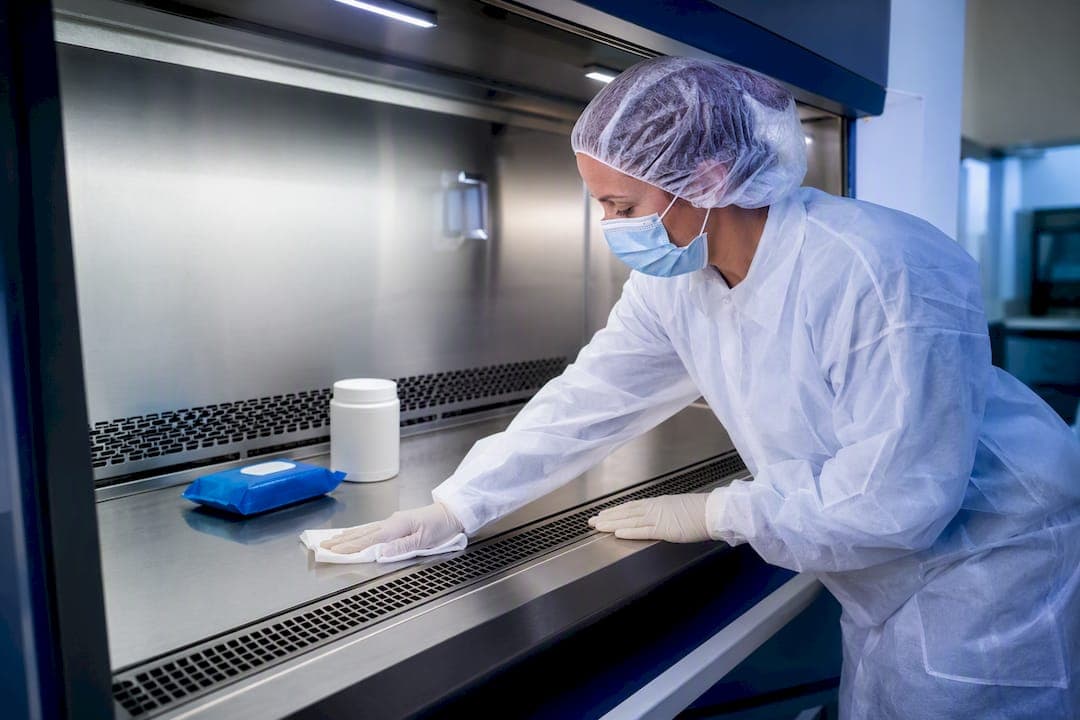
USP 797 requires daily cleaning of counters and floors on compounding days, monthly disinfection of walls, ceilings, and shelving, and sterile 70% isopropyl alcohol for wiping down primary engineering controls before each batch and at least every 30 minutes during continuous compounding. A sporicidal disinfectant must be applied at least monthly. Every one of these actions must be documented in a written SOP, backed by training records that prove your staff actually knows how to do it.
TL;DR:
- Disinfectants used inside the PEC must be sterile, and surfaces should be wiped with sterile 70% IPA every 30 minutes during continuous compounding.
- Monthly sporicidal disinfectant application is required for classified areas, followed by a sterile IPA wipe within the PEC to remove residue.
- Cleaning logs must be detailed, timestamped, and linked to specific shifts or batches to withstand audit scrutiny.
- Any positive environmental culture or visible soil inside classified areas requires immediate cleaning, documentation, and retesting before resuming work.
- Outsourcing cleaning to trained vendors can enhance compliance, ensure consistent documentation, and reduce operational disruptions during staff shortages.
Table of Contents
- What Are the USP 797 Cleaning Requirements? A Quick Compliance Checklist
- Cleaning Frequencies, Agents, and Contact Times You Need in Your SOPs
- PEC Cleaning and Disinfection: The Rules That Protect Sterility Most Directly
- Choosing the Right Cleaning Supplies, Tools, and PPE
- Building SOPs, Documentation, and Training Records That Survive an Audit
- Environmental Monitoring, Certification, and What to Do After a Failed Result
- A Practical Cleaning Workflow That Keeps Your SOPs Alive Day to Day
- Why Documentation Beats Ad-Hoc Cleaning Every Time
- How Sparkleprocommercialcleaning Supports Audit-Ready USP 797 Cleaning Programs
- Sources
What Are the USP 797 Cleaning Requirements? A Quick Compliance Checklist
Before diving into schedules and agents, run your facility against this list. If you can't check every box today, you have a gap that an inspector will find before you do.
- Documented SOPs exist for every surface and zone — PEC, counters, floors, walls, ceilings, and shelving each need a written procedure specifying method, agent, and frequency, per General Chapter <797>.
- PEC disinfection logs are current — every wipe-down of the primary engineering control (the ISO Class 5 hood or isolator) should be timestamped and tied to a specific batch or shift.
- Staff training and competency records are on file — anyone who cleans a classified area, even someone who only restocks supplies outside the PEC, needs documented training under the chapter's scope.
- Cleaning supplies used inside the PEC are sterile — wipers, mop heads, and disinfectants that touch the hood interior cannot be pulled from a general janitorial closet.
- Garbing matches the task — cleaning personnel working inside classified areas follow the same hygiene and garbing rules as compounding staff.
Cleaning duties inside the buffer room and PEC should fall to trained pharmacy technicians or dedicated environmental services staff who have completed compounding-specific garbing and competency checks, not general janitorial staff working without that training. Outside the classified area, in areas like waiting rooms or administrative offices, a standard cleaning crew is fine.
A few triggers should send you into corrective-action mode immediately: a positive environmental culture, visibly soiled surfaces inside a classified area, a failed recertification, or a disinfectant applied past its labeled contact time. Any of these means you stop, document the deviation, remediate, and retest before compounding resumes. Waiting until the next scheduled audit to address a positive culture is one of the fastest ways to turn a fixable issue into a shut-down order.
Cleaning Frequencies, Agents, and Contact Times You Need in Your SOPs
USP 797 draws a hard line between three distinct actions: cleaning (removing visible soil and debris), disinfecting (killing vegetative organisms), and sporicidal application (killing bacterial spores that ordinary disinfectants miss). Confusing these three in your SOP is one of the most common citation triggers auditors report.
Cleaning physically removes dirt, dust, and residue, usually with a detergent. Disinfecting follows cleaning and targets bacteria, fungi, and viruses using an EPA-registered agent or sterile 70% isopropyl alcohol. Sporicidal disinfection is a separate, stronger step aimed specifically at spore-forming organisms like Clostridioides difficile and Bacillus species, which survive standard disinfectants. Sterile 70% IPA is a sanitizing and disinfecting agent, not a sporicide, according to the USP <797> FAQs — a distinction that trips up a surprising number of facilities that assume IPA covers everything.
The chapter's minimum frequencies break down by surface type:
| Surface or area | Minimum cleaning frequency | Typical agent |
|---|---|---|
| PEC interior (ISO Class 5) | Before each batch; every 30 min during continuous compounding | Sterile 70% IPA |
| PEC interior (sporicidal step) | At least monthly | EPA-registered sporicidal disinfectant, followed by sterile IPA wipe |
| Counters and easily cleanable work surfaces | Daily on compounding days | EPA-registered disinfectant or sterile IPA |
| Floors (buffer room, anteroom, segregated compounding area) | Daily on compounding days | EPA-registered disinfectant |
| Sinks (where present in anteroom) | Daily on compounding days | EPA-registered disinfectant |
| Walls, ceilings, and storage shelving in classified areas | Monthly | EPA-registered disinfectant |
| Ceilings specifically | Monthly, or immediately if visibly soiled or contamination is suspected | EPA-registered disinfectant |
These frequencies come from the USP <797> FAQs and are echoed in practical cleanroom guidance from Wolters Kluwer, which also confirms the ceiling exception: you don't have to touch ceilings monthly if they show no visible soil and no contamination is suspected, unless your own SOP sets a stricter standard. Once you write that stricter standard into your SOP, though, you're bound to it. Auditors check the SOP against your logs, not against the chapter's floor.
Choosing between an EPA-registered one-step disinfectant and a sterile agent comes down to location and task. Outside the PEC, on counters, floors, and shelving, a standard EPA-registered disinfectant does the job. Inside the PEC, every agent that touches the work surface has to be sterile, because that surface is where you're compounding sterile preparations. Some facilities simplify their protocol by choosing a single EPA-registered one-step sporicidal disinfectant that handles both disinfection and sporicidal duty in one pass, but that shortcut still requires documented validation that the agent is compatible with your PEC surfaces and your compounded preparations.
After any sporicidal application inside the PEC, you're required to follow up with sterile 70% IPA to wipe away residue before compounding resumes. Skipping that step leaves disinfectant residue on a surface where sterile preparations are about to be made, which is its own contamination risk.
PEC Cleaning and Disinfection: The Rules That Protect Sterility Most Directly
The primary engineering control is where the sterility of everything you compound actually gets decided, and USP 797's rules here are the least forgiving in the whole chapter.
Sterile 70% IPA has to touch every horizontal PEC surface at the start of each shift, before compounding each new batch, and at intervals no longer than 30 minutes throughout continuous compounding, according to guidance on cleanroom cleaning and maintenance. If a single compounding run stretches past that 30-minute window without a break, you disinfect again immediately once the run ends, rather than waiting for the next scheduled interval. This isn't a suggestion buried in a footnote. It's the mechanism that keeps airborne and surface contamination from accumulating during a long compounding session.
Every cleaning agent, disinfectant, and sporicidal product used inside the PEC must be sterile, full stop. That includes the wipers and mop heads themselves, not just the liquid you're applying. The USP <797> FAQs draw one useful exception here: tool handles and holders don't have to be sterile, but they do need to be cleaned and disinfected before they enter the PEC. So a mop handle can come from general inventory as long as it's wiped down first; the mop head that actually contacts the hood surface has to arrive sterile from the package.
Spills and visible contamination inside the PEC demand an immediate, out-of-sequence response, not a note for the next shift. The moment you spot a spill or suspect contamination, stop active compounding in that zone, clean and disinfect the affected surface following your SOP's spill procedure, and document what happened, when, and how it was resolved. If the spill involved a hazardous drug, your response also has to follow your facility's hazardous-drug spill kit procedure, which typically adds containment steps and specific PPE beyond what a routine spill requires. Either way, the area doesn't go back into service until it's been recleaned, redisinfected, and, if the contamination was significant, until you've confirmed through visual inspection or sampling that the surface is fit for use again.
Hazardous compounding environments carry an added layer on top of everything above. Because hazardous drug residue itself poses a contamination and exposure risk, cleaning agents and procedures for those PECs often need to address deactivation and decontamination of drug residue in addition to microbial disinfection, and the PPE for staff performing that cleaning steps up accordingly. Non-hazardous PECs don't carry that residue-deactivation burden, but every sterility rule above still applies equally to both.
Choosing the Right Cleaning Supplies, Tools, and PPE
Material choice matters more in a classified area than almost anywhere else in a facility, because the wrong wiper can introduce more contamination than it removes.
USP 797 guidance consistently points toward low-lint, nonporous, silicone-free consumables, with disposable versions preferred inside the PEC specifically. Porous materials, like a wood-handled brush or a cotton mop head, shed particles and harbor moisture where organisms can grow, which is exactly what a classified environment is designed to prevent. Disposable wipers solve that problem outright: use once, discard, no laundering cycle that could reintroduce contamination.
Tool dedication by area is one of the simplest controls to implement and one of the easiest to get wrong. A mop that touches the anteroom floor should never touch the buffer room floor, and neither should ever cross into the PEC. The Wolters Kluwer cleanroom guidelines recommend color-coding or labeling tools by zone so there's no ambiguity about which mop belongs where, paired with unidirectional cleaning that always moves from the cleanest area toward the least clean. That means the PEC gets attention before the buffer room, the buffer room before the anteroom, and the floor gets mopped from the point farthest from the door toward the exit, never the reverse.
Garbing rules for cleaning personnel mirror the rules for compounding personnel in the same space. Anyone entering a classified area to clean, whether they're wiping down a hood or restocking supplies on a shelf, follows the same gowning, gloving, and hand hygiene sequence as the pharmacist preparing the next batch. This applies even to staff who never touch the PEC directly. The chapter's scope covers all persons in all places where compounded sterile preparations are made, according to General Chapter <797>, and that includes the person who only enters to swap out a trash liner in the anteroom.
Building SOPs, Documentation, and Training Records That Survive an Audit
Every cleaning action described above only counts if it's written down, and written down in a way that connects the action to a specific person, place, and time.
A defensible cleaning SOP names the approved agent for each surface, states the exact frequency and required contact time, describes the tool-handling procedure (dedication, unidirectional technique, disposal), and spells out what happens to an opened sterile supply that isn't fully used, whether it gets discarded at end of shift or has an approved reuse window. The ASHP standard operating procedure guidance treats this level of specificity as the baseline, not the ideal, and auditors focus as much on whether your documented evidence matches your stated procedure as they do on the cleaning itself.
Your log design matters more than most facilities realize. A strong log timestamps each cleaning action and links it to a specific shift or batch number, so an inspector can trace any compounded preparation back to the exact disinfection cycle that preceded it. Some facilities add a photo or scan step, snapping a quick image of a cleaned surface or a completed checklist, which creates a visual record alongside the written one. Retention policy should match your facility's broader compounding record retention period, since a cleaning log with no retention rule is functionally useless the day an inspector asks for six-month-old records.
Training isn't a one-time event. Initial competency checks establish a baseline when someone joins the cleaning team, but ongoing verification, typically annual, confirms that technique hasn't drifted. If a competency check fails or a cleaning-related noncompliance surfaces, document the specific gap, the retraining provided, and the date of successful reassessment. That remediation record is often the single piece of paperwork that convinces an inspector a lapse was isolated rather than systemic. For a deeper look at building this kind of paper trail, see why documentation in cleaning services matters.
Environmental Monitoring, Certification, and What to Do After a Failed Result
Cleaning and monitoring are two halves of the same compliance obligation. One reduces contamination; the other proves the reduction actually worked.
ISO Class 5 primary engineering controls need periodic certification, typically performed by a qualified third-party technician who verifies airflow, particle counts, and physical integrity of the hood or isolator. Between certifications, ongoing environmental monitoring fills the gap using three main methods: total air particle counts, viable air organism counts measured in colony-forming units (CFU), and surface sampling using RODAC contact plates pressed directly onto a work surface. Together, these tell you not just whether the air is clean, but whether your cleaning and disinfection routine is actually killing what lands on your surfaces.
The threshold for a failing result is stricter than many facilities assume. Recovery of even a single CFU of an epidemiologically significant pathogen, meaning an organism with known potential to cause serious infection, triggers immediate remediation according to guidance from PDI Healthcare on cleaning and disinfection updates. That's not a statistical threshold you average over a monitoring period. It's a one-and-done trigger.
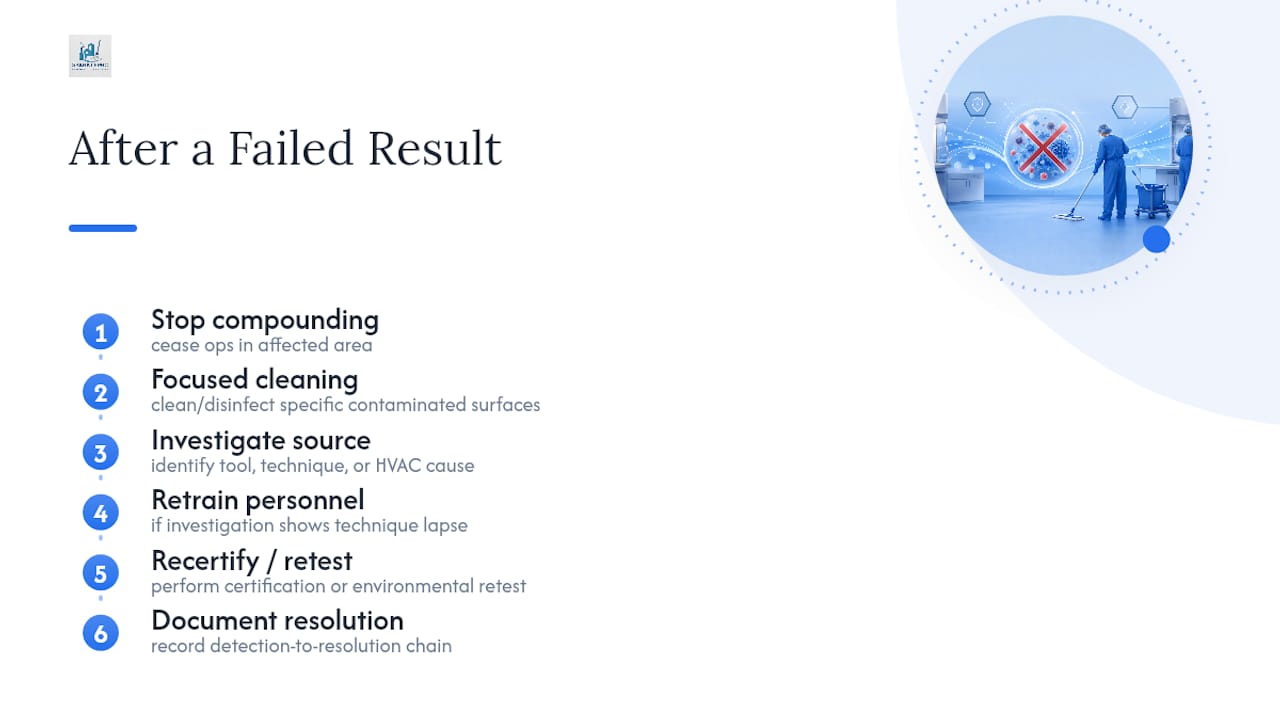
When a sample comes back positive or a certification fails, the sequence is the same every time: stop compounding in the affected area, perform focused cleaning and disinfection targeting the specific surfaces involved, investigate the likely source (a tool, a technique lapse, an HVAC issue), retrain the personnel involved if the investigation points to technique, and retest before resuming operations. Recertification after a failed result isn't optional, and neither is documenting the entire chain from detection to resolution. That documentation is often what separates a facility that handles an excursion well from one that gets flagged for a pattern of unaddressed contamination events.
A Practical Cleaning Workflow That Keeps Your SOPs Alive Day to Day
A written SOP that nobody follows consistently is worse than no SOP at all, because it creates a paper trail proving you knew the standard and missed it. Turning the chapter's requirements into a daily rhythm is what actually keeps a facility compliant between audits.
- Start of shift: Wipe the PEC interior with sterile 70% IPA before any compounding begins, and confirm the previous shift's sporicidal log shows the last monthly application within window.
- Before each batch: Reapply sterile IPA to PEC surfaces, even if the same technician just finished the prior batch minutes earlier.
- Every 30 minutes during continuous compounding: Reapply sterile IPA to horizontal PEC surfaces without pausing the compounding queue longer than necessary.
- End of compounding day: Clean counters, floors, and sinks in the anteroom and buffer area with an EPA-registered disinfectant, and log the completion.
- Weekly: Rotate dedicated cleaning tools for inspection and replace any showing wear, particularly mop heads and wipers assigned to the buffer room.
- Monthly: Apply sporicidal disinfectant throughout classified areas, follow with a sterile IPA wipe in the PEC to clear residue, and clean walls, ceilings, and shelving.
- On any deviation: Document the event, execute the spill or contamination SOP, and flag the batch or shift for supervisor review before resuming.
Two operational habits catch problems before they become citations. First, check supplier specification sheets for every sterile consumable before it enters inventory, confirming sterility claims and expiration dates rather than assuming a new case matches the last one. Second, schedule cleaning windows around compounding demand rather than against it. If your busiest compounding hours run mid-morning, don't schedule the monthly sporicidal application for that window and expect staff to rush it.
Pro Tip: Keep a small dedicated supply kit inside or immediately outside each classified area, stocked with sterile wipers and IPA specific to that zone, so nobody has to leave the buffer room mid-shift to hunt for supplies and risk tracking contamination back in.
Verifying dwell time in practice, not just on paper, matters more than most SOPs acknowledge. A disinfectant labeled for a two-minute contact time does nothing useful if staff wipe it dry after fifteen seconds. Build a visible timer or checklist step into the procedure itself rather than trusting memory. For facilities scaling this across multiple zones, a maintenance cleaning schedule built around daily, weekly, and monthly tiers keeps the whole program from collapsing into ad-hoc effort during busy weeks.
Why Documentation Beats Ad-Hoc Cleaning Every Time
The facilities that struggle most with USP 797 rarely have a dirty PEC. They have an undocumented one. Inspectors can't verify a clean hood retroactively, but they can verify a log, and a facility with three months of timestamped, batch-linked cleaning records walks into an inspection in a completely different position than one relying on staff memory of "we always wipe it down."
Consistent, written cleaning programs also cut down on operational disruption in ways that don't show up until you compare a facility that has one against a facility that doesn't. When a key technician calls in sick, a documented SOP means the substitute knows exactly which agent, which frequency, and which technique to use without a scramble. When staffing gaps hit, and they will, a facility running on institutional memory alone loses continuity fast. One built on a written, trained, and logged program barely notices the gap.
The gap between what most facilities intend to document and what they actually produce during an inspection is often the real compliance risk, more than any single missed cleaning cycle. A vendor-supported program, where an outside cleaning partner brings its own trained crews and standardized logging, tends to close that gap faster than internal teams juggling cleaning duties alongside compounding responsibilities. If your facility is weighing whether a vendor relationship makes sense, a site visit conversation is usually more useful than trying to solve the documentation gap alone.
— Sales
How Sparkleprocommercialcleaning Supports Audit-Ready USP 797 Cleaning Programs
Specialized commercial cleaning services can help healthcare facility managers outsource cleaning execution while maintaining documentation responsibilities. Using crews already familiar with scheduled cleanroom and sterile-area work, paired with checklist-based logging designed to hold up under inspection, can alleviate the need to train internal janitorial staff from scratch or scramble during staff absences.
This approach can help maintain monthly sporicidal applications, daily counter and floor cleaning, and PEC wipe-down schedules consistently during staffing gaps, reducing the internal training burden for specialized cleaning competencies. Facility teams that have leaned on terminal cleaning practices for periodic deep cleans already understand the value of a crew that shows up trained rather than one that needs onboarding every time.
If you manage a compounding facility in Massachusetts and want a vendor quote or site visit built around your current SOPs, request cleaning services in Massachusetts to get a specific scope and schedule for your facility.
Sources
Your SOPs should cite the chapter itself, not a summary of it. Keep General Chapter <797> and the USP <797> FAQs on hand as your primary citations, since both directly address sterile-agent rules and frequency requirements inspectors will reference. The ASHP list of standard operating procedures is worth keeping as a template reference when drafting or revising your own SOP language. For practical technique explainers to hand new staff during training, the cleanroom cleaning guidance for facility managers translates the chapter's requirements into day-to-day steps.
This article is general information, not a substitute for advice from a qualified doctor. Consult a qualified healthcare professional about your own circumstances before acting on anything here.
- USP <797> FAQs (December 2023)
- General Chapter <797> - USP Compounding Standards
- USP 797 List Of Standard Operating Procedures | ASHP
- 7 USP 797 Clean Room Guidelines You Need to Know | Wolters Kluwer