

Documentation in cleaning services is the verifiable record that cleaning tasks were completed correctly, on schedule, and by the right personnel. Without it, you have no proof that your facility met its cleaning standards, no defense against liability claims, and no mechanism for catching quality failures before they become costly problems. For property managers and facility directors, cleaning documentation — formally called cleaning records or cleaning logs — is the operational backbone of any quality assurance program. Tools like JM Connect, SafetyCulture, and structured SOPs turn scattered cleaning activity into traceable, auditable evidence.
Why documentation in cleaning services is the foundation of accountability
Cleaning records serve a function that goes far beyond paperwork. A cleaning log is a foundational safety protocol that records inspection intervals, observed conditions, and cleaning actions taken. That record becomes your operational proof when a client questions service quality, when a regulator requests evidence of compliance, or when an incident triggers a legal review.
The core value of documentation is traceability. Regulators seek traceability, not just tidy logs. Auditors want to know who cleaned a specific area, when they cleaned it, what product they used, and whether the correct contact time was observed. A well-organized binder of logs that omits those details provides almost no protection. A complete, timestamped record with operator identification and disinfectant lot numbers provides substantial protection.
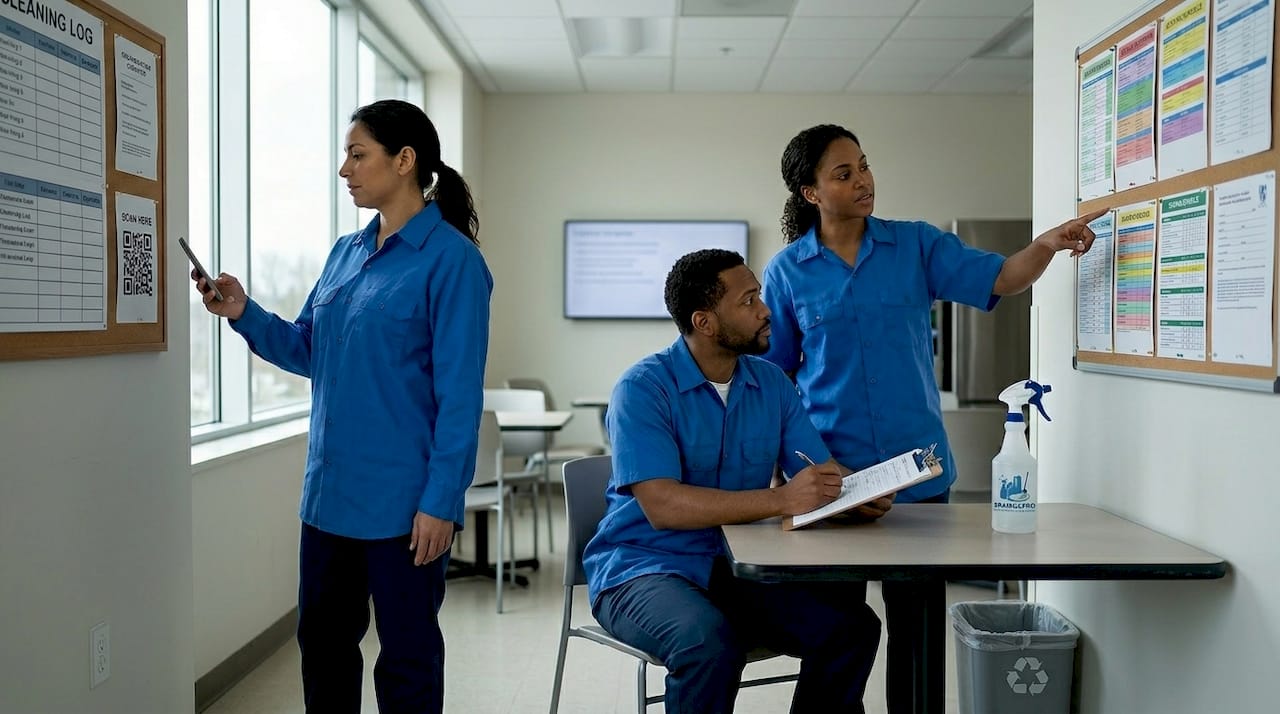
For commercial facilities, this distinction matters in practical terms. A retail center, office building, or healthcare facility that cannot produce traceable cleaning records during an audit or incident investigation is in a far weaker position than one that can pull up a full cleaning history within minutes. Documentation is not a bureaucratic exercise. It is the mechanism that converts cleaning activity into verifiable operational performance.
What effective cleaning documentation must include
Effective cleaning records require specific data points to be compliant and defensible. GMP-compliant documentation must include the date and time of each cleaning activity, the operator's identity, the specific surfaces or areas cleaned, the disinfectant name and concentration, the lot number, the required contact time, the cleaning method or sequence used, and any deviations from the standard operating procedure.
For commercial property managers, the following elements form a complete cleaning documentation package:
- Date, time, and operator ID for every cleaning task performed
- Specific areas and equipment covered in each session
- Disinfectant details: product name, concentration, lot number, and contact time
- Cleaning sequence or method used, referenced against the validated SOP
- Verification steps: secondary review or supervisory sign-off
- Deviations or corrections: any departure from the standard procedure, with explanation
Incomplete documentation creates audit risk equivalent to incomplete cleaning. Missing signatures, absent contact times, or late entries can lead auditors to question whether cleaning was performed at all, regardless of actual cleaning quality. This is the critical insight most facility managers miss: the record is the proof, and a flawed record undermines the work it is supposed to represent.
Pro Tip: Design your cleaning log templates to mirror your validated SOPs field by field. If your SOP requires a 10-minute contact time for a specific disinfectant, the log should have a dedicated field for that contact time. Alignment between your SOP and your log eliminates the most common documentation gaps.
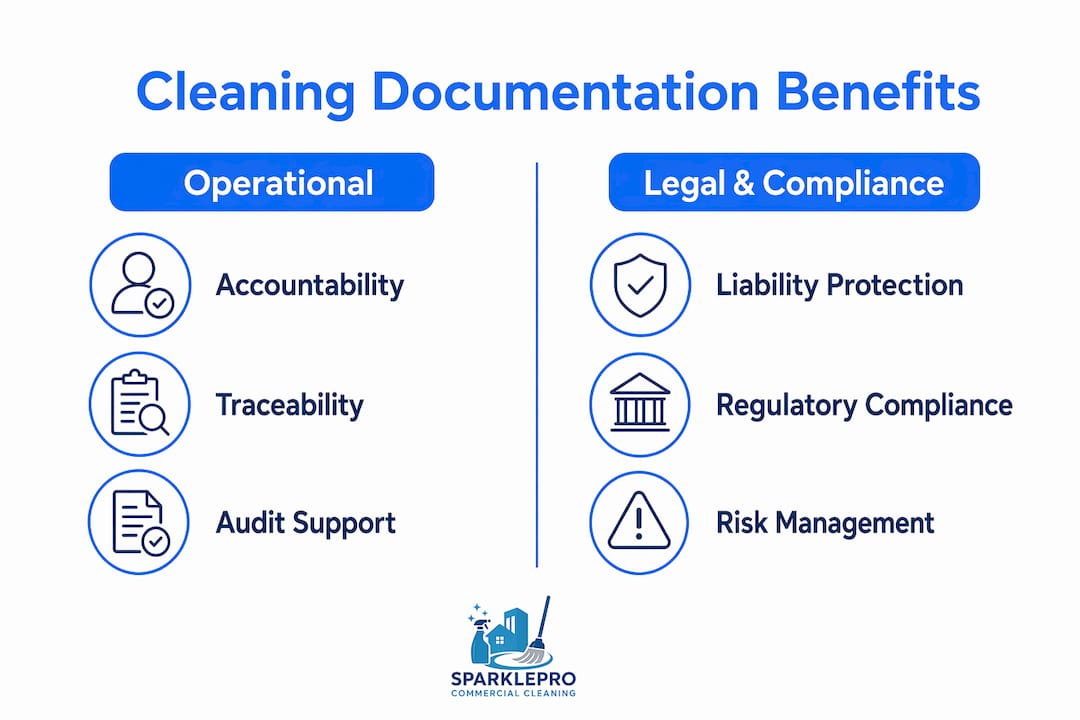
Common failures auditors flag include missing operator signatures, entries completed after the fact rather than in real time, disinfectant lot numbers left blank, and contact times recorded as a range rather than a specific duration. Each of these gaps signals to an auditor that the documentation process is not integrated into the cleaning workflow.
How cleaning documentation supports compliance audits and risk management
Proper cleaning records serve three distinct risk management functions: they support regulatory compliance, they enable internal quality oversight, and they provide legal defensibility.
On the compliance side, cleaning validation requires written procedures, defined acceptance criteria, and documented results to satisfy CGMP standards and demonstrate contamination control to regulators like the FDA. Even in non-pharmaceutical commercial settings, the principle applies. A facility that can show documented evidence of consistent cleaning practices is far better positioned during any third-party audit than one relying on verbal assurances.
"Strong cleaning documentation enables internal quality oversight, trend analysis, deviation tracking, and supports environmental monitoring investigations." — VibraClean
This internal oversight function is where documentation delivers ongoing operational value. Logs help identify operator or shift-specific issues linked to contamination incidents and track whether disinfectant rotation is working as intended. If a particular zone consistently shows contamination findings, your cleaning records can tell you whether the issue is a product problem, a method problem, or a specific operator's execution. Without records, you are guessing.
The legal defensibility function is equally concrete. Cleaning logs establish timelines used in slip-and-fall liability defense by showing the last documented inspection time versus the time of an incident. A log entry showing an inspection at 2:30 p.m. and an incident at 2:47 p.m. can support a claim that reasonable care was exercised. The absence of any log entry for that period makes the same defense nearly impossible. For property managers overseeing high-traffic retail or office spaces, this timeline function alone justifies the investment in consistent cleaning records.
You can read more about how cleaning supports commercial properties and the documentation practices that underpin those benefits.
Digital versus paper: which cleaning documentation system works better?
The choice between digital and paper-based cleaning records is not purely a technology preference. It has direct consequences for audit readiness, record accuracy, and long-term defensibility.
| Factor | Digital systems | Paper logs |
|---|---|---|
| Timestamp accuracy | Automatic, system-generated | Manual entry, prone to after-the-fact completion |
| Operator accountability | Unique login IDs tied to each entry | Handwritten signatures, harder to verify |
| Audit retrieval speed | Searchable within seconds | Manual search through physical files |
| Record durability | Cloud-stored, survives turnover and site changes | Risk of loss, water damage, or illegibility |
| Cross-site consistency | Syncs across multiple locations automatically | Requires manual aggregation |
| Implementation cost | Requires software and training investment | Low upfront cost, high long-term risk |
Digital records survive staff turnover, sync across multiple sites, and remain searchable when you need to pull records for an audit or incident review. Paper logs carry the opposite risk profile: they are cheap to start but expensive to manage and nearly impossible to search efficiently at scale.
Tools like JM Connect use timestamped entries and unique operator IDs to associate every cleaning action with a specific person and time. Scan4Clean uses QR scanning to log area-specific cleaning in real time. Digital documentation enhances accountability by associating operator IDs with cleaning records, making shift transitions and supervisor reviews more effective. SafetyCulture provides mobile-based checklists that integrate cleaning logs with incident reporting, giving facility directors a single platform for both operational records and compliance documentation.
The transition from paper to digital does require staff training and a period of adjustment. The practical recommendation for most commercial facilities is to pilot a digital system in one building or zone, measure the improvement in record completeness, and then scale. The audit and liability benefits materialize quickly once records are consistently complete and retrievable.
How to implement effective cleaning documentation practices
Implementing a documentation system that actually works requires more than distributing log templates. It requires a structured approach that connects records to SOPs, training, supervision, and continuous improvement.
- Develop standardized log formats that mirror your validated cleaning SOPs field by field. Every required SOP element should have a corresponding log field.
- Train cleaning staff on real-time documentation. Entries completed after the fact are a primary audit risk. Staff must understand that the log is part of the cleaning task, not a separate administrative step.
- Incorporate supervisory review into your weekly schedule. A supervisor who reviews logs regularly catches gaps before they accumulate into audit findings.
- Use checklists and digital tools to enforce completeness. A digital form that cannot be submitted without all required fields completed eliminates the most common documentation failures.
- Establish a retention policy aligned with your legal and regulatory obligations. Many commercial facilities retain cleaning records for a minimum of two years. Healthcare and food service environments may require longer retention.
- Link documentation to performance reviews. If a cleaner's records are consistently incomplete, that is a performance issue, not just a paperwork issue. Treating documentation quality as a measurable performance metric changes behavior.
- Conduct trend analysis quarterly. Review your logs for patterns: recurring deviations, specific areas with repeated issues, or shifts with lower documentation quality. This analysis turns your records into a continuous improvement tool.
Pro Tip: When evaluating cleaning contracts, require vendors to provide sample documentation templates and explain their supervisory review process. A vendor who cannot describe their documentation practices clearly is a vendor whose records will not hold up under scrutiny. See our guide on evaluating cleaning contracts for a full framework.
For post-construction environments, documentation takes on additional complexity. The post-construction cleaning process involves multiple phases and handoffs, each requiring its own traceable record to confirm that each phase was completed before the next began.
Key takeaways
Cleaning documentation is the operational proof that your facility's cleaning standards are being met consistently, and without it, compliance, accountability, and liability defense all fail simultaneously.
| Point | Details |
|---|---|
| Documentation is proof, not paperwork | Records convert cleaning activity into verifiable evidence for audits and legal defense. |
| Traceability beats tidiness | Auditors prioritize who, when, what, and how over organized-looking but incomplete logs. |
| Digital systems outperform paper | Timestamped, searchable digital records reduce audit risk and survive staff turnover. |
| Incomplete records equal incomplete cleaning | Missing fields or signatures can invalidate an otherwise compliant cleaning operation. |
| Documentation drives improvement | Trend analysis of cleaning logs identifies shift, operator, and area-specific quality issues. |
The case for treating documentation as a management discipline
I have reviewed cleaning programs at commercial facilities where the physical cleaning quality was genuinely excellent, and the documentation was a disaster. Logs were filled in at the end of shifts, signatures were missing, and disinfectant lot numbers were never recorded. When those facilities faced audits or incident reviews, the quality of the actual cleaning was irrelevant. The records told a different story, and that story was the one that mattered.
The most common mistake I see property managers make is treating documentation as the cleaning vendor's responsibility alone. It is not. Documentation is a shared accountability system. The vendor executes and records. The property manager reviews, audits, and enforces standards. When that review function is absent, documentation quality degrades within weeks.
The facilities that handle audits and liability situations best are the ones where documentation is treated as a management discipline, not a clerical task. They have retention policies. They conduct quarterly log reviews. They tie documentation quality to vendor contract renewals. That approach is not excessive. It is what separates facilities that pass audits from those that scramble to explain gaps.
The future of cleaning documentation is moving toward automation: digital platforms that generate records automatically from sensor data, QR-based area logging, and integration with building management systems. Getting your documentation practices right now positions your facility to adopt those tools without rebuilding your entire records infrastructure from scratch.
— Sales
Sparkleprocommercialcleaning: documented cleaning you can verify
Sparkleprocommercialcleaning delivers commercial cleaning services built around accountability, not just activity. Every service includes structured record-keeping practices that give property managers the documentation they need for audits, client reporting, and liability defense.
Sparkleprocommercialcleaning operates across Delaware, Massachusetts, Washington, South Carolina, and New Jersey, serving office buildings, retail centers, healthcare facilities, and industrial spaces. Whether you need routine janitorial services with consistent cleaning records in Massachusetts or documented post-construction cleanouts in New Jersey, the team brings the processes and oversight that turn cleaning into verifiable performance. Contact Sparkleprocommercialcleaning for a customized cleaning program that includes the documentation framework your facility requires.
FAQ
What is the purpose of documentation in cleaning services?
Documentation in cleaning services creates a verifiable record that cleaning tasks were performed correctly, on time, and by identified personnel. It supports compliance audits, quality control, and legal defensibility in liability situations.
What should a cleaning log include?
A complete cleaning log includes the date, time, operator identity, areas cleaned, disinfectant name and concentration, lot number, contact time, cleaning method, and any deviations from the standard procedure. Missing any of these fields creates audit risk.
How do cleaning records help with slip-and-fall liability?
Cleaning logs establish a documented timeline showing when inspections and cleaning occurred relative to an incident. A log entry showing an inspection at 2:30 p.m. and an incident at 2:47 p.m. can support a reasonable care defense in court.
Are digital cleaning records better than paper logs?
Digital systems produce timestamped, operator-authenticated records that are searchable and survive staff turnover. Paper logs carry higher risk of loss, illegibility, and after-the-fact entry, all of which weaken audit and legal defensibility.
How long should cleaning records be retained?
Most commercial facilities retain cleaning records for a minimum of two years, though healthcare and food service environments often require longer retention periods based on regulatory requirements. Establish a written retention policy and apply it consistently.