
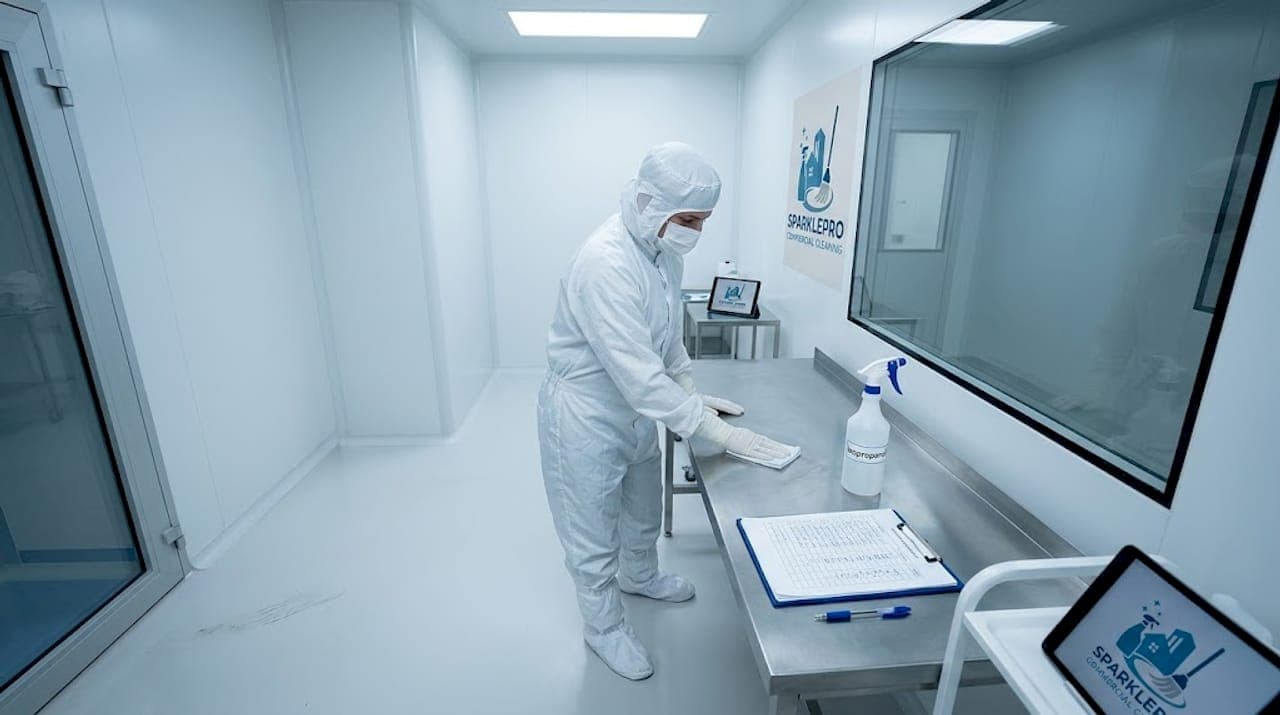
Cleanroom cleaning is not janitorial work with a lab coat on. What is cleanroom cleaning, really? It is a validated, protocol-driven process designed to maintain specific contamination limits within a controlled environment, using approved materials, defined sequences, and documented evidence. Your HVAC system and HEPA filters do a lot of heavy lifting, but they cannot remove surface particles, biological residues, or chemical soils on their own. Without an active, structured cleaning program, even the most sophisticated cleanroom design will drift out of specification. This article breaks down the methods, standards, and practices that make cleanroom cleaning work.
Table of Contents
- Key takeaways
- What cleanroom cleaning actually means
- How ISO and GMP classification shapes your cleaning program
- Residue management and disinfection strategy
- Tying cleaning to environmental monitoring
- Scheduling, training, and recovery cleaning
- My honest take on where cleanroom programs go wrong
- Professional cleanroom cleaning services from Sparkleprocommercialcleaning
- FAQ
Key takeaways
| Point | Details |
|---|---|
| Cleaning is not automatic | Cleanroom design controls airborne particles but cannot remove surface contaminants without active cleaning protocols. |
| Sequence matters critically | Top-to-bottom, clean-to-dirty cleaning order prevents recontamination and is the foundation of every effective protocol. |
| Classification drives frequency | ISO and GMP class determines how often you clean, which agents you use, and what documentation you must produce. |
| Residue removal is mandatory | EU GMP Annex 1 treats disinfectant residue removal as a validated, documented step, not an optional finishing touch. |
| Monitoring closes the loop | Environmental monitoring data should directly inform cleaning schedule adjustments and corrective actions. |
What cleanroom cleaning actually means
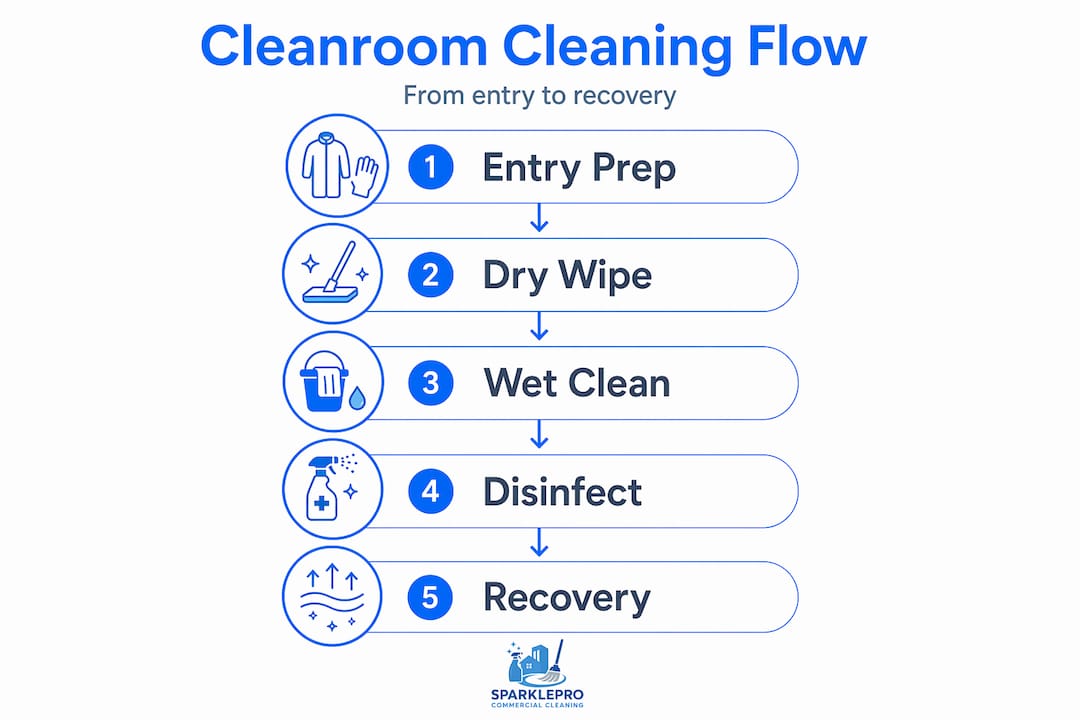
The core of cleanroom cleaning is a structured dry and wet process that systematically removes particles, bioburden, and chemical residues from all surfaces within the controlled environment. It is not a single action. It is a sequence of steps: pre-cleaning removes large debris, wet cleaning removes contaminants with purified water and compatible detergents, disinfection targets microbial load, and drying plus inspection confirm the surface is in a controlled state before operations resume.
Understanding cleanroom sanitation techniques starts with the materials you use. Every wipe, mop, and cleaning tool must be low-lint and cleanroom-approved to avoid introducing new particle sources during the cleaning process itself. HEPA-filtered vacuums are required during pre-cleaning to capture debris without re-aerosolizing particles into the room. Standard shop vacuums or household mops are disqualifying.
The directional cleaning pattern is just as critical as the tools. Gravity pulls dislodged particles downward, so cleaning always moves from ceiling to floor and from the cleanest zones toward exits. Reversing that order means you are dragging contamination from dirty areas across surfaces you already cleaned. This single principle eliminates a massive source of recontamination that non-specialized cleaning crews get wrong repeatedly.
- Pre-cleaning: Use HEPA-filtered vacuums to remove gross particulate before any wet cleaning begins
- Wet cleaning: Apply purified water or low-residue detergents with non-shedding wipes using validated wipe-down patterns
- Disinfection: Apply the appropriate disinfectant at the validated concentration and contact time after surfaces are visibly clean
- Drying: Allow surfaces to dry completely before introducing product or personnel
- Inspection: Visually confirm all surfaces are clean and residue-free before signing off the cleaning record
Pro Tip: Validate every material before it enters your cleanroom. Swapping a wipe brand or changing a detergent supplier without testing is the kind of shortcut that shows up as a particle excursion on your environmental monitoring data.
How ISO and GMP classification shapes your cleaning program
Not all cleanrooms clean the same way, and the reason is classification. ISO cleanroom classes run from ISO 1 (the most stringent) to ISO 9, with each class defining maximum allowable particle counts per cubic meter. Your commercial cleaning standards must match the contamination control demands of your specific ISO class.
| ISO Class | Typical Use | Cleaning Frequency | Deep Clean Requirement |
|---|---|---|---|
| ISO 5 (Class 100) | Aseptic filling, semiconductor wafer processing | After every shift, sometimes continuous | Weekly, with full surface disinfection |
| ISO 6/7 (Class 1,000/10,000) | Medical device assembly, compounding pharmacies | Daily minimum | Bi-weekly to monthly |
| ISO 8 (Class 100,000) | General pharmaceutical manufacturing, packaging | Daily to several times per week | Monthly |
Pharmaceutical compounding environments governed by USP <797> tie cleaning and disinfection frequencies directly to compounding category and surface contamination risk. That means the frequency written into your SOP must reflect what your monitoring data actually shows, not what was convenient to schedule. Regulatory inspectors do not accept "we clean daily" as an answer. They want frequency justified by classification, usage patterns, and trending environmental data.
Recertification is another dimension of cleanroom maintenance procedures that many facility managers treat as an afterthought. It is not. Your cleaning program must support the cleanroom's classified state between formal recertifications, which means consistent documentation, calibrated monitoring instruments, and records that show the room has remained in control.
Pro Tip: Set your cleaning frequency based on your highest-risk activity, not your average activity. If your ISO 7 room runs a high-touch process three days per week, clean as if it runs every day.
Residue management and disinfection strategy
Here is where many cleanroom programs fail audits. Cleaning and disinfection are related but distinct steps, and confusing them is a compliance liability. Cleaning removes physical soil. Disinfection reduces microbial load. Disinfection applied to a dirty surface is significantly less effective because organic material neutralizes the disinfectant before it can act on microorganisms.
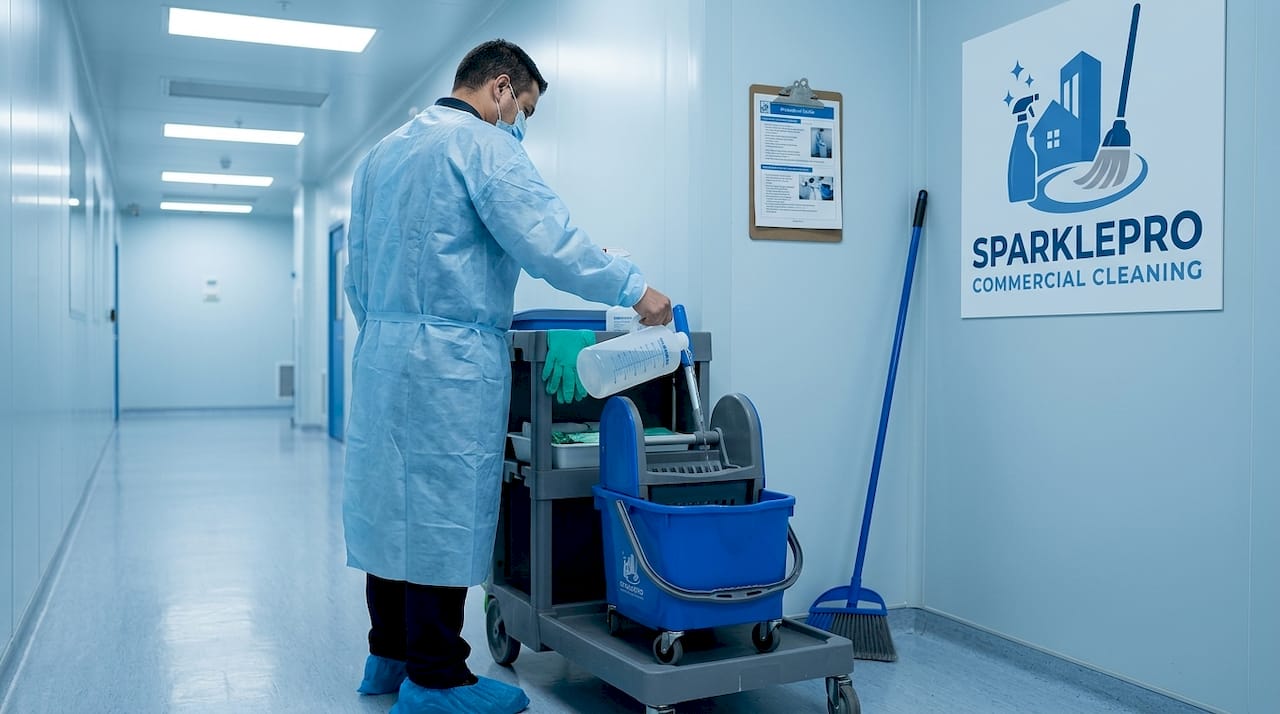
EU GMP Annex 1 requires that cleaning precede disinfection and that residue removal itself be a validated, documented step. This is not a suggestion buried in guidance. It is a mandatory part of your contamination control program, and auditors are specifically looking for it.
Disinfectant residues are their own problem. Leaving quaternary ammonium compounds or sporicidal agents on surfaces creates buildup over time that can interfere with subsequent disinfection cycles and presents its own contamination risk. The principle of disinfectant rotation in standard operations is less about microbial resistance and more about managing residue accumulation and ensuring broad-spectrum coverage.
Disinfectant residues represent a major audit risk and must be controlled and validated for removal. EU GMP Annex 1 treats this as a non-negotiable documented step, not routine maintenance.
Common disinfectant categories used in cleanrooms include:
- Sporicidal agents: Hydrogen peroxide-based solutions or peracetic acid compounds for highest-risk environments
- Quaternary ammonium compounds (quats): Effective against bacteria and some fungi; widely used for routine disinfection in ISO 7 and ISO 8 spaces
- Isopropyl alcohol (IPA): Fast-acting, low-residue option used for equipment wipe-downs and spot disinfection
- Bleach-based solutions: Broad-spectrum effectiveness at validated concentrations, though residue rinsing is required
Pro Tip: Document your disinfectant rotation schedule, concentration verification, and contact times in your SOP. An auditor who cannot find that documentation will assume the rotation is not happening.
Tying cleaning to environmental monitoring
Cleaning effectiveness is not self-evident. You cannot look at a surface and confirm it meets your ISO class particle limits. That is why cleaning and disinfection are continuous risk controls that require environmental monitoring to verify their effectiveness and close the contamination control loop.
Here is how a properly integrated program works:
- Establish baseline monitoring data across your cleanroom zones before finalizing your cleaning SOP. Trending data tells you which areas carry the highest contamination risk.
- Set warning and action limits for both viable (microbial) and non-viable (particle) counts. Warning limits trigger investigation before you have a real excursion.
- Link cleaning schedule reviews to monitoring trends. If a zone consistently trends toward warning limits after three days, your weekly cleaning is not frequent enough for that zone.
- Document all deviations and corrective actions. Every excursion above an action limit requires a CAPA (Corrective and Preventive Action) that traces back to a cleaning, personnel, or process root cause.
- Verify cleaning effectiveness after protocol changes. When you switch a cleaning agent or modify a procedure, your monitoring data for the following cycles is your validation evidence.
This feedback loop is what separates a working cleanroom maintenance procedure from a paper exercise. The GMP contamination control strategy concept formalizes this relationship, requiring facilities to document how cleaning, monitoring, and corrective actions interlock.
Scheduling, training, and recovery cleaning
Day-to-day cleanroom cleaning is driven by three variables: room classification, operational intensity, and the contamination risk profile of activities performed in the space. Typical daily tasks include floor cleaning, surface wipe-downs, pass-through decontamination, and waste removal. Periodic tasks like wall cleaning, vent inspection, and equipment deep-cleaning happen on schedules defined by your ISO class and usage data.
Staff training is where many programs break down silently. A trained cleaner who understands why directional cleaning matters will catch a protocol deviation before it becomes an excursion. A cleaner following steps without understanding the rationale will improvise under pressure. Your cleanroom cleaning protocols should include documented training records, competency assessments, and periodic retraining rather than a single onboarding session.
Recovery cleaning after a contamination excursion follows a stricter version of the standard sequence:
- Remove personnel and halt operations immediately upon confirmed excursion
- Perform thorough gross cleaning of all affected surfaces using validated tools
- Execute validated residue removal before applying any disinfectant
- Apply targeted disinfection with sporicidal agents at confirmed concentrations and contact times
- Conduct environmental monitoring sampling before releasing the room for operations
Skipping residue removal before disinfection during recovery is one of the most documented ways facilities extend their downtime. The disinfectant cannot work through residual organic matter or previous cleaning agent buildup. You end up re-cleaning anyway, but later and under more regulatory scrutiny.
Pro Tip: Build your recovery cleaning procedure into your contamination control SOP before you need it. Facilities with predefined recovery plans return to a compliant state faster than those improvising under pressure.
My honest take on where cleanroom programs go wrong
I have seen cleanroom programs that looked excellent on paper and collapsed at inspection. The pattern is almost always the same. Facilities invest heavily in room design and HVAC infrastructure, then treat the cleaning program as a supporting task rather than a primary control. The result is underdocumented SOPs, inconsistent residue management, and cleaning staff who are technically executing steps but not understanding the contamination control logic behind them.
What I have found to be genuinely effective is treating your cleaning program the way you treat your equipment qualification program. It needs a validation baseline, regular review against monitoring data, and a defined owner who is accountable for SOP currency. The facilities I have seen maintain long-term compliance without recurring excursions all share one trait: their cleaning program is tied directly to their environmental data. When the data trends, cleaning frequency or intensity changes. That feedback loop keeps the program calibrated to real-world risk rather than theoretical schedules.
The disinfecting services audit failures I have watched unfold were almost never about the wrong disinfectant. They were about residues that were never validated for removal, rotation schedules that existed only on paper, and training records that showed attendance but not competency. Fix those three things and your program becomes defensible under almost any regulatory framework.
— Sales
Professional cleanroom cleaning services from Sparkleprocommercialcleaning
Maintaining ISO and GMP compliance requires a cleaning partner who understands contamination control, not just commercial janitorial work. Sparkleprocommercialcleaning provides specialized commercial cleaning services for controlled environments across the Northeast and beyond, with trained staff who follow validated protocols, documented procedures, and customized schedules matched to your facility's classification and usage profile.
Whether your facility operates under ISO 7 pharmaceutical standards or requires routine maintenance for a regulated manufacturing space, Sparkleprocommercialcleaning builds programs around your compliance requirements. We work with facility managers to develop cleaning schedules aligned with your environmental monitoring plan, support audit readiness through documentation, and provide disinfecting services that meet the residue management standards your regulators expect. Contact Sparkleprocommercialcleaning for a site assessment and service quote tailored to your cleanroom environment.
FAQ
What is cleanroom cleaning, exactly?
Cleanroom cleaning is a validated, protocol-driven process that removes particles, bioburden, and chemical residues from surfaces in a controlled environment using approved materials, defined sequences, and documented evidence. It goes beyond standard janitorial cleaning by requiring ISO or GMP-compliant methods, approved cleaning agents, and complete traceability.
How often does a cleanroom need to be cleaned?
Cleaning frequency depends on ISO classification, operational intensity, and contamination risk. ISO 5 environments may require cleaning after every shift, while ISO 7 and ISO 8 spaces typically require daily to several-times-per-week cleaning schedules with periodic deep cleaning cycles.
What cleaning agents are used in cleanrooms?
Common cleaning agents for cleanrooms include low-residue detergents with purified water for general surface cleaning, isopropyl alcohol for spot disinfection, quaternary ammonium compounds for routine disinfection, and hydrogen peroxide or peracetic acid-based sporicidal agents for high-risk environments and recovery scenarios.
Why does disinfectant residue matter in a cleanroom?
Disinfectant residue interferes with subsequent disinfection cycles, creates audit findings, and is classified under EU GMP Annex 1 as a contamination risk requiring validated removal. Leaving residue unmanaged is one of the most common causes of regulatory non-compliance in pharmaceutical cleanrooms.
What happens after a cleanroom contamination excursion?
Recovery cleaning follows a staged sequence: gross cleaning of affected surfaces, validated residue removal, targeted disinfection with sporicidal agents at confirmed concentrations, and environmental monitoring sampling before the room returns to operation. Skipping residue removal before disinfection reduces effectiveness and extends downtime.