
Janitorial risk management is how a cleaning vendor identifies and controls the hazards its work creates for your property, your tenants, and your budget. In practice, it comes down to five things you can verify on paper: insurance documentation, staff training records, chemical handling controls, contract terms that assign responsibility, and ongoing checks that confirm the vendor is doing what it promised. Any vendor worth hiring should be able to produce evidence for each one without hesitation.
The paperwork isn't bureaucratic overhead. A Certificate of Insurance (COI), a current Safety Data Sheet (SDS) for every chemical on site, and alignment with OSHA general industry standards are the baseline artifacts that separate a controlled operation from a liability waiting to happen. Here's what to expect a compliant vendor to have ready:
- A current Certificate of Insurance naming your property as an additional insured
- Safety Data Sheets accessible on site for every chemical in use
- Documented training logs covering OSHA and bloodborne pathogen protocols
- A written scope of work with measurable service frequencies and KPIs
- A verification process that confirms all of the above stays current, not just at signing
Key Takeaways
Janitorial risk management works because it converts abstract safety promises into verifiable documents, contract clauses, and audit trails that hold up when something goes wrong.
| Point | Details |
|---|---|
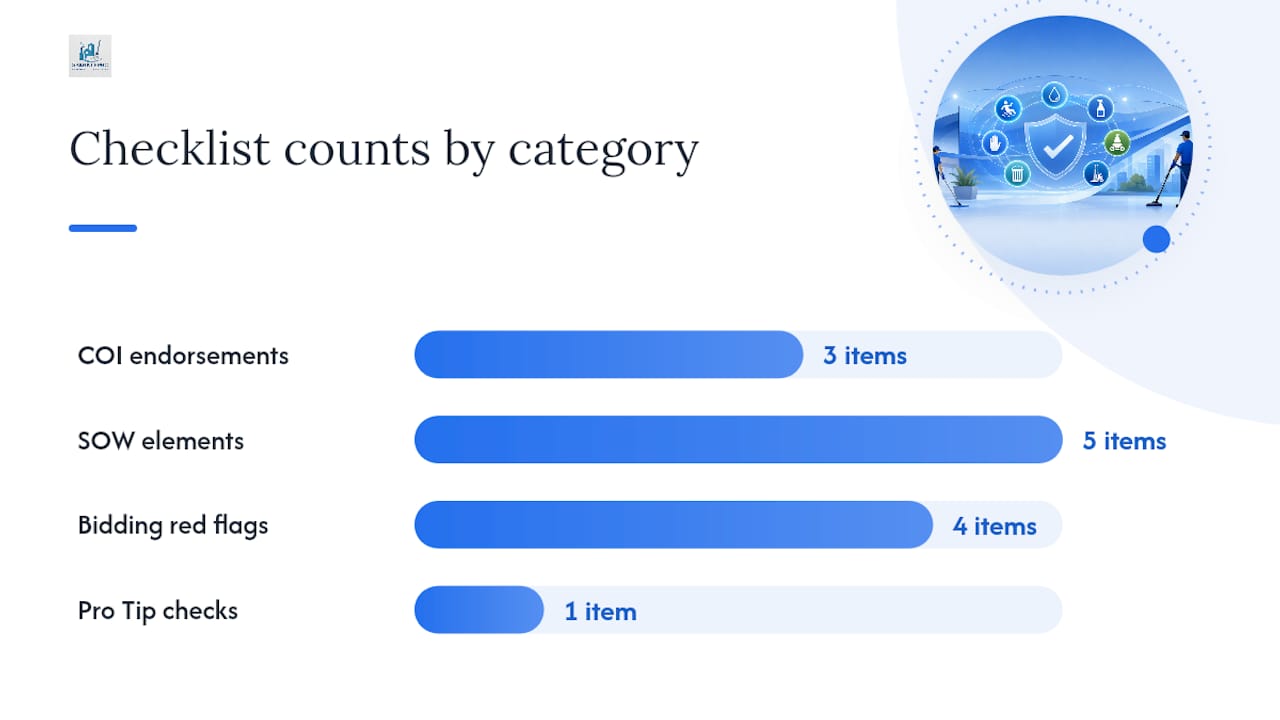
| Verify insurance endorsements | Confirm additional insured status, waiver of subrogation, and primary/non-contributory language on every COI. |
| Check safety history, not just coverage | Request EMR and TRIR data; an EMR above 1.0 warrants closer scrutiny or rejection. |
| Build KPIs into the contract | Track restroom sanitation pass rates and spill response time to catch risk before claims happen. |
| Confirm payroll matches coverage | Verify workers' compensation headcount aligns with the crew actually assigned to your site. |
| Sparkle Pro as a compliant option | Sparkle Pro provides current COIs, SDS access, and training logs upfront through its four-step quote and site-visit process. |
Table of Contents
- What Are the Core Components of Janitorial Risk Management?
- How Do You Read a COI and Write a Risk-Focused Scope of Work?
- What Happens After the Contract Is Signed?
- What Should You Do When an Incident Happens?
- How Sparkle Pro Puts These Controls Into Practice
- What Property Managers Get Wrong About Vendor Risk
- How to Engage a Vendor That Already Follows These Controls
- Frequently Asked Questions
- Sources
What Are the Core Components of Janitorial Risk Management?
Five control buckets do the actual work. Skip one, and the rest lose most of their value.
- Prequalification screens vendors before you sign anything. This means checking insurance limits, workers' compensation coverage, business licenses, and background checks on staff who'll have building access.
- Contract controls turn verbal promises into enforceable terms: scope of work, frequency, indemnification language, and insurance requirements written into the agreement itself.
- Operational safety controls govern daily behavior on your property: SDS access, PPE use, wet-floor signage, and chemical storage rules.
- Monitoring and quality assurance catch problems before they become claims, through inspections, audits, and checklists tied to remediation.
- Incident controls define what happens the moment something goes wrong, including reporting, documentation, and claims coordination.
At the procurement stage, request these documents before you request a price:
- Certificate of Insurance with your property listed as additional insured
- Workers' compensation certificate matching the crew size proposed for your site
- Current Safety Data Sheets for the chemical line the vendor intends to use
- Training logs showing OSHA and bloodborne pathogen certification dates
A robust prequalification process checks safety performance history, not just a signed COI. Ask for the vendor's Experience Modification Rate (EMR) and Total Recordable Incident Rate (TRIR) from the last three years. An EMR above 1.0 signals an above-average claims history and should trigger closer scrutiny or a pass altogether.
How Do You Read a COI and Write a Risk-Focused Scope of Work?
A Certificate of Insurance is only useful if you read the endorsements, not just the coverage limit. Confirm three things: your property is listed as additional insured, the policy includes a waiver of subrogation, and coverage is primary and non-contributory to your own insurance. Without those three endorsements, a generic COI protects the vendor more than it protects you.
The scope of work (SOW) is where risk actually gets assigned. A strong SOW includes an area-by-area task matrix built on cleanable square footage rather than gross square footage, a list of approved chemicals, defined service frequencies, access rules for after-hours work, and clear KPI definitions tied to remedies. Using cleanable square footage instead of raw building size prevents the understaffing that leads to skipped tasks and safety lapses.
Watch for these red flags during the bidding process:
- A bid significantly below the market range for your building type or square footage
- A vague staffing model that doesn't specify crew size or hours on site
- Workers' compensation headcount that doesn't match the proposed crew size
- Reluctance to provide EMR or TRIR history
A bid priced well under market is often the clearest sign a vendor is cutting corners on payroll reporting or safety spending. Ask directly how the vendor profits at that price; the answer tells you a lot.
Pro Tip: Request the vendor's workers' compensation certificate and count the covered headcount against the crew size in their proposal. A mismatch is one of the fastest ways to catch underreported payroll before you sign anything.
What Happens After the Contract Is Signed?
Signing the contract is the easy part. The controls that actually reduce risk happen after crews start working your building.
Startup orientation matters more than most property teams realize. Every crew member assigned to your site should walk through a documented site hazards map and sign an orientation checklist covering emergency exits, communication protocols, and any building-specific hazards. Keep those signed checklists in the vendor's compliance file, not a drawer somewhere.
From there, monitoring runs on a schedule:
- Scheduled supervisor walkthroughs, typically weekly or biweekly depending on facility size
- Random, unannounced audits that catch what a scheduled visit might miss
- Photo-documented logs for restroom conditions, common areas, and any flagged deficiencies
The KPIs worth tracking are the ones tied directly to liability, not just appearance. Restroom sanitation pass rates and spill response time are two of the most useful, because both map to the leading cause of janitorial-related claims: slip-and-fall incidents. Roughly 45% of non-fatal injuries in the cleaning sector come from slips, trips, and falls, which is exactly why wet-floor signage timing and PPE compliance deserve their own line items in your inspection checklist.
A documented inspection method that combines scheduled and random checks turns subjective complaints into verifiable performance data. That's what lets you trigger a corrective action clause or a service credit instead of just having an awkward phone call. A detailed onboarding and audit checklist built into your procurement process makes this a lot easier to enforce consistently.
What Should You Do When an Incident Happens?
The first ten minutes after an incident determine whether you have a manageable situation or a legal exposure. Secure the scene, document conditions with photos and timestamps, notify the contacts specified in your contract, and escalate to the vendor's insurer per the reporting timeline in the agreement.
A signed COI at contract start doesn't guarantee coverage holds up months later. This is where the paperwork you collected during prequalification earns its keep:
- Confirm the vendor notified its insurer within the policy's reporting window
- Preserve incident documentation independently, don't rely solely on the vendor's file
- Check that the crew on site at the time matches the roster covered by workers' compensation
- Escalate per the termination and remediation triggers written into your contract
Indemnification clauses and a signed COI mean less than most property teams assume if a vendor has misclassified workers or underreported payroll. Some states apply joint-employer rules that can expose the facility owner regardless of what the contract says.
Worker classification is the single most overlooked exposure in janitorial contracts. Verify that payroll headcount matches the workers' compensation policy before you need to, not after.
How Sparkle Pro Puts These Controls Into Practice
Sparkle Pro Commercial Cleaning runs a four-step engagement built around the controls covered above: a detailed quote based on cleanable square footage, an on-site visit to document hazards and access requirements, scheduled cleaning against a written SOW, and a customer approval step before the contract renews.
Documentation isn't an afterthought. Clients working with Sparkle Pro can expect:
- A current Certificate of Insurance provided and updated on request
- Safety Data Sheets accessible for every chemical used on site
- Training logs covering OSHA and bloodborne pathogen protocols
Sparkle Pro also handles specialized work where exposure runs higher, including post-construction cleanouts, disinfecting services, and biohazard response, each governed by the same documentation standard rather than a scaled-down version of it.
What Property Managers Get Wrong About Vendor Risk
The biggest mistake I see property teams make is treating a vendor's word as equivalent to a vendor's paperwork. A sales rep who tells you "we're fully insured and trained" isn't the same as a COI with the right endorsements and a training log with dates on it. Documented evidence beats verbal assurance every time, and any vendor who resists producing it is telling you something.
The second mistake is chasing the lowest bid without asking what got cut to hit that number. Paying more for a vendor that actually meets its insurance, training, and staffing commitments is almost always cheaper than the claim, the tenant complaint, or the emergency re-clean that follows a corner cut.
Contract enforcement is the real risk control, not the contract itself. A well-written SOW with KPIs is worthless if nobody audits against it. Build the inspection cadence into your own calendar, not just the vendor's promises.
How to Engage a Vendor That Already Follows These Controls
Sparkle Pro Commercial Cleaning gives property managers a way to skip the guesswork of vetting vendor compliance from scratch. Instead of chasing down COIs, SDS binders, and training logs after a problem surfaces, Sparkle Pro provides current documentation upfront as part of the quoting process.
Requesting a quote starts with a site visit, where Sparkle Pro documents your building's specific hazards and access needs before any cleaning begins, and a COI review happens as part of that same conversation rather than as an afterthought once you're already under contract. Sparkle Pro operates on a nationwide basis with local operational knowledge in each market, including active service pages for Delaware, Massachusetts, and Washington. If you manage a property in one of these regions, start there; otherwise, request a quote through the main site to get a site visit scheduled and your compliance documentation in hand before you commit.
Frequently Asked Questions
What is janitorial risk management in simple terms? It's the set of controls a cleaning vendor uses to protect your building, tenants, and budget from cleaning-related hazards, covering insurance, training, chemical safety, and contract enforcement.
What documents should I request before hiring a janitorial vendor? Ask for a Certificate of Insurance naming your property as additional insured, a workers' compensation certificate, current Safety Data Sheets, and training logs for OSHA and bloodborne pathogen protocols.
How often should a janitorial vendor be audited? Combine scheduled supervisor walkthroughs, typically weekly or biweekly, with unannounced random audits to catch issues a scheduled visit might miss.
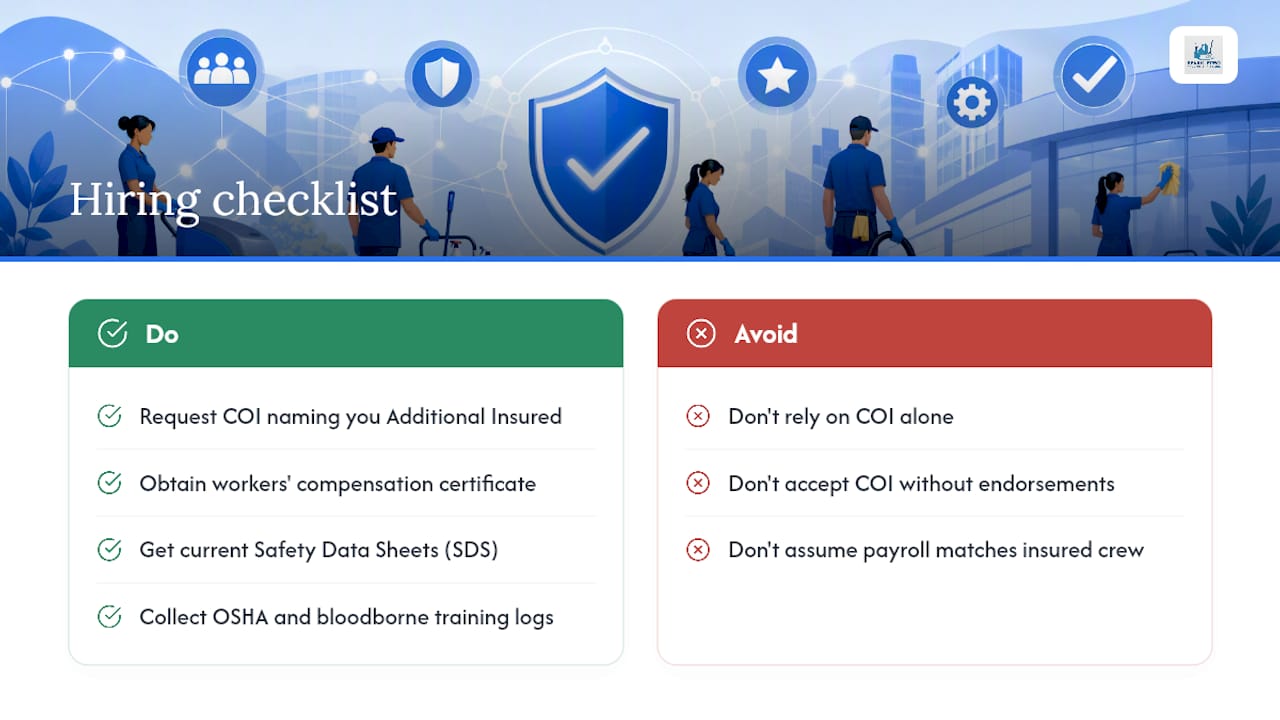
Why isn't a Certificate of Insurance enough on its own? A COI can look complete while missing the endorsements that actually protect you, and it says nothing about whether the vendor's payroll headcount matches its insured crew size.
Sources
- Commercial Cleaning Compliance: A Guide to Safety, Insurance, and Vendor Requirements
- A Practical Guide to Contractors Risk Management
- The most commonly missed risk in cleaning contracts | Facilities Dive