
When a biohazard incident occurs on a commercial property, the instinct is to call the regular cleaning crew. That instinct is wrong, and it can cost you far more than you expect. Biohazard incidents carry overlapping regulatory, health, and liability risks that standard janitorial contracts were never designed to handle. Property managers and facility directors who treat these events as routine cleaning jobs expose their organizations to OSHA violations, insurance disputes, and ongoing contamination risks that show up weeks or months later as odor complaints, illness concerns, or legal challenges.
Table of Contents
- What counts as a biohazard—and why commercial properties face added risks
- Biohazard cleaning standards and compliance: The regulatory backbone
- Critical materials, contamination challenges, and containment best practices
- Documentation, clearance, and defensibility: Closing the compliance loop
- Cost drivers and selecting the right biohazard cleaning partner
- Our take: What most commercial property managers miss about biohazard cleaning
- How Sparklepro helps you tackle biohazard cleaning challenges
- Frequently asked questions
Key Takeaways
| Point | Details |
|---|---|
| Biohazard cleanup is specialized | Standard commercial cleaning cannot meet legal and safety requirements for biohazard incidents. |
| Compliance reduces risk | Following OSHA, ANSI/IICRC, and EPA protocols protects workers, occupants, and owners from liability. |
| Documentation is vital | Comprehensive records and clearance help satisfy insurance and regulatory scrutiny after incidents. |
| Cost depends on complexity | Surface types, contamination extent, and verification testing shape price and project scope. |
| Qualified vendors matter most | Vet service providers for certifications, method transparency, and documentation to avoid recurring problems. |
What counts as a biohazard—and why commercial properties face added risks
Not every incident involving biological material is equal, but the range of scenarios that qualify as biohazard events in a commercial setting is broader than most facility managers realize. Blood and other potentially infectious materials (OPIM) top the list. This category includes bodily fluids present after a workplace injury, an undiscovered death, or a public-access incident in a restroom, stairwell, or parking structure. Animal remains and sharps (needles, broken glass contaminated with biofluids) also fall under biohazard classification. Decomposition, which often appears in vacant units, storage areas, or large facilities with limited foot traffic, presents some of the most severe decontamination challenges.
Commercial properties carry added complexity because public access, multi-tenant structures, and shared HVAC systems all expand the contamination footprint and elevate regulatory scrutiny. A workplace injury in a loading dock can trigger OSHA recordkeeping requirements before the mop even touches the floor. A decomposition event in a multi-tenant office building may involve multiple regulatory agencies and insurers simultaneously.
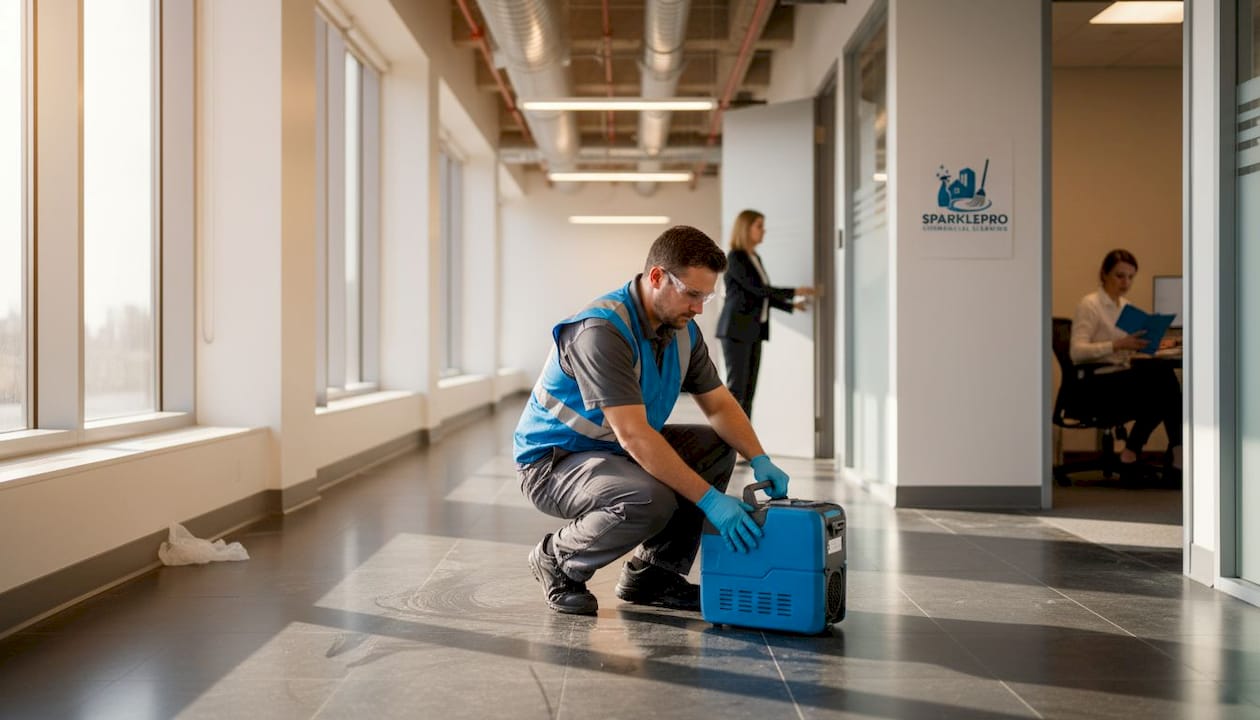
The cleaning benefits for commercial properties extend well beyond aesthetics, and that becomes most obvious when a property faces a biohazard event. Standard janitorial services lack the specialized training, personal protective equipment (PPE), and disposal protocols that these situations require. As one remediation guide for property managers notes, biohazard cleanup typically requires contractor capability for OSHA-compliant worker protection, proper containment and disposal, and full documentation, none of which appear in a standard janitorial scope of work.
Key biohazard incident types that commercial sites encounter:
- Blood and OPIM from workplace injuries, assaults, or accidents
- Decomposition in vacant units, storage spaces, or rarely accessed areas
- Sharps and drug paraphernalia in restrooms, parking garages, and exterior areas
- Sewage backflow or wastewater contamination in mechanical rooms
- Animal remains in roof spaces, crawl spaces, or HVAC plenums
Every one of these scenarios carries distinct disposal, containment, and documentation requirements that go far beyond what a routine cleaning contract will specify.
Biohazard cleaning standards and compliance: The regulatory backbone
Understanding which standards apply is essential before you engage any contractor. Three frameworks govern commercial biohazard cleaning: OSHA's Bloodborne Pathogens standard, the ANSI/IICRC S540, and the EPA's registered disinfectant lists.
OSHA's Bloodborne Pathogens standard (29 CFR 1910.1030) requires an exposure control plan, appropriate PPE, worker training, and specific recordkeeping whenever blood or OPIM is present. This applies to the workers performing the cleanup, which means any contractor you hire must demonstrate compliance for their own team before they enter your property. If they cannot provide an exposure control plan, that is an immediate disqualifier.
The ANSI/IICRC S540 is the internationally recognized standard for trauma and crime scene cleanup. It establishes best practices for containment, personal protection, material removal, disinfection, and documentation. A contractor familiar with S540 will approach a scene differently than one relying on general cleaning protocols. They will scope the contamination zone carefully, contain it before beginning work, and document each stage of the process.
EPA-registered disinfectants are the third pillar. Not every hospital-grade or commercial disinfectant product is registered for bloodborne pathogen decontamination. Contractors must use products from the EPA's relevant lists, applied strictly according to label instructions, including contact time. A product wiped off before the required contact time has elapsed is legally and functionally the same as using the wrong product.
| Standard | Governing body | Core requirement | Who it protects |
|---|---|---|---|
| OSHA 29 CFR 1910.1030 | U.S. Department of Labor | Exposure control, PPE, recordkeeping | Workers |
| ANSI/IICRC S540 | IICRC/ANSI | Containment, removal, documentation | Property and occupants |
| EPA List S/relevant lists | U.S. EPA | Pathogen-appropriate disinfectants | Occupants and environment |
Steps property managers should take to verify compliance before work begins:
- Request the contractor's OSHA exposure control plan and confirm it is current.
- Ask specifically whether their protocols align with ANSI/IICRC S540.
- Verify that the disinfectants they plan to use are EPA-registered for the relevant pathogens.
- Request sample documentation from a prior job to evaluate their record-keeping quality.
- Confirm that disposal is handled under proper regulatory manifests.
Review your OSHA cleaning standards obligations before the first conversation with any vendor, so you know what questions to ask.
Pro Tip: Ask every prospective biohazard contractor to walk you through how they document each phase of a job, from initial scope to disposal manifest. A contractor who hesitates or provides vague answers on documentation is a contractor who will leave you exposed when an insurance claim or regulator inquiry arrives.
Critical materials, contamination challenges, and containment best practices
One of the most common and costly mistakes in biohazard cleanup is underestimating the spread of contamination. What is visible on the surface often represents a fraction of the actual contamination zone. Blood and other biofluids wick into porous materials rapidly. Carpet, drywall, subfloor panels, grout lines, and unsealed wood can all absorb biological material to depths that surface cleaning cannot reach. Incomplete removal and disinfection of porous materials frequently leads to odor relapse weeks after the initial cleanup, requiring additional remediation at significant additional cost.
HVAC systems present a specific and underappreciated risk. Decomposition odors, aerosolized particles, and contaminated dust can travel through ventilation paths across large floor plates or between floors in a multi-story building. A competent biohazard contractor will assess airflow patterns and seal or isolate HVAC returns in the affected zone before work begins. Failing to do this converts a contained incident into a building-wide air quality problem.
"Contamination regularly extends under and behind surfaces. An area that looks addressed to the naked eye may still harbor biological material, pathogens, or persistent odor compounds in subflooring, wall cavities, or ventilation paths."
| Material | Contamination risk | Remediation approach |
|---|---|---|
| Carpet and padding | High: deep absorption | Bag and remove; replace padding |
| Drywall | High: wick and spread | Remove affected sections; treat framing |
| Tile and grout | Moderate: surface plus grout lines | Enzymatic and EPA-registered disinfectant |
| Hardwood and subfloor | High: grain absorption | Remove, treat, assess for salvage |
| HVAC ductwork | High if aerosolized | Seal and assess; duct cleaning may be needed |
Red flags that suggest incomplete cleanup:
- Persistent odor 24 to 72 hours after the contractor has left
- No visible moisture mapping or scope documentation provided after the job
- Contractor did not remove or test underlying porous materials
- No containment barriers (negative air pressure zones) were used during work
- Disinfectant contact time was not documented or was clearly insufficient
Good disinfecting service selection starts with verifying that contractors understand these material-specific challenges before they begin work. For guidance on maintaining safe commercial cleaning standards across all scenarios, align contractor expectations with documented protocols.
Pro Tip: Always walk the affected area before the contractor departs and photograph every surface, including walls, floors, and any materials that were cut, removed, or treated. Those photos become your baseline if odor or contamination issues resurface later.
Documentation, clearance, and defensibility: Closing the compliance loop
Documentation is where many biohazard jobs fall apart for property managers. The cleaning may be thorough, but without the paper trail, you have no defense when an insurer questions the scope of work, a tenant raises a health concern, or a regulator reviews the incident. Think of documentation as the difference between a job that was done and a job that can be proven to have been done correctly.
Minimum documentation that any credible biohazard contractor should provide includes a written scope of work, a containment plan, a chain of custody for all removed biological materials, disposal manifests from a licensed waste hauler, before-and-after photographs, contractor credentials and certifications, and the specific disinfectants used with lot numbers.
Clearance testing is increasingly required for serious cleanups, particularly in insurance contexts. This typically involves surface swab sampling conducted by an independent environmental hygienist after the contractor has finished. The results confirm whether pathogens or contamination markers have been reduced to acceptable levels. Clearance testing is not free, ranging from a few hundred dollars for basic surface sampling to several thousand for complex multi-room scenarios, but it is significantly less expensive than re-remediation or litigation.
Steps to verify closure and maintain defensibility:
- Collect all documentation before the contractor's final invoice is paid.
- Confirm disposal manifests reference a licensed medical or biohazardous waste hauler.
- Retain before-and-after photos in your incident file, not just in an email chain.
- If clearance testing was performed, store the lab results with the job file.
- Record the contractor's license numbers, certifications, and insurance information.
- Notify your insurer promptly and provide documentation as required under your policy terms.
"Defensibility is not an afterthought. Because timelines and verification expectations differ between insurers and regulators, requiring full documentation from work plan through disposal chain is the most cost-effective risk management decision you will make."
Establishing clear cleaning solution documentation standards and knowing how to evaluate cleaning contracts for documentation requirements will protect your organization before an incident occurs, not after.
Cost drivers and selecting the right biohazard cleaning partner
Biohazard cleanup pricing varies significantly based on contamination extent, material porosity, time elapsed since the incident, disposal volume, and whether structural material removal or post-remediation testing is needed. A fresh, contained blood spill on a hard floor in an accessible area might cost a few hundred dollars. A decomposition event discovered weeks after the fact in a carpeted office suite could exceed $10,000 to $30,000 when full material removal, structural drying, odor treatment, and clearance testing are factored in. Elapsed time is one of the most significant cost multipliers. Contamination that sits for days or weeks penetrates more deeply, requires more aggressive intervention, and is far more likely to result in structural material removal.
Questions to ask when vetting a biohazard cleaning partner:
- Can you provide your OSHA exposure control plan and worker training records?
- Do your protocols align with IICRC S540 and can you document that alignment?
- What EPA-registered disinfectants do you use, and can you provide the product labels?
- How do you handle disposal, and can you provide manifests from licensed waste haulers?
- Do you offer clearance testing coordination, or can you recommend an independent hygienist?
- What does your documentation package include, and can I see an example from a prior job?
- Are you fully licensed and insured in this state for biohazardous waste handling?
Pro Tip: Demand clarity on regulatory alignment and documentation practices before price becomes the deciding factor. A low-cost contractor who skips clearance testing or cannot produce disposal manifests leaves you holding the liability for any recurrence or regulatory inquiry, which will always cost more than the difference in quotes.
Our take: What most commercial property managers miss about biohazard cleaning
After working with facility directors and property managers across a wide range of incident types, the pattern we see repeatedly is this: managers assume that a contractor who shows up in Tyvek suits and carries industrial disinfectant is, by definition, doing the job correctly. That assumption is dangerous.
The gap between appearing professional and actually being compliant is wide. We have seen jobs where containment was bypassed because the contractor judged it unnecessary. Jobs where porous flooring was disinfected in place rather than removed, resulting in odor relapse and a second remediation that cost twice the first. Jobs where disposal manifests were never provided because the contractor simply did not know they were required.
What gets missed most consistently is the documentation package. Managers focused on getting the area back to operational quickly often accept verbal assurances rather than formal documentation. That works fine until an insurer denies a claim, a tenant raises a health complaint, or an OSHA inspector asks for records. At that point, a rushed job with no paper trail is indistinguishable from a job that was never done properly.
For move-in cleaning and commercial turnover situations that follow a biohazard event, the same principle applies. A space that looks clean and smells acceptable is not necessarily cleared for occupancy. Independent verification is not a luxury. It is the mechanism that closes the loop.
What's invisible isn't always gone. Insist on independent checks and full documentation. Your job is not to supervise the cleanup in real time. It is to verify that the contractor you hired met the standards they agreed to meet, and that the paper trail proves it.
How Sparklepro helps you tackle biohazard cleaning challenges
Managing a biohazard incident under time pressure is stressful enough without having to evaluate contractor credentials and compliance frameworks at the same time.
Sparklepro Commercial Cleaning delivers OSHA, ANSI/IICRC, and EPA-aligned services with the documentation practices that facility directors and property managers need to protect their organizations. Whether you manage properties in Delaware, Massachusetts, or New Jersey, our teams are equipped to respond quickly, document thoroughly, and coordinate with your insurance and compliance contacts. Reach out today for a consultation, a documentation review, or urgent biohazard response support. You should not be navigating this alone.
Frequently asked questions
What is included in a commercial biohazard cleaning service?
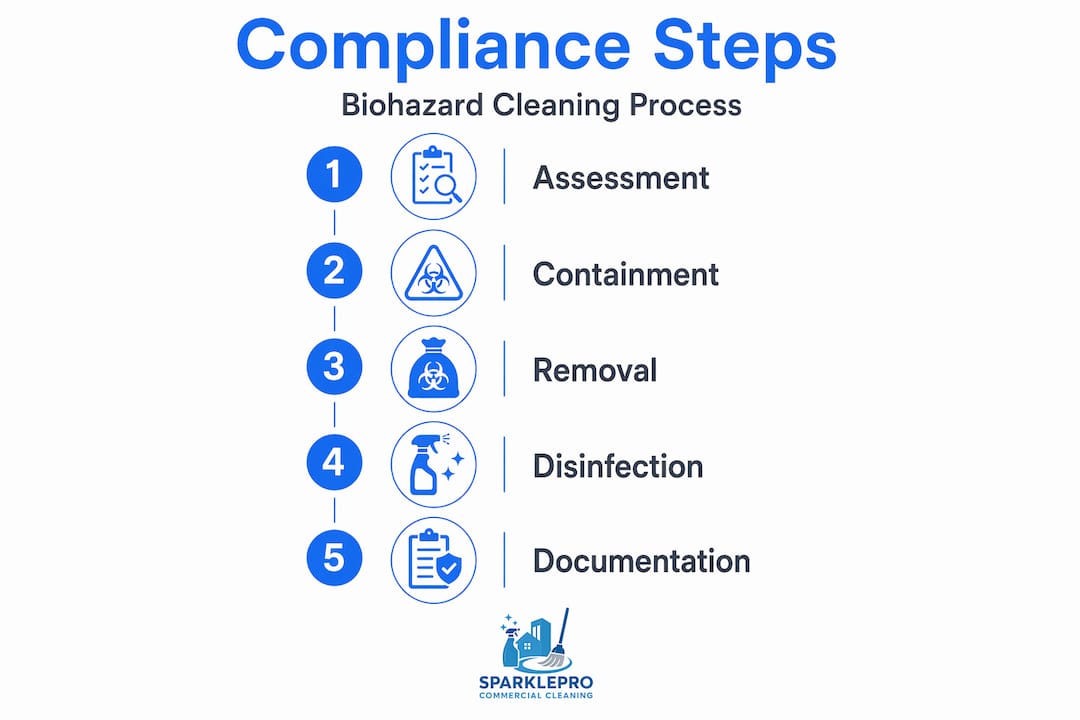
A commercial biohazard cleaning service covers assessment, hazard containment, safe removal and regulated disposal, thorough disinfection using ANSI/IICRC S540-aligned protocols, and full documentation for compliance and insurance purposes.
When does OSHA require special procedures for biohazard cleanup in a workplace?
OSHA mandates specific protocols whenever blood or potentially infectious materials are present, requiring worker protection and exposure controls under 29 CFR 1910.1030, along with formal recordkeeping.
Are all disinfectants suitable for biohazard cleanup?
No. Only EPA-registered antimicrobial products labeled for the specific pathogens involved should be used, and they must be applied at the labeled contact time to be effective and legally compliant.
How can property managers document and verify biohazard cleanup?
Collect the contractor's work plan, disposal manifests, before-and-after photos, and any clearance testing results; full documentation is what supports compliance and insurance claims if questions arise later.
How much does commercial biohazard cleanup cost?
Costs range from a few hundred to tens of thousands of dollars, depending on contamination extent, material porosity, time elapsed, and whether structural removal or post-remediation testing is required.