

Most facility managers think they know what office cleaning means. Empty the trash, vacuum the carpet, wipe down the breakroom counter. Done. But that assumption is costing businesses money, compliance standing, and employee health. Professional office cleaning is a structured, standards-driven operation that varies dramatically based on facility type, risk level, and regulatory environment. This guide breaks down what office cleaning actually covers, what standards govern it, what it costs in 2026, and how to choose a provider who will protect your facility rather than just make it look presentable.
Table of Contents
- Defining office cleaning: Not just tidiness
- Standards, regulations, and safety protocols
- Office cleaning costs, value, and pricing benchmarks
- Choosing the right office cleaning service
- Perspective: Why industry standards matter more than ever in 2026
- Connect with expert commercial office cleaning
- Frequently asked questions
Key Takeaways
| Point | Details |
|---|---|
| Not just tidying | Office cleaning means following specific industry standards unique to each facility type. |
| Compliance is critical | Safety rules and certifications like ISSA/CIMS reduce risk and ensure quality results. |
| Cost varies widely | Prices depend on facility, service scope, and region, with US averages ranging from $0.08 to $0.20 per sq ft. |
| Choose with care | Always check for credentials, references, and alignment with your facility’s compliance needs. |
Defining office cleaning: Not just tidiness
When most people picture office cleaning, they picture a mop and a trash bag. The reality is far more structured. Professional office cleaning is a system of scheduled tasks, chemical protocols, trained staff, and measurable outcomes designed to maintain a facility at a specific appearance and hygiene level.
The ISSA Power Clean Standards define five appearance levels for cleaned spaces, ranging from Level 1 (orderly tidiness, suitable for warehouses) up to Level 5 (immaculate, required for cleanrooms and surgical environments). Most commercial offices operate at Level 2 or 3, but healthcare facilities, labs, and pharmaceutical spaces often require Level 4 or 5. These standards also include the Cleaning Industry Management Standard (CIMS), production rates that define how much area a worker can clean per hour, and detailed SOPs (standard operating procedures) specifying tools, chemicals, and task frequencies.
Understanding these levels matters because they directly affect how a cleaning contract is written, staffed, and priced. A vendor quoting on a general office may not be equipped to handle a medical suite on the same floor.
Here is a quick comparison of task expectations by facility type:
| Task | General office | Medical office | Warehouse/industrial |
|---|---|---|---|
| Surface disinfection | Weekly | Daily or more | As needed |
| Floor care | Vacuuming, mopping | Hospital-grade mopping | Heavy-duty scrubbing |
| Restroom sanitation | Daily | Multiple times daily | Daily |
| Air vent/duct wiping | Monthly | Weekly | Monthly |
| Biohazard handling | Not required | Required | Situational |
| Chemical grade | Commercial | Hospital-grade | Industrial |
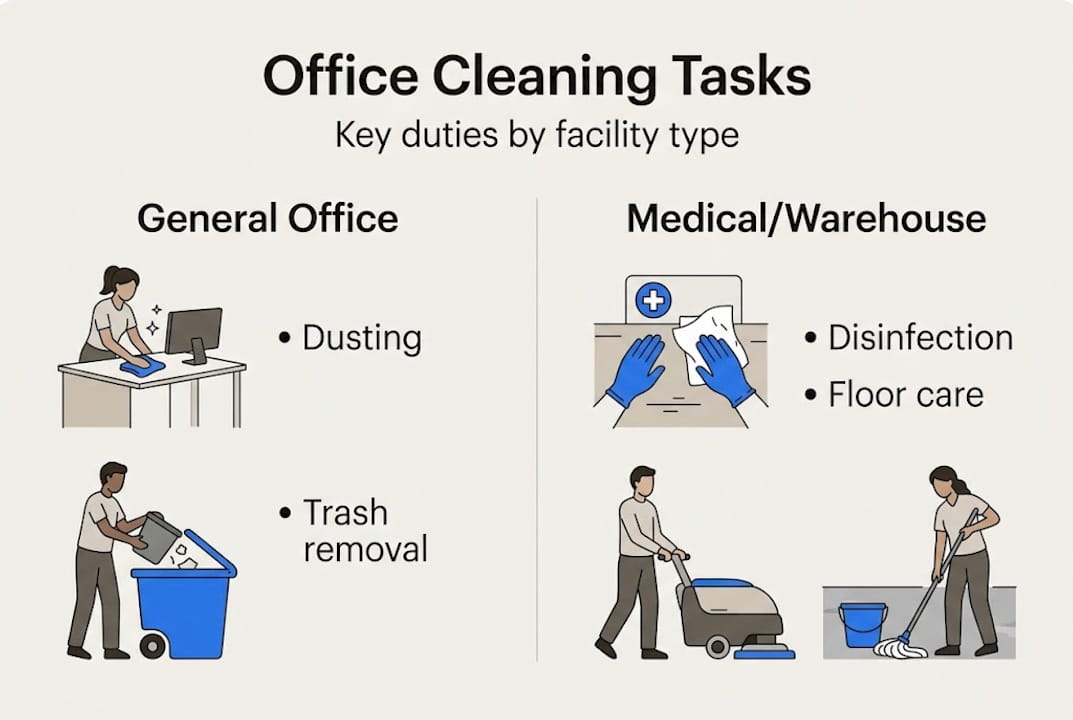
For a broader look at how these tasks translate across different environments, janitorial services examples illustrate what proper scope looks like in practice.
Key tasks included in a professional office cleaning scope typically cover:
- Dusting and wiping all horizontal and vertical surfaces
- Restroom sanitation and restocking
- Kitchen and breakroom cleaning
- Trash removal and liner replacement
- Vacuuming, sweeping, and mopping floors
- Glass and partition cleaning
- High-touch point disinfection (door handles, light switches, elevator buttons)
If you are not familiar with the terminology vendors use in proposals, reviewing cleaning industry terms before signing a contract will save you from misunderstandings later.
Pro Tip: Before you request a bid, identify which ISSA appearance level your facility actually requires. A general office and a physical therapy clinic are not the same cleaning environment, and treating them the same way creates both quality gaps and unnecessary cost.
Standards, regulations, and safety protocols
Knowing what gets cleaned is only half the picture. How it gets cleaned, and under what regulatory framework, determines whether your facility is truly protected or just visually clean.
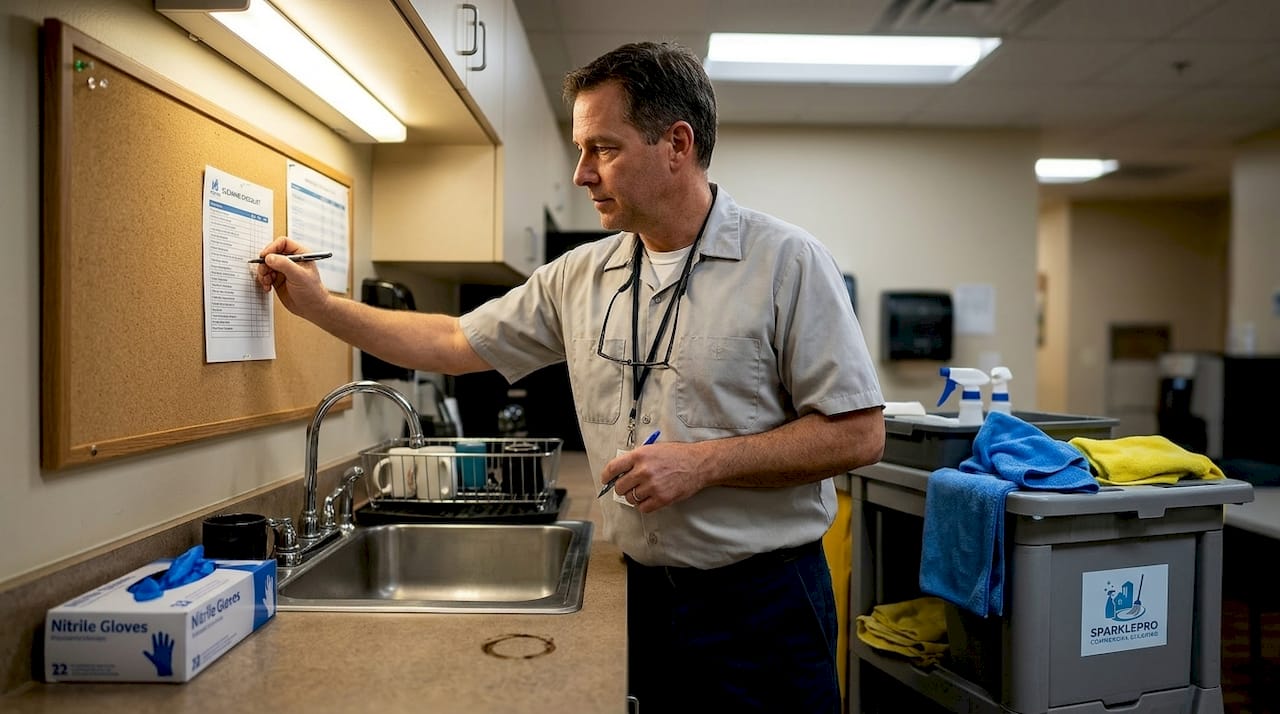
Different environments carry different risk profiles. A corporate office has relatively low biological risk. A medical office, urgent care clinic, or physical therapy suite carries significant infection control obligations. A warehouse or industrial space faces OSHA compliance requirements around chemical storage, equipment cleaning, and worker safety.
For healthcare environments, infection control requirements include hospital-grade disinfectants, strict OSHA and CDC compliance for handling biohazardous waste, and more frequent disinfection schedules than standard offices. Industrial spaces shift focus toward OSHA safety compliance, heavy-duty floor cleaning, and equipment maintenance protocols.
Key safety practices that any credible cleaning provider should follow include:
- Proper use of personal protective equipment (PPE) for all staff
- Chemical control procedures including SDS (Safety Data Sheet) access and storage
- Color-coded microfiber systems to prevent cross-contamination between zones
- Written SOPs for each facility type and task
- Staff training documentation and certification records
- Hazardous waste segregation and disposal protocols
For floors specifically, the protocols go well beyond mopping. Proper floor cleaning processes account for surface material, foot traffic, chemical compatibility, and drying time to prevent slip hazards and surface degradation.
"The standard you choose for your facility is not just about appearance. It is a direct reflection of your duty of care to employees, clients, and visitors. Matching the cleaning standard to the actual risk level of your environment is the single most important decision a facility manager makes when contracting cleaning services."
Local health codes and building regulations add another layer. Some jurisdictions require specific licensing for cleaning companies operating in healthcare or food-adjacent environments. Always verify that your vendor holds the correct licenses for your facility type and location.
Office cleaning costs, value, and pricing benchmarks
Once you understand what professional cleaning involves, the cost conversation becomes much easier to navigate. Pricing is not arbitrary. It reflects square footage, facility type, cleaning frequency, required protocols, and regional labor costs.
2026 US benchmarks show the following ranges per visit:
| Facility type | Cost per sq ft per visit | Notes |
|---|---|---|
| General office | $0.08 to $0.20 | Higher in Northeast and West Coast |
| Medical/healthcare | $0.15 to $0.35 | Reflects specialized protocols |
| Industrial/warehouse | $0.05 to $0.12 | Lower density, heavy-duty tasks |
The commercial cleaning industry in the US is valued at over $90 billion and employs approximately 2.3 million workers. That scale reflects just how critical consistent, professional cleaning has become across every sector of the economy.
When comparing bids from multiple vendors, use this process to evaluate them accurately:
- Define your scope first. Document your square footage, facility type, frequency needs, and any specialized requirements before requesting quotes.
- Request itemized proposals. Ask each vendor to break out labor, materials, and any surcharges separately.
- Compare protocols, not just price. A lower bid may exclude high-touch disinfection, restroom restocking, or floor care.
- Check chemical and equipment specs. Confirm the vendor uses appropriate-grade products for your facility type.
- Ask about staffing consistency. High turnover in cleaning crews creates compliance and security risks.
The long-term value of professional cleaning extends well beyond aesthetics. Consistent cleaning extends the life of flooring, furniture, and HVAC systems. It reduces sick days by lowering pathogen loads in shared spaces. And it protects you from liability in environments where hygiene standards are regulated.
Choosing the right office cleaning service
With cost and standards in hand, the selection process becomes about fit and verification. Not every cleaning company is equipped for every facility type, and choosing the wrong vendor creates more problems than it solves.
Here is a checklist of questions to ask every vendor before signing a contract:
- Are you fully licensed and insured in this state?
- Do you hold ISSA or CIMS certification?
- Have you cleaned facilities of this type and size before?
- Can you provide references from similar facility types?
- What training do your staff receive, and how is it documented?
- How do you handle chemical storage, SDS compliance, and PPE requirements?
- What is your process for quality control and issue resolution?
Vetting ISSA and CIMS certification is straightforward. Ask the vendor for their certification number and verify it directly through ISSA's registry. CIMS certification, in particular, signals that the company has been audited against a standardized management framework, not just self-reported.
Watch for these warning signs during vendor evaluation:
- No proof of insurance or liability coverage
- Vague or verbal-only scope of work
- No written SOPs or training records
- Inability to provide references from comparable facility cleaning examples
- Prices dramatically below market rate without explanation
Pro Tip: Always request references specifically from facilities that match your type. A vendor with strong retail experience may not be the right fit for a healthcare clinic, even if their general reviews are excellent.
Once you have narrowed your list, a site visit before contract signing is essential. It gives the vendor accurate data for pricing and gives you a chance to assess their professionalism and attention to detail in person.
Perspective: Why industry standards matter more than ever in 2026
Here is something the industry does not say loudly enough: most cleaning contracts are written around cost, not capability. Facility managers under budget pressure default to the lowest bid, and vendors under competitive pressure strip out the protocols that actually protect people.
That approach made sense when office cleaning was invisible infrastructure. It does not make sense anymore. The past several years permanently changed how employees, clients, and regulators think about shared spaces. People notice. They ask questions. They make decisions about where to work and whether to trust a business based on what they see and feel in your facility.
ISSA, CIMS, and regulatory compliance are not bureaucratic checkboxes. They are the operational backbone of a cleaning program that actually works. A company certified to those standards has been audited, trained, and held accountable. That is a fundamentally different product than a crew showing up with generic supplies and a vague scope.
View cleaning as an operational investment. The cost of a compliant, credentialed cleaning partner is a fraction of what you spend recovering from a preventable outbreak, a regulatory citation, or a liability claim.
Pro Tip: Budget for cleaning the same way you budget for security or IT. It is not optional infrastructure. It is risk management.
Connect with expert commercial office cleaning
If this guide has clarified what professional office cleaning actually requires, the next step is finding a partner who can deliver it at the standard your facility needs.
Sparkle Pro Commercial Cleaning works with property managers, facility directors, and business owners across the country to deliver ISSA-aligned cleaning programs built for your specific environment. Whether you manage a corporate office, a healthcare suite, or an industrial space, we match protocols to your risk level and operational requirements. We serve clients in California commercial cleaning, New York commercial cleaning, and across all regions through our nationwide cleaning solutions. Contact us today for a site-specific consultation and quote.
Frequently asked questions
What's the difference between office cleaning and janitorial services?
Office cleaning typically refers to scheduled, specialized services focused on appearance and hygiene standards, while janitorial services cover daily, ongoing maintenance tasks like trash removal and restroom upkeep. ISSA standards describe varying service and appearance levels that help define both categories.
Are all office cleaners required to meet ISSA standards?
No, but ISSA and CIMS standards are considered best practice across the industry and signal that a provider has been trained, audited, and held to a consistent performance benchmark.
How often should my office be professionally cleaned?
Most offices schedule at least weekly professional cleaning, but frequency depends on size, foot traffic, industry type, and current health guidelines. ISSA production rates and standard frequency guidance provide a useful baseline for planning.
What are typical costs for office cleaning in 2026?
US offices pay between $0.08 and $0.20 per square foot per visit, with medical facilities running $0.15 to $0.35 and industrial spaces ranging from $0.05 to $0.12, depending on region and protocol complexity.