
For 2026, the best commercial cleaning services for U.S. property managers are Sparkleprocommercialcleaning (best overall for national portfolios and specialized services), JAN-PRO (best for healthcare-grade disinfection), Stratus Building Solutions (best for LEED/green documentation), Jani-King (best for multi-location enterprise consistency), and Coverall (best for health-based cleaning methodology). The deciding factors are outcome-based SLAs with digital audit trails, verifiable green certifications such as EPA Safer Choice and Green Seal, and documented proof-of-service. Roughly 80% of large contract cleaning firms now use digital platforms for audits and workforce accountability, which means a vendor still running paper checklists is already behind the baseline.
Quick shortlist:
- Sparkleprocommercialcleaning — Nationwide coverage, post-construction, healthcare-capable, and LEED/green services with a documented four-step onboarding process
- JAN-PRO — EnviroShield electrostatic disinfection and ATP-verified cleanliness for medical and infection-sensitive facilities
- Stratus Building Solutions — Green Seal-certified products with full product traceability for ESG-reporting facilities
- Jani-King — 12,000+ franchisees and a centralized national-accounts program for multi-city enterprises
- Coverall — Evidence-based Core 4 Process that documents exactly what gets cleaned, how, and with which products
Table of Contents
- Best commercial cleaning services 2026: at-a-glance comparison
- Provider profiles: what each company actually delivers
- How to choose the right commercial cleaning partner
- What does commercial cleaning actually cost in 2026?
- Specialized services: what they are and when you need them
- Why Sparkleprocommercialcleaning is a recommended choice
- Key Takeaways
- What 2026 trends mean for your next cleaning contract
- Sparkleprocommercialcleaning: get a documented quote and site visit
- Further reading and sources
Best commercial cleaning services 2026: at-a-glance comparison
The table below covers all 13 providers on the dimensions that matter most to facility managers this year.
| Provider | Best For | Geographic Coverage | Pricing Model | Specialties | Certifications & Compliance | Contract Types |
|---|---|---|---|---|---|---|
| Sparkleprocommercialcleaning | Multi-location portfolios, post-construction, LEED properties | Nationwide (state landing pages) | Per-scope contract; recurring or one-time | Post-construction, healthcare-capable, LEED/green, day porter, disinfection | Licensed & insured; green/LEED-documented | Recurring janitorial, one-time, specialty engagements |
| JAN-PRO | Healthcare-grade disinfection, infection-sensitive facilities | National franchise | Custom quote; per-sq-ft or scope-based | Electrostatic disinfection, ATP testing, medical offices | EnviroShield; MedMetrix ATP verification | Recurring; franchise-managed |
| Jani-King | Multi-location enterprises needing unified billing | National franchise (12,000+ franchisees) | Custom; consolidated national-account billing | Multi-site janitorial, national accounts | Optional green programs | National accounts; recurring |
| ServiceMaster Clean | Mid-to-large offices needing janitorial + specialty floor care | National franchise | Custom; per-sq-ft typical $0.10–$0.20/clean | Carpet, hard-floor, post-construction, disinfection | Capture & Removal system; documented training | Recurring; specialty add-ons |
| Coverall | Medical offices, dental practices, illness-reduction priority | National franchise | Custom quote | Health-Based Cleaning System, Core 4 Process | Evidence-based methodology; documented protocols | Recurring |
| Stratus Building Solutions | LEED-certified and ESG-reporting facilities | National franchise | Custom; green-program pricing | Green Seal-certified products, product traceability | Green Seal; LEED-supportive documentation | Recurring; green-program contracts |
| Vanguard Cleaning Systems | Mid-sized offices (5,000–25,000 sq. ft.) | National franchise (3,500+ owners) | Custom; competitive mid-market rates | Nightly janitorial, Vanguard Green Clean | Green Clean program | Recurring |
| CleanNet USA | Local delivery with centralized account oversight | Regional-to-national | Custom; account-managed | Janitorial, specialty services | Account management programs | Recurring; flexible |
| BuildingStars | Office buildings and commercial centers | Regional/national franchise | Custom | Routine janitorial, specialty maintenance | Quality-control processes | Recurring |
| Anago Cleaning Systems | Tech-forward clients needing real-time digital management | National franchise | Custom | CleanCom app, Protection+ Disinfection | App-based work-order verification | Recurring; digital-managed |
| Advantage Maintenance Inc. | Regional clients wanting hands-on account management | Regional | Custom | Janitorial, specialty maintenance | Local operator familiarity | Recurring |
| OpenWorks | Large enterprise and multi-site portfolios | National | Custom; enterprise-scale | Integrated facilities services, enterprise accounts | Enterprise account management | Recurring; enterprise contracts |
| Enviro-Master Services | High-traffic venues, restroom hygiene focus | National | Custom | Restroom hygiene, targeted disinfection | Hygiene program documentation | Recurring; program-based |
The sharpest divide in this field is between providers built for franchise scale (Jani-King, JAN-PRO, Coverall) and those offering outcome-based, documented service delivery (Sparkleprocommercialcleaning, Anago, Stratus). Scale gets you coverage; documentation gets you compliance.
Provider profiles: what each company actually delivers
Sparkleprocommercialcleaning
Sparkleprocommercialcleaning operates as a nationwide commercial cleaning company covering post-construction cleanouts, routine janitorial, tenant move-out and turn cleaning, deep cleans, healthcare-capable disinfection, eco-friendly LEED cleaning, and day porter services. The client base spans office buildings, retail centers, multifamily properties, industrial spaces, and healthcare facilities.
Best for: Property managers running multi-location portfolios, general contractors finishing construction projects, and facility directors at LEED-certified buildings who need documented green practices.
Standout: A four-step onboarding process (quote, site visit, scheduled cleaning, customer approval) that creates a documented record before the first mop hits the floor. That matters when you are managing compliance for a regulated facility or reporting to an ESG-focused ownership group.
- Pros: Nationwide coverage with state-specific landing pages; full-service scope from post-construction to healthcare-capable disinfection; documented processes
- Cons: Custom pricing requires a site visit quote; not a franchise model, so local operator familiarity varies by region
JAN-PRO
JAN-PRO built its reputation on the EnviroShield electrostatic disinfection system and protocols that verify cleanliness scientifically rather than by visual inspection alone. For medical offices, fitness centers, and any facility where infection prevention is a documented requirement, JAN-PRO's protocols go further than standard janitorial work.
- Pros: Disinfection protocols verified with ATP testing; strong franchise network depth; tech-enabled protocols
- Cons: Franchise quality can vary by unit; pricing is custom and not publicly listed
Jani-King
With thousands of franchisees and numerous regional support offices, Jani-King is one of the largest commercial cleaning franchises by location count. The national-accounts program centralizes billing, service standards, and account management across regions. If you manage offices in eight cities and need one invoice and one point of contact, Jani-King is built for exactly that.
- Pros: Unmatched geographic reach; consolidated billing; single national-account contact
- Cons: Franchise model means local execution quality varies; green certifications are optional, not standard
ServiceMaster Clean
ServiceMaster Clean has a long operating history and hundreds of U.S. and Canadian locations. The Capture & Removal cleaning system is a genuine differentiator for indoor air quality, and the specialty floor and carpet services are in-house, not subcontracted. Typical pricing for full-service nightly cleaning is commonly expressed per square foot, with rates varying by market and scope.
- Pros: Deep specialty services; broad footprint; documented training programs
- Cons: Premium pricing for full-service scope; franchise consistency varies
Coverall
Coverall's Health-Based Cleaning System and Core 4 Process document what gets cleaned, how, and with which products. That level of process documentation is what separates Coverall from generic janitorial providers for medical offices, dental practices, and financial services firms where cleaning consistency is a compliance issue, not just a preference.
Stratus Building Solutions
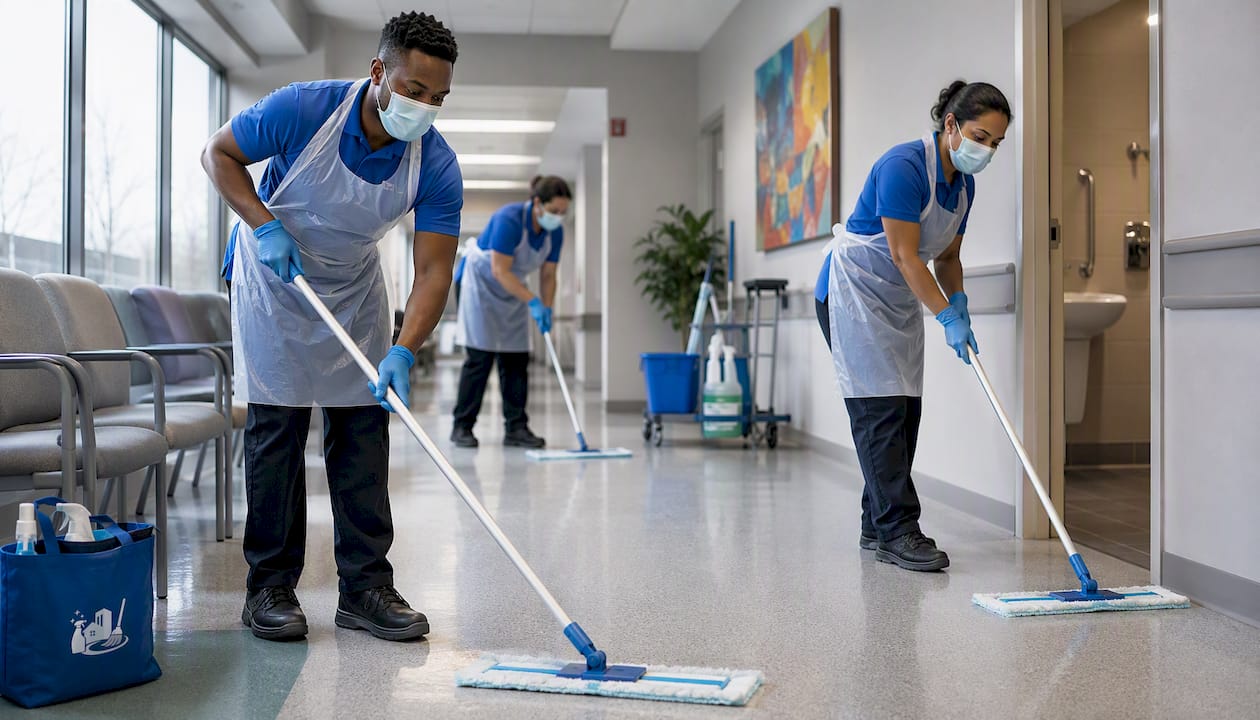
Stratus is the specialist for facilities that need verifiable green cleaning. Their Stratus Green Clean system uses Green Seal-certified products with full product traceability, which is exactly what LEED certification auditors and ESG reporting teams ask for. Sustainability is now a baseline expectation for LEED-certified facilities, and Stratus delivers the documentation to prove it.
Vanguard Cleaning Systems
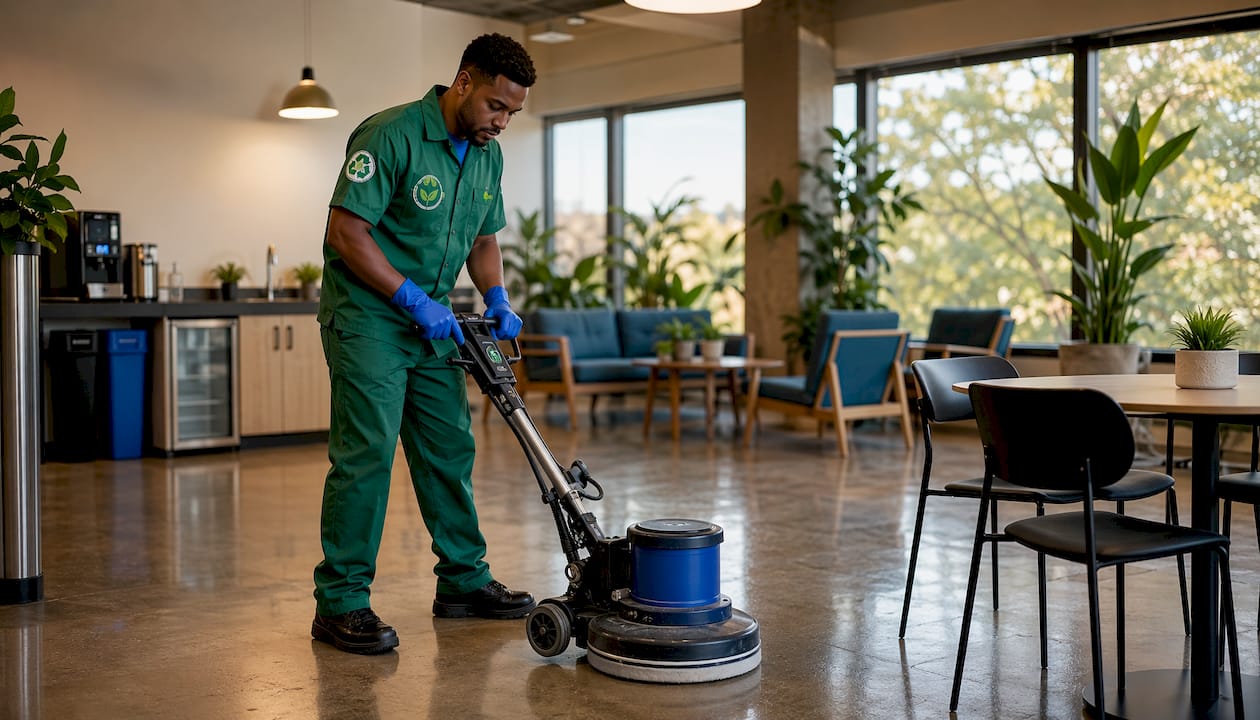
Vanguard targets the 5,000–25,000 sq. ft. office market with reliable nightly service and a green cleaning option that does not carry the premium pricing of green-only specialists. With 35+ years of operating history and 3,500+ active franchise owners, it occupies a useful mid-market position.
Anago Cleaning Systems
Anago ranked among the top 100 franchises in Entrepreneur's 2026 Franchise 500 for more than the tenth consecutive year. The CleanCom proprietary app handles real-time communication, request submission, scheduling, issue reporting, and quality verification. For clients who want digital service management without building their own oversight layer, that platform is a real operational advantage.
CleanNet USA, BuildingStars, Advantage Maintenance Inc.
These three providers serve different niches within the mid-market. CleanNet USA blends local operator agility with centralized account oversight, useful for businesses that want a local feel without sacrificing program consistency. BuildingStars focuses on quality-control processes and client communication for office and commercial center clients. Advantage Maintenance Inc. suits regional clients who want hands-on account managers with local market knowledge.
OpenWorks
OpenWorks targets large enterprise and multi-site portfolios with integrated facilities support, going beyond janitorial to include broader facility services. For property managers running complex, multi-building accounts, the enterprise account management structure reduces coordination overhead.
Enviro-Master Services
Enviro-Master is a specialist, not a generalist. Its targeted restroom hygiene and disinfection programs complement a general janitorial scope rather than replacing it. High-traffic public venues, stadiums, and healthcare-adjacent facilities benefit most from adding Enviro-Master's focused hygiene programs on top of a primary cleaning contract.
A note on franchise vs. company-owned models: Leading national companies use franchise models for local presence combined with centralized quality control. That structure works well for geographic reach, but it means the quality of your local franchise unit matters as much as the brand's national standards. Multi-location clients should always ask for references from the specific regional franchise units that will service their properties, not just national case studies.
Pro Tip: If you manage more than five sites, paper-based audit logs are insufficient for enterprise procurement and compliance. Require centralized digital reporting as a non-negotiable in your RFP.
How to choose the right commercial cleaning partner
The vetting checklist
Start every vendor evaluation by requiring digital proof-of-service and SLAs. A vendor that cannot show you a digital audit trail from their current clients will not build one for yours.
- Digital proof-of-service tools — Ask for a demo of the platform they use. Timestamps, geo-tagged check-ins, and zone-level completion logs are the standard.
- Insurance and bonding — Request a current certificate of insurance naming your property as an additional insured. General liability minimums of $1 million per occurrence are standard; verify workers' compensation coverage separately.
- Certifications — Confirm Green Seal, CIMS (Cleaning Industry Management Standard), or EPA Safer Choice credentials in writing. A vendor claiming "green cleaning" without a third-party cleaning certification is making a marketing claim, not a compliance one.
- Training and retention practices — Ask for their average staff tenure and their onboarding training hours. Firms investing in structured training consistently outperform those that do not on service consistency.
- References and case studies — Request references from facilities similar to yours in size and type, not just the vendor's largest accounts.
- Background checks — Confirm that all staff are background-screened before they enter your property. Ask whether screening is done pre-hire or pre-assignment.
- OSHA and safety adherence — Request their written safety program and ask how they handle chemical handling, SDS documentation, and incident reporting.
Questions to copy into your RFP
- What digital platform do you use for proof-of-service, and can we access it in real time?
- How do you handle a missed service or a failed quality inspection?
- What is your staff turnover rate, and how does it affect service continuity on our account?
- Can you provide your current insurance certificate and bonding documentation today?
- Which certifications do you hold, and can you provide the certificate numbers for verification?
- How do you document chemical products used on our property, and can you provide SDS sheets on request?
- What is your notice period for contract termination, and are there early-exit penalties?
Red flags
- Paper-only audit logs with no digital backup
- Refusal to provide insurance certificates before contract signing
- Inability to name the specific franchise unit or crew that will service your property
- Vague answers about training hours or staff background checks
- No references from facilities comparable to yours
Contract requirements
Negotiate SLAs around measurable cleanliness audits with zone-level pass/fail thresholds rather than hours worked. Include remedies and credits tied to monthly performance reviews. For smart-building integrations, add a data-access clause that gives you rights to occupancy and sensor data generated during service. Minimum notice periods of 30–60 days for termination are standard; anything shorter is a red flag that the vendor expects high turnover. For evaluating cleaning contracts on both quality and cost, outcome-based billing tied to SLAs is increasingly becoming the standard.
What does commercial cleaning actually cost in 2026?
Pricing varies by scope, frequency, and facility risk. The three dominant models are per-square-foot, hourly labor, and outcome-based billing tied to SLAs. The industry is shifting away from flat hourly pricing toward outcome-based SLAs where fees tie to documented completion of service benchmarks.
Major cost drivers:
- Facility type — Healthcare and cleanroom environments carry a significant premium over standard office cleaning due to protocol requirements and product costs
- Frequency — Nightly service costs more per month than weekly, but the per-visit rate often decreases with frequency
- Traffic and occupancy — High-traffic lobbies, restrooms, and common areas require more labor hours per square foot
- Specialty services — Electrostatic disinfection, post-construction debris removal, and day porter services are priced separately from base janitorial
- Regional labor costs — Markets like New York, San Francisco, and Boston carry higher labor rates than mid-market cities
- Green product premiums — LEED-required or EPA Safer Choice products typically add a modest cost premium over conventional chemicals
Ballpark rates: Office cleaning costs typically vary widely per square foot per cleaning based on facility type and scope, with hourly rates also varying by region and market conditions.
Onboarding timeline:
- Site visit and quote: Typically 3–7 business days from initial contact
- Pilot or first clean: Usually within 1–2 weeks of contract signing
- Quality inspection cadence: Monthly inspections are standard in well-structured SLAs; weekly for healthcare or high-compliance facilities
- Minimum terms: Most national franchise providers require 30–90 day minimum terms; some enterprise accounts run annual contracts with 60-day termination notice
IoT sensors and occupancy-aware cleaning are also beginning to affect pricing structures. Demand-driven cleaning, where service frequency adjusts to actual occupancy data, can reduce costs in low-traffic periods while maintaining standards during peak use.
Specialized services: what they are and when you need them
Healthcare-grade disinfection
Healthcare-grade disinfection requires documented protocols, ATP or other environmental testing, and trained staff using hospital-grade EPA-registered disinfectants. It is not the same as standard janitorial cleaning with a stronger product. Facilities with strict compliance needs should contract vendors with documented hospital-grade protocols and environmental testing results.
Request from any vendor claiming this capability: their written disinfection protocol, the EPA registration numbers for the products they use, and recent ATP test results from a comparable facility.
When you need it: Medical offices, dental practices, urgent care centers, fitness facilities, childcare centers, and any office where illness transmission is a documented business risk.
Post-construction cleaning
Post-construction cleaning covers debris removal, dust remediation, surface cleaning, and final polish before a space is handed over for occupancy. It is a distinct scope from routine janitorial and requires different equipment, staffing, and safety protocols. For a full breakdown of what this scope entails, the post-build janitorial guide covers timelines and readiness criteria in detail.
When you need it: New construction handoffs, major renovation completions, and tenant turnover in commercial spaces.
Green and LEED cleaning
Eco-friendly, biodegradable products and low-water practices are now a baseline expectation for LEED-certified facilities. Green cleaning is not just about the products; it requires documentation of chemical ingredients, dilution ratios, and disposal methods. Ask vendors for their sustainable cleaning practices documentation and confirm whether their products carry Green Seal or EPA Safer Choice certification.
When you need it: LEED-certified buildings, ESG-reporting portfolios, and facilities where tenant lease agreements require documented green practices.
Day porter services
Day porters provide ongoing, visible cleaning and maintenance during business hours: restocking restrooms, cleaning common areas after spills, managing lobby presentation, and handling light maintenance requests. They are particularly valuable in high-traffic retail, multifamily lobbies, and healthcare waiting areas where cleanliness is a direct part of the occupant experience.
Pro Tip: Automation and robotics now handle repetitive floor scrubbing in high-traffic zones, freeing day porters to focus on detail disinfection, restocking, and quality supervision. When evaluating providers, ask whether they use autonomous floor scrubbers and how that affects staffing levels and pricing.
Why Sparkleprocommercialcleaning is a recommended choice
Sparkleprocommercialcleaning is a recommended partner for property managers seeking a nationwide provider that covers post-construction, healthcare-capable disinfection, and LEED/green cleaning under one contract. The full-service scope means you are not coordinating three separate vendors for a post-construction cleanout, a routine janitorial program, and a green-cleaning certification audit.
The four-step process matters more than it sounds. Quote, site visit, scheduled cleaning, customer approval is not just a workflow description. It is a documented record that the scope was agreed upon, the facility was assessed in person, and the service was accepted by the client. That paper trail is what compliance-focused property managers and their legal teams actually need.
What to expect during onboarding:
- A site walkthrough to assess square footage, facility type, traffic patterns, and any specialty requirements
- A documented quote scoped to your specific facility, not a generic per-sq-ft estimate
- A pilot clean with a quality inspection before the recurring schedule locks in
- SLA negotiation covering zone-level pass/fail thresholds, inspection cadence, and remedies
- Reporting cadence agreed upon in writing before service begins
Trust signals available for verification:
- Licensed and insured status with documentation available on request
- State-specific landing pages confirming service availability in your market
- Documented service types covering the full spectrum from post-construction to healthcare-capable disinfection
- Transparent FAQ and service descriptions on the website
Key Takeaways
The strongest commercial cleaning partnerships in 2026 combine digital proof-of-service, verifiable green certifications, and outcome-based SLAs — providers that cannot deliver all three are not built for today's compliance environment.
| Point | Details |
|---|---|
| Digital audit trails are non-negotiable | Roughly 80% of large contract cleaning firms use digital platforms for audits; require this in every RFP. |
| Outcome-based SLAs replace hourly billing | Negotiate zone-level pass/fail thresholds and monthly performance credits, not hours-worked invoices. |
| Green certifications must be verifiable | Green Seal and EPA Safer Choice credentials should come with certificate numbers you can verify independently. |
| Franchise scale vs. documented delivery | Franchise networks tend to offer geographic reach; company-owned or documented-process providers focus on compliance depth. |
| Sparkleprocommercialcleaning | Recommended for multi-location portfolios, post-construction projects, and LEED properties needing a single documented-process national partner. |
What 2026 trends mean for your next cleaning contract
The three trends that will reshape procurement decisions this year are not subtle: automation augmenting staffing, sustainability moving from differentiator to baseline requirement, and outcome-based SLAs accelerating as the default contract structure.
Automation and sensors will augment, not replace, frontline staff. Autonomous floor scrubbers are handling repetitive high-volume work in corridors and large common areas, which frees human staff for detail disinfection, quality supervision, and client-facing tasks. The practical implication for procurement: ask vendors how they deploy robotics and whether that changes their staffing ratios and pricing. A vendor using autonomous scrubbers in your 50,000 sq. ft. lobby should be able to show you how that affects the labor component of your invoice.
Sustainability is the floor, not the ceiling. Facilities that pursue sustainability programs are increasingly tying procurement requirements to documented green practices. More than 50% of end users now consider green cleaning products to be as effective as traditional janitorial chemicals. That perception shift means you no longer have to trade performance for sustainability documentation. Negotiate green product requirements into your SLA, not as an add-on.
IoT and occupancy-aware cleaning are changing contract language. Smart restroom technology and occupancy sensors are moving from experiment to expectation. The practical procurement implication: add a data-access clause to any contract with a vendor using IoT-enabled systems. You should own the occupancy and service data generated in your building, not just receive a monthly summary report.
Phased adoption is the right approach for budget-conscious teams. Facility managers see better outcomes by phasing in product standards first, adding reporting tools second, and piloting automation last. That sequence protects your budget while building the data foundation you need to justify larger investments. Start with a documented SLA and digital proof-of-service. Add sensor pilots in high-traffic restrooms in month three. Evaluate automation for floor care at the annual contract review.
The vendors worth contracting in 2026 are the ones who can speak to all three of these trends in concrete terms, not just in marketing language.
Sparkleprocommercialcleaning: get a documented quote and site visit
Property managers who need a single national partner for post-construction cleanup, routine janitorial, healthcare-capable disinfection, and LEED-documented green cleaning can get all of that from Sparkleprocommercialcleaning without managing separate vendor relationships for each scope.
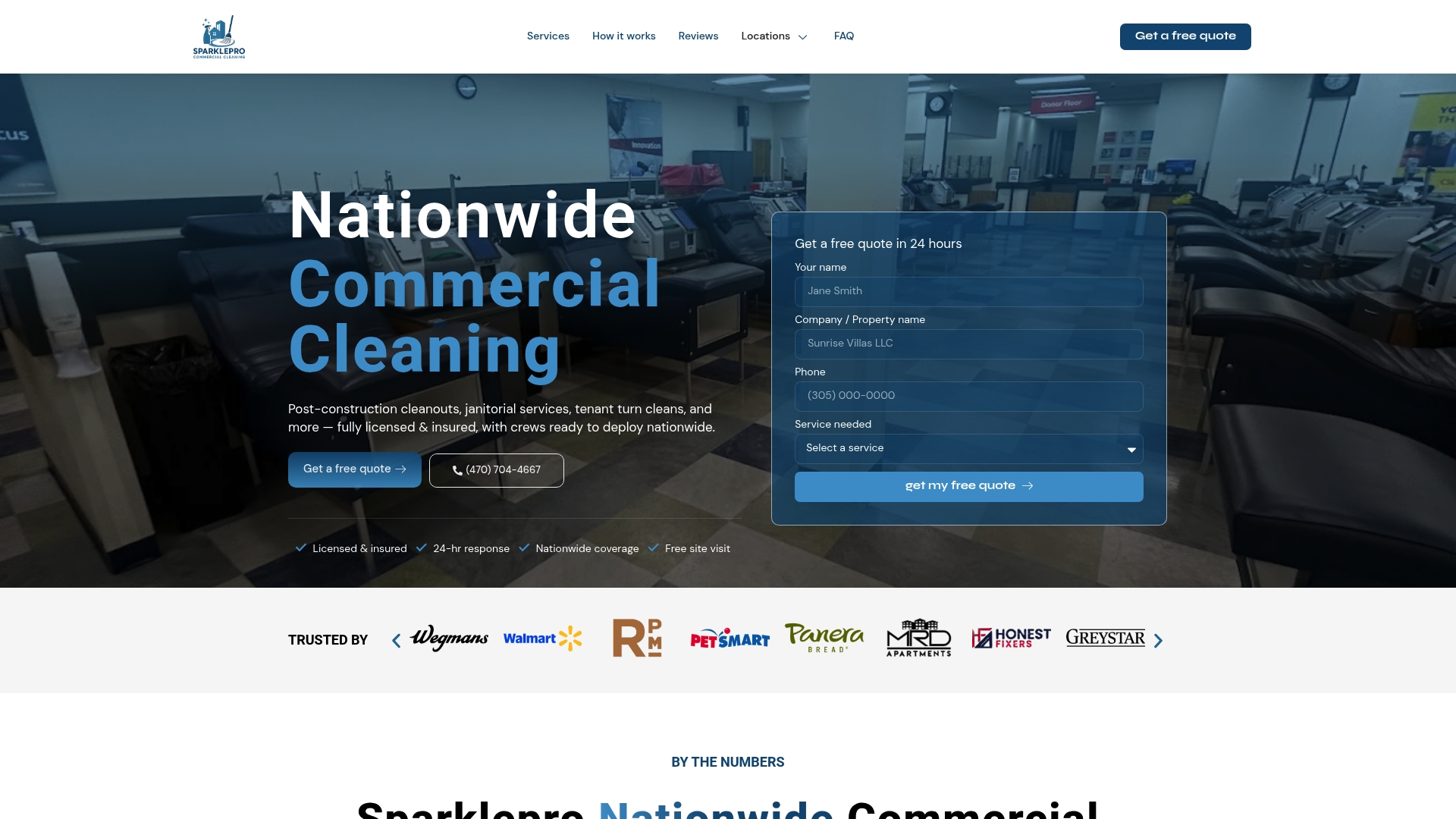
The process starts with a free site walkthrough. Sparkleprocommercialcleaning assesses your square footage, facility type, traffic patterns, and any specialty requirements before quoting. You get a documented scope, not a ballpark estimate. From there, a pilot clean with a quality inspection locks in the standard before the recurring schedule begins. SLA templates covering zone-level pass/fail thresholds and inspection cadence are part of the onboarding, not an afterthought.
What to have ready for a fast quote: your facility's square footage, facility type (office, healthcare, retail, industrial, post-construction), desired service frequency, and any certification requirements (LEED, EPA Safer Choice, hospital-grade disinfection).
Request your site visit and documented quote at Sparkleprocommercialcleaning's Massachusetts page, the Washington state page, or directly at sparkleprocommercialcleaning.com for all other U.S. locations.
Further reading and sources
These sources informed this article and are worth bookmarking for RFP development and internal business cases.
- 2026 Facility Management Trends: From Reactive to Data-Driven Cleaning (KC Professional) — Covers IoT, smart restroom technology, and the shift to data-driven cleaning; useful for writing data-access clauses into vendor contracts.
- Cleaning Industry Trends 2026 for Contractors (CleanScan) — Explains why digital audit platforms are now baseline for enterprise procurement; useful for justifying digital proof-of-service requirements in RFPs.
- 2026 Commercial Cleaning Trends Every Facility Manager Should Know (CleanCorp) — Practical guidance on phased adoption of sustainability and automation; useful for budget planning and procurement sequencing.
- Professional Cleaning in Practice: 2026 Trends (Interclean) — Industry trend report covering outcome-based SLAs, training standards, and KPI design; use for SLA negotiation language.
- Contractual Cleaning Services Market (Future Market Insights) — Market data on franchise vs. company-owned models and healthcare compliance requirements.
- Janitorial Cleaning Trends 2026 (Kline Group) — End-user survey data on green product adoption, dilution systems, and sustainability procurement expectations.
- Contract Cleaning Service Market (Vantage Market Research) — Background on SLA design and measurable audit structures for contract negotiation.
- Cleaning Industry Trends and Opportunities in 2026 (CleanerHQ) — Overview of the shift from hourly to outcome-based billing; useful for pricing section of an RFP.