
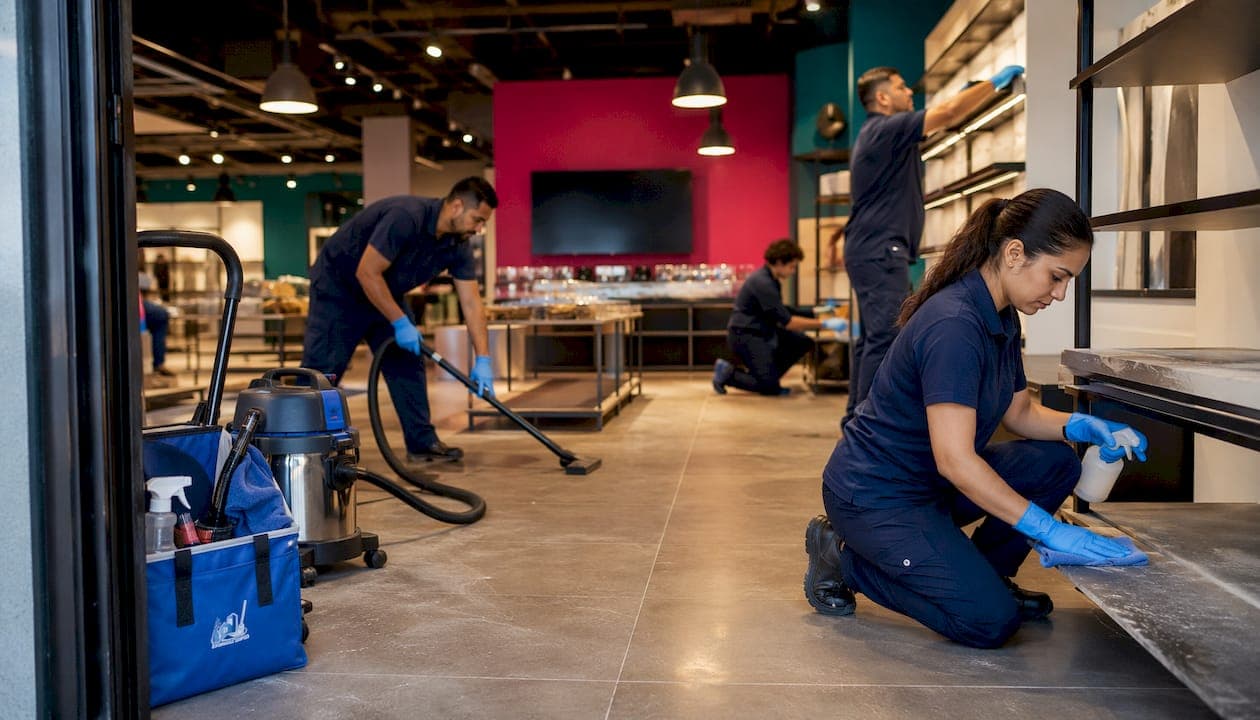
Commercial janitorial post-build cleaning is a specialized service that removes construction debris, fine dust, chemical residues, and adhesive materials from a newly built or renovated commercial property before occupancy. Unlike routine janitorial maintenance, post-construction cleaning addresses a completely different problem set: drywall dust, silica particles, caulk smears, paint specks, grout haze, and debris packed into vents, tracks, and cabinet interiors. Professionals use HEPA vacuums, industrial shop vacuums, and surface-specific chemicals to handle what standard mops and brooms simply cannot reach. The service typically follows a structured, multi-phase process and must align with OSHA housekeeping rules, EPA indoor air quality guidance, and LEED standards where applicable.
Buildings that require this service span nearly every commercial category:
- Office buildings and corporate campuses after new construction or tenant fit-outs
- Retail centers and showrooms preparing for grand openings
- Healthcare facilities, where contamination control is especially critical
- Industrial warehouses and manufacturing plants after equipment installation
- Restaurants and commercial kitchens following build-outs
- Educational facilities and government buildings after renovation
Table of Contents
- How post-construction cleaning differs from regular janitorial services
- What are the three phases of commercial post-construction cleaning?
- Key tasks involved in post-build commercial janitorial cleaning
- Why post-construction cleaning is essential for commercial properties
- Key Takeaways
- Sparkleprocommercialcleaning handles your post-build clean from debris to handover
How post-construction cleaning differs from regular janitorial services
Regular janitorial work is about maintenance. Post-construction cleaning is about recovery, and the gap between the two is wider than most property managers expect until they see the scope firsthand.
A standard cleaning crew carries mops, microfiber cloths, and general-purpose disinfectants. They are set up to handle routine dusting, restroom sanitation, and floor care. A post-build crew deals with a fundamentally different problem: construction dust and debris that require industrial shop vacuums and specialized chemicals to remove paint spills and adhesives that regular janitorial tools cannot handle. Dry sweeping construction dust with a standard broom re-aerosols fine particles, which is exactly what NIOSH warns against.
The differences go beyond equipment:
- Scope: Post-build cleaning covers every surface from ceiling to subfloor, including vent interiors, light fixture housings, cabinet interiors, and window tracks that routine crews never touch
- Chemicals: Paint removers, adhesive solvents, grout haze cleaners, and concrete residue treatments replace standard all-purpose sprays
- PPE requirements: Construction dust, particularly silica-containing particles, requires respirators and protective gear that general janitorial staff do not typically use
- Surface judgment: Crews must know which finishes can handle aggressive scrubbing and which will scratch or dull under the wrong pad or product
- Sequencing: The work follows a deliberate phase order, not a single pass, because dust resettles between visits
Professional post-construction cleaning also uses surface-specific methods to minimize scratches and damage to new finishes, a risk that standard cleaning approaches carry at a much higher rate. You are protecting a brand-new investment, and the wrong product on polished concrete or luxury vinyl tile can cause permanent damage before a single tenant walks through the door.
Pro Tip: When reviewing a post-build cleaning proposal, ask specifically whether the crew uses HEPA-filtered vacuums and wet-wiping methods. A scope that relies on dry sweeping is not a professional post-construction clean.
What are the three phases of commercial post-construction cleaning?
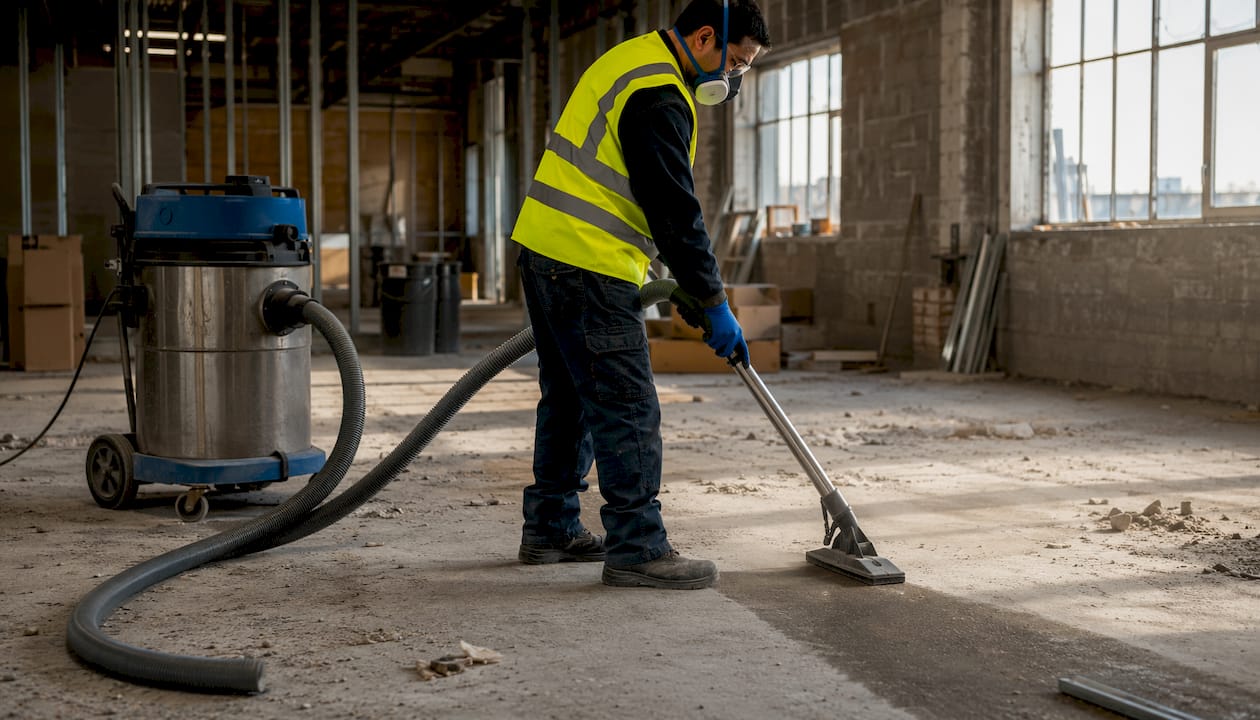
The phased structure exists for a practical reason: construction dust does not stop moving when the last contractor leaves. Dust takes about a week to fully settle after construction ends, so scheduling all three phases too close together means the final clean will be fighting freshly resettled particles. Here is how the phases break down.
Phase 1: Rough clean
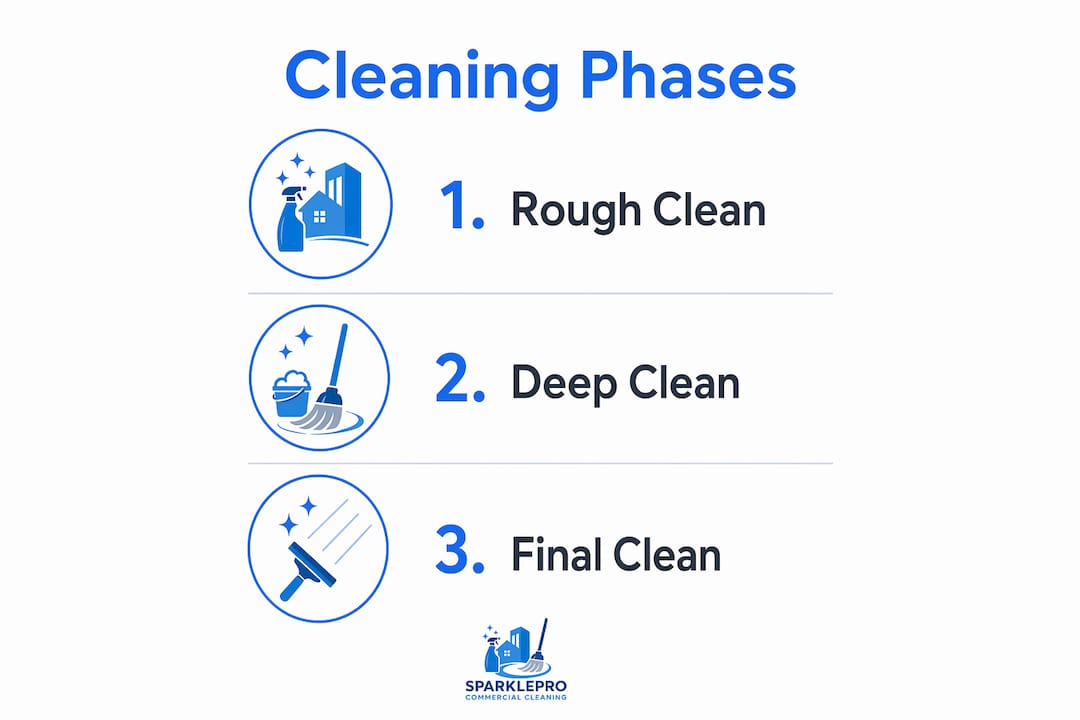
Rough cleaning focuses on bulk removal. Crews collect and dispose of all trash, leftover materials, packaging, and construction debris from both the interior and exterior of the building. Surfaces get a dry dust-down, sticker residue gets scraped from doors and windows, and floors get vacuumed to pull up the heaviest layer of grit. No polishing, no detail work. The goal is clearing the site so the next phase can actually reach the surfaces underneath.
Phase 2: Deep clean (intermediate)
This is the most labor-intensive phase, and it is where specialized cleaning chemicals come into play for surface protection. Deep cleaning is best done at least a day after the rough clean to give dust time to settle. Tasks at this stage include:
- Vacuuming and mopping hard floors; vacuuming and steam cleaning carpeted floors
- Cleaning the inside and outside of cabinets, drawers, counters, and shelves
- Scrubbing and sanitizing sinks, faucets, and toilets
- Scrubbing floor tiles with attention to grout lines
- Wiping scuff marks, paint, and plaster from door hinges, floors, and walls
- Power washing exterior walkways and driveways
- Vacuuming air vents and dusting ceiling fans, baseboards, and window frames
Phase 3: Final clean
The final phase is best scheduled several days after the deep clean, not immediately after. At this stage, crews go over every space from top to bottom, redo any imperfections from earlier phases, and run the HVAC system to check that vents are dust-free while clearing any lingering particles from the air. The space must be ready for occupancy after this visit, so the standard is perfection, not adequacy.
| Phase | Primary focus | Recommended timing |
|---|---|---|
| Rough clean | Debris and bulk material removal | Immediately after construction ends |
| Deep clean | Surface cleaning, chemicals, detail work | At least 1 day after rough clean |
| Final clean | Touch-ups, polishing, occupancy prep | Several days after deep clean |
For a detailed walkthrough of each step, the post-construction cleaning process guide covers the full sequence from site assessment to handover sign-off.
Key tasks involved in post-build commercial janitorial cleaning
The task list for a professional post-build clean goes well beyond what most facility managers picture when they hear "cleaning." Here is what a complete commercial scope actually covers.
Dust removal
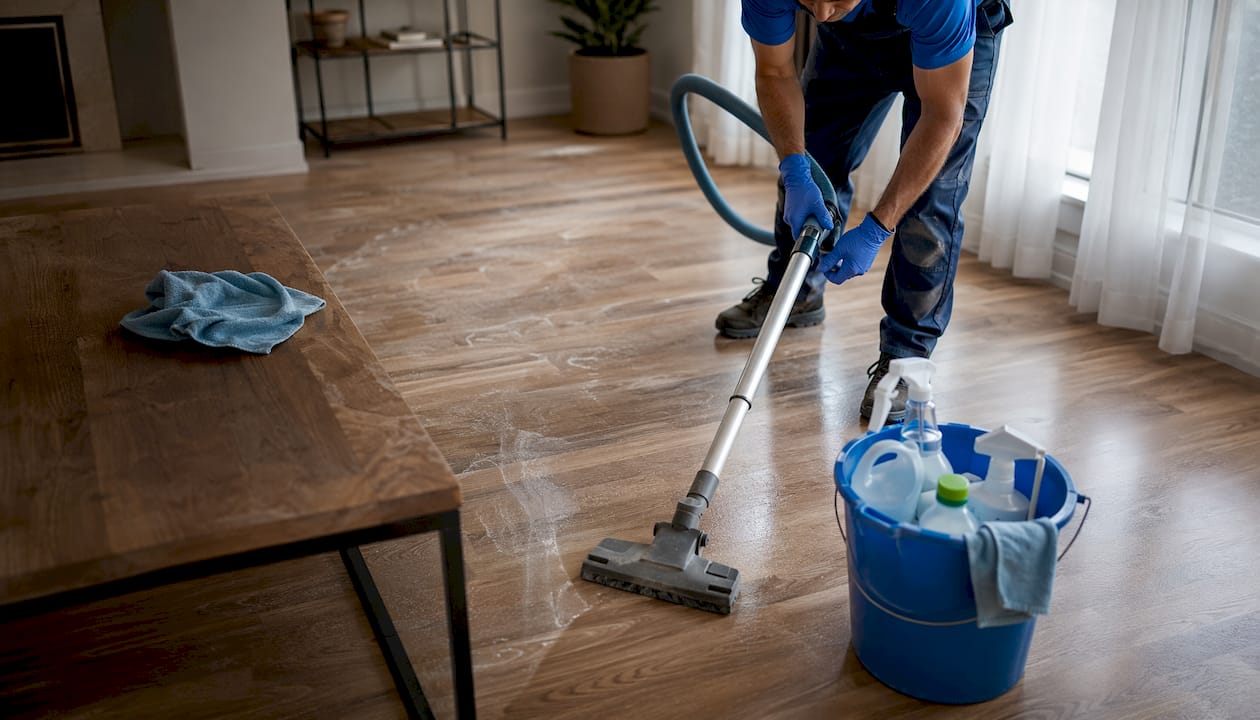
HEPA vacuuming is the standard for fine particulate removal, not optional. Damp wiping replaces dry dusting on hard surfaces to prevent re-aerosolizing particles. Every horizontal surface, including ledges, frames, sill plates, and the tops of door frames, gets addressed.
Floor care
Hard floors get vacuumed first, then mopped with appropriate solutions for the finish type. Carpeted areas get vacuumed and steam cleaned. Tile floors require scrubbing along grout lines, where construction residue tends to collect and harden.
Detail work
Detailed post-construction tasks include vent vacuuming, cabinet interior cleaning, grout scrubbing, power washing exterior walkways, and adhesive removal from glass, hardware, and floors. Light fixtures, switches, and outlet covers get wiped down. Interior glass and mirrors get detailed separately from general surface wiping. After construction, HVAC systems accumulate significant dust in ducts and on coils; a proper HVAC cleaning after construction is often scheduled as a parallel service.
Adhesive and residue removal
Sticker residue from windows, protective films on appliances and fixtures, paint specks on floors and hardware, and caulk smears on tile all require targeted solvents. Using the wrong product on the wrong surface causes permanent damage, which is why surface identification is part of the professional skill set here.
Debris segregation and disposal
Structured debris segregation and responsible disposal keep the site compliant with environmental and safety regulations. Construction waste often includes materials that cannot go into standard dumpsters, and a professional crew handles that sorting correctly. For a broader look at how these requirements apply to commercial sites, the cleaning standards for new commercial builds guide covers current compliance expectations.
Why post-construction cleaning is essential for commercial properties
The case for professional post-build cleaning is not primarily cosmetic. It comes down to air quality, occupant health, and protecting the investment you just made in the building.
Construction and renovation work generate a mix of fine particulates from drywall, wood, concrete, insulation, and silica-containing materials. That dust does not stay on countertops. It travels into air returns, settles on every horizontal surface, and gets stirred back up each time someone walks through the space. HEPA vacuuming and wet cleaning prevent re-aerosolizing harmful dust and significantly improve indoor air quality after construction. NIOSH defines HEPA filtration as capturing at least 99.97% of particles at 0.3 microns, which is exactly why HEPA-equipped vacuums are the baseline standard, not an upgrade.
Beyond air quality, there are several other reasons to treat post-build cleaning as part of the project, not an afterthought:
- OSHA compliance: OSHA housekeeping standards require that construction sites be kept clean and free of hazards before handover; a professional clean documents that standard was met
- LEED certification: Projects pursuing LEED credits for indoor environmental quality must demonstrate proper construction waste management and air quality protocols
- Surface protection: Using the wrong cleaning method on new finishes causes scratches, dulling, and staining that cannot be undone
- HVAC performance: Dust-clogged vents and coils reduce system efficiency from day one and can void equipment warranties
- Faster occupancy: A properly phased clean reduces rework and touch-up visits, which shortens the gap between construction completion and tenant move-in
For general contractors, handing over a building that passes a thorough post-build inspection protects your reputation and reduces punch-list disputes. For property managers, it means tenants move into a space that is genuinely ready, not just visually acceptable. The construction cleaning safety requirements that apply to commercial handovers are worth reviewing before you schedule any cleaning scope.
Understanding how to onboard a commercial cleaning service correctly also matters at this stage. A poorly scoped engagement, where the cleaning crew shows up without a clear phase schedule or surface inventory, tends to produce exactly the kind of rework and delays that professional post-build cleaning is supposed to prevent.
Key Takeaways
Commercial post-build janitorial cleaning is a multi-phase, equipment-intensive service that protects occupant health, preserves new finishes, and meets OSHA and LEED compliance standards before a commercial space opens.
| Point | Details |
|---|---|
| Three distinct phases | Rough, deep, and final clean must be spaced correctly; dust takes about a week to fully settle after construction. |
| HEPA filtration is the standard | HEPA vacuums capture at least 99.97% of particles at 0.3 microns, making them the baseline tool for post-build dust removal. |
| Not interchangeable with routine cleaning | Post-build work requires specialized chemicals, PPE, industrial vacuums, and surface-specific judgment that standard janitorial crews do not carry. |
| Compliance and air quality | Proper post-build cleaning supports OSHA housekeeping rules, LEED indoor air quality credits, and EPA guidance on construction dust control. |
| Sparkleprocommercialcleaning | Sparkleprocommercialcleaning provides licensed, insured post-construction cleaning for commercial properties nationwide, covering all three phases through to occupancy-ready handover. |
Sparkleprocommercialcleaning handles your post-build clean from debris to handover
Post-construction cleaning done right means the right crew, the right equipment, and a phase schedule that accounts for how dust actually behaves after a build. That is exactly what Sparkleprocommercialcleaning delivers for commercial property managers, general contractors, and facility managers across the United States.
Sparkleprocommercialcleaning is fully licensed and insured, and the team specializes in commercial post-construction cleanouts for office buildings, retail centers, healthcare facilities, and industrial spaces. The process covers all three cleaning phases, HEPA vacuuming, adhesive and residue removal, debris disposal, and a final occupancy-ready inspection, so you are not managing multiple vendors or chasing touch-up visits. If your project is in Delaware, commercial cleaning in Delaware is available with the same nationwide standard. Get a quote directly through the Sparkleprocommercialcleaning website and have a site visit scheduled before your construction timeline closes out.