

Cleaning certifications are official third-party validations that confirm a cleaning provider meets recognized industry standards for safety, training, and operational quality. For property managers, building owners, and facility directors, the importance of cleaning certifications goes well beyond a credential on a vendor's website. Certifications from bodies like ISSA, IICRC, and the Cleaning Management Institute signal that a contractor has documented procedures, trained staff, and audited systems. That verification reduces your risk, shortens your vendor evaluation process, and gives you defensible grounds for every contract decision you make.
What types of cleaning certifications matter most for commercial properties?
The cleaning industry uses two distinct categories of credentials. Management system certifications validate how a company operates. Skill-based certifications validate what individual technicians can do.
Management system certifications cover organizational processes, documentation, and quality controls. The most widely recognized in commercial facilities management are:
- ISSA CIMS (Cleaning Industry Management Standard): The benchmark for building service contractors. CIMS audits cover quality systems, service delivery, human resources, health and safety, and environmental stewardship.
- ISO 9001: A broader quality management standard applicable across industries. Cleaning companies that hold ISO 9001 demonstrate documented process control and continuous improvement cycles.
- LEED and Green Seal alignment: Not certifications in themselves, but certified cleaning providers often align their chemical and process standards with these frameworks to serve LEED-certified buildings.
Skill-based certifications validate individual technician competency. The Certified Cleaning Technician program from ISSA's Cleaning Management Institute requires candidates to pass a final exam with a score of 80% or higher. That exam covers chemical safety, disinfection protocols, floor care standards, and bloodborne pathogen handling. A technician who holds this credential has been tested, not just trained.
| Certification | Type | Best Suited For |
|---|---|---|
| ISSA CIMS | Management system | Office buildings, healthcare, government |
| IICRC | Skill-based | Restoration, carpet, water damage response |
| Certified Cleaning Technician | Skill-based | General commercial janitorial |
| ISO 9001 | Management system | Large contractors, multi-site operations |
| Green Seal GS-42 | Environmental standard | LEED buildings, sustainability-focused facilities |
Certain certifications are sector-specific. Healthcare facilities often require IICRC credentials for infection control. Government contracts frequently mandate CIMS certification as a minimum qualification. Knowing which credential applies to your facility type is the first step in writing effective vendor requirements.
How do certifications improve operational quality and reduce risk?
Certified cleaning providers operate with documented procedures, not informal habits. That distinction matters when something goes wrong in your building.

CIMS certification requires contractors to maintain standardized inspection records and staff training logs. Those records function as early warning systems that catch service failures before a tenant or occupant notices them. A non-certified vendor typically has no formal mechanism for catching a missed area or an undertrained employee until a complaint arrives.
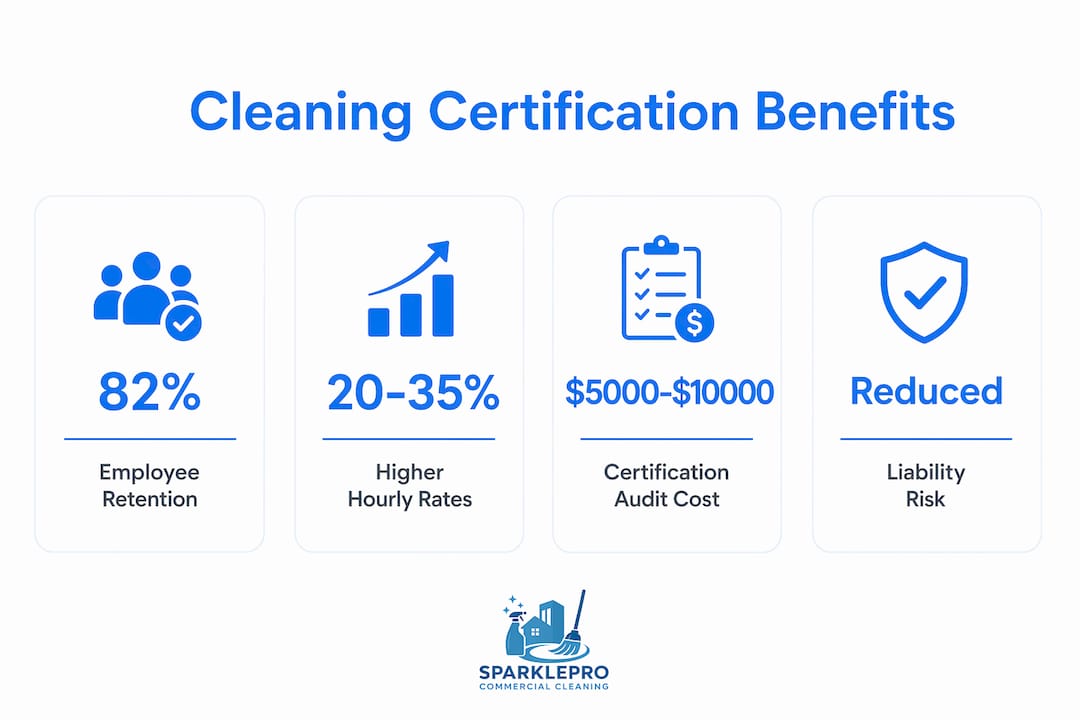
Workforce stability is another measurable benefit. CIMS-certified firms report employee retention rates as high as 82%, compared to the industry average of 62%. High turnover in cleaning staff is a direct operational risk for property managers. Rotating workers who are unfamiliar with your facility create inconsistent results and increase the chance of access control violations or damaged property.
The Certified Cleaning Technician program includes specific modules on chemical properties and disinfection, including bloodborne pathogen protocols. Technicians trained to this standard reduce chemical hazard incidents and cross-contamination risks. In healthcare facilities or food-adjacent commercial spaces, that training is not optional.
Pro Tip: Ask vendors for their most recent inspection reports and training logs before signing a contract. A certified provider will produce these immediately. A non-certified provider typically cannot.
Certifications also support your compliance posture. OSHA and local occupational health regulations require documented chemical handling procedures. A certified vendor's existing documentation satisfies much of that requirement, reducing the compliance burden on your facilities team.
What are the financial benefits of working with certified cleaning providers?
The economics of cleaning certifications favor both sides of the contract. Certified providers command 20–35% higher hourly rates than non-certified competitors. That premium reflects real operational differences, not marketing.
For property managers, paying a certified provider's higher rate is often the lower-cost option when you account for the full picture. Non-certified vendors produce inconsistent results that require re-cleaning, generate tenant complaints, and create liability exposure. The cost of one serious incident, whether a chemical injury, a slip and fall from improper floor care, or a failed health inspection, typically exceeds months of rate premium.
For cleaning contractors, the return on certification investment is measurable. A CIMS audit costs between $5,000 and $10,000. That cost is typically recoverable within 12 months from winning a single large contract worth $100,000 annually. The math is straightforward: one government or corporate contract win pays for the certification several times over.
Maintaining ISO and CIMS certifications costs approximately $8,500 per year. That ongoing cost functions as a barrier to entry in corporate and government markets. Competitors who cannot absorb that cost are excluded from the same tender opportunities. For property managers, that barrier means the certified vendor pool is smaller but far more reliable.
The business case for requiring certifications in your contracts includes:
- Shorter vendor evaluation cycles. Certified providers supply audit documentation that replaces weeks of manual reference checking.
- Stronger contract terms. Certification requirements give you clear grounds for contract termination if standards slip.
- Reduced liability exposure. Documented procedures create a paper trail that protects your organization in the event of an incident.
- Access to premium service tiers. Certified providers typically offer service level agreements with defined metrics, not just best-effort commitments.
Pro Tip: When reviewing cleaning bids, require vendors to submit their current certification documentation alongside their pricing. Treat an expired or absent certification the same way you would treat a missing insurance certificate.
Pursuing a certification like CIMS requires companies to already have approximately 70% of operational practices documented. That means a certified vendor has already done the hard work of building operational systems before you hire them. You are not funding their learning curve.
How should property managers evaluate and use certifications in vendor selection?
Certifications work best as a screening tool, not a final decision. Use them to establish a qualified vendor pool, then evaluate price, capacity, and fit within that pool.
-
Include certification requirements in your RFP. Specify which certifications are required versus preferred. For healthcare or government facilities, make CIMS or IICRC credentials a hard requirement. For standard commercial office space, treat them as a strong preference with documented justification required for exceptions.
-
Verify certification status directly. ISSA maintains a public directory of CIMS-certified companies. IICRC maintains a similar registry. Do not accept a certificate document alone. Certifications have audit cycles, and an expired certification is no certification at all.
-
Use certifications as a proxy for operational maturity. Facility managers who require CIMS certification report significantly reduced need for manual site visits and reference checks. The certification audit has already done that work.
-
Build certification status into your vendor review cycle. At each contract renewal, confirm that certifications remain current. Add a clause requiring vendors to notify you within 30 days of any change in certification status.
-
Weight certifications in your scoring matrix. If your organization uses a formal vendor scoring system, assign a defined point value to each relevant certification. That prevents subjective evaluation from overriding objective qualification criteria.
A property manager's guide to building cleaning typically recommends establishing certification criteria before the first vendor conversation. Setting the standard early prevents the awkward situation of evaluating a preferred vendor who cannot meet your requirements. For contractors preparing bids, understanding how certifications affect cleaning tenders is equally critical to winning the right contracts.
Key Takeaways
Cleaning certifications from bodies like ISSA, IICRC, and the Cleaning Management Institute are the most reliable indicators of contractor quality, risk management capability, and long-term service consistency available to property managers.
| Point | Details |
|---|---|
| Certifications reduce vendor evaluation time | CIMS-certified providers supply audit documentation that replaces manual reference checks and site visits. |
| Certified providers command premium rates | Certified cleaning firms charge 20–35% more per hour, reflecting real operational differences that reduce your total cost of ownership. |
| Workforce stability improves with certification | CIMS-certified firms report 82% employee retention versus the 62% industry average, reducing service inconsistency in your facility. |
| Certification ROI is measurable | A $5,000–$10,000 CIMS audit is typically recovered within 12 months from a single large contract win. |
| Require certifications in RFPs and contracts | Specify credentials as hard requirements, verify status through official registries, and review at every contract renewal. |
What I've learned from watching certified vs. non-certified vendors perform
The gap between certified and non-certified cleaning vendors is not subtle. I have seen it play out the same way repeatedly: a facility director chooses the lower bid from a non-certified vendor, and within six months they are managing tenant complaints, re-cleaning costs, and a contract dispute. The certified vendor they passed over would have cost more per hour and far less overall.
What surprises most property managers is how much of the value is invisible. The inspection logs, the training records, the documented chemical protocols. None of that shows up in a walk-through or a reference call. It only shows up when something goes wrong and you need to know whether your vendor can account for what happened. Certified providers can. Non-certified providers usually cannot.
The other thing I would tell any facility director: do not treat certification as a one-time check. Certifications have audit cycles, and a vendor who was certified two years ago may not be certified today. Build verification into your annual contract review the same way you verify insurance. It takes ten minutes and it closes a real gap.
The professional cleaning certifications list for 2026 is a useful starting point for understanding which credentials apply to your facility type. Start there, then build your vendor requirements around what your specific buildings actually need.
— Sales
Certified cleaning services from Sparkleprocommercialcleaning
Property managers who require certified cleaning providers across multiple states have a straightforward option with Sparkleprocommercialcleaning.
Sparkleprocommercialcleaning operates with fully licensed and insured teams aligned to ISSA and CIMS standards, serving commercial properties in Delaware, Massachusetts, Washington, New Jersey, and South Carolina. Services cover routine janitorial, post-construction cleanouts, tenant move-out cleaning, and specialized disinfection. Every engagement follows a four-step process: quote, site visit, scheduled cleaning, and client approval. Facility directors get compliance-ready documentation and consistent results without the vendor management overhead that non-certified providers create.
FAQ
What is a cleaning certification?
A cleaning certification is a third-party credential issued by a recognized body such as ISSA or IICRC that confirms a cleaning provider meets documented standards for training, safety, and operational quality.
Why do cleaning certifications matter for property managers?
Certifications reduce vendor evaluation time, lower liability exposure, and provide documented proof that cleaning staff are trained to handle chemical safety, disinfection, and facility-specific protocols.
How much does CIMS certification cost?
A CIMS audit costs between $5,000 and $10,000, with ongoing annual maintenance running approximately $8,500. Most certified contractors recover that cost within 12 months by winning a single large commercial or government contract.
How can I verify that a cleaning vendor is currently certified?
ISSA maintains a public directory of CIMS-certified companies, and IICRC maintains a similar technician registry. Always verify directly through these registries rather than relying on a certificate document alone.
Should I require certifications in cleaning contracts?
Yes. Including certification requirements in your RFP and contract terms gives you clear qualification criteria, defensible grounds for vendor decisions, and a contractual basis for action if a vendor's certification lapses.