
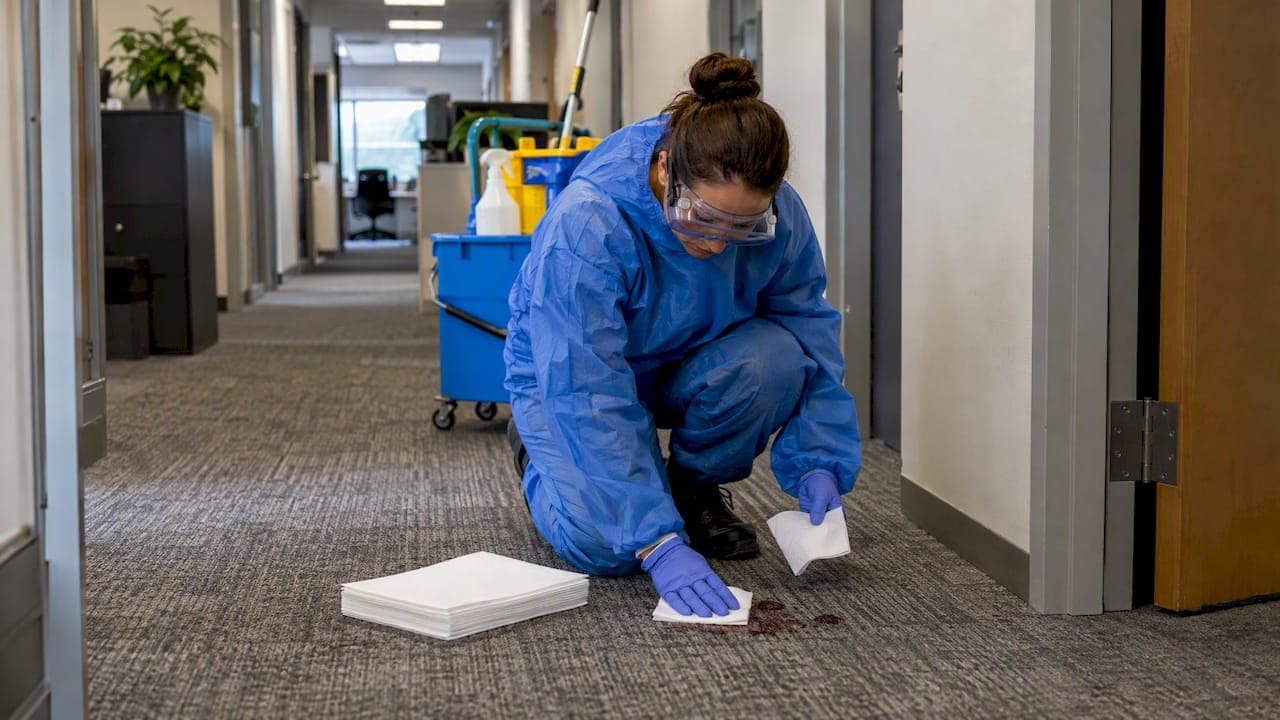
Under OSHA 29 CFR 1910.1030, employers with workers who have reasonably anticipated exposure to blood or other potentially infectious materials must maintain a written Exposure Control Plan, provide training and personal protective equipment at no cost, offer the hepatitis B vaccine, and make sure cleanup follows documented decontamination and regulated-waste procedures. If a spill happens right now, secure the area, send trained personnel or call a qualified contractor, gather PPE and sharps containment supplies, and start documenting the incident immediately.
TL;DR:
- For minor spills, trained staff should absorb the material, apply disinfectant from the edges inward, and maintain the label’s full wet contact time.
- For large spills or aerosol events, evacuate the area, close doors, let particles settle, and call a specialist if staff lack training.
- Never handle sharps by hand; use forceps, tongs, or a dustpan, then place each item directly into a container designed to resist punctures.
- Employers must review the Exposure Control Plan annually, train covered staff yearly, and offer hepatitis B vaccination within 10 working days of assignment.
Table of Contents
- Step-by-Step Cleanup Procedure for Blood and OPIM Spills
- Personal Protective Equipment for Cleanup: What to Provide and Why
- Disinfectants and Contact Times: Using the Right Product Safely
- Regulated Waste, Containment, and Disposal Rules
- Exposure Control Plan, Training, and Post-Exposure Steps
- Employer Duties and When to Call a Specialized Contractor
- How a Nationwide Cleaning Provider Approaches Bloodborne Cleanup
- What Employers Consistently Get Wrong About This Standard
- Get Compliant Bloodborne Cleanup Without the Guesswork
- FAQ
- Sources
Step-by-Step Cleanup Procedure for Blood and OPIM Spills
Not every spill calls for the same response. A few drops of blood on a tile floor is a different job than a pooled spill on carpet after a workplace injury, and treating them the same way either wastes resources or puts people at risk.
Start by securing the area. Keep uninvolved staff and the public away, and look at the spill itself before touching anything: how much material is there, is it on a porous or non-porous surface, and is there any chance of aerosolization from a device like a centrifuge or power tool. That assessment decides whether this is a job for trained in-house staff or one that needs a specialized response.
For a minor spill, the CDC's bloodborne pathogens spill kit and cleanup job aid lays out a sequence that trained staff can follow:
- Put on gloves, a gown, and eye protection before approaching the spill.
- Cover the spill completely with absorbent material to stop it from spreading.
- Apply an appropriate disinfectant starting at the outer edge and working toward the center, which limits splatter and keeps the contaminated zone from growing.
- Let the disinfectant sit for the full contact time printed on the product label.
- Pick up all absorbent material and visible debris, placing it directly into a labeled biohazard bag.
- Do a final wipe of the surface with detergent followed by disinfectant to remove any residue.
Large or aerosolizing spills call for a different sequence. If a spill involves a significant volume, bodily fluids spread across a wide area, or any aerosol-generating event, evacuate the immediate area, close doors to limit airflow, and allow any aerosolized particles time to settle before anyone reenters. This is the point where many facilities should stop and call a specialized response team rather than push staff into a job beyond their training.
Sharps need their own protocol regardless of spill size. Never pick up needles, glass, or other sharps by hand. Use mechanical tools such as forceps, tongs, or a dustpan, and drop them directly into a puncture-resistant sharps container the moment they are collected. Handling sharps twice, or setting them aside "for later," is how most needlestick injuries during cleanup actually happen.

Every step should be documented as it happens, including who responded, what time the cleanup started and ended, which products were used, and how waste was disposed of. If the spill is tied to a workplace injury that may become part of an incident investigation or workers' compensation claim, preserving that chain of custody protects both the injured worker and the employer.
Pro Tip: Keep a spill-response log next to your spill kit so the response gets documented in real time instead of reconstructed from memory afterward.
Personal Protective Equipment for Cleanup: What to Provide and Why
OSHA requires employers to supply PPE at no cost to employees and to base the selection on a hazard assessment of the specific task, not a one-size-fits-all kit. The right combination depends on spill size, surface type, and whether there is any splash or aerosol risk.
- Gloves: nitrile is generally preferred over latex because it resists punctures better and avoids latex allergy concerns.
- Gowns or coveralls: fluid-resistant coverage for the torso and arms, required whenever splashing is possible.
- Eye and face protection: goggles or a face shield whenever there is any chance of splash to the eyes, nose, or mouth.
- Shoe covers: useful on larger spills where foot traffic might track contaminated material.
- Respiratory protection: needed only when aerosolization is a realistic risk, such as spills involving power equipment or confined spaces.
Donning should happen in a clean area before any contact with the spill: gown first, then mask or face shield, then eye protection, then gloves pulled up over the gown cuffs. Doffing deserves even more attention, because contamination most often occurs during removal rather than during the cleanup itself. Gloves come off first, turned inside out, followed by eye protection, gown, and finally hand hygiene. Touching the outside of a contaminated glove or gown while removing it defeats the purpose of wearing it at all.
Once PPE comes off, it either goes into regulated waste if visibly contaminated or into a separate laundering process if it is reusable. OSHA holds employers responsible for laundering contaminated reusable PPE themselves or arranging it through a service that handles regulated materials: contaminated gowns never go home with an employee or into a standard laundry load.
Pro Tip: Store a fresh PPE kit near every spill kit so staff are not searching for gloves or eye protection while a spill sits unattended.
Disinfectants and Contact Times: Using the Right Product Safely
OSHA does not require one specific product; it requires an "appropriate disinfectant" and defines that fairly broadly. OSHA's standard interpretation on disinfectants and HIV/HBV accepts EPA-registered tuberculocidal disinfectants, products specifically labeled as effective against HIV and HBV, and diluted bleach solutions as appropriate choices for surface decontamination.
Whichever product you choose, the label is the rule. Contact time, the length of time a surface needs to stay visibly wet with disinfectant, is listed on every EPA-registered product and varies by formulation. Some products call for just a few minutes; others, particularly those validated against HBV, specify longer contact windows. Wiping a surface dry before the labeled time has passed means the disinfectant never did its job.
- Confirm the product is EPA-registered and that its label specifically addresses bloodborne pathogens or is tuberculocidal.
- Apply enough product to keep the surface visibly wet for the entire labeled contact time.
- Never substitute a general-purpose cleaner for a registered disinfectant, even if it smells similar to one.
Bleach works, but it is not always the best tool for the job. Sodium hypochlorite solutions are effective and inexpensive, but when used frequently, they may corrode metal fixtures and damage certain flooring and equipment. Many facilities choose EPA-registered disinfectants specifically labeled for HIV/HBV instead, which avoid that corrosion risk while still meeting the same regulatory bar.
Contact times are not guesswork. Controlled lab evaluations published in Emerging Infectious Diseases tested disinfectants including sodium hypochlorite, peracetic acid, and 70% ethanol against a virus in blood matrices, documenting the concentrations and contact times needed for effective decontamination. That kind of evidence is exactly why label instructions specify a minimum wet time rather than a quick wipe.
Regulated Waste, Containment, and Disposal Rules
Blood-soaked absorbents, used PPE, and anything else contaminated during cleanup qualifies as regulated waste under 1910.1030, and OSHA is specific about how it has to be contained before it ever leaves the building.
- Containers must be closable, leak-proof, and either labeled with the biohazard symbol or color-coded red; OSHA permits red bags in place of labels as long as staff are trained to recognize the color coding.
- Sharps go into puncture-resistant containers, never into a standard biohazard bag.
- Close every container securely before moving it, and never compact or manually push down regulated waste to make it fit.
OSHA's interpretation on contractors handling blood cleanup confirms that regulated waste rules apply the same way whether the cleanup is done by in-house staff or a hired contractor, and that final disposal must comply with federal, state, and local regulations, which vary significantly by jurisdiction. Some states require a licensed medical-waste hauler and a manifest or tracking document for every pickup; others leave more discretion to the facility. Before assuming your trash hauler can take biohazard bags, check your state's medical-waste program, because mixing regulated waste into general trash is one of the more common and expensive compliance mistakes employers make.
Keeping a simple log of waste pickups, dates, and the hauler's name gives you a paper trail if a regulator or insurer ever asks how a spill was handled.
Exposure Control Plan, Training, and Post-Exposure Steps
A written Exposure Control Plan is the backbone of compliance, and OSHA requires specific elements rather than a general safety statement. According to a summary of 29 CFR 1910.1030's ECP requirements, the plan must apply to every employee with occupational exposure, which makes this a standard employers cannot sidestep by assuming only medical staff are covered.
- Exposure determination: identify which job classifications and tasks carry a reasonable chance of exposure.
- Methods of compliance: detail the PPE, engineering controls, and work practices used to limit exposure.
- Hepatitis B vaccination: offer the vaccine series to covered employees at no cost within 10 working days of initial assignment, with the option to decline in writing.
- Post-exposure evaluation: provide prompt, confidential medical evaluation and follow-up after any exposure incident.
- Communication of hazards: label containers and train staff on biohazard signage and color coding.
- Recordkeeping: maintain training records, vaccination records, and a sharps injury log.
- Annual review: update the plan at least once a year or whenever new tasks, equipment, or job classifications change the exposure picture.
Training has to happen at initial assignment and then at least annually, covering the specific tasks employees perform, the PPE available to them, and what to do in the event of an exposure. If an exposure does happen, the clock starts immediately: the employee needs prompt access to confidential medical evaluation, and the incident needs to go into both the sharps injury log and any broader incident report the facility keeps.
Employer Duties and When to Call a Specialized Contractor
Once a spill is contained, your job as an employer is not finished; for guidance on emergency cleaning and containment, follow CDC backed steps for homeowners. Secure the area, make sure the affected employee gets any needed medical care, file an incident report, and preserve the scene if the injury might become part of a workers' compensation or liability claim.
OSHA has made clear in interpretation letters that contractors who clean up blood are covered by the Bloodborne Pathogens standard whenever their employees face occupational exposure, regardless of how much time has passed since the original spill. That matters when deciding who does the work: large-volume spills, anything involving decomposition, aerosol-generating incidents, or spills in public-facing spaces are usually better handled by a licensed specialist than by general janitorial staff. Before hiring one, confirm their bloodborne pathogens training documentation, liability insurance, and waste disposal credentials. Letting untrained staff handle a job that calls for specialized response is a frequent source of OSHA citations, and it leaves the facility exposed to liability it never needed to take on. For related procurement and safety-data-sheet practices, see our guide to OSHA cleaning compliance.
How a Nationwide Cleaning Provider Approaches Bloodborne Cleanup
We built our bloodborne pathogen response around a documented, ECP-aligned process rather than improvised cleanup. Every engagement follows a process including quote, site visit, scheduled cleaning, and customer approval, with crews trained in PPE use, proper disinfectant selection, and regulated-waste containment. Each step is documented to provide facility managers with a compliance record. For a closer look at how we approach disinfecting work on commercial sites, see our biohazard cleaning compliance guide.
What Employers Consistently Get Wrong About This Standard
The biggest gap we see is not a missing disinfectant or an expired glove box. It is the assumption that any janitorial staff can legally handle a blood spill because they clean the building every day. OSHA's own interpretation letters draw a sharp line here: occupational exposure to blood triggers the full weight of 1910.1030, documented training, ECP coverage, and all, regardless of whether the person holding the mop usually handles trash and floors.
Conventional advice tends to focus heavily on disinfectant brands and contact-time charts, which matter, but which are also the easy part. The harder, more commonly skipped piece is the paperwork trail: an ECP that gets reviewed annually instead of filed and forgotten, a sharps injury log that is actually current, and training records that would hold up if OSHA asked for them tomorrow. If you take one thing from this guide, make it that: fix your documentation and training records before you worry about which disinfectant brand sits in your supply closet. The spill kit is only as good as the plan behind it.
— Sales
Get Compliant Bloodborne Cleanup Without the Guesswork
We provide bloodborne pathogen cleanup aligned with ECP standards, handled by trained crews experienced in PPE, disinfecting, and regulated-waste procedures.

- Request a quote and we schedule a site visit to assess the spill or facility.
- We complete the cleaning on a schedule that works for your property.
- You review and approve the completed job, with documentation on file.
Reach out through our national cleaning services page to get a crew scheduled, or check our New Jersey service page if you need coverage in that region.
This article is general information, not a substitute for advice from a qualified doctor. Consult a qualified healthcare professional about your own circumstances before acting on anything here.
FAQ
What are the OSHA guidelines for biohazard cleanup?
OSHA requires employers to have a written Exposure Control Plan, train staff who may contact blood or OPIM, provide PPE at no cost, and use appropriate disinfectants with documented contact times. The full standard also requires regulated waste to be contained in labeled or red-coded, closable, leak-proof containers before disposal.
What are the OSHA bloodborne pathogen rules?
The Bloodborne Pathogens standard, 29 CFR 1910.1030, applies to any employee with reasonably anticipated occupational exposure to blood or other potentially infectious materials. It mandates an Exposure Control Plan, hepatitis B vaccination offers, PPE, training, and post-exposure medical evaluation procedures.
What are the OSHA compliance updates for 2026?
OSHA has not published a replacement standard for 1910.1030; the core requirements for Exposure Control Plans, training, PPE, and regulated-waste handling remain in effect as written. Employers should still review their ECP annually and confirm it reflects current job classifications and equipment, since that review is a standing requirement rather than a one-time update.
What are the OSHA guidelines for cleanup of blood spills?
Cleanup should start by containing the spill with absorbent material, applying an EPA-registered disinfectant from the outer edge inward, and letting it sit for the full label contact time before wiping and disposing of materials as regulated waste. The CDC's spill cleanup job aid outlines this sequence in detail, including sharps handling with mechanical tools rather than bare hands.
Who is responsible for cleaning up blood in a workplace, in-house staff or a contractor?
Either can do it, but whoever performs the cleanup must be trained under the Bloodborne Pathogens standard and have access to proper PPE and disposal procedures. OSHA has confirmed that contractors are covered by the same standard as employees when their workers face occupational exposure, so credentials and training documentation matter regardless of who handles the job.
Sources
- OSHA — 1910.1030 Bloodborne Pathogens (full standard)
- CDC — Bloodborne Pathogens spill kit and cleanup job aid
- Two-center evaluation of disinfectant efficacy against Ebola virus in clinical and laboratory matrices (EID table)