
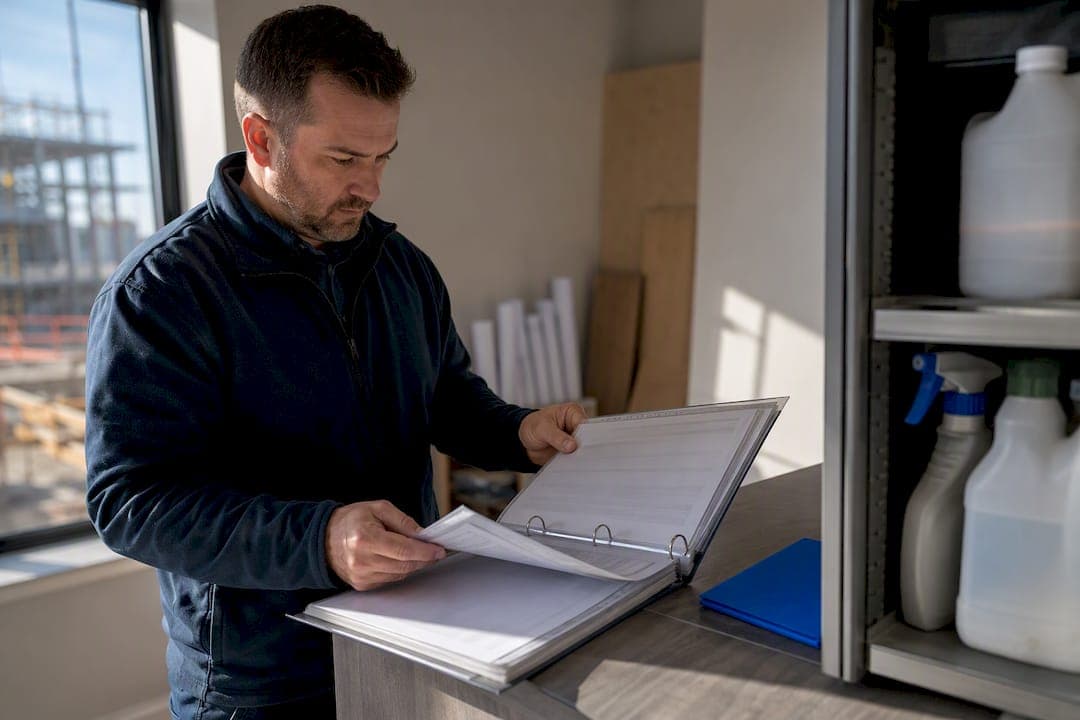
OSHA cleaning compliance rests on four pillars: Hazard Communication (SDSs, labels, written program), documented PPE hazard assessments, housekeeping and walking-working-surface controls, and injury recordkeeping. The Hazard Communication Standard, 29 CFR 1910.1200, drives the most citations, so your first move should be auditing every chemical against its safety data sheet and confirming staff training is documented. Do that this week, before anything else.
TL;DR:
- Keeping SDSs current and clearly labeled is the top priority, with a thorough audit recommended before implementing any other measures.
- PPE hazard assessments must be task-specific, documented in detail, and employees trained on proper use, with regular retraining following process changes.
- Housekeeping routines require documented inspections, timely repairs, and wet-floor signage to prevent slips and meet OSHA standards.
- OSHA’s 2024 HCS update is in transition until 2026, requiring companies to update SDSs, labels, and training within flexible but firm deadlines.
- Maintaining an organized SDS library and detailed training records through a designated owner prevents common citation reasons during inspections.
Table of Contents
- What OSHA Standards Apply to Cleaning Operations?
- HCS 2024: What Changed and When Employers Must Comply
- How Do You Document PPE Hazard Assessments for Cleaning Crews?
- Housekeeping and Sanitation Rules Facility Managers Must Enforce
- What Records Does OSHA Want, and How Fast Must You Report Incidents?
- Actionable OSHA Compliance Checklist for Facility Managers
- How a Nationwide Cleaning Provider Builds Compliance Into Every Job
- Why Hazard Communication Deserves Your Attention First
- Get Compliance Built Into Your Next Cleaning Contract
- Sources
- FAQ
What OSHA Standards Apply to Cleaning Operations?
Cleaning businesses fall under general industry rules, not a single "cleaning" standard. OSHA's cleaning-industry guidance points to a specific cluster of 1910 sections that cover almost everything a janitorial or facility crew does.
- Hazard Communication, 29 CFR 1910.1200 requires a written HazCom program, current SDSs for every chemical on site, compliant container labels, and employee training before anyone handles a hazardous product.
- Personal protective equipment, 29 CFR 1910.132–138 requires a written hazard assessment, PPE selection matched to that assessment, and employer-funded gear in most cases.
- Walking-working surfaces, 29 CFR 1910.22 requires floors kept clean and dry where feasible, with drainage or mats where wet processes are routine.
- Sanitation, 29 CFR 1910.141 sets restroom, potable water, and waste-disposal standards for the workplace itself.
- Recordkeeping, 29 CFR 1904 governs injury logs and incident reporting timelines.
One nuance matters here: OSHA distinguishes between office staff who occasionally wipe down a desk and professional cleaning crews who handle chemicals as their job. The full HazCom obligation attaches to the latter, not to incidental household-cleaner use by regular employees.
HCS 2024: What Changed and When Employers Must Comply
OSHA's 2024 update to the Hazard Communication Standard aligned it with GHS Revision 7, and the transition is still working through workplaces in 2026. The final rule revised classification criteria, small-container labeling exceptions, SDS content requirements, and trade-secret disclosure rules for first responders.
Compliance dates run on two tracks. Substance deadlines land ahead of mixture deadlines, and employers get an additional six-month window after their applicable date to update workplace labels and retrain staff. During the transition, OSHA allows compliance with the 2012 standard, the 2024 standard, or both at once, according to agency transition guidance.
That flexibility is not permission to wait. Here's the priority order for facility managers:
- Request updated SDSs from every chemical manufacturer or distributor you buy from.
- Update workplace container labels to match the new SDS language.
- Revise your written HazCom program to reflect GHS Revision 7 terms.
- Retrain every employee who handles hazardous chemicals, and log the date.
Getting a manufacturer's current SDS is far more reliable than trying to reclassify a product's hazards in-house.
How Do You Document PPE Hazard Assessments for Cleaning Crews?
A written assessment isn't optional paperwork. Under 29 CFR 1910.132(d), it has to name the workplace, the person certifying it, the date, and the specific hazards evaluated for each task.
- Walk each cleaning task (glass cleaning, floor stripping, biohazard cleanup) and identify the chemical, physical, and biological hazards present.
- Match each hazard to specific PPE, not a generic category. "Use gloves" fails an inspection; "nitrile gloves, chemical-resistant, rated for the solvent in use" passes.
- Provide and maintain PPE at no cost to the employee in nearly all cases.
- Train each worker on when PPE is needed, how to put it on and remove it, its limitations, and how to care for it, then have them demonstrate competency.
- Retrain after a process change, a new chemical, or any incident that shows a gap.
Pro Tip: Vague hazard assessments are one of the most frequent citation triggers OSHA finds during inspections. Write down the "why" behind every PPE choice, not just the item.
Housekeeping and Sanitation Rules Facility Managers Must Enforce
Clean floors are a legal requirement, not just good practice. 29 CFR 1910.22 requires walking-working surfaces to be kept clean and, where feasible, dry, with drainage, false floors, or mats where wet processes are routine.
- Post wet-floor signage the moment mopping or a spill starts, and remove it only once the surface is dry.
- Provide drainage or floor mats in areas where standing water is a constant condition, such as loading docks or wash bays.
- Keep restrooms sanitary and stocked, and maintain access to potable water under 1910.141; for practical guidance on washroom fixture selection and design, see Why Ergonomic Washroom Design Matters for Facilities.
- Empty and maintain waste receptacles on a schedule that prevents overflow and pest issues.
- Inspect walking surfaces regularly and log repairs; when immediate repair isn't practical, guard the hazard until it is fixed.
Documented inspection routines matter as much as the repair itself. OSHA expects a paper trail showing you found the hazard and acted on it, not just that the floor eventually got fixed.
What Records Does OSHA Want, and How Fast Must You Report Incidents?
Employers with 11 or more employees must maintain OSHA 300, 300A, and 301 injury and illness logs, and post the 300A summary annually per the recordkeeping rule. Reporting deadlines are strict: a fatality must be reported promptly within hours, and an in-patient hospitalization, amputation, or loss of an eye must be reported without delay within about one day.
Inspectors typically ask to see:
- Current SDSs and the written HazCom program
- PPE hazard-assessment certifications
- Training records with dates and signatures
- Container labels in active use
- Housekeeping inspection and repair logs
Actionable OSHA Compliance Checklist for Facility Managers
Break the work into three timeframes so nothing critical slips.
- This week: Audit your SDS library against every chemical actually on site, check container labels for compliance, run a spot-training refresher, and confirm wet-floor signage is deployed and accessible.
- Next 30 to 90 days: Complete or update your written PPE hazard-assessment certification, schedule formal training refreshers tied to the HCS 2024 transition, and revise your HazCom program language.
- Ongoing, quarterly: Rotate SDS reviews as products change, document every housekeeping inspection and repair, keep training logs current, and post the OSHA 300A summary each February.
Pro Tip: Assign one person as the SDS "owner." Inspectors consistently find that scattered, undated SDS binders across multiple supervisors are the single fastest way to fail a document request. A contractor cleaning compliance checklist built around these three timeframes gives you a template rather than a blank page.
How a Nationwide Cleaning Provider Builds Compliance Into Every Job
A typical commercial cleaning provider runs a four-step engagement: quote, site visit, scheduled cleaning, and customer approval. Compliance checks live inside the site visit, where the scope of work documents which chemicals will be used, what SDSs apply, and what PPE the assigned crew needs for that specific facility.
- A single SDS library tied to an assigned owner, rather than one per crew or per site.
- Documented training logs for every technician assigned to a job.
- A written PPE hazard-assessment certificate specific to the task list.
- A contractor checklist adapted from field procedures used on projects like the ones covered in the construction cleaning safety guide and the industrial cleaning safety walkthrough.
For a property manager facing an OSHA inspection, that structure means one call gets you the SDS, the training record, and the hazard assessment instead of three separate searches.
Why Hazard Communication Deserves Your Attention First

Most citations in cleaning operations trace back to the same three gaps: a missing SDS, an unlabeled spray bottle, or training nobody wrote down. None of those require new equipment or a bigger budget to fix. They require someone sitting down with the chemical inventory and closing the paper trail.
That's why an SDS audit paired with documented refresher training beats almost any other compliance investment you could make this quarter. It's the highest-return fix available, and it's entirely within a facility manager's control. If you haven't scheduled that audit yet, put it on the calendar this week, not next quarter.
— Sales
Get Compliance Built Into Your Next Cleaning Contract
Sparkleprocommercialcleaning gives property managers and facility directors something a patchwork of local vendors can't: one nationwide provider whose crews arrive with documented training, a written PPE hazard assessment, and SDS-aware protocols already in place.
That matters most in the categories where compliance risk runs highest, like post-construction cleanouts, healthcare and environmental services, and routine janitorial contracts where OSHA's Hazard Communication and housekeeping rules apply every single shift. Every engagement starts with a quote and a site visit, where the scope of work is documented, chemicals and SDSs are identified, and the PPE plan is set before a crew ever shows up. You get janitorial services, deep cleans, disinfecting services, tenant turn cleans, and facility and day porter services, all run through the same compliance-aware process, with local crews backed by nationwide standards, including dedicated coverage in New Jersey. If your next inspection is weighing on you, request a site visit and quote and get a documented compliance checklist alongside your cleaning schedule.
Sources
- HCS/HazCom Final Rule Regulatory Text | Occupational Safety and Health Administration
- 29 CFR 1910.22 — Walking-working surfaces
FAQ
What Are the OSHA Cleaning Guidelines?
OSHA doesn't publish one standalone "cleaning" rule. Instead, cleaning operations must follow Hazard Communication, PPE, walking-working-surfaces, and sanitation standards under 29 CFR 1910, plus recordkeeping under 1904.
What Are the OSHA Compliance Updates for 2026?
The HCS 2024 update, which aligns U.S. rules with GHS Revision 7, continues phasing in through 2026 on separate substance and mixture timelines. Employers get an additional six months after their compliance date to update labels and retraining.
What Are the Top OSHA Violations in Cleaning Operations?
The most common findings involve missing or outdated safety data sheets, unlabeled secondary containers, generic PPE hazard assessments that skip task-specific detail, and undocumented training. A single-owner SDS library with dated training logs closes most of these gaps.
What Are the OSHA Housekeeping Rules?
Under 29 CFR 1910.22, floors must be kept clean and dry where feasible, with drainage or mats in routinely wet areas, plus regular inspection and prompt repair or guarding of hazards. Sanitation rules under 1910.141 add restroom, potable water, and waste-disposal requirements on top of that.
Does Sparkleprocommercialcleaning Help With OSHA Compliance Documentation?
Yes. Sparkleprocommercialcleaning's site visit process documents chemical use, SDS assignments, and PPE plans before a crew starts work, giving facility managers a compliance-ready paper trail. Current service details and quote requests are available on the company's site.