
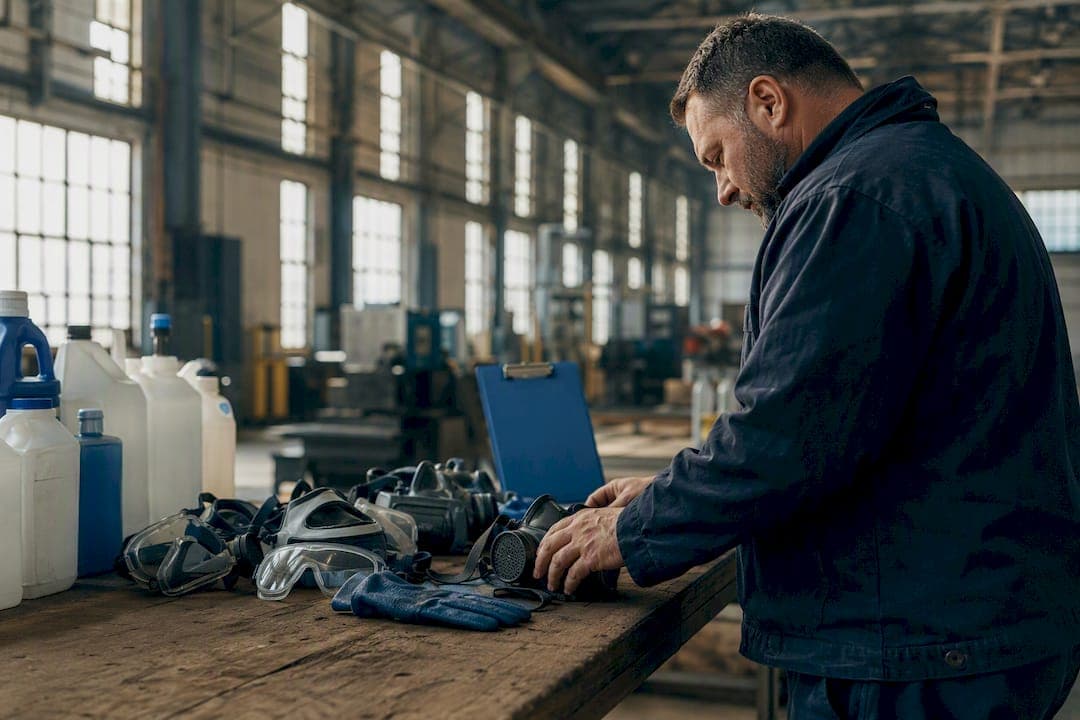
Making industrial cleaning safe and OSHA-compliant comes down to four elements: a written Hazard Communication program with accessible Safety Data Sheets, a documented PPE hazard assessment under 29 CFR 1910.132(d), site-specific SOPs that cover permit-to-work and confined-space controls, and training records that satisfy 1904 recordkeeping. Skip any one of these and you're exposed to citations, workers' comp claims, or worse. The sections below give you the checklists and templates to build each piece.
TL;DR:
- Ensuring SDS availability and quick access for all chemicals is critical, along with maintaining a current hazard communication program and documented PPE assessments.
- Most incidents stem from slips, chemical exposure, dust, confined spaces, or machinery, necessitating the hierarchy of controls including substitution, engineering, administrative policies, and PPE.
- Building a simple PPE hazard assessment table with task-specific hazards, PPE needs, and employee verification creates an effective inspector-ready record.
- Chemical safety relies on proper storage, labeling, and training, with specific rules against mixing bleach and ammonia and mandates for ventilation during concentrated chemical use.
- Regular safety checks on powered equipment, thorough documentation, and contractor SOP reviews help prevent citations, injuries, and ensure OSHA compliance.
Table of Contents
- Industrial Cleaning Safety Standards Under OSHA
- Primary Hazards in Industrial Cleaning and How to Control Them
- How to Build an Inspector-Ready PPE Hazard Assessment
- Chemical Safety and Hazard Communication in Practice
- Cleaning Equipment Safety and Maintenance Checks
- Training, Documentation, and OSHA Recordkeeping
- Building Site-Specific SOPs With Contractor Support
- An 8-Point Action Plan for This Week
- Why Documented Safety Programs Pay for Themselves
- Request an OSHA-Aligned Site Visit From Sparkleprocommercialcleaning
- Keep These Sources Bookmarked
- Sources
Industrial Cleaning Safety Standards Under OSHA
Five standards drive most cleaning-related citations, and knowing what each one actually demands beats memorizing the numbers.
1910.1200 (Hazard Communication) requires a written program, an accessible SDS library for every chemical on site, and training before an employee's first use of any hazardous product. It's the single most-cited standard for cleaning operations, which tells you where inspectors look first.
1910.132 through 138 (PPE) requires a documented hazard assessment matching gear to task, not a generic policy that says "wear gloves." 1910.22 (walking-working surfaces) covers housekeeping, spill response, and floor conditions during and after cleaning. 1910.23 governs ladder inspection and use. 1904 sets recordkeeping and reporting timelines, including OSHA 300/300A posting.
Run these checks now to see where you stand:
- Does an SDS exist for every product currently stored or in use, and can any employee pull it up in under a minute?
- Is there a written hazard communication program, not just a binder of SDSs?
- Has a PPE hazard assessment been documented per task, with signatures?
- Is there a current ladder inspection log?
- Are wet-floor and confined-space warnings posted where cleaning is active?
- Is the OSHA 300A summary posted February 1 through April 30 if your facility meets recordkeeping thresholds?
One catch: federal OSHA sets the floor, not the ceiling. States running their own OSHA-approved plans, including California, Washington, and Michigan, often impose stricter PPE, heat, or chemical-handling rules. Check your state plan before assuming federal minimums cover you.
Primary Hazards in Industrial Cleaning and How to Control Them
Seven hazards account for nearly every incident report in industrial cleaning: slips, trips, and falls; chemical exposure; dust and respirable particulates; confined-space atmospheres; working at height; machinery entanglement; and musculoskeletal injuries from repetitive motion or awkward lifting.
The fix isn't a single control. It's the hierarchy of controls applied in order: eliminate or substitute the hazard first, engineer around what's left, add administrative rules, and use PPE as the last line of defense.
- Slips and falls in warehouse aisles and loading docks: eliminate standing water with floor drains and squeegee protocols before relying on wet-floor signs.
- Chemical exposure during solvent or degreaser use: substitute lower-VOC formulas where possible, then add local exhaust ventilation rather than counting on a respirator alone.
- Dust and respirable particulates from production-line cleanup: use wet methods or HEPA vacuums instead of dry sweeping, which just redistributes fine particles into the air employees breathe.
- Confined-space atmospheres in tank or vessel cleaning: test air quality before entry every time, never assume yesterday's reading still applies.
- Working at height on mezzanines or overhead ductwork: swap ladders for elevated work platforms whenever the job runs longer than a few minutes.
- Machinery entanglement near conveyors and rollers: lockout/tagout before anyone reaches into or under moving equipment, full stop.
- Musculoskeletal injuries from repetitive scrubbing or heavy lifting: rotate tasks and provide extendable tools that reduce awkward postures.
Pro Tip: Walk your facility once specifically looking for hazards, not productivity. Managers who tour for output miss the wet spot by the loading dock every time.
How to Build an Inspector-Ready PPE Hazard Assessment
A one-page table beats a fifty-page report every time an inspector shows up, because OSHA's PPE standard asks for evidence of a hazard assessment and training, not volume.
Build it in four steps. First, list every distinct cleaning task performed at the facility, from routine floor scrubbing to tank interior work. Second, identify the hazard tied to each task, pulling directly from the SDS for any chemical involved. Third, specify the exact PPE required, down to glove material and respirator cartridge type where relevant. Fourth, record the issue date and training verification for each employee assigned that task.
Your table needs these columns at minimum:
- Task name and location
- Hazard identified (chemical, physical, ergonomic)
- Required PPE (specific brand-agnostic spec, not "appropriate gear")
- Date issued and employee sign-off
- Training date and trainer name
If any task involves airborne concentrations that could require a respirator, that triggers a formal respiratory protection program: medical evaluation, fit testing, and documented cartridge change schedules. Skipping fit testing because "the mask seemed fine" is one of the fastest ways to fail an inspection.
Chemical Safety and Hazard Communication in Practice
Your Hazard Communication program lives or dies on three things: SDS accessibility, correct labeling, and training that actually covers dilution and mixing, not just where the binder sits. Under 1910.1200, every hazardous chemical needs a corresponding SDS employees can retrieve without asking a supervisor for a key.
Four rules prevent the vast majority of chemical incidents on a cleaning crew:
- Never mix bleach and ammonia-based products. The combination produces chloramine gas, and it happens more often than facility managers expect when crews grab whatever bottle is closest.
- Always add chemical to water, never water to chemical, to avoid violent splashing or heat reactions.
- Use dedicated, labeled measuring devices for each chemical. Reusing an unmarked cup guarantees a dilution error eventually.
- Provide local exhaust ventilation or respiratory protection anytime concentrated product is used in an enclosed space.
Formal training on labels, pictograms, and dilution ratios is what actually prevents most cleaning-related injuries, not a policy memo nobody reads.
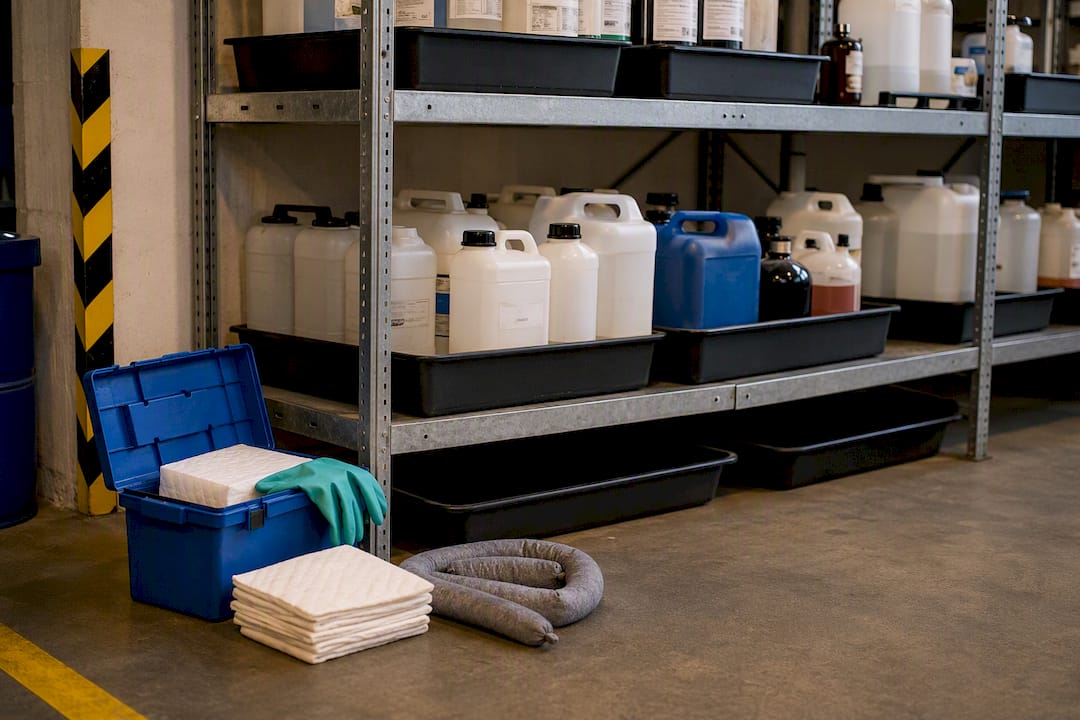
Storage matters just as much as handling. Segregate incompatible chemicals, use secondary containment for anything that could leak, and keep a fully stocked spill kit within reach of every chemical storage area. If solvent cleaning is part of your operation, check local air-quality rules first. Some regions, including South Coast AQMD jurisdictions, impose specific VOC limits and closed-container requirements on top of OSHA's baseline. For exposures, the response sequence is flush, remove contaminated clothing, seek medical evaluation, and report the incident the same day, not at the end of the week.
Cleaning Equipment Safety and Maintenance Checks
Powered scrubbers, wet-dry vacs, buffers, and powered industrial trucks cause a disproportionate share of preventable injuries because pre-use checks get skipped when crews are rushing.
Require a daily pre-use check before any powered equipment runs: cord integrity and grounding, guard placement, brake function, and battery condition on ride-on units. Any unit that fails gets tagged out and pulled from service immediately, not "used carefully until someone gets to it." Log every preventive maintenance visit and keep those records with your inspection package, because a maintenance gap is exactly what an OSHA inspector will ask about after an equipment-related incident.
- Inspect cords, plugs, and guards before every shift
- Tag out and remove any equipment with a known defect
- Log brake and battery checks on powered industrial trucks
- Keep PM schedules and completion dates on file
- Never operate electrical equipment in standing water without GFCI protection
Training, Documentation, and OSHA Recordkeeping
Documentation is what turns a good safety program into a defensible one. Every training session needs a record showing the date, the trainer's name, attendees, topics covered, and materials used. Pair that with SDS acknowledgment sign-offs and a PPE issue log, and you have the paper trail inspectors ask for first.
OSHA's 1904 recordkeeping rule applies once your facility meets the employee-count threshold for your industry, and it requires a 300 log, a 301 incident report for each recordable injury, and the 300A summary posted annually. Fatalities must be reported to OSHA within 8 hours; any hospitalization, amputation, or loss of an eye within 24 hours.
- Store training records digitally with searchable dates and topics
- Keep SDS sign-offs tied to individual employees, not just a general roster
- Retain OSHA 300 logs for five years per 1904 requirements
- Set a calendar reminder for the annual 300A posting window
Building Site-Specific SOPs With Contractor Support
General janitorial training isn't enough for industrial environments. Confined spaces, elevated work, and chemical-heavy tasks need site-specific SOPs, and the cleanest way to build one is to model a structured engagement process: site visit, risk assessment, written SOP, then trained execution. That's roughly how Sparkleprocommercialcleaning approaches new industrial accounts, and it's a workable template even if you're managing the work yourself.
Permit-to-work systems for confined spaces need atmospheric testing before entry, continuous monitoring during the work, and a trained attendant with rescue capability standing by. A university-published manual cleaning SOP is a useful reference for structuring task-level PPE and stop-work authority language.
- Verify contractor insurance and licensing before granting site access
- Require contractors to submit their SOP for your review, not just a generic safety policy
- Confirm confined-space entry permits include a named attendant and rescue plan
- Integrate contractor documentation into your own permit-to-work system
An 8-Point Action Plan for This Week
You don't need a six-month rollout to close your biggest gaps. Start here:
- Pull every SDS and confirm it's current and accessible. Safety officer, 2 hours.
- Draft or update the one-page PPE hazard assessment table. Safety officer, 2 hours.
- Schedule preventive maintenance on all powered cleaning equipment. Facility manager, 1 hour to coordinate.
- Post current wet-floor and ladder inspection checks. Shift supervisor, 30 minutes.
- Hold a 15 to 30 minute toolbox talk on dilution rules and chemical mixing hazards. Safety officer, 30 minutes.
- Confirm your OSHA 300A posting is current if applicable. HR or safety officer, 1 hour.
- Schedule third-party atmospheric testing for any confined-space work planned this month. Facility manager, coordination only, external vendor required.
- Review contractor SOPs and insurance documentation before any outside crew arrives. Facility manager, 1 hour.
Pro Tip: Items 7 and specialized solvent work almost always need outside expertise. Don't let an internal team improvise atmospheric testing to save a phone call.
Why Documented Safety Programs Pay for Themselves
Citations and workers' comp claims cost more than the paperwork you're avoiding. A documented Hazard Communication program and PPE assessment hold up when OSHA shows up, and they hold up in a claims dispute too. Folding contractor SOPs into your own permit-to-work system isn't extra bureaucracy, it's standard practice among facilities that don't get burned twice. Prioritize training records and PPE sign-offs before anything else on your list.
— Sales
Request an OSHA-Aligned Site Visit From Sparkleprocommercialcleaning
Building this program in-house takes real staff hours you may not have to spare. Sparkleprocommercialcleaning handles the heavy lift for facilities that need post-construction cleanouts, recurring janitorial service, deep cleans, or environmental and disinfecting work, all backed by licensed and insured crews trained on task-level PPE and site-specific SOPs.
The engagement runs in four steps: you request a quote, a site visit assesses your specific hazards and layout, cleaning gets scheduled around your operations, and you sign off before the crew leaves. Before that site visit, have your current SDS list, any known confined-space areas, and your equipment inventory ready. It speeds up the assessment considerably.
Facilities in the Northeast can start with the Massachusetts service page or the Delaware service page, and Pacific Northwest operations can check the Washington service page. Outside those regions, the main service page covers nationwide requests. For general post-construction cleanup tips while you wait on scheduling, this practical cleaning primer has a few useful pointers.
Keep These Sources Bookmarked
- OSHA Cleaning Industry Compliance Overview
- OSHA Personal Protective Equipment Standards
- NIOSH/CDC Cleaning and Disinfecting Hazards
- OSHA Frequently Cited Standards by Industry
Sources
- Cleaning Industry - Overview | Occupational Safety and Health Administration
- Personal protective equipment | Occupational Safety and Health Administration (OSHA)
- Janitorial safety: Reducing risks from cleaning chemicals | Texas Department of Insurance (TDI)
- Cleaning and disinfecting | NIOSH/CDC
- Manual Cleaning SOP | University of New Mexico EHS