
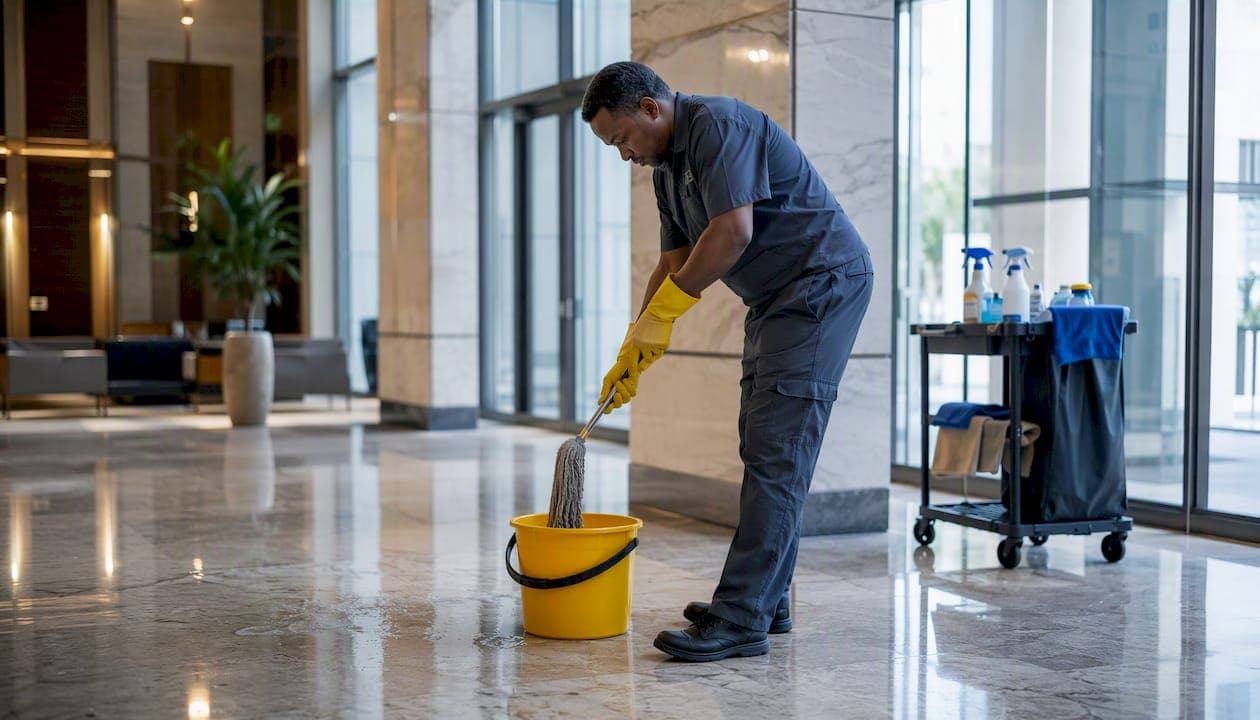
A complete commercial building sanitation workflow runs in four layers: clean daily, disinfect on trigger, document every step, and assign a named owner to each task. Per CDC guidance, cleaning removes most germs in routine settings; disinfection is reserved for known contamination or outbreaks, and the product's SDS contact/wet time must be honored for the disinfectant to work. Pair that decision rule with a Master Sanitation Schedule and signed completion records, and you have an audit-ready program from day one.
Start here:
- Assign an owner. Name one person responsible for each zone, not a department.
- Set frequencies. Regular cleaning frequencies include daily tasks for restrooms and high-touch surfaces, weekly tasks for floors and breakrooms, and monthly deep cleaning.
- Pick product families. Choose EPA-registered disinfectants for trigger events; low-VOC, non-toxic cleaners for routine work.
- Start a daily log today. Timestamped sign-offs, even on paper, create the evidence trail auditors expect.
Key Takeaways
A complete, audit-ready commercial building sanitation workflow requires named task ownership, SDS contact/wet time compliance, IAQ-safe product choices, and daily documented evidence from day one.
| Point | Details |
|---|---|
| Named ownership is non-negotiable | Assign one person, not a department, to each zone in the Master Sanitation Schedule. |
| Contact/wet time drives compliance | Surfaces must stay wet for the full SDS-specified duration or disinfection fails. |
| IAQ-safe products protect occupants | Choose low-VOC, EPA-registered cleaners and maintain a documented approved-product list. |
| Documentation is the audit trail | Daily logs, photos, and SDS file versions are the evidence auditors check first. |
| Sparkleprocommercialcleaning delivers the full program | Licensed, insured crews implement the schedule, logs, and reporting from site visit to monthly report. |
Table of Contents
- How do you build a Master Sanitation Schedule that holds up to audits?
- What area-specific protocols should your schedule include?
- When should you clean, sanitize, or disinfect?
- How do you choose products and protect indoor air quality?
- What documentation creates a defensible audit trail?
- What should you require from contractors and staff?
- How do you respond to a contamination incident or outbreak?
- Which KPIs tell you whether the workflow is actually working?
- What does rollout actually cost, and how long does it take?
- What actually works in real-world rollouts
- Sparkleprocommercialcleaning can implement this workflow for you
- Sources
How do you build a Master Sanitation Schedule that holds up to audits?
The Master Sanitation Schedule works best as a governance document, not a calendar. Each row should carry four fields: frequency, zone, named owner, and evidence required. A short excerpt looks like this:
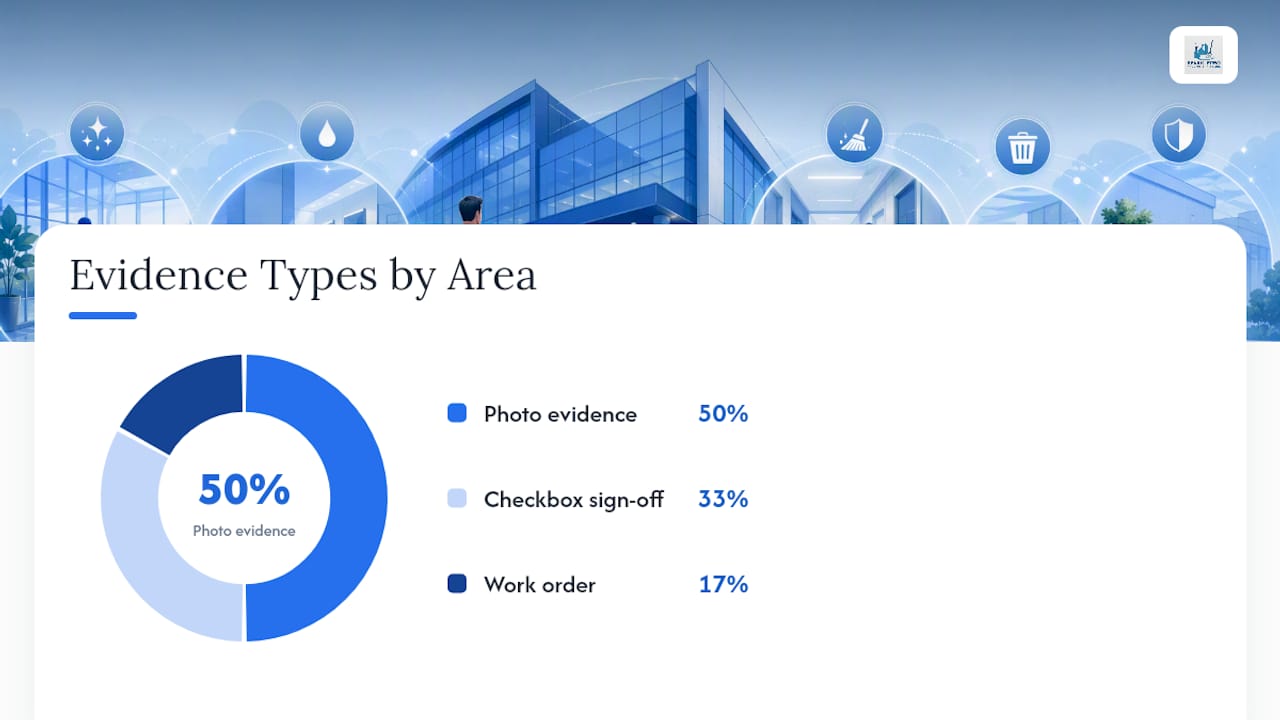
- Daily / Restrooms / Janitorial Lead / Photo or mobile check-in for verification
- Daily / Building Entry / Day Porter / Checkbox sign-off
- Weekly / Break Room / Zone Supervisor / Timestamped photo for verification
- Monthly / HVAC Vents / Facilities Manager / Maintenance work order documentation
- Quarterly / Floor Stripping / Contracted Crew / Completion report plus verification results
Named ownership matters because auditors ask who was responsible, not which team. Department-level ownership creates gaps; personal ownership closes them. GSA custodial specifications require contractors to submit a facility-specific schedule listing activities, locations, times, and staffing, along with monthly solid-waste metrics. Use that standard as your contract template.
Governance rules to build in: require task sign-off before the next shift starts, set a 24-hour escalation window for missed critical tasks, and schedule QC inspections at least monthly with a written corrective action trail.
Pro Tip: Lock restroom and entry checks behind a verification gate in your scheduling tool. If the evidence field is empty, the task is flagged overdue automatically, forcing the paper trail auditors look for.
What area-specific protocols should your schedule include?
| Area | Core Tasks | Frequency | Evidence |
|---|---|---|---|
| Restrooms | Disinfect fixtures, restock, mop floors | Daily | Photo or mobile check-in |
| Building Entry / Lobby | Wipe door hardware, mop, spot-clean glass | Daily | Checkbox sign-off |
| Break Room | Wipe counters, clean appliances, sanitize sink | Daily / Weekly deep | Timestamped photo |
| Offices | Dust surfaces, empty trash, wipe shared electronics | Daily / Weekly | Checkbox |
| Hard Floors | Sweep, mop, periodic strip and refinish | Daily sweep / Monthly deep | Work order |
| High-Touch Surfaces | Elevator buttons, light switches, door handles | Daily or twice daily | Photo log |
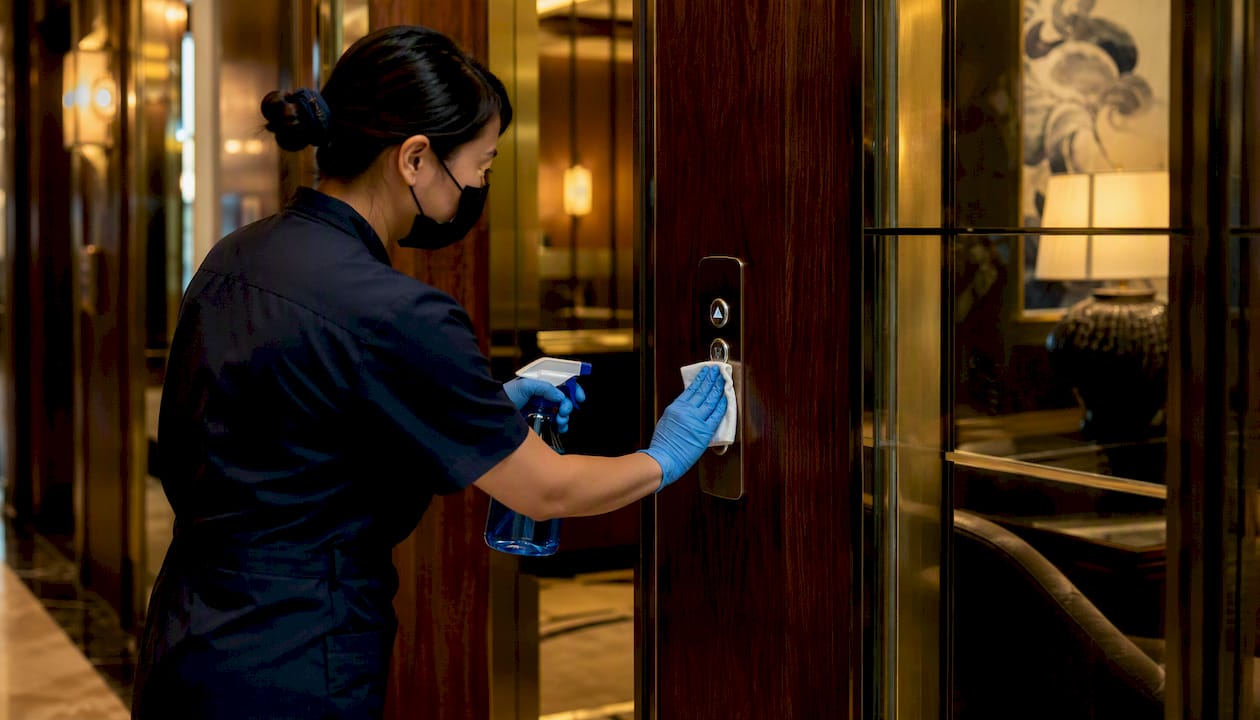
High-touch items deserve their own sub-list because they carry the highest cross-contamination risk: elevator call buttons, door hardware, shared keyboards, copier panels, and restroom fixtures. Disinfect these on a trigger basis when illness is reported; clean them daily otherwise.
For finish-specific cautions: wood surfaces need pH-neutral cleaners, not quaternary ammonium products. Electronics require product-compatible wipes, never spray-and-wipe. Stone floors reject acidic cleaners. Note these restrictions in the SOP so a substitute worker doesn't cause surface damage.
When should you clean, sanitize, or disinfect?
CDC guidance is direct: cleaning is sufficient for most routine commercial settings. Disinfect when there is visible contamination, a confirmed illness case, or an active outbreak. Sanitizing sits between the two and is appropriate for food-contact surfaces in break rooms and cafeterias.
The single most common compliance failure is contact time. Every EPA-registered disinfectant lists a required wet time on its SDS, typically 30 seconds to 10 minutes depending on the pathogen claim. The surface must stay visibly wet for that entire duration. Wiping dry after 15 seconds renders the product ineffective, regardless of what the label promises.
Contact/wet time compliance is the point inspectors check first. A product applied correctly but dried too fast provides no disinfection benefit and leaves your facility exposed.
Safe-use rules to post in every supply closet: wear the PPE the SDS specifies, ventilate the space during and after application, use dilution control dispensers rather than free-pour, and never mix chemicals. Bleach and ammonia-based cleaners produce toxic chloramine gas; quaternary ammonium and hydrogen peroxide products are similarly incompatible.
How do you choose products and protect indoor air quality?
WELL guidance flags that many standard cleaning chemicals emit VOCs that degrade indoor air quality and contribute to sick building syndrome. The recommendation is non-toxic, hypoallergenic cleaners with a documented approved-product list on file.
Product selection criteria:
- EPA registration number on any product used for disinfection
- SDS contact-time compatibility with your surface types
- Low or zero VOC content for routine cleaning products
- Dilution control dispensing systems to prevent overuse and chemical exposure
- HEPA vacuums for dust-generating tasks; microfiber cloths for surface capture
For HVAC coordination, run the ventilation system at full fresh-air exchange during and after disinfectant application to purge residual chemical load. Schedule duct cleaning and filter replacements in the Master Sanitation Schedule as quarterly or semi-annual line items. Avoid wide-area fogging unless the product label explicitly permits it and the space can be evacuated and ventilated properly.
Pro Tip: Log the product lot number and SDS version in the SOP each time a product changes. Auditors verify that products used matched the approved IAQ-safe list, and version mismatches create findings.
What documentation creates a defensible audit trail?
A solid SOP for any cleaning task covers: scope, frequency, materials and PPE required, step-by-step instructions, verification method, corrective action steps, and record retention period. That structure satisfies both internal QC and external audits.
Essential monthly report fields, modeled on GSA custodial requirements:
- Task completion dates and zone sign-offs
- Pounds or cubic yards landfilled vs. recycled/composted
- Incident log entries with corrective action status
- Training records updated for new staff or chemical changes
- SDS file version in use during the reporting period
Acceptable evidence types: timestamped mobile check-ins, before/after photos, ATP swab results, sanitizer ppm readings, and signed paper logs. Digital CMMS tools convert these into recurring work orders per asset and produce a single exportable audit trail, which cuts audit-prep time significantly. If digital tools aren't in place yet, a dated paper log with supervisor initials is still valid evidence.
What should you require from contractors and staff?
Contractor vetting checklist:
- Current general liability and workers' comp certificates
- State janitorial contractor license where required
- Sample SOPs and SDS management system
- Reference sites with verifiable inspection scores
- Equipment list confirming HEPA vacuums and dilution control dispensers
- Quality-inspection scorecard from a current client
Required training topics, in priority order:
- Chemical safety and SDS reading
- PPE selection and donning/doffing
- Contact/wet time compliance and verification
- ATP swab or surface-check basics
- Incident reporting and tenant interaction protocols
Role ownership ties directly to the Master Sanitation Schedule: the daily performer executes tasks, the zone owner verifies completion, the QC inspector scores monthly, and the escalation owner resolves overdue items within 24 hours. Build contractual clauses requiring record access, monthly reports, and corrective action response times of 48 hours or less for critical findings.
How do you respond to a contamination incident or outbreak?
Follow these steps in order:
- Isolate the area immediately; restrict access until assessment is complete.
- Assess the risk level: single case vs. multiple cases, pathogen known vs. unknown.
- Clean first, then disinfect per SDS instructions, including full contact/wet time.
- Document all actions: products used, SDS version, start and end times, personnel involved.
- Notify stakeholders: tenants receive a factual notice within 24 hours; health department reporting triggers apply when a communicable disease is confirmed.
- Collect evidence: before/after photos, SDS used, ATP or lab results if obtained, corrective action log.
- Escalate to health authorities if the pathogen is reportable under your state's communicable disease rules, and document that notification with date, contact name, and reference number.
The WHO WASH strategy frames sanitation and hygiene as core public-health infrastructure, which means outbreak response isn't just a building issue; it's a health-system obligation. Keep a pre-written tenant notification template on file so communication doesn't slow down response.
Which KPIs tell you whether the workflow is actually working?
Track these metrics monthly:
- Task completion rate by zone with a high compliance expectation
- Overdue task count and average days overdue
- Corrective action closure time aimed to be prompt for critical items
- Tenant complaint rate related to cleanliness
- ATP pass rate if surface testing is in use
- Waste diversion percentage (landfill vs. recycled/composted)
Inspection template fields: zone, checklist items scored, evidence reviewed, supervisor sign-off, and follow-up work order ID. The IPF five-phase framework (assessment, baseline, roadmap, modular planning, implementation and monitoring) translates directly into a pilot-to-scale sanitation rollout with built-in measurement.
What does rollout actually cost, and how long does it take?
Main cost drivers: square footage, cleaning frequency, certified disinfectant costs, equipment upgrades (HEPA vacuums, dilution dispensers), training and QA audits, and digital tracking tools. Circular-economy procurement choices like concentrated refillable chemistries and reusable microfiber reduce consumable spend over time.
Budget line items to include in internal approvals:
- Labor (recurring janitorial and day porter hours)
- Consumables (cleaners, disinfectants, PPE, microfiber)
- Equipment capital (HEPA vacuums, dilution dispensers, sprayers)
- Training and QA audits
- Digital tracking tools or CMMS license
- Contingency (10–15% of total for incident response and scope changes)
For RFPs, require contractors to submit sample SOPs, proof-of-performance reports, and escalation SLAs as deliverables. A work order scheduling process built into the contract keeps escalation timelines enforceable from day one.
What actually works in real-world rollouts
The programs that hold up under audit share one trait: governance came before products. Every facility that struggled with missed tasks had the same root cause — no named owner. Once a person's name is attached to a zone and a verification step, completion rates climb and stay there.
Three recommendations based on what works in practice:
First, build the governance layer before selecting products. A great disinfectant applied by an unaccountable team produces inconsistent results. Second, require photo or ATP evidence from the start, even if it feels like overkill in week one. That evidence is what separates a defensible program from a liability when an incident occurs. Third, choose IAQ-safe chemistries from the beginning rather than retrofitting later; switching products mid-contract disrupts SDS files and training records.
Sparkleprocommercialcleaning operates nationwide with fully licensed and insured crews trained on SDS compliance, contact/wet time verification, and audit-ready documentation. The approach is governance first, evidence second, products third.
Sparkleprocommercialcleaning can implement this workflow for you
Putting a complete sanitation workflow in place takes more than a checklist. Sparkleprocommercialcleaning delivers the full program: Master Sanitation Schedule setup, recurring janitorial services with signed daily logs, incident response mobilization, and IAQ-friendly chemistries that meet WELL-aligned product criteria.
The engagement is straightforward: a site visit to map zones and frequencies, a written proposal with SOP drafts included, a Master Sanitation Schedule built to your facility's hours and occupancy, and implementation with monthly reporting from day one. Crews are licensed, insured, and trained on contact/wet time compliance and corrective action protocols.
If you manage facilities in Massachusetts, the Massachusetts service page has regional contact options and service details. Ready to get a quote? Reach out at Sparkleprocommercialcleaning to schedule a site visit.
Sources
The following sources underpin the guidance in this article:
- When and How to Clean and Disinfect a Facility | Water, Sanitation, and Environmentally Related Hygiene (WASH) | CDC
- WHO water, sanitation, hygiene and waste strategy 2026–2035
- The Global Sanitation Crisis: Pathways to Urgent Action (background paper) | World Bank
- Master sanitation schedule (Fabrico blog)