
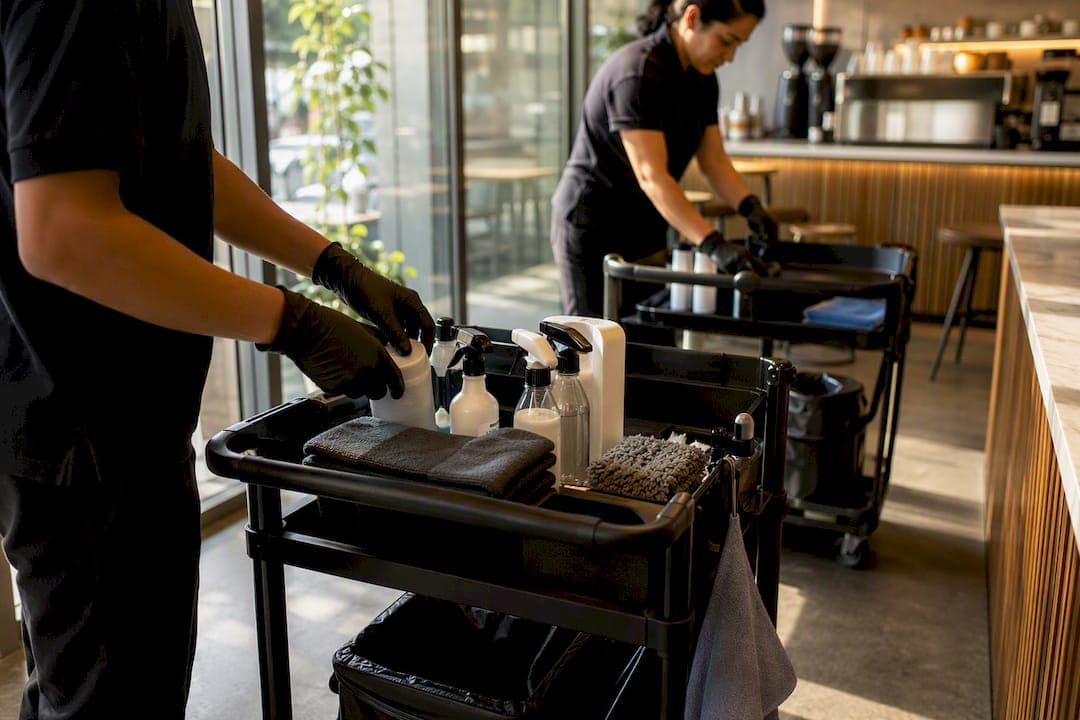
Budget $0.05 to $0.25 per square foot per visit for recurring commercial cleaning, with standard office accounts typically landing at $0.08 to $0.15 per square foot, according to ISSA and CleanQuote benchmark data. One-time jobs, like a first deep clean or post-construction cleanout, price differently and run $25 to $75 an hour, with $30 to $60 as the common range. Medical facilities and industrial plants sit above these figures because of compliance and equipment demands.
Use per-square-foot pricing when the scope is predictable and recurring, like nightly office janitorial work. Switch to hourly pricing when you can't predict labor hours in advance, such as a one-off carpet extraction or a post-construction cleanout where nobody knows exactly how much drywall dust is on the floor until the crew walks in. Sparklepro Commercial Cleaning applies both models depending on the job.
- Recurring janitorial: $0.05 to $0.25 per sq ft per visit
- One-time or variable jobs: $25 to $75 per hour
- Medical, industrial, food service: expect a premium above standard office rates
Key Takeaways
Commercial cleaning cost depends more on labor efficiency and facility type than on square footage alone, and a bottom-up labor check beats trusting a bare quote.
| Point | Details |
|---|---|
| Use the right pricing model | Per-square-foot for recurring work, hourly for one-time or unpredictable jobs. |
| Labor sets the floor | BLS wage data shows labor as the largest cost component in any legitimate bid. |
| Facility type changes the range | Medical and industrial accounts carry compliance premiums above standard office rates. |
| Location shifts pricing | Major metros run roughly 1.15x to 1.4x the national benchmark; rural markets run lower. |
| Sparklepro matches scope to price | Quotes follow a four-step process built around your actual square footage and frequency. |
Table of Contents
- How Commercial Cleaning Cost Models Actually Work
- What Does Cleaning Cost by Facility Type?
- Why Do Cleaning Bids Vary So Much for Similar Buildings?
- How Do You Calculate a Fair Per-Square-Foot Rate?
- Sample Budgets for Small, Mid-Size, and Large Facilities
- What Should You Ask Before Signing a Cleaning Contract?
- Sparklepro Commercial Cleaning: Built for Accurate, Predictable Pricing
- Editorial Perspective: What Facility Managers Get Wrong About Cleaning Costs
- Get a Cleaning Quote That Matches Your Actual Building
- Sources
How Commercial Cleaning Cost Models Actually Work
Vendors quote three different ways, and mixing them up is how facility managers end up comparing apples to oranges. Per-square-foot pricing multiplies your total cleanable area by a rate per visit. It works well for offices, retail floors, and multifamily common areas where the scope barely changes week to week. Hourly pricing charges for time on-site, which fits one-time jobs, small tenant spaces, or work where the starting condition is unknown. Flat-rate pricing bundles a fixed monthly fee regardless of minor scope drift, and larger property management companies often prefer it because it simplifies accounting.
Frequency changes the math in a way that trips people up. A vendor cleaning your building five nights a week can often quote a lower per-visit rate than a vendor coming once a week, because route density and staff scheduling get more efficient. But your monthly total still climbs, since you're paying for 21 or so visits instead of four or five.
- Per square foot: best for stable, recurring scope
- Hourly: best for unpredictable or first-time jobs
- Flat-rate: best for simplified monthly budgeting across similar properties
Pro Tip: Insist on separate per-visit line items for specialty tasks like strip-and-wax or window cleaning. Bundling them into a flat monthly number hides which service actually drove a price increase later.
What Does Cleaning Cost by Facility Type?
Office buildings, retail spaces, and medical facilities don't share a pricing floor, and treating them like they do is the fastest way to underbudget. A standard office cleaned three times a week typically runs $0.08 to $0.15 per square foot per visit, which translates to roughly 13 visits a month. Retail spaces often track close to office rates unless they carry heavy foot traffic or food service, which pushes costs up.
Medical offices and cleanrooms carry a compliance premium tied to infection-control protocols and documentation requirements, significantly above standard office rates. Industrial and warehouse space depends heavily on floor type and machinery clearance, so per-square-foot ranges swing wider than office accounts.
Specialty services get quoted separately from routine janitorial work:
- Strip and refinish (VCT floors): typically $0.50 to $1.50 per sq ft, done periodically rather than weekly
- Carpet extraction: often priced per room or per 100 sq ft, separate from daily service
- Electrostatic disinfection: priced per visit or per square foot, frequently a rider on top of base janitorial contracts
Food-service and healthcare accounts also carry regulatory overhead that is reflected in the quote, since OSHA standards shape staffing and PPE requirements for higher-risk cleaning tasks.
Why Do Cleaning Bids Vary So Much for Similar Buildings?
Labor is the cost driver that swamps everything else on a cleaning bid. Wages, payroll taxes, workers' compensation, and supervision typically make up 60% to 80% of what a vendor charges, which means BLS wage data for building cleaning workers sets a real floor under any legitimate quote. A bid that ignores that floor either cuts staffing hours or cuts corners.
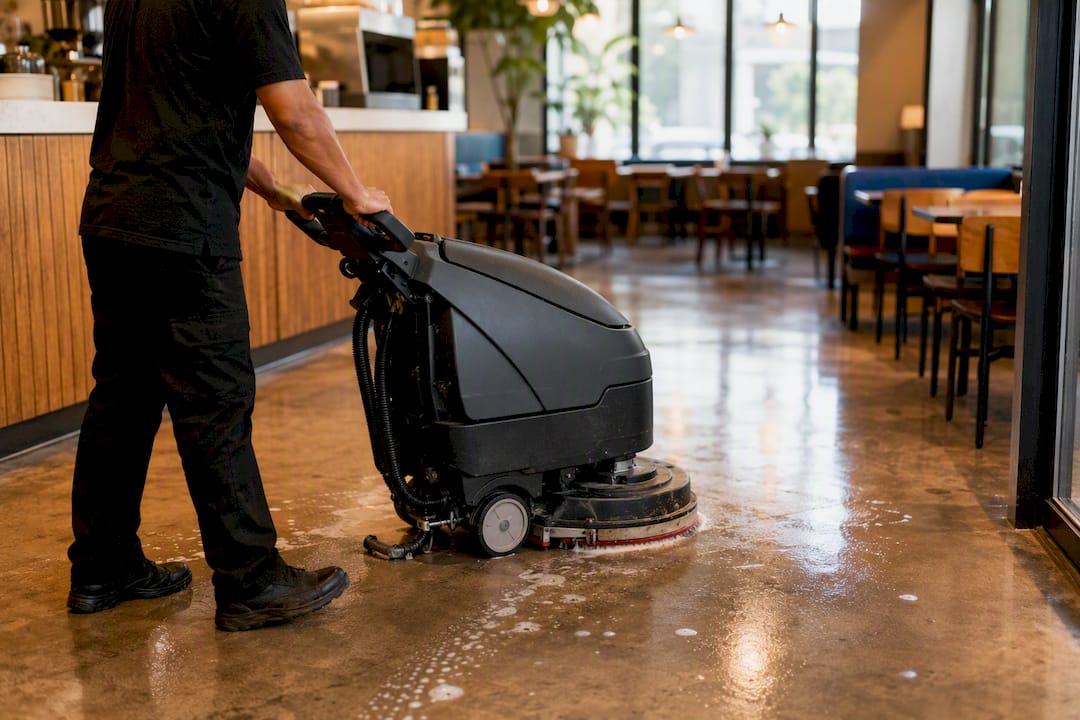
Production rate, the square footage one cleaner can cover in an hour, is the second big lever. A vendor working a large open-plan office covers more ground per hour than one working a maze of small private offices and supply closets, and Nilfisk's production-rate guidance shows this efficiency gap directly changes the price per square foot.
What you can actually negotiate or adjust:
- Cleaning frequency (fewer visits lowers the monthly total, not necessarily the per-visit rate)
- Scope inclusions (restrooms, breakrooms, high-touch disinfection)
- Supply provisioning (vendor-supplied vs. building-supplied paper and chemicals)
- Local wage multipliers, which shift the labor floor by metro area
How Do You Calculate a Fair Per-Square-Foot Rate?
Building your own bottom-up estimate lets you check a vendor's math instead of taking their number on faith.
- Estimate production rate: square feet one cleaner covers per hour, using your own history or Nilfisk-style benchmarks.
- Calculate loaded labor cost per hour: wage plus payroll taxes, insurance, and supervision.
- Divide loaded labor cost by production rate to get a base $/sq ft.
- Add overhead and margin, typically 15% to 30% over labor cost.
- Compare the result against the $0.08 to $0.15 office benchmark as a sanity check.
That last figure comes from multiplying the per-visit rate by roughly 21.5 visits a month for a five-day-a-week schedule.
Sample Budgets for Small, Mid-Size, and Large Facilities
These scenarios use the national ranges above, adjusted for frequency.
- Small office, 5,000 sq ft, 3x/week: at $0.10 per sq ft per visit and roughly 13 visits a month, expect around $650 monthly.
- Mid-size retail, 15,000 sq ft, 5x/week: at $0.09 per sq ft per visit and 21.5 visits a month, expect around $2,900 monthly.
- Large industrial facility, 50,000 sq ft, 5x/week plus periodic floor care: base janitorial near $0.07 per sq ft per visit runs about $7,500 monthly, plus periodic strip-and-refinish billed separately.
Location changes these numbers directly. CleanQuote's market data puts major metro pricing at roughly 1.15x to 1.4x the national benchmark, while rural markets often run 0.8x to 0.95x. A building in a high-cost metro should expect the upper end of every range above.
Before you compare a sample budget to a real quote, confirm what's actually included:
- Restroom supply restocking (paper, soap) included or billed separately?
- Trash removal and dumpster fees bundled or extra?
- Periodic floor care included in the base contract or quoted per project?
What Should You Ask Before Signing a Cleaning Contract?
A vendor who can't answer these clearly is a vendor you should keep shopping past. Ask for exact scope by area, staffing levels per shift, proof of insurance and bonding, supply provisioning terms, and how they measure quality against a defined checklist. Ask what happens at contract renewal and what the exit terms look like if service quality slips.
Red flags worth walking away from: a quote with no line-item breakdown, a price noticeably below the labor floor for your area, no verifiable references, or a vendor who can't produce a certificate of insurance on request.
- Request an itemized first-visit estimate separate from recurring pricing
- Confirm staffing levels, not just total hours
- Get insurance and bonding documentation before signing anything
Pro Tip: Ask every bidder for the same itemized format. A vendor who refuses to break out labor, supplies, and specialty tasks separately is usually hiding where the real cost sits.
Sparklepro Commercial Cleaning: Built for Accurate, Predictable Pricing
Sparklepro Commercial Cleaning covers recurring janitorial service, post-construction cleanouts, tenant move-out cleaning, disinfecting, and floor care, matching the pricing models discussed above to the actual scope of the job rather than a one-size-fits-all rate.
The engagement process runs in four steps:
- Request a quote based on your square footage, frequency, and facility type.
- A site visit confirms actual conditions, since floor plans rarely tell the whole story.
- Cleaning gets scheduled around your building's hours and access requirements.
- You review and approve before the contract locks in.
Have your square footage, current frequency, and any specialty needs (medical compliance, LEED requirements, disinfection protocols) ready before the site visit. It speeds up an accurate quote.
Editorial Perspective: What Facility Managers Get Wrong About Cleaning Costs
Most budgeting guides hand you a single national average and call it done. That number is close to useless on its own, because a $0.08 per square foot office rate and a $0.08 per square foot industrial rate represent completely different labor realities underneath. The range matters less than knowing which end of it your building actually belongs on, and that depends on production rate and compliance burden more than square footage alone.
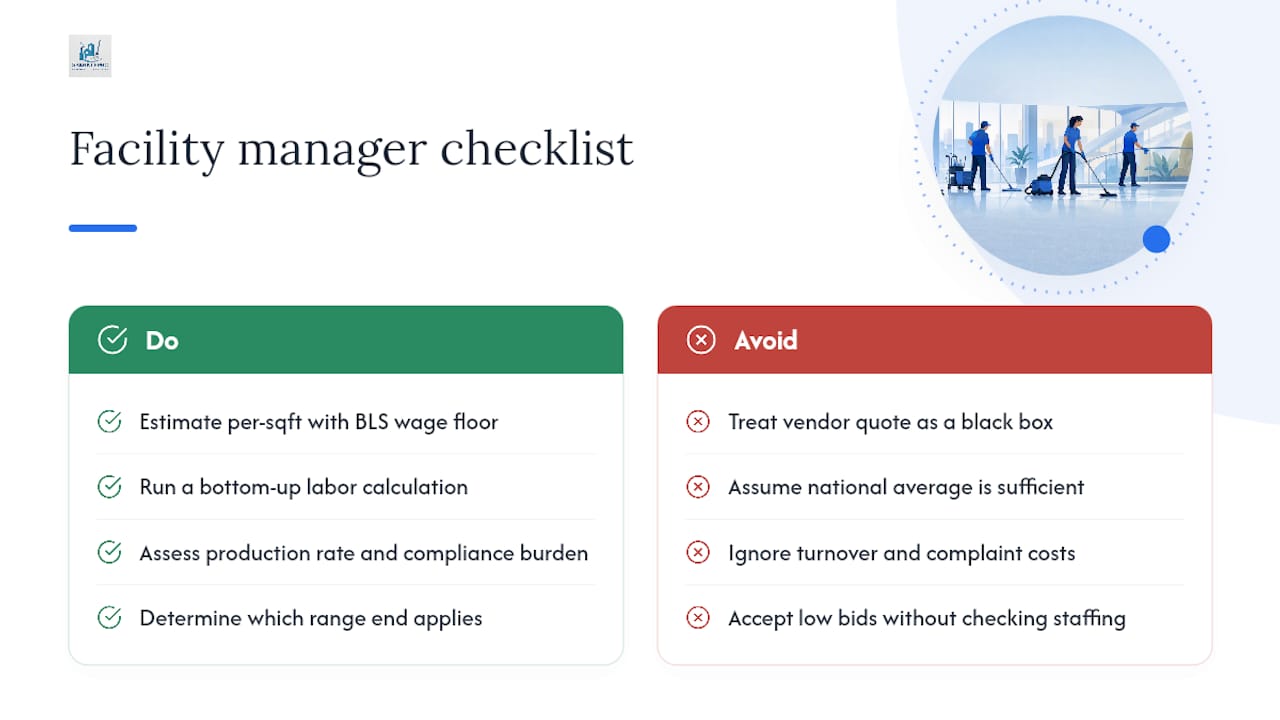
The bigger blind spot is treating the vendor's quote as a black box. Facility managers who never run their own bottom-up labor calculation have no way to know if a low bid is efficient or just underpriced, which usually means understaffed. Cheap quotes have a way of getting expensive once turnover and complaint calls start piling up.
Prioritize this first: build your own rough per-square-foot number using the BLS wage floor before you even open a vendor's proposal. It turns you from someone reacting to a price into someone who can spot exactly where a bid doesn't add up.
— Sales
Get a Cleaning Quote That Matches Your Actual Building
Sparklepro Commercial Cleaning prices every job against the real scope of your facility instead of a flat national average, so the number you get reflects your square footage, frequency, and compliance needs from the first quote. That matters most for readers who've just run the math above and want a bid that actually holds up against it.
Post-construction cleanouts and specialty jobs get the itemized treatment this article recommends, not a bundled guess. If you're weighing staffing models for a large property, the labor-efficiency approach in Postal Solutions' guide to on-site team savings offers a useful outside perspective, though Sparklepro's own bottom-up pricing method covers most of the same ground for cleaning specifically. If you're managing property in Delaware, request a localized quote for Delaware buildings and get a site visit scheduled around your actual conditions rather than a phone estimate.
Sources
- Commercial Cleaning Rates per Square Foot: Full Pricing Guide - ISSA
- How to Price Commercial Cleaning Jobs: 2026 Costs - HousecallPro
- Bureau of Labor Statistics (BLS) — building cleaning worker wage data
- Commercial cleaning cost per square foot (2026 benchmark data) - CleanQuote