

Building maintenance cleaning cost reduction is the practice of managing cleaning operations through data-driven scheduling, preventive upkeep, and resource planning to lower expenses while maintaining service quality. Property managers and facility directors who treat cleaning as a fixed overhead miss the real opportunity: janitorial costs are highly variable and respond directly to smarter management. The industry terms most relevant here are workloading, occupancy-triggered scheduling, and preventive maintenance integration. Each strategy addresses a different cost driver, and combining them produces the largest savings. Sparkleprocommercialcleaning works with facility teams across the country to apply exactly these methods at scale.
How can occupancy-triggered cleaning scheduling reduce costs?
Fixed janitorial schedules waste labor. Occupancy variations of 60–70% between peak and trough days mean crews clean empty spaces at full cost. That gap represents pure budget loss with no hygiene benefit.
Occupancy-triggered cleaning uses IoT sensors, badge access data, and AI scheduling tools to deploy crews only when spaces actually need attention. A conference room used twice a week gets cleaned twice a week. A lobby with constant foot traffic gets cleaned more often. The logic is simple, but the financial impact is significant: facilities using AI-driven scheduling reduced janitorial labor hours by an average of 23%. That reduction translates directly to payroll savings without any drop in cleanliness standards.

Tenant satisfaction also improves. Occupancy-triggered scheduling reduces tenant hygiene complaints by 41% within 90 days of implementation. Cleaning happens where and when people actually are, so the results are visible and consistent.
Pro Tip: Set cleaning thresholds by space type. High-traffic restrooms may trigger a clean after every 50 uses. Low-traffic storage areas may only need weekly service. Calibrating thresholds by zone prevents both over-cleaning and under-cleaning.
| Metric | Fixed schedule | Occupancy-triggered |
|---|---|---|
| Labor hours per week | Constant regardless of use | Adjusted to actual occupancy |
| Hygiene complaint rate | Baseline | Reduced by up to 41% |
| Chemical consumption | Fixed volume | Reduced in proportion to cleaning frequency |
| Tenant satisfaction | Variable | Measurably improved within 90 days |
For a deeper look at how sensor technology fits into your scheduling model, the office cleaning guide from Sparkleprocommercialcleaning covers the practical setup in detail.
What role does preventive maintenance play in building upkeep savings?
Preventive maintenance (PM) is a scheduled program of inspections, filter changes, and equipment servicing designed to catch problems before they become emergencies. Reactive maintenance, by contrast, waits for failure. Reactive maintenance always costs more, both in repair bills and in the cleaning work that follows equipment failures.
The financial case for PM is concrete. Integrating a preventive maintenance program reduced emergency HVAC repair costs by over $56,000 annually in one major commercial building. Emergency service calls dropped from 23 to 3 per year, saving approximately $88,200 in emergency repair costs. That is not a marginal improvement. It is a structural change in how money flows out of a facility budget.
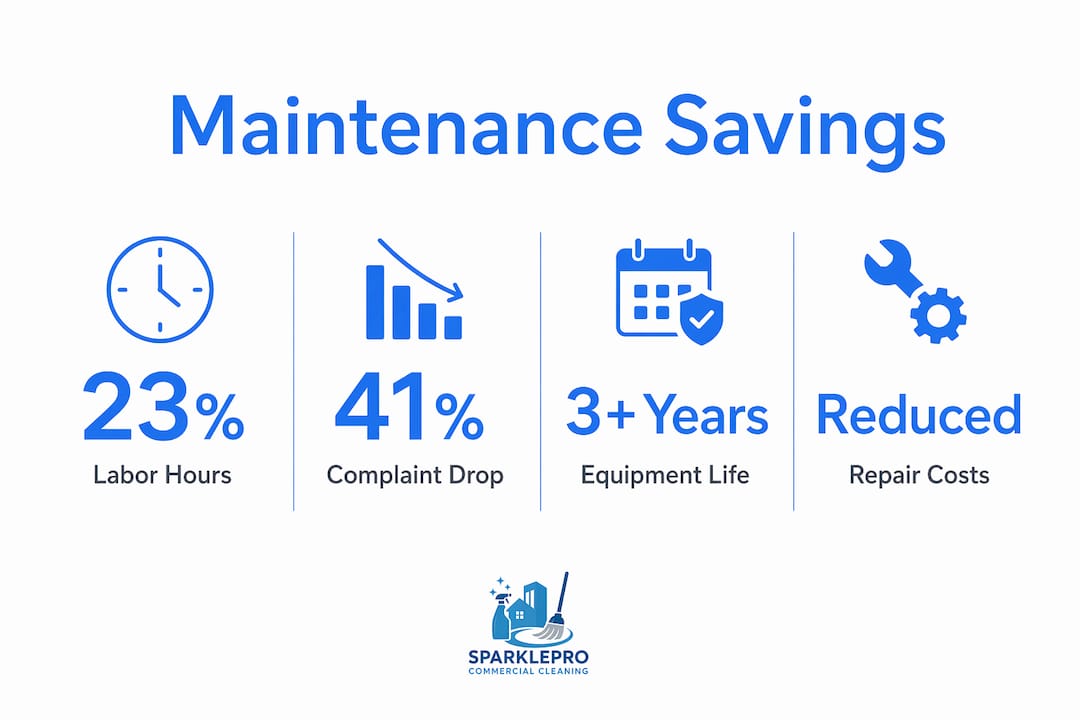
PM also extends equipment life by three or more years on average. Deferred capital replacement is one of the most underused tools in facility budget management. When a rooftop unit lasts four years longer because of consistent filter changes and coil cleaning, the savings dwarf the cost of the PM program itself. Coordinating commercial roof drainage maintenance with your PM calendar prevents water intrusion that creates costly remediation and cleaning work downstream.
Pro Tip: Align your PM schedule with your janitorial calendar. Filter changes and duct inspections generate dust and debris. Schedule a cleaning pass immediately after any mechanical maintenance to prevent that debris from spreading through the building.
| PM task | Cleaning coordination benefit |
|---|---|
| HVAC filter replacement | Schedule post-maintenance cleaning to capture released dust |
| Drain and gutter inspection | Prevents water damage that requires remediation cleaning |
| Restroom fixture inspection | Identifies leaks before mold or staining develops |
| Floor drain servicing | Reduces odor complaints and deep-clean frequency |
How can automation and robotics contribute to cleaning cost efficiency?
Robotic cleaning units reduce labor hours without reducing cleaning coverage. The technology has moved well past novelty. At The Rex co-living development, robotics absorbed 7 hours of cleaning per week while a night concierge absorbed 21 hours, producing a combined 30% reduction in weekly cleaning hours. That outcome came from combining autonomous equipment with role consolidation, not from replacing staff entirely.
The practical benefits of robotic cleaning in commercial facilities include:
- Consistent coverage quality. Robots follow programmed routes without fatigue or variation. High-traffic corridors get the same pass every time.
- Reduced peak-hour labor costs. Autonomous vacuuming and floor scrubbing can run overnight, eliminating premium-hour staffing.
- Budget predictability. Equipment costs are fixed and depreciable. Labor costs fluctuate with turnover, overtime, and absenteeism.
- Obstacle detection and safety. Current units navigate around furniture and people without supervision, making them viable in occupied spaces.
- Data output. Many units log coverage maps and run times, giving facility directors verifiable proof of service.
The caution is real: robotics require human oversight to handle exceptions, refill consumables, and manage areas the equipment cannot reach. A hybrid model, where robots handle repetitive coverage and staff handle detail work, outperforms full automation in most commercial settings.
Pro Tip: Before purchasing autonomous cleaning equipment, calculate the payback period using your current hourly labor cost multiplied by the hours the robot would absorb per week. Most mid-size facilities see payback within 18 to 36 months.
What staffing practices optimize your facility maintenance budget?
Labor is the largest cost in any cleaning operation. Labor costs comprise 75–82% of total janitorial expenses. That concentration means even small efficiency gains in labor management produce outsized budget results.
Workloading is the most reliable method for right-sizing your cleaning staff. It calculates labor needs based on cleanable square footage, fixture counts, and traffic levels rather than rough estimates. ISSA 612 Cleaning Times benchmarks provide the industry standard reference: carpet vacuuming runs at 4,000 square feet per hour, and restroom servicing averages 6.5 minutes per fixture. Using these figures, you can calculate exactly how many labor hours a building requires and avoid both overstaffing and underbidding.
Operational best practices that directly reduce cleaning expenses include:
- Geo-fenced clock-in. Staff clock in only when physically on-site. This eliminates time fraud and ghost labor, two of the most common sources of undetected payroll waste.
- Route optimization for multi-site operations. Sequencing cleaning stops by geography reduces drive time and fuel costs. For a portfolio of 10 buildings, optimized routing can recover several hours of productive labor per week.
- Cross-training staff. A cleaner trained in both janitorial and light maintenance tasks reduces the need for separate service calls.
- Performance-based contract structuring. Contracts tied to output metrics rather than hours worked shift the incentive toward efficiency.
Consolidating janitorial tasks into existing on-site roles, such as a night concierge absorbing daily cleaning hours, increases efficiency by 30% without adding headcount. This approach works best in mixed-use or residential commercial buildings where staff are already present overnight. For scheduling frameworks that fit different building types, the janitorial schedule guide from Sparkleprocommercialcleaning offers practical templates.
How can supply management contribute to cleaning cost reduction?
Supply costs are smaller than labor costs, but they are also easier to control quickly. The most common waste pattern is over-ordering based on habit rather than actual consumption. Facilities that switch to usage-based reordering consistently find they were carrying excess inventory and over-applying chemicals.
Sensor-detected stock levels automate the reorder trigger. Automated supply reordering triggered by sensor data reduces waste and prevents out-of-stock situations simultaneously. Centralized inventory control tracks chemical and consumable use per zone, which reveals which areas consume disproportionate supplies and why.
- Audit current consumption by zone. Pull three months of supply data and map it against square footage and traffic. High-consumption zones that do not match their traffic level signal waste or misuse.
- Switch to concentrated chemical systems. Dilution-control dispensers reduce chemical cost per use and eliminate guesswork in mixing.
- Set par levels by zone type. Restrooms, break rooms, and lobbies each have different consumption rates. Zone-specific par levels prevent both shortage and excess.
- Review paper product usage. High-capacity dispensers reduce refill frequency and cut per-use cost compared to standard dispensers.
Pro Tip: Track supply consumption per 1,000 square feet monthly. A sudden spike in a specific zone almost always points to a leak, a dispenser malfunction, or a staff training gap. Catching it early saves both supply costs and potential damage costs.
Key takeaways
Combining occupancy-triggered scheduling, preventive maintenance, automation, and workloading-based staffing produces the most reliable building maintenance cleaning cost reduction results available to facility directors today.
| Point | Details |
|---|---|
| Occupancy-triggered scheduling | Reduces labor hours by 23% and hygiene complaints by 41% within 90 days. |
| Preventive maintenance integration | Cuts emergency repair costs by over $56,000 annually and extends equipment life by 3+ years. |
| Robotics and role consolidation | Saves up to 30% of weekly cleaning hours when combined with on-site staff role integration. |
| Workloading and geo-fencing | Eliminates labor waste using ISSA 612 benchmarks and location-verified clock-in. |
| Supply usage tracking | Zone-level consumption monitoring identifies waste and reduces unnecessary reordering. |
What I've learned after years of watching facilities cut costs the wrong way
Most facility directors I work with come in focused on the wrong number. They want to cut the cleaning contract rate. That feels like a direct saving. What actually happens is the contractor reduces staff hours, coverage drops, tenant complaints rise, and the director ends up paying for supplemental cleaning or emergency deep cleans that cost more than the original contract savings.
The real money is in the structure of the operation, not the line-item rate. I have seen buildings cut their effective cleaning cost by rethinking when and where cleaning happens, not by squeezing the vendor. Occupancy-triggered scheduling alone changes the math entirely. You stop paying for cleaning that serves no one.
The other thing I would push back on is the idea that automation replaces the need for good oversight. It does not. Robotics and AI scheduling tools are multipliers. They make a well-run operation more efficient. They make a poorly-run operation more expensive, because the problems are harder to see. The deep cleaning techniques that protect your building's long-term condition still require trained human judgment.
My honest recommendation: benchmark your current operation against APPA and ISSA 612 standards before you change anything. Know your baseline. Then apply technology and preventive maintenance where the data shows the biggest gaps. That sequence works. Skipping the baseline assessment is where most cost-reduction efforts stall.
— Sales
Sparkleprocommercialcleaning: cost-efficient cleaning built for your portfolio
Property managers who want to put these strategies into practice need a cleaning partner who already works this way.
Sparkleprocommercialcleaning provides commercial cleaning services across Delaware, Massachusetts, Washington, and New Jersey, with scheduling built around your building's actual occupancy patterns. Every engagement starts with a site assessment, so your cleaning program reflects real usage data rather than a generic template. Sparkleprocommercialcleaning's trained staff and fully licensed, insured service model give facility directors the budget predictability and service consistency they need. Contact Sparkleprocommercialcleaning for a custom quote and operational assessment tailored to your portfolio.
FAQ
What is occupancy-triggered cleaning scheduling?
Occupancy-triggered cleaning scheduling deploys janitorial crews based on real-time or historical building usage data rather than fixed time intervals. Facilities using this model reduce labor hours by an average of 23% while improving tenant satisfaction.
How much can preventive maintenance reduce facility cleaning costs?
Preventive maintenance reduces emergency repair costs significantly. One commercial building cut emergency HVAC calls from 23 to 3 per year, saving over $88,000 annually in repair and associated remediation costs.
What is workloading in commercial cleaning?
Workloading is the calculation of labor needs based on cleanable square footage, fixture counts, and traffic levels using benchmarks like ISSA 612 Cleaning Times. It prevents overstaffing and underbidding by replacing rule-of-thumb estimates with measurable data.
How do robotics reduce cleaning costs in commercial buildings?
Robotic cleaning units absorb repetitive coverage tasks, freeing human staff for detail work. At The Rex co-living property, robotics and role consolidation together reduced weekly cleaning hours by 30%.
What percentage of cleaning costs come from labor?
Labor accounts for 75–82% of total janitorial expenses in commercial facilities. Reducing labor waste through geo-fenced clock-in, route optimization, and workloading produces the largest cost savings of any single operational change.