
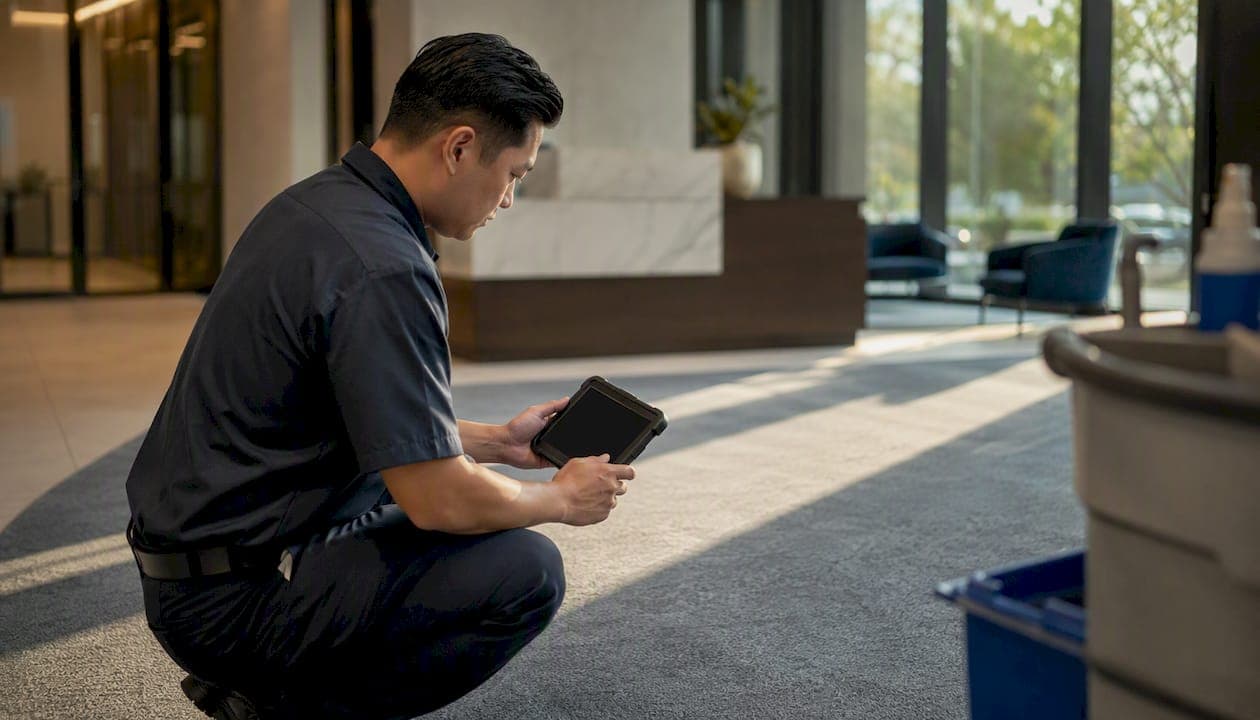
Commercial cleaning in 2026 is contract-based janitorial, post-construction, deep and disinfecting, tenant move-out, day-porter, and facility services delivered with digital quality checks and demand-based scheduling rather than a fixed weekly checklist. The work itself hasn't reinvented itself. What's changed is how vendors plan it, prove it, and price it.
Three shifts define the current market. First, predictive and usage-based scheduling has replaced blanket frequency schedules, using occupancy data to decide where crews actually need to be. Second, digital inspection and reporting have become standard rather than a premium add-on. Third, sustainability credentials and expanded environmental disinfecting have moved from nice-to-have to a line item buyers ask about before they ask about price.
If you're writing an RFP this quarter, here's what to require:
- Proposals that show usage-based or predictive scheduling, not just a static frequency chart
- Digital inspection reports with photo evidence and timestamped corrective actions
- Documented sustainability practices, including product certifications and waste-reduction commitments
- A clear onboarding timeline with milestones you can hold the vendor to
Key Takeaways
Commercial cleaning in 2026 works best as a documented, data-driven program with digital QA and usage-based scheduling built into the contract from day one.
| Point | Details |
|---|---|
| Require digital QA | Ask for photo-documented inspections and corrective task logs in every proposal, not just a verbal promise. |
| Demand SLA metrics tied to data | Set service-level agreements against inspection pass rates and response times, not vague frequency language. |
| Budget deep cleaning separately | Treat deep cleans as scheduled capital-preservation projects with their own line item and acceptance criteria. |
| Verify sustainability credentials | Confirm Green Seal, EPA Safer Choice, or LEED-aligned product use in writing before signing. |
| Consider a unified vendor | Sparkleprocommercialcleaning bundles janitorial, post-construction, move-out, and deep cleaning under one licensed, insured contract with a four-step onboarding process. |
Table of Contents
- What Falls Under Commercial Cleaning Services
- How Vendors Prove the Work Actually Got Done
- What Compliance Paperwork Should Be on File Before Signing
- Choosing a Cleaning Partner: What Actually Matters
- What the First 90 Days Should Look Like
- The Financial Case for Treating Cleaning as an Asset Program
- Why Most Buyers Still Underprice Deep Cleaning
- Ready to Request a Site Visit and Quote
- Frequently Asked Questions
- Sources
What Falls Under Commercial Cleaning Services
Commercial cleaning is standardized, scheduled work governed by documented procedures rather than an ad hoc favor someone does when the lobby looks bad. That distinction matters when you're comparing bids, because it tells you whether a vendor is running a program or just sending people over with mops.
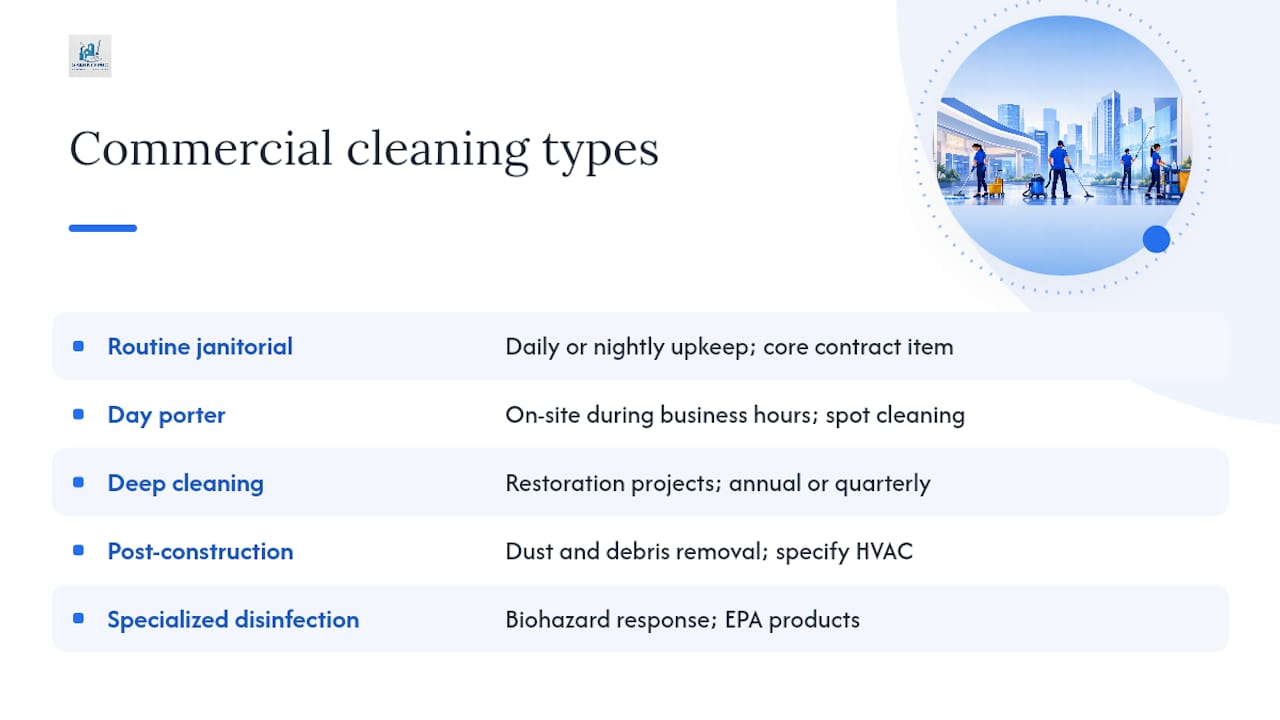
Routine janitorial covers daily or nightly upkeep: restrooms, common areas, trash, floors, glass. This is the backbone of most contracts and is typically the largest recurring line item.
Day porter services put a dedicated person on-site during business hours for spot cleaning, restocking, and immediate response to spills or messes. High-traffic retail centers and multi-tenant office buildings lean on this the most.
Deep cleaning is a project, not a routine. It's restoration-focused work like grout descaling, upholstery extraction, and high-dusting that offices often need once or twice a year, while high-traffic venues may need it quarterly. Treat it as its own scheduled shutdown project, not an extension of nightly janitorial.
Post-construction cleanouts deal with dust, adhesive residue, and debris after a build or renovation. This scope should specify HVAC coil and duct cleaning separately, since drywall dust in a fresh system can cut efficiency fast. Our construction debris removal guide breaks down what belongs in the base scope versus what needs a specialty addendum.
Tenant move-out and turn cleaning prepares a unit or suite for the next occupant, usually on a tight multifamily or office turnaround window.
Specialized environmental disinfecting covers biohazard response, outbreak-related sanitizing, and nonclinical healthcare-adjacent spaces where electrostatic application and EPA-registered products are expected, not optional.
Facility services bundle grounds, minor maintenance requests, and porter duties into one contract, common in industrial and large multi-tenant properties that want one point of accountability.
How Vendors Prove the Work Actually Got Done
The operational model that separates a serious 2026 vendor from a mop-and-bucket outfit comes down to one thing: can they show you the work happened, or do you just have to take their word for it?
The digital inspection workflow now looks like this: a scheduled inspection triggers a walkthrough, the technician captures photo evidence on a mobile app, any deficiency generates a corrective task with an owner and a deadline, and the client signs off through a digital approval, not a phone call three weeks later when someone finally notices the baseboards.
Usage-based scheduling works the same logic. Footfall sensors or badge-swipe data show which floors and restrooms actually get used, and crews get reallocated toward the busy zones instead of splitting time evenly across a building where half the space sits empty three days a week. That's not just efficiency theater. It cuts labor cost while improving the areas occupants actually notice.
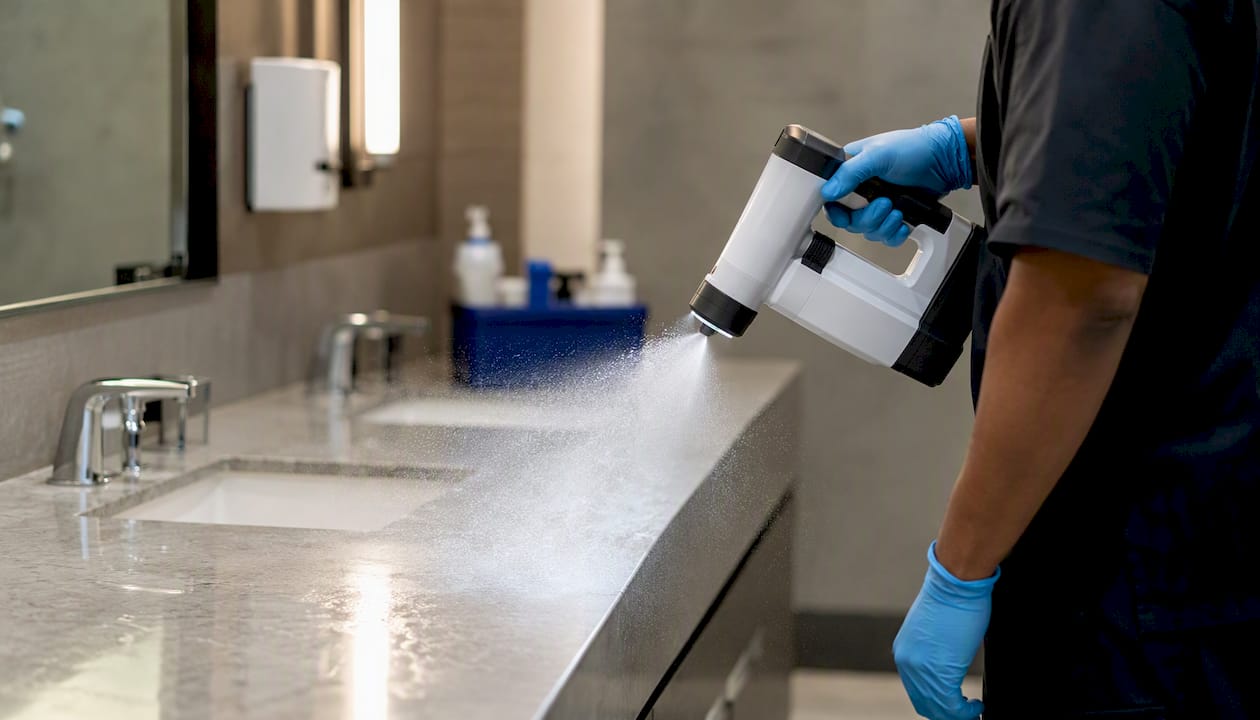
On equipment and staffing, expect electrostatic sprayers for disinfecting, HEPA-filtered vacuums for indoor air quality, and technicians with documented training records, not a rotating cast of subcontractors nobody vetted. Our guide to improving building cleanliness covers how these tools show up in day-to-day results.
Pro Tip: When you write the statement of work, add one sentence: "Vendor shall provide digital inspection reports with photo documentation for each scheduled visit, accessible to the client within 24 hours." That single clause turns QA from a promise into a paper trail.
What Compliance Paperwork Should Be on File Before Signing
Before you sign anything, get these documents in hand, not just referenced in a sales deck:
- General liability and workers' compensation insurance certificates, current and naming your property if required
- Active business licenses in your state or municipality
- Safety Data Sheets for every chemical used on-site
- EPA-registered disinfectants for any healthcare-adjacent or outbreak-response work
- Evidence of OSHA-aligned safety training for cleaning staff, especially where chemicals or lifts are involved
On sustainability, ask specifically about Green Seal or EPA Safer Choice certified products, whether the vendor runs a LEED-aligned cleaning program, and what their waste-reduction commitments look like in writing, not just marketing language.
For healthcare-adjacent nonclinical spaces or cleanrooms, expect subcontracted specialists rather than a generalist crew stretching into unfamiliar territory. If a vendor claims in-house capability for hazardous material handling, ask who holds the certification and how recently it was renewed.
Choosing a Cleaning Partner: What Actually Matters
Rank your evaluation criteria by impact, not by what's easiest to compare on a spreadsheet. Digital QA and reporting should sit at the top, followed by direct experience with your specific property type, staffing stability, sustainability practice, and insurance compliance.
Pricing drivers break down predictably: square footage, visit frequency, scope depth (a full deep clean costs more than a nightly wipe-down), supply and equipment costs, and labor market pressure, which has pushed wages up across the janitorial sector in most metro markets. Specialty services like biohazard response or HVAC coil cleaning get priced separately, and they should.
Ask vendors these questions before you shortlist anyone:
- How do you document and share inspection results with clients?
- What's your average staff retention rate on similar contracts?
- Who handles escalations, and what's your response window for a failed inspection?
- What SLA remedies apply if a corrective task misses its deadline?
- How do you handle change orders for added scope mid-contract?
- What products and certifications back your sustainability claims?
- How is pricing structured for CAM-recoverable versus landlord-direct services?
- What's your onboarding timeline from signed contract to first scheduled clean?
- Do you subcontract specialty services, and if so, to whom?
- How does your pricing adjust over a multi-year term?
For property management contracts specifically, master service agreements typically split common-area maintenance that's CAM-recoverable from landlord-direct cleaning billed straight to ownership. Know which bucket each service falls into before you sign, because it affects how costs get passed through to tenants.
Your contract should include a clear scope-of-work frequency matrix, SLA definitions tied to actual inspection metrics rather than vague language like "as needed," a stated onboarding timeline, defined termination terms, and a CPI or escalation clause so pricing doesn't blindside you in year two. Our buyer's guide for general contractors and property managers walks through how to structure these clauses without over-lawyering the document.
What the First 90 Days Should Look Like
Onboarding follows a predictable arc if the vendor knows what they're doing. Days 1 to 15 cover the quote and site visit, where scope gets finalized against your actual floor plan, not a generic template. Days 15 to 30 typically involve a pilot clean or initial deep clean that establishes a baseline condition. Days 30 to 60 roll out the standard recurring schedule. Days 60 to 90 wrap up with a digital QA baseline review and the first formal performance check-in.
| Phase | Task | Responsible Party | Acceptance Criteria |
|---|---|---|---|
| Days 1-15 | Quote and site visit | Vendor + client facilities lead | Scope matches walkthrough notes and floor plan |
| Days 15-30 | Initial deep clean / pilot | Vendor crew | Baseline photo documentation signed off |
| Days 30-60 | Standard schedule roll-out | Vendor | Consistent visit logs, no missed shifts |
| Days 60-90 | QA baseline and review | Both parties | First SLA report reviewed and approved |
From day one, track SLA pass rate on digital inspections, response time to corrective tasks, supply and consumable uptime, occupant complaints per 1,000 visits, and safety incident counts. Those five numbers tell you more about vendor performance in 90 days than a year of anecdotal impressions. Our prep guide for property managers covers what to have ready before the crew's first visit.
The Financial Case for Treating Cleaning as an Asset Program
Cleaner indoor environments aren't just a comfort issue. The EPA estimates Americans spend roughly 90% of their time indoors, and that exposure link is tied to measurably fewer short-term sick days in properly maintained buildings, with some data pointing to reductions as high as 35%.
The ROI shows up in places facilities budgets don't always connect back to cleaning. Grout descaling and flooring maintenance extend the life of finishes that are expensive to replace. HVAC coil cleaning prevents the gradual efficiency loss that shows up later as an inflated energy bill. Consistent floor care in entryways cuts slip-and-fall risk, which matters both for occupant safety and for the liability exposure that follows a claim.
Facility experts increasingly frame cleaning as an asset-preservation tool rather than a cost center, and the programs that deliver on that promise are the ones using inspection data to shift from reactive scheduling to predictive scheduling. Our post on protecting property value through cleaning digs into specific asset categories where this pays off fastest.
Why Most Buyers Still Underprice Deep Cleaning
The biggest mistake procurement teams make isn't picking the wrong vendor. It's treating deep cleaning as an upsell instead of a separate capital-preservation line item with its own budget and schedule.
Routine janitorial and deep cleaning solve different problems, and pricing them the same way almost guarantees one of them gets shortchanged. A nightly crew wiping counters isn't equipped to descale grout or extract years of soil from carpet fiber, and asking them to squeeze it in "when there's time" is how buildings end up replacing flooring three years earlier than they should have. Deep cleaning needs its own line item, its own schedule, and its own acceptance criteria, exactly the way a roof inspection gets budgeted separately from commercial gutter system maintenance.
The other underrated shift is what predictive scheduling actually changes about vendor relationships. Buyers assume usage-based scheduling is about cutting cost, and it can, but the sharper benefit is accountability. When a vendor commits to inspection metrics tied to actual occupancy data, you've replaced a subjective "does it look clean" conversation with a number either side can point to. That's the difference between a vendor relationship you have to manage and one that manages itself.
Property teams that skip this and stick with flat-frequency contracts aren't saving money. They're just deferring the cost to a future capital replacement budget.
Ready to Request a Site Visit and Quote
For property managers and facility directors who want the digital QA, predictive scheduling, and sustainability practices covered above without stitching together three different vendors, Sparkleprocommercialcleaning runs on exactly that model: one licensed and insured provider handling janitorial, post-construction, move-out, deep cleaning, and disinfecting under a single contract instead of a patchwork of specialists.
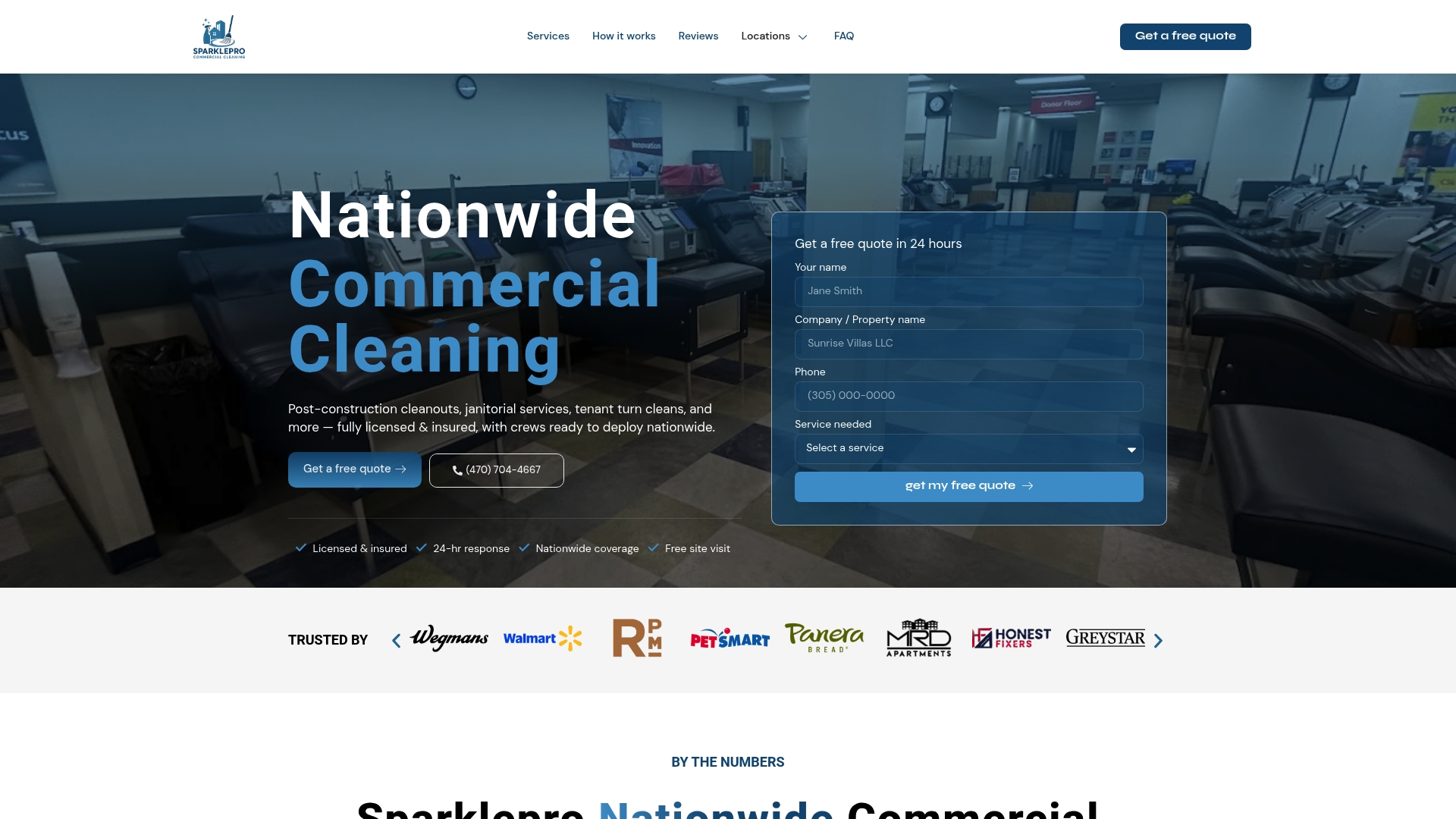
Getting started follows the same four-step process outlined throughout this guide: request a quote, schedule a site visit so scope gets locked to your actual property, move into scheduled cleaning on the frequency your building needs, and sign off through client approval once the work is verified. No long-term lock-in assumptions, no vague scope language. If you're managing a property in Massachusetts, you can request a quote directly and get a site visit scheduled this week.
Frequently Asked Questions
What is the biggest change in commercial cleaning for 2026? The shift toward predictive, usage-based scheduling backed by digital inspection data, replacing flat weekly frequency charts with cleaning allocated to where occupancy data shows it's actually needed.
How often should a commercial office get a deep clean? Most offices need one to two full deep cleans per year, while high-traffic retail or hospitality venues often need quarterly deep cleaning or targeted hot-spot cleans between full sessions.
What documents should I require before signing a cleaning contract? General liability and workers' compensation insurance, active business licenses, Safety Data Sheets for chemicals used, and evidence of staff safety training, at minimum.
How long does onboarding with a new commercial cleaning vendor take? Expect roughly 30 to 90 days from signed quote to a fully verified standard schedule, covering the site visit, an initial pilot or deep clean, schedule roll-out, and a first performance review.
Is CAM-recoverable cleaning different from landlord-direct cleaning? Yes. CAM-recoverable services cover common areas and get passed through to tenants via operating expenses, while landlord-direct cleaning is billed straight to the property owner.
Sources
The research behind this guide draws on a mix of facility-management and building-operations reporting:
- The Hidden ROI of Clean: How Your Cleaning Strategy Drives Performance | Buildings
- The Facility Manager’s Guide to Deep Cleaning Commercial Buildings in 2026 – Facility Management Insights
- Janitorial Services for Property Management Companies | National Janitorial Authority
If you manage property in Delaware or Washington state, Sparkleprocommercialcleaning's regional pages for Delaware and Washington list local service details and quote requests. For anywhere else, the main site is the place to start.