

If you manage a commercial property, you've probably faced the same frustrating gap: you know you need professional cleaning services, but the details around what are commercial cleaning FAQs, compliance standards, and contract terms feel murky at best. From kitchen hood regulations to evaluating proposals, the questions pile up fast. This guide cuts through the noise and gives you direct, practical answers to the most common commercial cleaning questions facility managers ask before, during, and after hiring a service provider.
Table of Contents
- Key takeaways
- What commercial cleaning FAQs actually cover
- What commercial cleaning services typically include
- Kitchen hood cleaning and NFPA 96 compliance
- How to evaluate cleaning proposals and service quality
- Best practices for maintaining clean commercial properties
- My honest take on commercial cleaning partnerships
- How Sparkleprocommercialcleaning can support your facility
- FAQ
Key takeaways
| Point | Details |
|---|---|
| Scope matters in contracts | Commercial cleaning services go far beyond basic tasks; always verify what's included in writing. |
| NFPA 96 compliance is non-negotiable | Kitchens operating 16+ hours daily require monthly hood cleaning under updated 2025 standards. |
| Proposals should be clear, not long | Concise answers to five core operational questions win more contracts and reduce misunderstandings. |
| Documentation protects you | Digital records of cleaning activity are now required under NFPA 96's 2025 update to satisfy inspections. |
| Proactive maintenance fills the gaps | Coordinating cleaning schedules with building usage patterns improves hygiene between professional visits. |
What commercial cleaning FAQs actually cover
Before getting into specifics, it helps to understand what cleaning service FAQs are really designed to answer. They're not just about mops and vacuums. Frequently asked cleaning questions from facility managers tend to cluster around four core areas: scope of services, regulatory compliance, contract evaluation, and day-to-day maintenance best practices.
Knowing these categories matters because a gap in any one of them creates real operational risk. A misunderstood service scope leads to dirty restrooms that no one owns. A missed compliance deadline leads to fire marshal fines. A vague contract leads to a vendor dispute you didn't see coming. The goal here is to address each area with the specificity that facility managers and property owners actually need.
What commercial cleaning services typically include
Commercial cleaning is not residential cleaning at a larger scale. The differences run deeper than square footage. Commercial environments operate under regulatory requirements, serve dozens or hundreds of occupants simultaneously, and often require specialized equipment and chemicals that residential crews don't carry.
According to a janitorial scope of work framework used across office, medical, and retail facilities, standard commercial cleaning tasks typically include:
- Floor care: vacuuming carpets, mopping hard floors, buffing or stripping as scheduled
- Surface dusting: desks, countertops, windowsills, vents, and light fixtures
- Trash removal and liner replacement
- Restroom sanitation: toilets, urinals, sinks, mirrors, and restocking of supplies
- High-touch point disinfection: door handles, elevator buttons, shared equipment
- Break room and kitchen cleaning at a basic level
- Specialized services per contract: carpet extraction, window washing, post-construction cleanout, or disinfection services
The frequency of these tasks depends on your facility type and occupancy load. An office building with 50 employees may need nightly janitorial service. A healthcare facility or food service space will have a more demanding schedule with stricter disinfection protocols. This is why your service agreement needs to spell out tasks, frequency, responsible parties, and performance standards explicitly.
Pro Tip: Ask your provider for a line-item scope of work document before signing anything. If they can't produce one, that tells you something important about their operational discipline.
Kitchen hood cleaning and NFPA 96 compliance
This is the area where common cleaning inquiries get serious fast. If your facility includes any commercial food service operation, NFPA 96 is the governing standard you need to understand. It's not optional. NFPA 96 compliance is a legal requirement enforced to prevent fire hazards from grease buildup in exhaust systems.
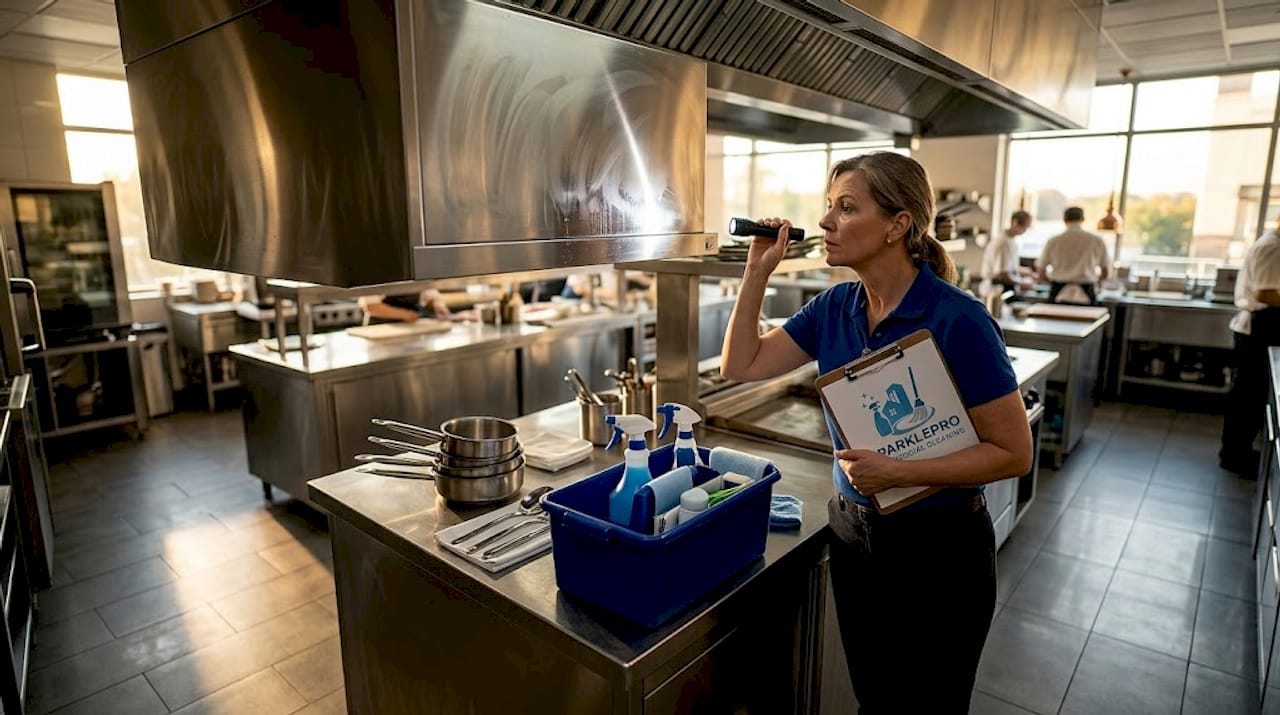
The standard defines cleaning frequency in tiers based on cooking volume and fuel type. Here's a quick reference pulled directly from the regulation:
| Operation type | Required cleaning frequency |
|---|---|
| Solid fuel cooking (wood, charcoal) | Monthly |
| High-volume cooking (16+ hours/day) | Monthly |
| Moderate-to-high volume cooking | Quarterly |
| Moderate volume cooking | Semi-annually |
| Low-volume or seasonal operations | Annually |
Under the 2025 NFPA 96 update, kitchens running 16+ hours daily now face mandatory monthly cleaning regardless of fuel type. Extended operating hours accelerate grease accumulation in ways that quarterly schedules simply can't manage.
The same 2025 update introduced a significant documentation change. Digital cleaning records are now required to satisfy compliance. Physical hood stickers alone no longer cut it when a fire marshal shows up for an inspection. Your cleaning provider must supply timestamped digital activity logs, and those records need to match the NFPA 96 schedule precisely.
Failing a hood cleaning inspection is not just a paperwork problem. FDNY inspections check grease buildup, fan condition, access panels, and fire suppression systems. Fines start at $500 per violation, and repeat offenses can result in forced kitchen closure.
Certification is equally critical. Your cleaning provider must be qualified under ANSI/IKECA C10 or an equivalent standard, and they need to provide full documentation to maintain your compliance and insurance validity. Using an uncertified cleaner can void your compliance status entirely, even if the physical cleaning was performed correctly. For a detailed look at how NFPA inspection requirements apply in your region, reviewing state-specific compliance guides is a smart move.
Pro Tip: Request photographic proof of cleaning alongside digital logs. Compliance insiders use photos to match documentation with actual work performed, and this level of evidence satisfies even the most aggressive inspections.
How to evaluate cleaning proposals and service quality
Most facility managers make the same mistake when reviewing cleaning proposals. They focus on price first and everything else second. That order creates problems. Clear, concise answers to core operational questions win cleaning contracts faster than lengthy proposals, and the same principle applies when you're the one evaluating.
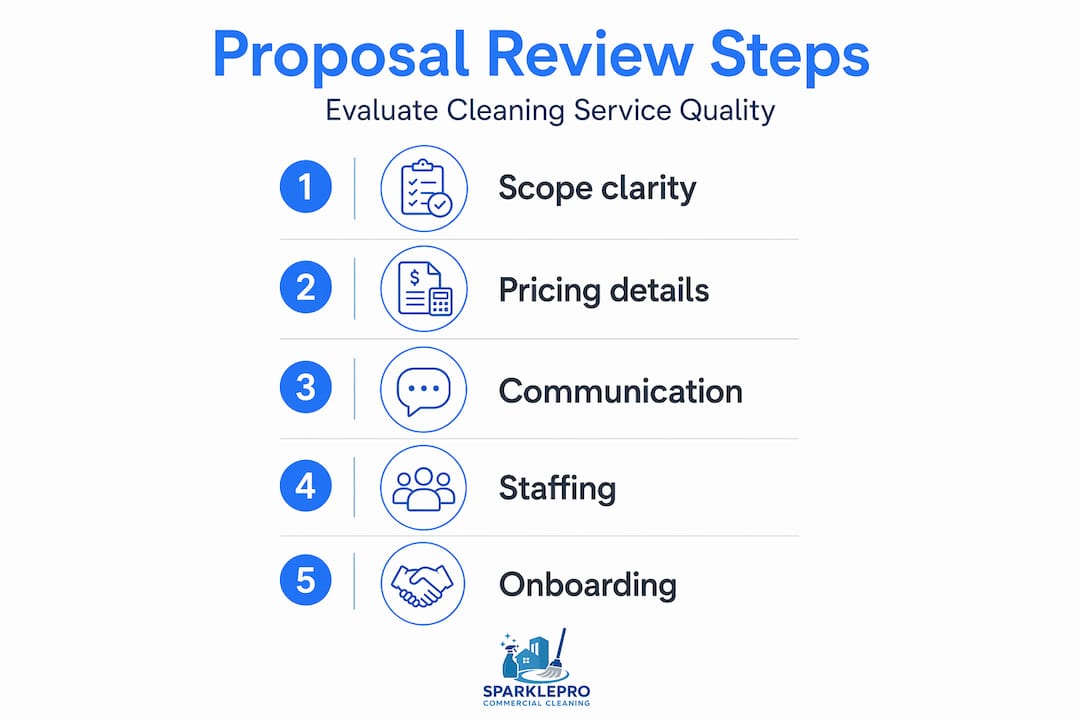
When you receive a proposal, work through these five questions before making any decision:
- What exactly is included in the quoted price? Get a line-item task list, not a summary paragraph. Vague language like "general cleaning" is a red flag.
- How do we communicate when something goes wrong? You need a named contact, a response time commitment, and a clear escalation path. A provider without these is a liability.
- How do you handle staffing reliability? Ask about backup protocols when a regular cleaner calls out sick. Staffing reliability and show-up rates directly impact your building's cleanliness and your occupants' experience.
- What does the onboarding process look like? A provider with a structured 30/60/90-day startup plan is one who understands that first impressions are set by the first three months. This is often overlooked, but a good onboarding plan clarifies service expectations and builds trust faster than any contract clause.
- Can you provide references from comparable facilities? A medical office building and a retail strip mall have different needs. References should match your context.
Once you've confirmed the basics, dig into the contract language around scope changes. Facilities evolve. Tenant turnover, renovation projects, and seasonal occupancy shifts all affect cleaning needs. Your contract should have a clear process for adjusting scope without requiring a full renegotiation every time.
Pro Tip: Ask the provider how they handle a quality complaint in the first 60 days. A great answer includes a documented process. A bad answer is "we'll take care of it." Vague reassurance is not a protocol.
You can find deeper guidance on evaluating cleaning contracts for quality and cost to help you compare proposals side by side.
Best practices for maintaining clean commercial properties
Professional cleaning services do the heavy lifting, but facility managers who stay actively involved between visits get measurably better results. Research from Sparkleprocommercialcleaning confirms that coordinating cleaning schedules with facility usage patterns improves building hygiene and occupant satisfaction consistently.
Here are the best practices for commercial cleaning maintenance that make the biggest difference day to day:
- Match scheduling to occupancy. Schedule deep cleaning when the building is least occupied. A 24-hour facility needs a different approach than a Monday-through-Friday office.
- Post visible protocols for occupants. Employees and tenants who know basic hygiene expectations (kitchen cleanup rules, trash protocols) reduce the burden on cleaning crews.
- Track filter changes and high-use equipment. HVAC filters, break room appliances, and entryway mats accumulate contaminants faster than most managers realize. Build a maintenance calendar for these items specifically.
- Use digital tools for compliance tracking. Whether it's a CMMS platform or a shared digital log, tracking cleaning activity in real time protects you during audits and insurance reviews.
- Address spills and minor issues immediately. Waiting for the next scheduled visit turns a five-minute cleanup into a floor refinishing project. Assign building staff to handle minor incidents as part of their standard responsibilities.
- Conduct monthly walk-throughs with your provider. A 20-minute walkthrough with your cleaning supervisor catches performance drift before it becomes a pattern.
These habits don't replace professional service. They protect and extend the value of it.
My honest take on commercial cleaning partnerships
I've seen hundreds of facility managers approach cleaning contracts the same way they'd approach purchasing office furniture: compare prices, pick the lowest, move on. And I've watched that approach generate the same predictable problems every single time.
What I've learned from working with facility teams across a range of property types is that the biggest issues almost never come from a provider's inability to clean. They come from poor communication, undefined expectations, and a complete absence of onboarding structure. A provider who shows up on day one without a written checklist, a site-specific task list, and a named supervisor is already setting you up for friction.
My honest advice: weight communication and documentation at least as heavily as price. Ask every provider how they document their work, how they handle a missed task, and how they onboard a new facility. The answers to those three questions will tell you more about a vendor's reliability than any proposal ever will.
Compliance documentation is another area where I see facilities get caught off guard. Facility managers sometimes assume that a certificate on the wall is enough to satisfy an inspection. It isn't. Especially with the 2025 NFPA 96 update, the expectation is now photographic evidence and digital logs that match the exact schedule in the standard. If your provider can't produce those records on request, you are exposed.
The best cleaning partnerships I've seen share one trait: the facility manager treats the cleaning company as a vendor partner, not just a service commodity. That mindset changes how you communicate, how you handle complaints, and how quickly problems get resolved.
— Sales
How Sparkleprocommercialcleaning can support your facility
Sparkleprocommercialcleaning operates as a fully licensed and insured nationwide commercial cleaning company, serving office buildings, healthcare facilities, retail centers, and industrial spaces across the United States. Whether you need routine janitorial services, post-construction cleanouts, tenant move-out cleaning, or specialized disinfection services, Sparkleprocommercialcleaning builds a schedule and scope around your facility's actual needs.
Their four-step process covers everything from your initial quote and site visit through scheduled cleaning and customer sign-off. If you're located in the Northeast, Mid-Atlantic, or Southeast, you can reach out directly through regional service pages for Delaware commercial cleaning, New Jersey services, or South Carolina coverage. Every engagement starts with a transparent conversation and a customized plan.
FAQ
What does commercial cleaning typically include?
Commercial cleaning services typically include floor care, surface dusting, trash removal, restroom sanitation, and high-touch disinfection. Specialized services like carpet extraction, window washing, or post-construction cleanup are usually added by contract.
How often should a commercial kitchen hood be cleaned?
Cleaning frequency depends on your operation type. High-volume kitchens and those running 16+ hours daily require monthly hood cleaning under NFPA 96, while low-volume or seasonal operations may qualify for annual service.
Is digital documentation really required for NFPA 96 compliance?
Yes. The 2025 NFPA 96 update requires digital cleaning records in addition to physical certificates. Physical hood stickers alone no longer satisfy inspections.
What should I look for when evaluating a commercial cleaning proposal?
Focus on five areas: task-level pricing clarity, communication protocols, staffing reliability, structured onboarding, and references from comparable facilities. Vague proposals without line-item scopes should raise immediate concerns.
Can using an uncertified hood cleaning company create compliance problems?
Yes. Providers must be qualified under ANSI/IKECA C10 or an equivalent standard. Using an uncertified cleaner can void your compliance status even if the actual cleaning work was completed.