
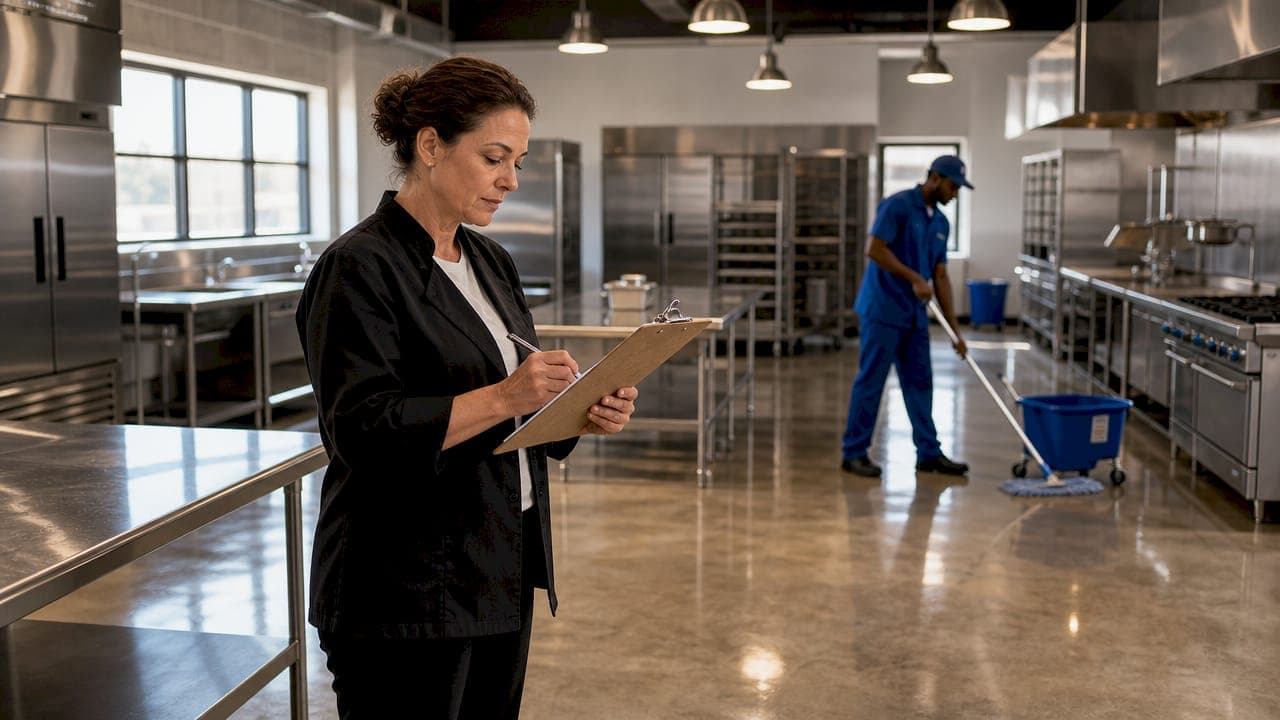
Commercial kitchen post-construction cleanup is the process of removing construction debris, fine dust, grease residue, and chemical contaminants to prepare a kitchen for safe, sanitary, and code-compliant operation. This process goes far beyond a standard janitorial sweep. It requires HEPA vacuuming, HVAC duct cleaning, equipment degreasing, and surface sanitizing aligned with NFPA 96 and the FDA Food Code. Whether you are completing a full kitchen renovation cleaning or wrapping up a new build, skipping any phase of this process creates fire hazards, failed inspections, and contaminated food surfaces before you serve a single plate.
What does commercial kitchen post-construction cleanup involve?
Post-construction cleanup in a commercial kitchen extends well beyond sweeping sawdust off the floor. The scope covers debris removal, detailed dust control, HVAC component cleaning, equipment degreasing, and full surface sanitization. Airborne construction dust settles into every horizontal surface, including the interiors of exhaust hoods, prep tables, and storage shelving. Without systematic removal, that dust redistributes the moment ventilation systems activate.
The cleanup also addresses grease pathways. Even in a newly built kitchen, construction activity deposits particulates inside duct interiors and on grease-contact surfaces. Degreasing and sanitizing are separate steps with distinct products and methods. Confusing the two is one of the most common and costly mistakes kitchen managers make before opening day.
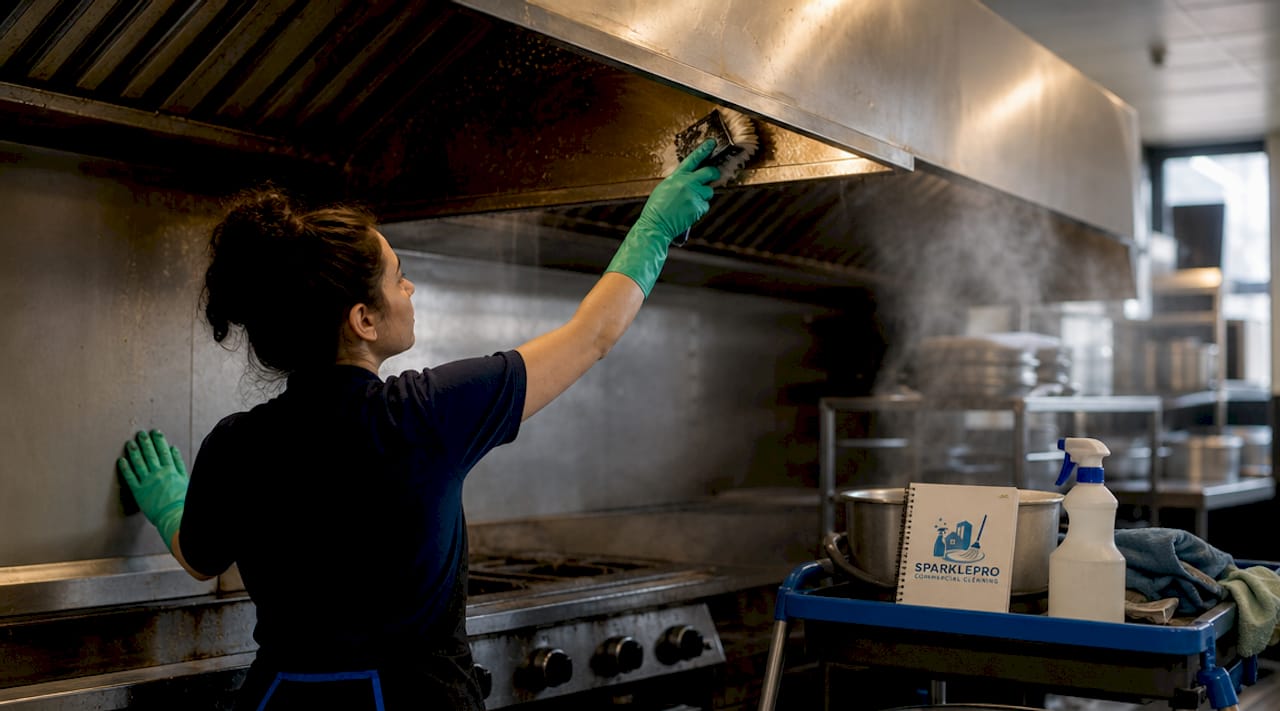
Three regulatory frameworks govern what "clean" means in this context. NFPA 96 sets fire safety standards for exhaust systems and grease removal. The FDA Food Code defines cleaning and sanitizing protocols for food-contact surfaces. Local health department codes add jurisdiction-specific requirements. Meeting all three is not optional. It is the baseline for receiving your certificate of occupancy and passing your first health inspection.
How to clean a commercial kitchen after construction: phases and steps
A thorough post-build kitchen cleaning follows three sequential phases: rough cleanup, light cleanup, and final detail cleanup. Each phase has a defined scope, and skipping ahead creates rework.
Phase 1: Rough cleanup removes the bulk of construction waste. This includes drywall scraps, wood offcuts, packaging materials, and heavy debris. Workers sweep, shovel, and haul material from the kitchen floor, prep areas, and storage rooms. No wet cleaning happens at this stage.
Phase 2: Light cleanup addresses dust and residue left after rough clearing. This is where HEPA vacuums become non-negotiable. Fine particulate removal must happen before ceiling tiles and HVAC covers are reinstalled, because sealing dust inside the system guarantees contamination during operation.
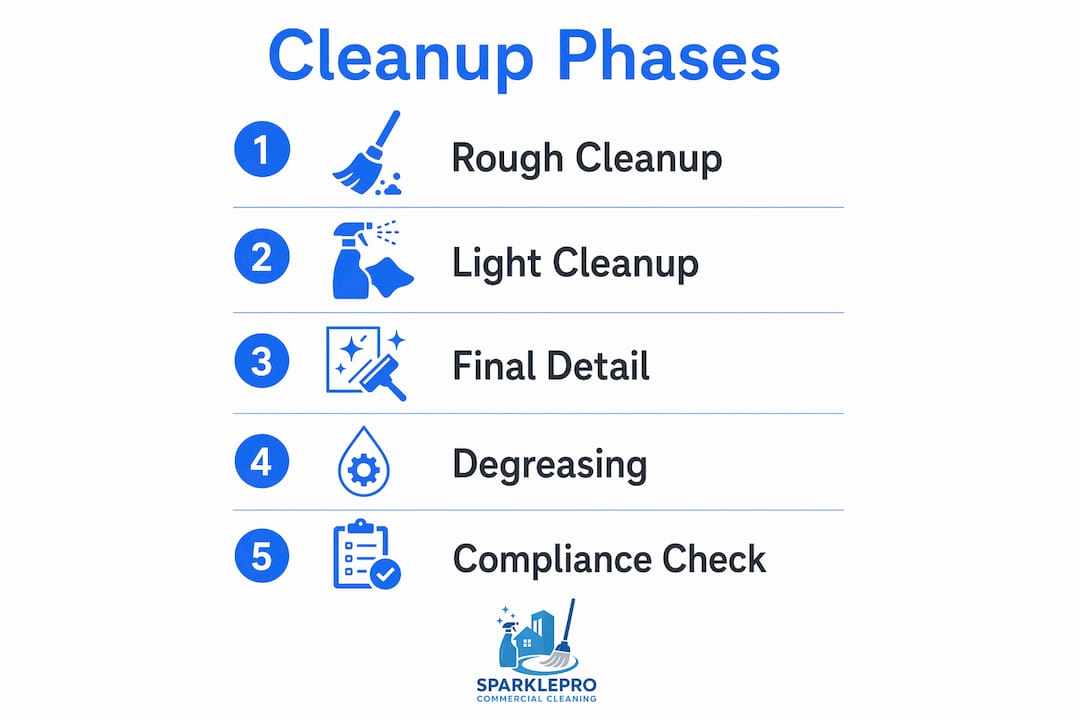
Phase 3: Final detail cleanup prepares the kitchen for inspection and occupancy. This phase covers every surface a health inspector or fire marshal will examine.
Here is the sequential workflow for Phase 3:
- Wipe all ceiling surfaces, light fixtures, and exposed ductwork with damp microfiber cloths.
- Clean HVAC grilles, filters, and accessible duct interiors using HEPA vacuums and approved duct cleaning equipment.
- Degrease exhaust hoods, fans, and grease traps using alkaline degreasers rated for commercial kitchen use.
- Clean all cooking equipment interiors and exteriors, including ovens, ranges, fryers, and steamers.
- Sanitize all food-contact surfaces using an EPA-registered sanitizer after cleaning removes organic matter.
- Scrub walls, backsplashes, and tile grout from top to bottom.
- Clean floor drains, grease traps, and floor surfaces using a commercial floor cleaner.
- Wipe down storage shelving, walk-in cooler interiors, and dry storage areas.
- Polish stainless steel surfaces and glass panels.
- Conduct a final walkthrough using a readiness checklist covering dust-free floors, clean HVAC filters, sanitized restrooms, and polished light fixtures.
Pro Tip: Apply alkaline degreaser to exhaust hood surfaces and let it dwell for 10 to 15 minutes before scrubbing. This dwell time breaks down grease bonds and cuts labor time by roughly half compared to immediate scrubbing.
How to meet NFPA 96 and FDA Food Code compliance during cleanup
NFPA 96 treats inspection and cleaning as two separate events with separate triggers. Cleaning is required when grease buildup in hoods, grease removal devices, fans, and ducts reaches depth thresholds that create combustion risk. In a post-construction context, this means cleaning before the kitchen ever operates, because construction particulates contaminate grease pathways during the build.
The key compliance requirements under NFPA 96 include:
- Hoods, fans, ducts, and grease-contact surfaces must be cleaned to bare metal where grease accumulates.
- Access panels must be restored and documented after cleaning.
- Service reports must list all cleaned areas, inaccessible areas, technician details, and documented cleaning processes for inspector review.
- Grease buildup must be addressed proactively, not reactively after heavy contamination occurs.
The FDA Food Code adds a second layer of requirements for food-contact surfaces. Sanitizing is ineffective on dirty surfaces. Cleaning must remove all organic matter first, and only then does sanitizing achieve the microbial reduction targets the code requires. This sequence is not a suggestion. It is a regulatory standard with defined microbial reduction benchmarks.
"Sanitizing only works effectively after thorough cleaning. Understanding this regulatory distinction is the single most important factor in achieving compliant kitchen sanitation outcomes." — Kitchen Management Authority
Coordinate your cleanup schedule with your local fire marshal and health department inspection dates. Schedule the final detail cleanup no more than 48 to 72 hours before inspection to prevent dust resettlement. If construction trades return for punch work after cleanup, plan for targeted re-cleaning of affected zones before the inspector arrives.
What special considerations apply to HVAC, ventilation, and equipment cleaning?
HVAC and ventilation systems are the highest-risk areas in any kitchen renovation cleaning project. Construction dust is airborne and redistributes through duct systems the moment fans activate. Cleaning HVAC components before sealing the system is the only way to prevent that contamination from cycling through the kitchen during service.
The critical areas and methods for this phase include:
- Exhaust hoods: Degrease interior surfaces, baffles, and grease cups using alkaline cleaners. Remove and soak baffles separately.
- Duct interiors: Use rotary brush systems or HEPA-equipped duct cleaning equipment to remove particulates from duct walls.
- Supply and return air grilles: Remove, wash, and reinstall after HEPA vacuuming the duct opening.
- Makeup air units: Wipe down unit interiors and replace filters before commissioning.
- Exhaust fans: Clean fan blades, housings, and motor covers to remove dust and grease film.
For cooking equipment, airborne construction dust contaminates surfaces that must be thoroughly cleaned before kitchen operation. This applies to equipment interiors as much as exteriors.
| Equipment area | Cleaning method | Product type |
|---|---|---|
| Oven interiors | Scrub with alkaline degreaser, rinse, sanitize | Commercial oven cleaner |
| Fryer baskets and vats | Soak in degreaser solution, scrub, rinse | Alkaline degreaser |
| Range grates and burners | Soak and scrub, dry thoroughly before use | Heavy-duty degreaser |
| Prep table surfaces | Clean with detergent, then sanitize | EPA-registered sanitizer |
| Walk-in cooler walls | Wipe with food-safe cleaner, sanitize | Food-safe sanitizer |
Pro Tip: Clean HVAC duct interiors before ceiling tiles are installed. Once tiles are in place, accessing duct runs becomes significantly harder and more expensive. Schedule duct cleaning as the last trade activity before final detail cleanup begins.
What are the best practices for coordinating cleanup with construction trades?
Proper coordination between construction trades and cleaning services prevents contamination of cleaned areas during final punch work. This is the most overlooked variable in post-construction kitchen readiness, and it causes more re-cleaning costs than any other factor.
Follow this coordination sequence to avoid rework:
- Confirm with the general contractor that all major trade work, including electrical, plumbing, and millwork, is complete before scheduling Phase 2 or Phase 3 cleanup.
- Request a formal punch list from the GC and identify which items require trade re-entry after cleaning begins.
- Assign specific zones for any remaining trade work and protect cleaned areas with plastic sheeting or temporary barriers.
- Schedule a joint walkthrough with the GC and cleaning supervisor to verify scope and sign off on completed zones.
- Build a re-cleaning buffer into your schedule. Re-cleaning may be necessary if final punch work disturbs clean zones, so plan for at least one targeted touch-up session after all trades exit.
Lingering dust after cleanup often signals inadequate HEPA vacuuming during Phase 2, not a Phase 3 failure. If dust reappears on surfaces within 24 hours of final cleanup, the HVAC system is redistributing particulates that were not removed from duct interiors. Address the source before repeating surface cleaning.
Moisture is the second common challenge. Construction materials like concrete and grout release moisture for weeks after installation. Wipe down surfaces with dry microfiber cloths after wet cleaning and verify that exhaust ventilation is operational before final cleanup to support drying. Improving indoor air quality post-cleanup also means running the makeup air system at full capacity for several hours to flush residual particulates before the health inspector arrives.
Key takeaways
Effective commercial kitchen post-construction cleanup requires three sequential phases, strict separation of degreasing and sanitizing steps, and coordinated scheduling with construction trades and regulatory inspections.
| Point | Details |
|---|---|
| Three-phase cleanup structure | Rough, light, and final detail cleanup must be completed in sequence to prevent rework and contamination. |
| NFPA 96 grease compliance | Clean hoods, ducts, and fans to bare metal and document all cleaned areas before any kitchen operation begins. |
| Cleaning before sanitizing | Remove all organic matter and construction residue before applying EPA-registered sanitizers to food-contact surfaces. |
| HVAC cleaning timing | Clean duct interiors before ceiling tiles are installed to reduce cost and prevent dust redistribution during operation. |
| Trade coordination | Confirm all construction punch work is complete before final detail cleanup, and schedule a re-cleaning buffer for last-minute trade re-entry. |
What I've learned from watching kitchens rush this process
Most kitchen managers understand that post-construction cleanup is necessary. Where they consistently underestimate the process is in the distinction between degreasing and sanitizing. These are not interchangeable steps. They require different chemistry, different dwell times, and different verification methods. I have seen kitchens pass a visual inspection and fail a swab test because the crew applied sanitizer over surfaces that still carried construction grease film. The sanitizer never reached the microbes. The kitchen failed its health inspection on opening week.
The second pattern I see repeatedly is treating HVAC cleaning as optional or secondary. Facility managers often defer duct cleaning because it is invisible work. You cannot see a dirty duct from the kitchen floor. But the moment that exhaust fan activates, every particle in that duct system lands on your prep surfaces. The HVAC cleaning procedures that get skipped in week one become the contamination source that triggers a re-inspection in week three.
The most effective kitchen managers I have worked with treat the cleanup as a documented process, not a one-time event. They maintain service reports, technician logs, and zone-by-zone sign-off sheets. When the fire marshal or health inspector arrives, those documents are ready. That preparation is what separates a smooth opening from a delayed one. If you are coordinating a kitchen renovation cleaning or a full new build, invest in a cleaning preparation guide before the final trade exits the building. The cost of preparation is always lower than the cost of re-inspection.
— Sales
How Sparkleprocommercialcleaning supports your kitchen cleanup
Sparkleprocommercialcleaning delivers fully licensed and insured commercial kitchen post-construction cleanup services across the United States, with local teams in Delaware, New Jersey, Massachusetts, and Washington. Every project follows a documented four-step process: site assessment, custom quote, scheduled cleaning, and client sign-off. Crews are trained in NFPA 96 grease removal protocols and FDA Food Code sanitizing sequences, so your kitchen meets compliance requirements before the first inspection. Flexible scheduling accommodates construction punch list timelines and health department inspection windows. Contact Sparkleprocommercialcleaning for a free consultation and site-specific quote.
FAQ
What is included in a commercial kitchen post-construction cleanup?
A commercial kitchen post-construction cleanup covers debris removal, HEPA vacuuming, HVAC and duct cleaning, equipment degreasing, food-contact surface sanitizing, and a final detail clean of floors, walls, ceilings, and storage areas. The scope addresses both fire safety requirements under NFPA 96 and food safety standards under the FDA Food Code.
How is degreasing different from sanitizing in a commercial kitchen?
Degreasing removes grease, oil, and organic matter using alkaline cleaners, while sanitizing uses EPA-registered chemical solutions to reduce microbial contamination to safe levels. Sanitizing is ineffective on surfaces that have not been cleaned first, making degreasing a required step before any sanitizer is applied.
When should HVAC ducts be cleaned during a kitchen renovation?
HVAC duct interiors should be cleaned before ceiling tiles are installed, because sealing construction dust inside the duct system guarantees redistribution during kitchen operation. Scheduling duct cleaning as the final trade activity before detail cleanup reduces both labor cost and contamination risk.
What documentation does NFPA 96 require after kitchen exhaust cleaning?
NFPA 96 requires service reports that list all cleaned and inaccessible areas, technician details, and the date of service. Inspectors expect these documents on-site and use them to verify that grease removal meets code thresholds before approving kitchen operation.
How do you prevent re-contamination after post-construction cleanup?
Confirm all construction trade work is complete before final detail cleanup begins, protect cleaned zones with barriers during any remaining punch work, and run the makeup air system at full capacity after cleaning to flush residual particulates. If trade re-entry disturbs cleaned areas, schedule a targeted touch-up clean before the health inspection date.