
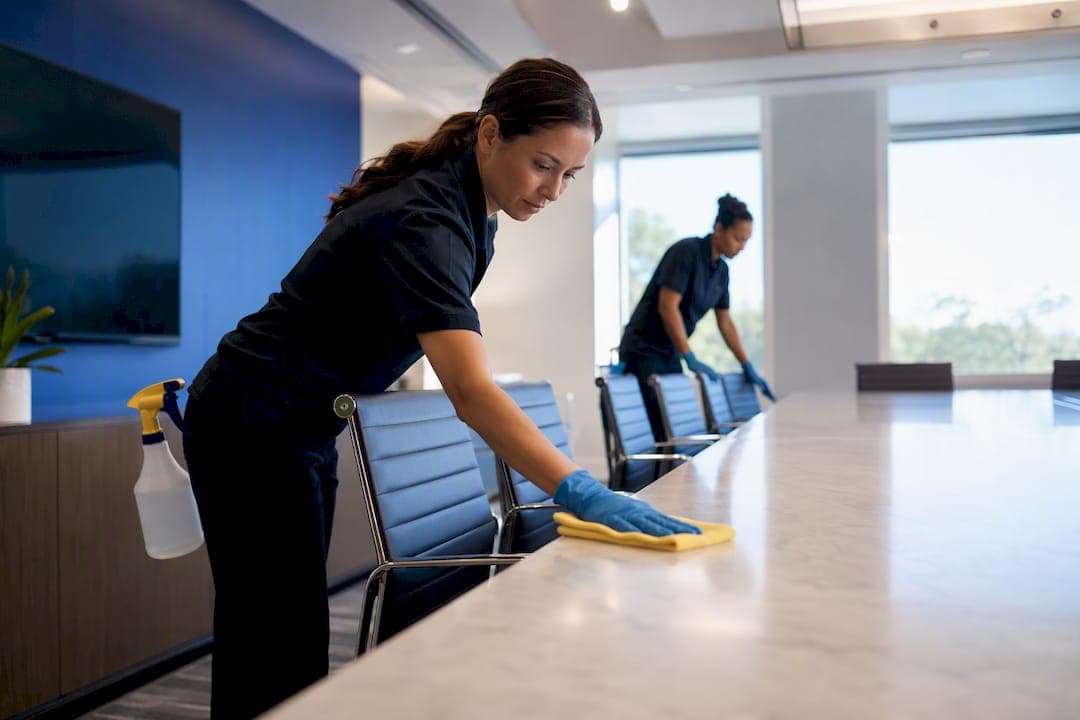
A professional conference room cleaning checklist covers three non-negotiables every visit: disinfect every high-touch surface, spot-mop floors after any catered event, and clean AV equipment without spraying liquids near a single screen or lens. Everything else in a solid cleaning program builds around those three priorities, and any crew skipping them is setting up a room for complaints, pest problems, or a damaged display.
TL;DR:
- Disinfect all high-touch surfaces and clean AV equipment without spraying liquids near screens or lenses during each visit.
- Post-event cleaning requires trash removal, disinfection of surfaces, and AV cleaning, with floor spot-mopping immediately after catered events.
- PPE must be matched to disinfection tasks, including gloves, eye protection, gowns, and respirators, using EPA-registered disinfectants with proper dwell times.
- Floor care involves immediate spot-mopping after events, daily vacuuming or dust-mopping, and scheduled deep cleaning for carpets and floors.
- Documentation through inspections, photos, and logs is essential to prove task completion and ensure compliance with contract scope and standards.
Table of Contents
- What Goes on a Conference Room Cleaning Checklist?
- What PPE and Chemicals Should Crews Use for Disinfection?
- How Do You Clean AV Equipment Without Damaging It?
- Why Floor Care Can't Wait Until the Next Scheduled Clean
- How Do You Turn Checklist Requirements Into Contract Terms?
- How Do You Prove the Job Got Done?
- Handling Waste, Linens, and Post-Event Materials
- How SparklePro Applies This Checklist on Real Properties
- Get a Conference Room Cleaning Quote From SparklePro
- Sources
What Goes on a Conference Room Cleaning Checklist?
A checklist built for contract cleaning crews isn't a tidiness reminder, but rather a detailed commercial cleaning checklist that organizes tasks with time targets and inspection points. It's a task sequence with time targets, assigned roles, and inspection points that a supervisor can sign off on and a client can audit. Templates built around this model typically map to several categories and multiple individual items, with an estimated time per standard event according to POPProbe's checklist template.
Break the work into four frequency tiers, and the SOP writes itself.
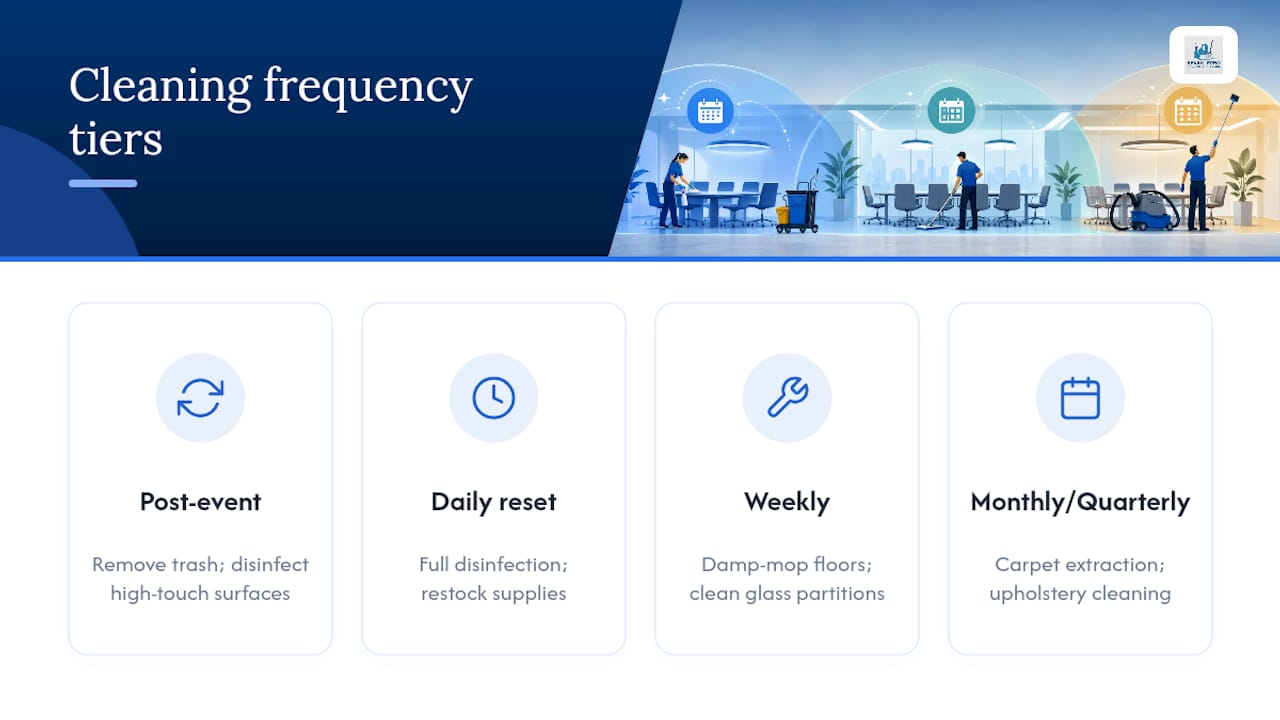
1. Post-event reset (a typical duration, porter or janitor). Survey the room first: chairs out of place, leftover materials, spilled coffee near a laptop bag. Remove trash and recyclables. Wipe and disinfect every high-touch surface: table tops, chair arms, door handles, light switches, and the thermostat. Spot-mop any area near catering or beverage service. Clean AV touchpoints using electronics-safe methods. Straighten furniture and do a final visual inspection before marking the room ready.
2. Daily/nightly reset (janitor). Full disinfection pass on tables and touchpoints, vacuum or dust-mop the floor, empty all bins, restock supplies like markers and sanitizer, and check for AV cables or remotes left out of place. On days with back-to-back bookings, a quick five-minute daytime reset (trash, wipe table, straighten chairs) between meetings keeps rooms presentable without a full clean.
3. Weekly deep tasks (janitor or lead). Damp-mop hard floors, vacuum carpet edges and under furniture, clean glass partitions and windows, dust vents and light fixtures, and wipe down wall-mounted AV panels.
4. Monthly/quarterly deep clean (supervisor-scheduled crew). Carpet extraction or shampoo, upholstery cleaning on chairs, high dusting above eye level, and a full inventory check of supplies and equipment condition.
Sequencing matters more than most managers assume. Crews should clean top to bottom and in one consistent direction, back to front or clockwise around the room, so dust and debris fall into areas not yet cleaned rather than back onto finished surfaces, a discipline outlined in SIPA's enhanced cleaning procedures. Skip that order and you double the rework.
What PPE and Chemicals Should Crews Use for Disinfection?
Enhanced meeting room cleaning calls for specific personal protective equipment, not a generic glove-and-spray-bottle approach. Match PPE to the task, not the room.
- Gloves for all disinfectant contact, changed between rooms to prevent cross-contamination.
- Eye protection when handling concentrated chemicals or spray-dilution stations.
- Gowns or aprons for enhanced cleaning protocols in higher-risk facilities like healthcare-adjacent conference spaces.
- N95 respirators when label instructions or facility policy call for them during heavier disinfection work.
Use only EPA-registered disinfectants, and enforce the label's stated dwell time. Wiping a surface dry ten seconds after application does nothing. That dwell time enforcement, paired with color-coded microfiber cloths and a mop-head change after every room, is standard practice in the SOPs that WorkProcedures recommends for consistent commercial service. Every SOP should also document which Safety Data Sheet applies to each product and confirm staff have been trained on it, aligning with OSHA's Hazard Communication requirements.
Pro Tip: Keep a laminated dwell-time card taped inside every cleaning cart. Crews under time pressure default to the fastest wipe, not the correct one, unless the reminder is physically in front of them.
How Do You Clean AV Equipment Without Damaging It?
Conference room technology is the single easiest way to turn a routine cleaning visit into an IT ticket. The fix is simple: never spray liquid directly onto a screen, lens, or camera.
- Use dry microfiber cloths on monitors, projector screens, and display panels.
- Clean microphone touch controls and shared remotes with 70% isopropyl alcohol on a cloth, never sprayed directly onto the device.
- Power down or isolate sensitive gear before wiping, and confirm the facility's IT team has approved the method for anything beyond basic surfaces.
- Escalate to IT rather than guessing on cabling, conferencing hubs, or anything behind a wall-mounted panel.
Spraying screens or letting liquid pool near bezels is a common source of repeat service calls, according to Opora's field guide, and those calls cost more than the cleaning visit itself. Build IT-approved methods directly into training, not as a footnote.
Why Floor Care Can't Wait Until the Next Scheduled Clean
Skipping the post-event floor check is the single most common failure in conference room maintenance. Beverage residue left on hard flooring or carpet dries within hours and becomes a pest attractant, along with a staining risk, according to Opora's field guide. A spot-mop after any catered event isn't optional maintenance. It's a contract trigger.
- Spot-mop immediately after any event involving food or beverage service.
- Run a daily vacuum or dust-mop pass regardless of visible dirt.
- Damp-mop hard floors on a set weekly cadence, with wet-floor signage posted every time.
- Schedule carpet extraction or restorative floor work monthly or quarterly, based on foot traffic.
Residue left overnight can attract pests within 24 to 48 hours, which is a fast enough window that "we'll catch it tomorrow" isn't a real plan.
How Do You Turn Checklist Requirements Into Contract Terms?
Checklist items only matter if they're enforceable. Facility managers who translate task frequency into scope-of-work language get consistent results; those who leave it verbal get inconsistent ones.
- Define your triggers. Set clear criteria: meetings running over four hours, any event with more than 20 attendees, or same-day back-to-back bookings all trigger a post-event reset within roughly 60 minutes, a standard drawn from Opora's trigger-based cleaning model.
- Price event cleaning separately. A common structure runs 1.5 to 2 times standard hourly labor with a two-hour minimum, reflecting the rushed turnaround these resets demand.
- Choose your integration level. A daily booking-system export is usually enough to run trigger-based scheduling. Full IT integration is rarely necessary and adds cost without much added accuracy.
- Spell out exclusions. IT-owned equipment stays out of scope for janitorial staff, and catering companies, not the cleaning crew, typically own their own waste and dish removal unless the contract states otherwise.
How Do You Prove the Job Got Done?
Documentation is what turns a cleaning contract from a handshake into something you can audit. Set a fixed inspection cadence, weekly for new accounts, monthly once performance stabilizes, and score against the actual checklist items rather than a general impression.
- Photograph high-touch surfaces and floor conditions after major events for dispute protection.
- Log dwell-time compliance and product usage on a per-room basis.
- Run corrective action within 24 hours of a failed inspection, with a documented client notification step.
- Keep cleaning logs, SDS binders, and training records on file, since these are exactly what WorkProcedures flags as the recordkeeping that supports SLA compliance and OSHA documentation requests.
Handling Waste, Linens, and Post-Event Materials
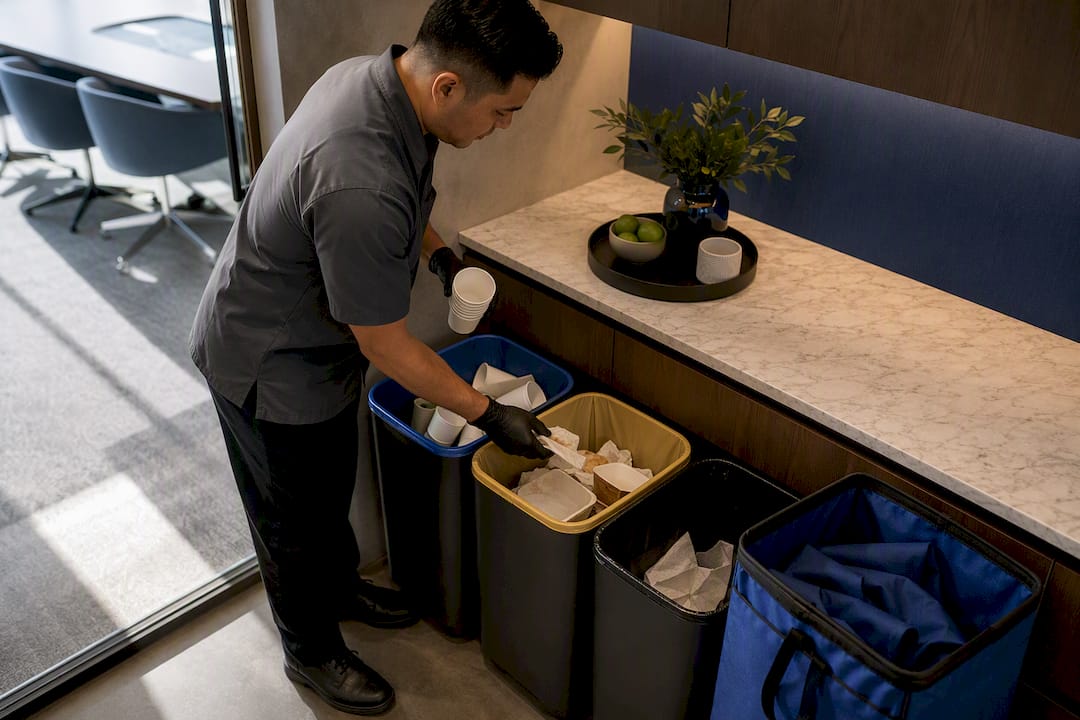
Conference rooms generate a different waste stream than a typical office desk, and treating it the same way causes problems fast. Catering leftovers, disposable cups, napkins, and food packaging need same-visit removal, not next-day pickup, because that's exactly the residue that attracts pests within a day or two.
Separate recycling from general trash at the point of collection rather than sorting it later. If the room uses cloth linens for table settings or catering service, those need a documented pickup and laundering workflow, ideally coordinated with whichever vendor supplied them, since a cleaning crew generally isn't responsible for laundering table linens unless the contract explicitly says so.
Disposable microfiber cloths used during enhanced cleaning or disinfection should be treated as single-use for cross-contamination control, then disposed of according to facility policy rather than rinsed and reused on the next surface. HEPA-filter vacuum bags and canister contents need regular disposal checks too, particularly in rooms used for extended meetings where dust and allergen buildup happens faster than in a typical office.
Assign clear ownership in the SOP: who bags the trash, who handles recycling separation, who's responsible if a catering company leaves dishware behind. Ambiguity here is where waste handling breaks down on multi-vendor properties, and it's an easy fix once someone actually writes it down.
How SparklePro Applies This Checklist on Real Properties
SparklePro Commercial Cleaning builds every conference room engagement around a four-step process, quote, site visit, scheduled cleaning, client approval, mapped directly to checklist deployment. Crews work from high-security carts and HEPA vacuums suited to sensitive office environments.
— Sales
Get a Conference Room Cleaning Quote From SparklePro
If you're managing multiple properties, chasing down a janitorial team for one-off event resets and hoping they know not to spray a projector screen isn't a system, it's a liability. SparklePro Commercial Cleaning brings documented SOPs, EPA-registered disinfectant protocols, and trained crews to conference and meeting rooms nationwide. The checklist above isn't something you have to enforce yourself.
The process starts with a quote, followed by a site visit to scope your specific rooms and booking patterns, then scheduled service built around your actual usage triggers. If your properties are in Delaware, request a site visit and quote for Delaware properties. Managing buildings in Massachusetts or Washington gets the same treatment through the Massachusetts service page or the Washington service page. For properties elsewhere, start at Sparkleprocommercialcleaning and a team member will scope your conference room needs directly.
Sources
- Meeting/Conference/Training room enhanced cleaning (SIPA)
- Conference room cleaning: CDC hygiene standards | Opora field guide
- Commercial cleaning SOPs for consistent service | WorkProcedures
- Conference Room checklist (POPProbe)