

Quotes for the same 50,000-square-foot building can differ by thousands of dollars per month, and most property managers have no idea why. That gap isn't random. It reflects hidden variables in scope, staffing, pricing method, and service verification that most vendors bury in fine print or simply never mention. If you're managing commercial properties and trying to compare bids fairly, you need a clear map of what goes into a cleaning quote, how the numbers are actually calculated, and where the surprises tend to hide. This article delivers exactly that.
Table of Contents
- What goes into a cleaning service quote?
- Commercial cleaning pricing methods explained
- Facility type and its impact on cleaning quote pricing
- How quote calculations are performed: Behind the numbers
- Edge cases: Specialty cleans and what drives exceptions
- What managers often miss—and how to gain confidence in your quotes
- Get a transparent cleaning quote for your facility
- Frequently asked questions
Key Takeaways
| Point | Details |
|---|---|
| Quote transparency | Detailed quotes should outline scope, pricing breakdown, and exclusions for clarity. |
| Pricing methods | Understanding square foot, hourly, and flat-rate pricing helps you compare quotes accurately. |
| Facility type impact | Facility type and complexity directly affect cleaning service pricing benchmarks. |
| Quote calculation formula | Quotes are based on production rates, labor, supplies, overhead, and profit for accuracy. |
| Proof-of-service | Including verification steps like checklists or photos ensures work is completed and reduces disputes. |
What goes into a cleaning service quote?
Once you understand why cleaning quotes can be confusing, it's critical to know what actually appears in a typical quote. A professional proposal is not just a number on a page. It's a structured document that defines your working relationship with a vendor for months or years.
A well-structured quote should include the following core components:
- Scope of work: Which areas are cleaned, what tasks are performed in each area, and at what frequency (daily, weekly, monthly). This is the foundation of every quote.
- Itemized pricing breakdown: Not a lump sum, but a line-by-line breakdown of costs so you can see exactly where your money goes.
- Staffing plan: How many workers will be on-site, their roles, and their estimated hours per visit.
- Insurance and compliance documentation: Proof of general liability insurance, workers' compensation, and any bonding required for your facility type.
- Contract terms and exit clauses: Many commercial cleaning contracts include a 12-month minimum term and a 30-day written notice period for cancellation. Know these before signing.
- Exclusions list: Clearly stated services that are NOT included in the quoted price. This is where scope creep (when additional tasks are added without adjusting the price) begins if left vague.
As detailed in janitorial proposal best practices, key quote components include a detailed scope of work, itemized pricing, a staffing plan, insurance and compliance documentation, standard terms, and explicit exclusions to prevent scope creep.
Understanding cleaning terminology guide terms like "scope creep," "burden rate," and "production rate" gives you a real advantage when reviewing a vendor's proposal.
"A vague scope of work is the single biggest source of billing disputes between property managers and cleaning contractors. If the quote doesn't specify the task, don't assume it's included."
Pro Tip: Before you sign anything, ask the vendor to walk through their exclusions list line by line. If they don't have one, that's a red flag.
Commercial cleaning pricing methods explained
With quote components clear, understanding how those numbers are calculated is the next logical step. Vendors don't all use the same formula, and the method they choose directly affects how you should compare bids.
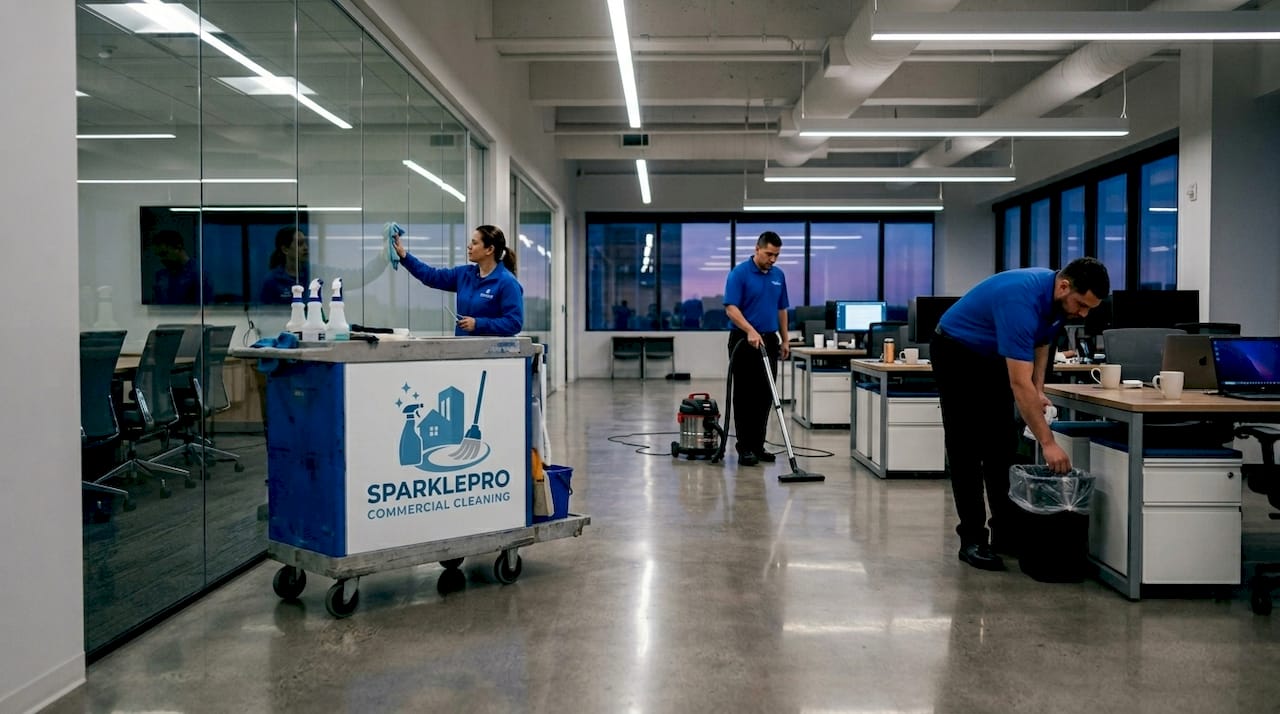
There are four primary pricing structures used in commercial cleaning:
| Pricing method | Best for | Predictability | Risk |
|---|---|---|---|
| Per square foot | Recurring service, large facilities | High | Low if scope is fixed |
| Hourly rate | Variable or specialty work | Low | Risk of inefficiency perception |
| Flat monthly rate | Routine janitorial contracts | Very high | Scope creep if vague |
| Per room | Specialized areas (restrooms, labs) | Medium | Depends on room complexity |
According to a commercial cleaning pricing breakdown, pricing methods include per square foot (scalable for recurring jobs), hourly rates ranging from $30 to $75 per hour for variable work, flat monthly rates for predictable budgeting, and per room pricing for specialized areas.
Here's how each method plays out in practice:
- Per square foot pricing works well when you have a stable, recurring cleaning schedule. The larger the facility, the more negotiating room you have to push the rate down.
- Hourly pricing is common for deep cleans, post-construction cleaning, or unusual situations where the time required is genuinely uncertain. The downside is that it's hard to budget for, and it can create tension if a crew takes longer than expected.
- Flat monthly rates are the most popular structure for long-term janitorial contracts. You know exactly what you're paying each month, which makes budget planning simple. However, a flat rate without a tight scope of work is a recipe for a vendor gradually doing less over time.
- Per room rates are typically applied to high-care areas like restrooms, medical exam rooms, or server rooms where the cleaning requirements are significantly more intensive than the surrounding space.
Reviewing cleaning standards for managers will help you understand which pricing model fits your facility's compliance requirements and operational rhythm.
Facility type and its impact on cleaning quote pricing
Knowing the pricing methods, it's important to see how your facility type alters expectations and what benchmarks to reference. The same 10,000 square feet costs very different amounts to clean depending on what happens inside that space.
Here's a real-world benchmark table by facility type:
| Facility type | Price range per sq ft | What drives the rate |
|---|---|---|
| Standard office | $0.08 to $0.15 | Moderate traffic, predictable tasks |
| Medical facility | $0.15 to $0.25 | Infection control, compliance, PPE use |
| Retail space | $0.08 to $0.12 | High foot traffic, display areas, restrooms |
| Warehouse | $0.05 to $0.10 | Large open areas, lower detail requirements |
| School or university | $0.10 to $0.18 | Multiple zones, restrooms, gym and cafeteria areas |
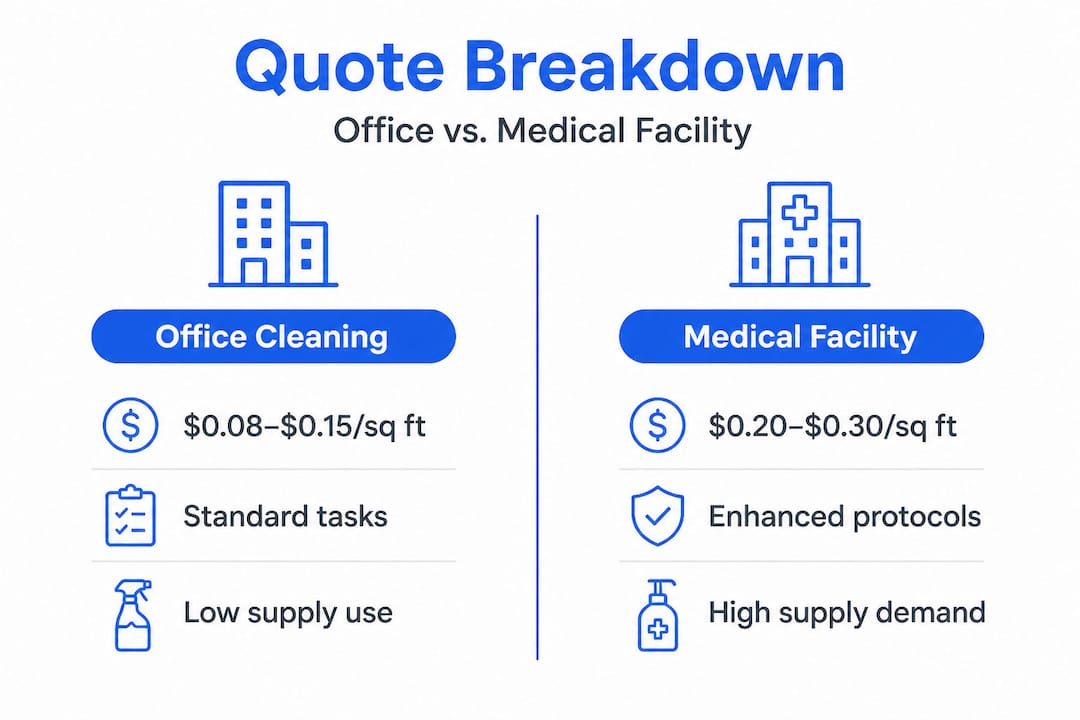
These benchmark rates per facility reflect real market data: offices at $0.08 to $0.15 per square foot, medical facilities at $0.15 to $0.25, retail at $0.08 to $0.12, warehouses at $0.05 to $0.10, and schools at $0.10 to $0.18.
Why such a wide spread? Consider these four factors that directly raise or lower rates:
- Infection control requirements: Medical facilities must meet regulatory standards for pathogen elimination. That means more trained staff, specialized disinfectants, and more time per square foot cleaned.
- Surface complexity: A warehouse with sealed concrete floors is fast to clean. A healthcare facility with detailed equipment, vents, and patient zones is not.
- Frequency of service: Daily cleaning costs more than three-times-a-week service, but it may lower your per-visit rate due to the volume commitment.
- Access restrictions and security requirements: Facilities that require background-checked staff, badged entry, or nighttime-only cleaning add operational overhead that gets priced in.
Reviewing janitorial service examples by facility type helps you benchmark your current contract against what's realistic for your specific building category.
How quote calculations are performed: Behind the numbers
With price ranges set by facility type, the next step is understanding what numbers go into the overall quote calculation. Most property managers see a final dollar figure. Here's what actually generated it.
The calculation follows a logical sequence:
- Determine the production rate. This is the square footage a trained cleaner can cover per hour. For standard offices, that's roughly 2,500 to 4,000 square feet per hour. For medical facilities, it drops to 1,500 to 2,500 square feet per hour due to the detailed protocols involved.
- Calculate labor hours. Divide the total cleanable square footage by the production rate to get the estimated hours per visit. Multiply by visit frequency to get monthly hours.
- Apply the wage and burden rate. Take the hourly wage and multiply by 1.25 to 1.35 to account for payroll taxes, benefits, and workers' compensation. This is called the "burden rate," a standard labor cost multiplier.
- Add supplies. Cleaning supply costs typically represent 3 to 5% of the total quote. Some vendors include supplies in the flat rate; others bill them separately.
- Layer in overhead and profit. Overhead (insurance, equipment, management) adds 20 to 30% to the labor base. Profit margin typically runs 15 to 25%.
These production rate and labor calculations form the backbone of any legitimate commercial cleaning quote, and supply cost inclusion of 3 to 5% is a standard cost factor regardless of pricing method.
Understanding the floor cleaning process for your specific facility also helps you verify whether the quoted production rates are realistic. Hard floors clean faster than carpet, and multi-level buildings add travel time that affects the overall labor estimate.
Pro Tip: Ask every vendor to share their assumed production rate for your specific facility type. If they can't tell you, they're probably guessing at the quote rather than calculating it.
Edge cases: Specialty cleans and what drives exceptions
Even with the general calculation method explained, some facilities have unique needs that demand special pricing consideration. Not every building fits neatly into the standard quote model.
Here are the most common situations that push quotes outside the normal range:
- Post-construction cleanouts: After a renovation or new build, construction debris, drywall dust, and adhesive residue require specialized labor and equipment. These jobs are typically quoted at $0.25 to $0.35 per square foot or priced hourly since the time required is difficult to predict.
- Neglected or previously unserviced buildings: A building that hasn't had professional cleaning in months requires a heavy initial clean before a recurring service schedule can begin. Vendors often price this separately as a one-time deep clean add-on.
- High-traffic retail or entertainment spaces: Venues with continuous foot traffic need faster turnaround times, more frequent restroom checks, and more consumable restocking. All of that drives up the per-visit cost.
- Hazardous material or biohazard situations: These fall outside standard commercial cleaning and are quoted entirely separately with specialized licensing requirements.
- Supply inclusion vs. client-supplied products: When a vendor provides all cleaning supplies, expect the total cost to rise by 3 to 5%. Some managers prefer to supply products themselves to reduce cost and control what's used in sensitive environments.
"Specialty cleaning situations require a separate line item in your quote, not a verbal agreement. If it isn't written, it won't happen consistently."
See post-construction cleaning examples across multiple facility types to understand how these edge-case scenarios are typically scoped and priced in real proposals.
What managers often miss—and how to gain confidence in your quotes
Here's the perspective that most articles skip entirely: the biggest risk in evaluating a cleaning quote isn't overpaying. It's signing a quote you can't verify.
We've seen this pattern repeatedly. A manager selects the lowest bid because the square-foot rate looks competitive. The contract is signed. Six months in, restrooms aren't being cleaned at the stated frequency, floors are skipped on Fridays, and when the manager brings it up, the vendor points to a vague scope of work that gives them plenty of wiggle room. The manager has no documentation to push back with. That's a losing position.
The solution isn't distrust. It's structure. Proof-of-service protocols, meaning photos, task checklists, and digital logs completed at the end of each service visit, protect both parties. The vendor can show they performed the work. The manager has a paper trail if they didn't. That single addition to a contract eliminates the majority of vendor disputes we've seen.
On the pricing side, monthly flat rates vs. hourly is a real debate in the industry. Hourly pricing gives flexibility for unusual situations, and some managers prefer it for that reason. But hourly pricing also creates an awkward dynamic: when a crew finishes faster than expected, do you pay the estimated hours or the actual hours? That ambiguity strains the relationship over time. Flat monthly pricing, paired with a tight scope and a proof-of-service system, is almost always the cleaner arrangement for both sides.
The managers who feel most confident evaluating quotes are the ones who ask two specific questions: "What exactly will you NOT clean?" and "How will you prove it was done?" If a vendor can't answer both clearly, push them until they can. Understanding cleaning jargon well enough to ask smart follow-up questions is what separates managers who get great service from those who get average service at any price.
Get a transparent cleaning quote for your facility
With these tools and clarity, you're ready for confident, side-by-side quote comparisons instead of guessing games.
At Sparkle Pro Commercial Cleaning, we build every quote with the components this article covers: a defined scope of work, itemized pricing, a clear staffing plan, and proof-of-service protocols built in from day one. Whether you're managing a regional office portfolio or a large retail center, our team provides detailed, honest quotes with no hidden surprises. Managers in cleaning services in California and cleaning services in New York can request a tailored site visit and quote today. We'll walk your facility, explain every line item, and give you a number you can actually budget from.
Frequently asked questions
What is the average cost per square foot for commercial cleaning?
Standard commercial rates range from $0.07 to $0.25 per square foot, depending on facility type, cleaning frequency, and service complexity. Medical and specialty facilities sit at the higher end of that range.
What makes some quotes higher than others for similar-sized buildings?
Facility type, service frequency, and specialty cleaning needs all shift the price, and supply inclusion adds another 3 to 5% on top of the base rate. Post-construction or deep cleans carry premium pricing of $0.25 to $0.35 per square foot.
How can managers verify cleaning work is actually performed?
Request proposals that include proof-of-service documentation such as photos and task checklists completed after each visit. This eliminates guesswork and gives you a clear record if service levels drop.
Is hourly pricing a good approach for commercial facility cleaning?
Hourly pricing works for flexible or one-time jobs, but flat monthly rates build more trust and predictability for recurring service contracts. The ambiguity of hourly billing can strain long-term vendor relationships.
What should I look for in a cleaning service quote before signing?
Check for a detailed scope of work with itemized costs, explicit exclusions, and a verification plan. A quote missing any of these three elements leaves you exposed to disputes, scope creep, and inconsistent service.