

Choosing the wrong cleaning vendor costs you more than money. It costs you tenant complaints, compliance exposure, and hours of your time chasing problems that a solid evaluation process would have caught upfront. Examples of cleaning vendor evaluations give property managers and facility directors a concrete starting point for building that process, instead of relying on gut feel or whoever submitted the lowest bid. This article covers three proven evaluation methods, the criteria that make them work, and how to combine them into a cleaning vendor performance review process that actually holds vendors accountable.
Key takeaways
| Point | Details |
|---|---|
| Criteria drive objectivity | Define quality, timeliness, compliance, communication, and cost before scoring any vendor. |
| Scorecards reduce bias | A 1–5 scorecard with quarterly reviews creates a repeatable, defensible vendor performance record. |
| Proposals reveal fit early | A focused five-question proposal framework identifies vendor transparency before you sign a contract. |
| Audits confirm actual quality | Scored zone inspections verify real cleaning outcomes, not just whether a task was logged. |
| Combine methods for full coverage | Pairing scorecards with audit checklists covers both operational performance and contract compliance. |
Examples of cleaning vendor evaluations: the core criteria
Before you score anything, you need to agree on what you are scoring. Structured evaluation criteria reduce bias and increase procurement efficiency by giving every stakeholder a shared vocabulary. The industry term for this baseline is cleaning service evaluation criteria, and these are the pillars that every evaluation framework covered below is built on.
Here is what those criteria should cover:
- Quality of work: Does the vendor meet the scope of work? Are audited spaces consistently clean, or do standards drift after the first month?
- Punctuality and reliability: Are crews showing up on schedule and completing tasks within the agreed window? Attendance patterns matter more than most managers realize.
- Communication: How fast does the vendor respond when something goes wrong? Is there a clear escalation path, or are you texting a supervisor's personal cell at 9 p.m.?
- Compliance and certifications: Current insurance certificates, OSHA-compliant safety data sheets, and any required industry licenses should be verified before contract signing and at each renewal.
- Cost transparency: Line-item pricing, accurate invoicing, and clear billing for add-on work are non-negotiable. Surprise charges are a signal of deeper problems.
- Sustainability practices: Green cleaning protocols, including certified low-VOC products and responsible waste disposal, are now a differentiator for properties targeting LEED certification or ESG goals.
Pro Tip: Build a one-page vendor evaluation checklist for cleaning that maps each criterion to a specific, verifiable data point. "Good communication" is subjective. "Responded to all service tickets within 4 hours" is not.
1. Standardized scorecard approach
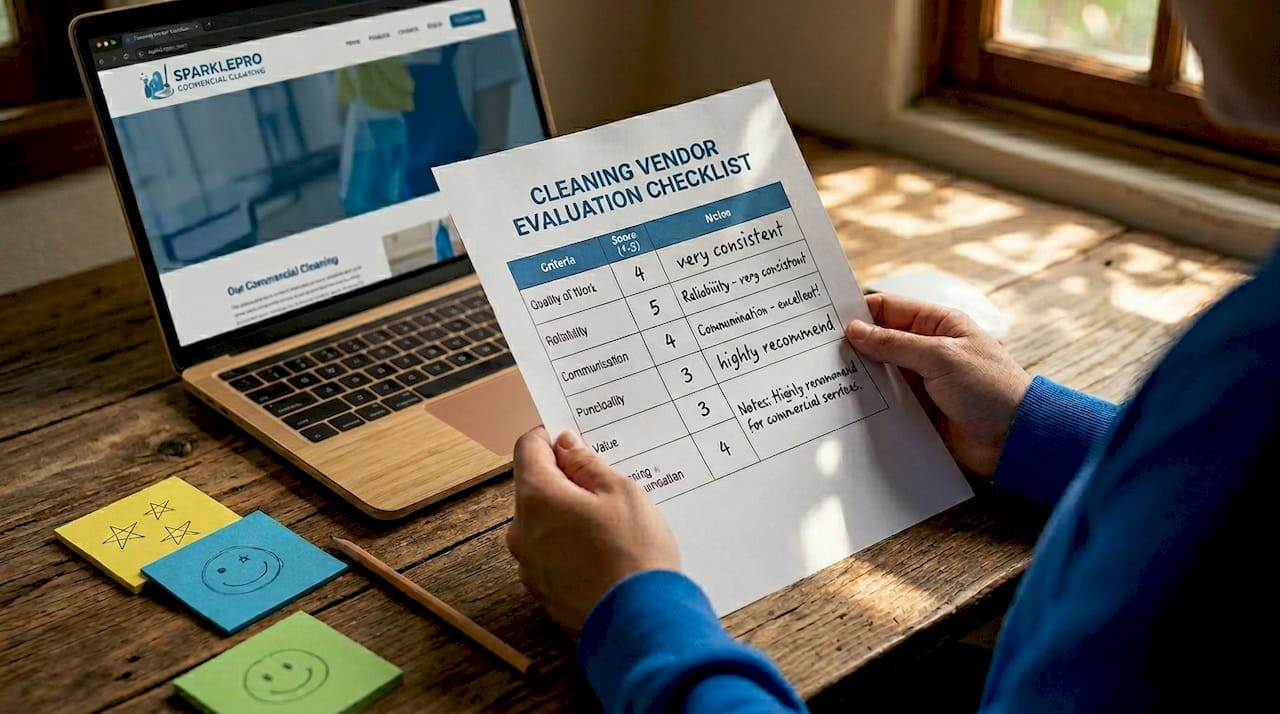
The scorecard method is the most widely used structure in a formal cleaning vendor performance review process. It works because it converts judgment calls into numbers, and numbers are harder to argue with.
Here is how a standard scorecard is structured:
- Define your five pillars: Quality, Timeliness, Communication, Compliance, and Cost Control. Each pillar gets its own score.
- Set a 1–5 scale: 1 means consistently unacceptable performance, 3 means meets expectations, and 5 means consistently exceeds them. Define what each level looks like in writing so scores mean the same thing to every reviewer.
- Gather input internally first: Before any vendor meeting, align scores internally across your team. Unresolved internal disagreements handed to the vendor weaken your negotiation position.
- Set a review cadence: Annual formal reviews should occur 60 to 90 days before contract expiration, leaving time to act on the results. Conduct quarterly operational check-ins for high-risk or high-spend vendors.
- Calculate and compare: Average pillar scores to get a total vendor performance score. Track this across review cycles to identify trends, not just snapshots.
| Pillar | Score (1–5) | Notes |
|---|---|---|
| Quality of work | 4 | Restrooms consistently meet spec; lobby floor wax still needs improvement |
| Timeliness | 5 | Zero missed service days over 90 days |
| Communication | 3 | Response times within 24 hours but inconsistent escalation follow-through |
| Compliance | 5 | All certificates current; SDS binder updated quarterly |
| Cost Control | 4 | Invoices accurate; one disputed add-on resolved quickly |
| Total average | 4.2 | Meets high performance threshold for renewal |
Pro Tip: Run cleaning contract evaluations alongside scorecards at renewal time. The scorecard tells you how the vendor performed. The contract review tells you whether the terms still reflect your actual needs.
2. Proposal evaluation framework
The scorecard method handles ongoing management well. What it does not do is help you make the right choice before a vendor is in the building. That is where a focused proposal evaluation framework fits in.
The insight here is counterintuitive: clearer proposals win more contracts, not more detailed ones. A 40-page proposal that buries pricing in appendices signals that working with this vendor will feel the same way.
When reviewing proposals, ask whether the submission clearly answers these five questions:
- What will it cost, and how is that price structured? Look for line-item transparency, not a single lump sum.
- Who will be on-site, and what are their qualifications? Staffing assumptions directly affect service consistency.
- How will you communicate with us when problems arise? Dedicated account managers matter more than 24-hour hotlines.
- What is your startup plan for this facility? Vendor onboarding quality predicts long-term performance.
- Can you provide references from comparable properties? Healthcare facility references do not help you evaluate a warehouse vendor.
"Clarity beats complexity in cleaning vendor proposals, and upfront cost transparency respects buyer time and improves trust." — cmmonline.com
Apply this framework as a pre-qualification filter. If a vendor cannot answer those five questions clearly in writing, they are unlikely to manage complex service issues clearly in person.
3. Quality audit and inspection checklist method
This is where most facility managers leave real money on the table. Schedule completion logs prove that someone showed up. They do not prove that cleaning met your standards.
The quality audit method fills that gap by using scored zone-based checklists to verify actual cleaning outcomes. Here is how it works in practice:
- Divide the facility into inspection zones: Restrooms, lobbies, common areas, stairwells, and tenant-specific spaces each get their own checklist. Different zones have different standards.
- Align scoring with APPA custodial levels: The APPA (formerly the Association of Physical Plant Administrators) defines five custodial effectiveness levels, from Level 1 (orderly spotlessness) to Level 5 (unkempt). Map your required standard to a specific APPA level per zone so scoring is consistent.
- Use digital inspection tools: GPS-tagged and timestamped inspections catch deficiencies three times earlier than schedule-only verification. They also create an audit trail that removes ambiguity in vendor disputes.
- Trigger corrective work orders automatically: Any zone scoring below your acceptable threshold should generate a corrective action request with a deadline. Do not rely on verbal follow-up.
- Track trends over time: A single low score is a blip. Three consecutive low scores for the same zone are a performance problem that belongs in the vendor's formal review.
| Verification method | What it proves | What it misses |
|---|---|---|
| Schedule completion log | Crew was present | Whether cleaning met quality standards |
| Scored zone inspection | Actual cleanliness level per area | Efficiency or labor cost data |
| Digital audit with GPS tag | Timestamped, location-verified quality data | Subjective tenant satisfaction signals |
The property manager's guide to hiring commercial cleaners covers how audit results should inform your initial vendor selection, not just ongoing management.
4. Comparing the three evaluation approaches
Each method described above serves a different purpose. Property managers who see strong results typically use all three. Here is a side-by-side view of when each approach is most useful:
| Evaluation method | Best used for | Primary strength | Key limitation |
|---|---|---|---|
| Scorecard | Ongoing vendor management and renewals | Objective, repeatable, data-driven | Requires consistent data collection to work |
| Proposal evaluation | Vendor selection and pre-qualification | Reveals communication style and transparency early | Does not capture post-contract performance |
| Quality audit checklist | Day-to-day and monthly quality verification | Confirms real outcomes at the zone level | Time-intensive without digital tools |
A few guidelines on when to prioritize each:
- During vendor selection, weight the proposal framework heavily. You are assessing fit, transparency, and whether the vendor understands your facility.
- During the first 90 days of a new contract, run weekly quality audits. This is when performance patterns are established.
- At 6 and 12 months, conduct formal scorecard reviews using data you have collected across the contract period.
Data-driven vendor evaluations backed by work order histories, complaint rates, and invoices reduce bias and give you real negotiation leverage at renewal time. The combination also gives you defensible documentation if you ever need to terminate a vendor for cause.
Pro Tip: Start with your highest-spend or highest-risk vendors when rolling out a new evaluation program. Refine the process there before applying it organization-wide.
A common challenge is getting consistent buy-in from internal stakeholders who score vendors differently. Solve this before any vendor meeting by aligning on scores internally. Divergence on a 1–5 scale is normal. Unresolved divergence handed to the vendor is a problem. KPIs like delivery timeliness and responsiveness reinforce accountability across the organization, not just within the facilities team.
What I have learned from years of vendor evaluation work
Most property managers do not fail at vendor evaluations because they lack information. They fail because they do not apply it consistently.
I have seen facilities with six-page scorecards that were filled in once and forgotten, and other facilities where a single-page audit checklist run every 30 days caught $18,000 in annual service deficiencies. The difference was not sophistication. It was discipline.
The biggest misconception I encounter is equating schedule completion with quality assurance. A signed service log tells you a vendor honored the appointment. It does not tell you the restrooms met standard. These are fundamentally different things, and confusing them is how quality drift goes unnoticed for months.
My honest advice: narrow your evaluation criteria to five or fewer pillars, score them consistently every quarter, and run zone audits monthly on your highest-traffic areas. Effective cleaning solutions come from vendors who expect to be measured, not just trusted. If a vendor resists your audit process, that tells you something more useful than any scorecard score could.
You do not need a perfect evaluation system. You need one that you actually run.
— Sales
How Sparkleprocommercialcleaning supports your evaluation standards
When you have built a solid evaluation framework, the next step is finding a vendor who welcomes it. Sparkleprocommercialcleaning operates as a fully licensed and insured commercial cleaning partner for property managers across the United States, with services specifically designed to meet the kinds of transparent, measurable criteria this article covers.
Whether you manage properties in Massachusetts, Washington, New Jersey, South Carolina, or Delaware, Sparkleprocommercialcleaning delivers services built around scope adherence, clear communication, and documented performance. From routine janitorial work to post-construction cleanouts, every engagement follows a four-step process designed to give you approval authority at each stage. Request a proposal and see exactly how Sparkleprocommercialcleaning answers those five evaluation questions before you sign anything.
FAQ
What are the most important cleaning vendor evaluation criteria?
The five most important criteria are quality of work, timeliness, communication, compliance, and cost transparency. Structured KPIs across these areas create a defensible, repeatable review process.
How often should cleaning vendor performance reviews happen?
Run formal scorecard reviews annually, 60 to 90 days before contract expiration. Conduct quarterly operational check-ins for high-risk or high-spend vendors.
What is the difference between a scorecard and a quality audit checklist?
A scorecard tracks overall vendor performance across multiple pillars over time. A quality audit checklist verifies specific cleaning outcomes at the zone level during or after each service visit.
How do I evaluate a cleaning vendor proposal objectively?
Score proposals against five questions: pricing structure, staffing assumptions, communication protocols, onboarding plan, and verifiable references. Clearer proposals with upfront cost transparency generally reflect vendors who will communicate the same way once under contract.
When should I use digital inspection tools for vendor audits?
Use digital tools with GPS tagging and timestamping whenever you manage multiple zones or facilities. Digital audit programs identify deficiencies three times earlier than schedule-only verification methods.