
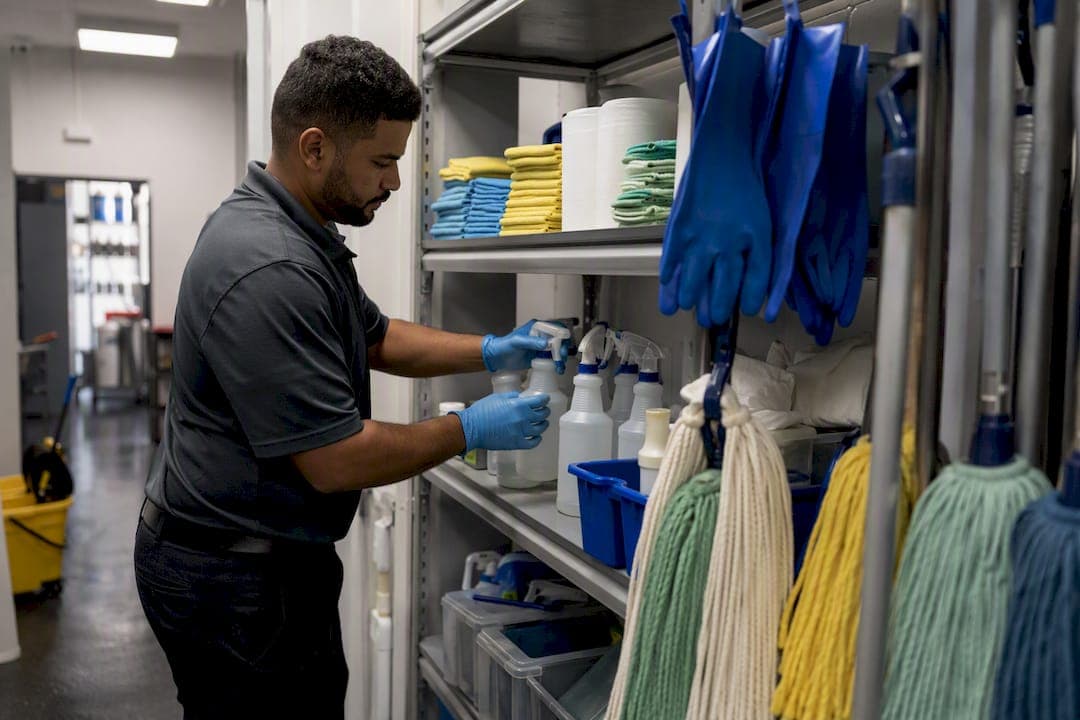
Large-scale cleaning coordination means running one consistent system, not a dozen separate habits, across every building, shift, and crew you're responsible for. If you manage more than one site, the verdict is simple: you need four things working together, or nothing else you buy will fix the chaos.
Those four elements are zone-based standards, a schedule model that separates recurring work from projects, staffing and routing built around proximity, and quality controls that catch problems before a tenant does. The cleaning industry moves $500 billion a year, yet most operators still coordinate crews with spreadsheets and group texts. A tracked KPI like critical route pass rate tells you more in a week than a year of informal check-ins, and providers like Sparkleprocommercialcleaning build their site visits around exactly this framework.
- Zone standards define frequency, method, and acceptance criteria per area.
- Schedule model splits always-on checks from deep, project-based work.
- Staffing and routing assign by proximity to cut travel and handoff loss.
- Quality controls turn inspections into evidence, not opinions.
Pro Tip: Before adding software or headcount, write down the answer to one question: can anyone on your team explain the cleaning plan for a site without calling the one person who normally handles it? If not, that's your starting point.
Key Takeaways
Reliable large-scale cleaning coordination depends on zone-based standards, separated recurring and project schedules, proximity-based staffing, and documented evidence at every inspection.
| Point | Details |
|---|---|
| Start with failure markers | Pilot your system at the site that can't answer basic questions without one specific person. |
| Standardize by zone | Define frequency, method, and acceptance criteria per zone, not by square footage alone. |
| Separate schedule types | Keep always-on checks, routine cleans, and project work on different tracks with named owners. |
| Track evidence, not attendance | Require photo and timestamp proof, and separate task completion from inspection results. |
| Consider a proven operator | Sparkleprocommercialcleaning builds SOPs, checklists, and audit evidence into every site visit and quote. |
Table of Contents
- What Makes Large-Scale Cleaning Coordination So Hard?
- How Do You Coordinate Cleaning Across Multiple Sites?
- Standardizing Operations: SOPs, Checklists, and Audits
- Building a Staffing and Training Model That Scales
- Scheduling Recurring and Project-Based Cleaning Without Collisions
- Which Technology Features Actually Improve Coordination?
- What KPIs and Audits Should You Track at Scale?
- What Do Large Cleaning Projects Typically Cost and Take?
- How Sparkleprocommercialcleaning Supports Large-Scale Coordination
- Frequently Asked Questions
- Sources
What Makes Large-Scale Cleaning Coordination So Hard?
Size multiplies complexity faster than most managers expect. Add more entrances, more traffic routes, and more contamination pathways, and coordination problems compound rather than simply add up. A single-floor office is forgiving. A twelve-building campus with overlapping tenant hours is not.
The deeper problem is usually knowledge fragmentation. Site instructions, access codes, and "the way we've always done it" live in one supervisor's head or a group chat nobody archives. When that person is out sick, the whole site improvises. Scheduling adds its own strain: overlapping service windows, shift handoffs, travel time between properties, and last-minute client changes all stack on top of each other.
Resource unpredictability makes it worse. Equipment gets shared across sites, consumables run short during audits, and surge capacity for a move-out or post-construction job rarely exists until you plan for it. The result shows up as missed jobs, rework, safety incidents, and cost overruns that never trace back to a single obvious cause.
- More entrances and traffic routes mean more contamination pathways to manage.
- Fragmented knowledge means one absence can stall an entire site.
- Overlapping schedules and last-minute changes erode planned capacity.
- Equipment and consumable shortages surface fastest during surges.
Pro Tip: Track "unanswered questions" for a week. Every time a supervisor has to call someone for information that should already be documented, that's a coordination gap, not a staffing problem.
How Do You Coordinate Cleaning Across Multiple Sites?
Coordinating crews across many locations while holding quality steady and reacting fast to schedule changes are the three capabilities that separate reliable operators from the rest, according to cleaning project management research. Getting there takes a specific sequence, not just more effort.
- Define zone standards, not square footage rules. A large-site cleaning strategy organizes work by zone type, mapping traffic routes and pinch points so high-risk areas get the right method, not just the same mop.
- Separate recurring maintenance from project work, and give each a named owner so neither gets silently deprioritized when the other gets busy.
- Assign by role, shift, and proximity. Grouping crews near each other cuts travel time and reduces the handoff errors that happen when nobody actually knows who covered the last shift.
- Use visible scheduling with accepted assignment states and verify work before calling it done, not after a tenant complains.
- Write contingency rules in advance for absences, surge deep cleans, and urgent requests, so those moments don't require improvisation from whoever picks up the phone.
Pro Tip: Pilot this sequence at your worst-performing site first. If the system holds up there, it will hold up everywhere else.
Standardizing Operations: SOPs, Checklists, and Audits
A zone standard should specify frequency, method, and a clear acceptance condition, borrowed directly from the zone-based cleaning framework used on large campuses. Converting that scope into actual scheduled work means every job carries a service window, required role, access notes, and a handover record.
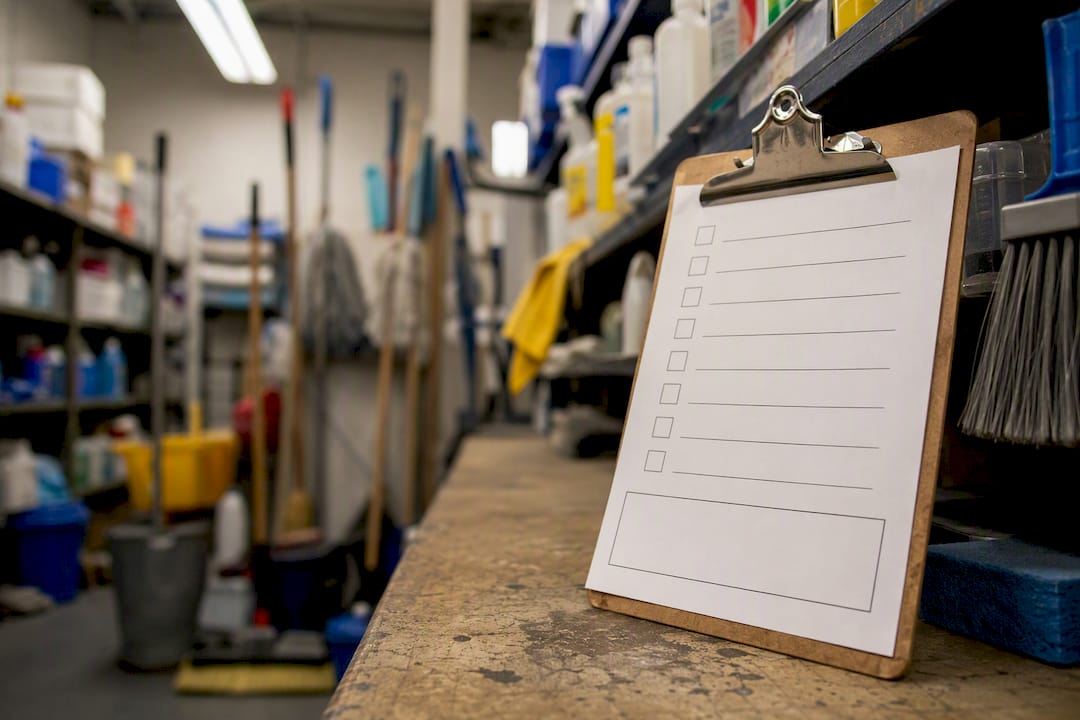
Job-level digital checklists should require evidence, not just a checked box. That means notes, photos, and timestamps tied to each task, the same documentation model built into housekeeping project schedulers that replace paper logs entirely.
Audit cadence matters as much as the checklist itself. Run spot checks weekly, scheduled audits monthly, and a full post-project review after any deep clean or turnover. At the process level, track critical route pass rate, repeat hotspot frequency, and spill response time. Companies that add visible checklists and pre-delivery verification see dramatic drops in missed appointments and rework, which is the entire point of standardizing in the first place.
- Zone standards define frequency, method, and acceptance criteria.
- Digital checklists require photo and timestamp evidence, not checkboxes.
- Audit cadence: weekly spot checks, monthly scheduled audits, post-project reviews.
Pro Tip: If a checklist item can't produce a timestamp or a photo, rewrite it. Vague items are the ones that quietly stop getting done.
Building a Staffing and Training Model That Scales
Reliability at scale comes from clear roles: cleaner, team lead, field supervisor, float or backup, and project lead for larger jobs. Keeping the same crew assigned to the same zones preserves site knowledge and cuts down on the handoff errors that show up whenever a stranger walks into an unfamiliar building.
Training should be a checklist, not a verbal walkthrough. Require documented competency records before anyone works independently, covering safety, chemical handling, and site-specific procedures. Retention follows from predictable schedules, visible progression paths, and documented processes that don't depend on one supervisor's memory.
- Assign crews to fixed zones or locations whenever staffing allows.
- Require a signed competency checklist before independent assignments.
- Document site maps, key locations, consumable storage, and access restrictions.
- Review turnover risk quarterly and identify which sites depend on one irreplaceable person.
- Predictable shifts and clear progression reduce turnover more than pay bumps alone.
- Site knowledge captured in writing survives staff departures; knowledge in someone's head does not.
Scheduling Recurring and Project-Based Cleaning Without Collisions
Split your schedule into three categories: always-on checks (restrooms, high-traffic entries), routine maintenance cleans, and planned deep cleans or project work. Treating all three the same way is where most scheduling conflicts start.
- Set clear start and end points for high-traffic zones, with a confirmed reopening check before the space goes back into service.
- Route crews by proximity, batching short tasks together and avoiding overlap between two teams on the same critical path.
- Require a shift handoff record: what's incomplete, what's flagged, and who's picking it up next.
- Set response-time targets for urgent events. A spill in a lobby needs a fifteen-minute response; a spill in a back hallway can wait longer.
- Never schedule two crews on the same critical route at the same time.
- Handoffs without a written record are where completed-but-undocumented work quietly disappears.
Platforms that handle automated task routing move jobs through a clear lifecycle, from pending to assigned to completed, which removes the ambiguity that manual dispatch creates.
Which Technology Features Actually Improve Coordination?
The features that move the needle are specific: mobile-accepted assignments, photo proof of completion, timestamps, a recurring project scheduler, route optimization, issue tracking, and audit dashboards you can actually read. Anything beyond that is a nice-to-have.
What this replaces matters more than what it adds. A housekeeping project scheduler that creates recurring schedules and assigns work by team or location eliminates the spreadsheet, the group chat, and the paper log in one move.
Pilot the tool at one site that already fails the "can't answer basic questions without a phone call" test described in the multi-site operations guide. Early wins usually show up as fewer missed appointments, faster processing of schedule changes, and better crew utilization within the first month.
- Mobile accepted assignments remove ambiguity about who owns a task.
- Photo and timestamp evidence replace disputed "it was done" conversations.
- Route optimization and issue tracking surface problems before they escalate.
Pro Tip: Don't roll out every feature at once. Start with photo-verified completion and recurring scheduling. Add route optimization once staff trust the basics.
What KPIs and Audits Should You Track at Scale?
A useful quality view shows failed items by site and repeated defects, not one blended average that hides which building is actually struggling, per the multi-site operations guide. Separate attendance records (did someone show up and complete the task) from inspection records (did the result meet the standard). Those are two different truths.
| KPI | Definition |
|---|---|
| Critical route pass rate | Percentage of high-traffic zones passing inspection on first check |
| Spill response time | Minutes from report to resolved for spills and urgent events |
| Repeat hotspot frequency | How often the same area fails inspection across cycles |
| Inspection pass rate | Percentage of scheduled inspections meeting acceptance criteria |
- Time-stamp every inspection so results are comparable across sites and cycles.
- Use repeat failures to trigger corrective work orders, not just a note in a file.
What Do Large Cleaning Projects Typically Cost and Take?
Recurring program setup at a new site usually runs two to four weeks from first audit to a stable schedule. One-off deep cleans take a day to a week depending on square footage, and post-construction cleanouts commonly run three to seven days across multiple passes.
Labor, especially overtime and travel between sites, drives most of the cost, followed by equipment utilization, consumables, and reactive rework. Prevention beats headcount here: mapping contamination pathways and controlling sources cuts repeat work more effectively than adding staff to clean up the same mess twice.
- Budget surge capacity for audits, seasonal peaks, and project handovers before you need it.
- A contractor cleaning compliance checklist helps control cost drivers during post-construction handoffs specifically.
A Template You Can Pilot This Week
Build one project scheduler entry with four fields: assignment (who, where, when), acceptance (what "done" means), pre-delivery verification (photo and timestamp), and inspection (pass or fail against your zone standard).
- Pick the one site that breaks when your go-to person is unavailable.
- Apply the template there for 30 days and track pass rate weekly.
- At 60 days, expect fewer repeat hotspots; at 90, expect audit pass rates to stabilize above your baseline.
Pro Tip: Don't pilot your best site. You'll learn nothing. Pilot the one that's currently held together by one person's memory.
What Actually Breaks Coordination Rollouts
Most failed rollouts add software before fixing the basics: training and simple KPIs. Get your team measuring three numbers well before adding a fifth dashboard nobody checks.
How Sparkleprocommercialcleaning Supports Large-Scale Coordination
If you're weighing whether to build this system in house or bring in a partner who already runs it across multiple properties, the honest answer is: most facility teams don't need to build the wheel from scratch. Sparkleprocommercialcleaning approaches every new site the same way this article outlines. Site visits map zones and traffic routes before a quote goes out, SOPs and job-level checklists get documented rather than left to memory, and completion evidence, photos, timestamps, inspection results, gets tracked so you have proof, not just a promise.
When you're evaluating any provider for a multi-site contract, ask direct questions: What's your coverage across the states you'd need? Which KPIs do you actually track and report? Do you photo-verify completion on every job, or just spot-check? What does a pilot program look like before a full rollout? If you manage properties in the Bay State, the Massachusetts landing page is the fastest way to request a site visit and get a scoped quote for your portfolio.
Frequently Asked Questions
What is large-scale cleaning coordination, in practical terms? It's the combination of zone-based standards, separated recurring and project schedules, proximity-based staffing, and documented quality checks that let multiple sites run consistently without relying on one person's memory.
How many sites justify moving to a formal coordination system? There's no fixed number. The real trigger is whether your team can answer basic operating questions, like who's assigned where and what the inspection results were, without calling one specific person.
What's the single fastest fix for missed cleaning appointments? Visible scheduling with accepted assignment states, paired with photo-verified completion, closes most of the gap between what's assumed done and what's actually done.
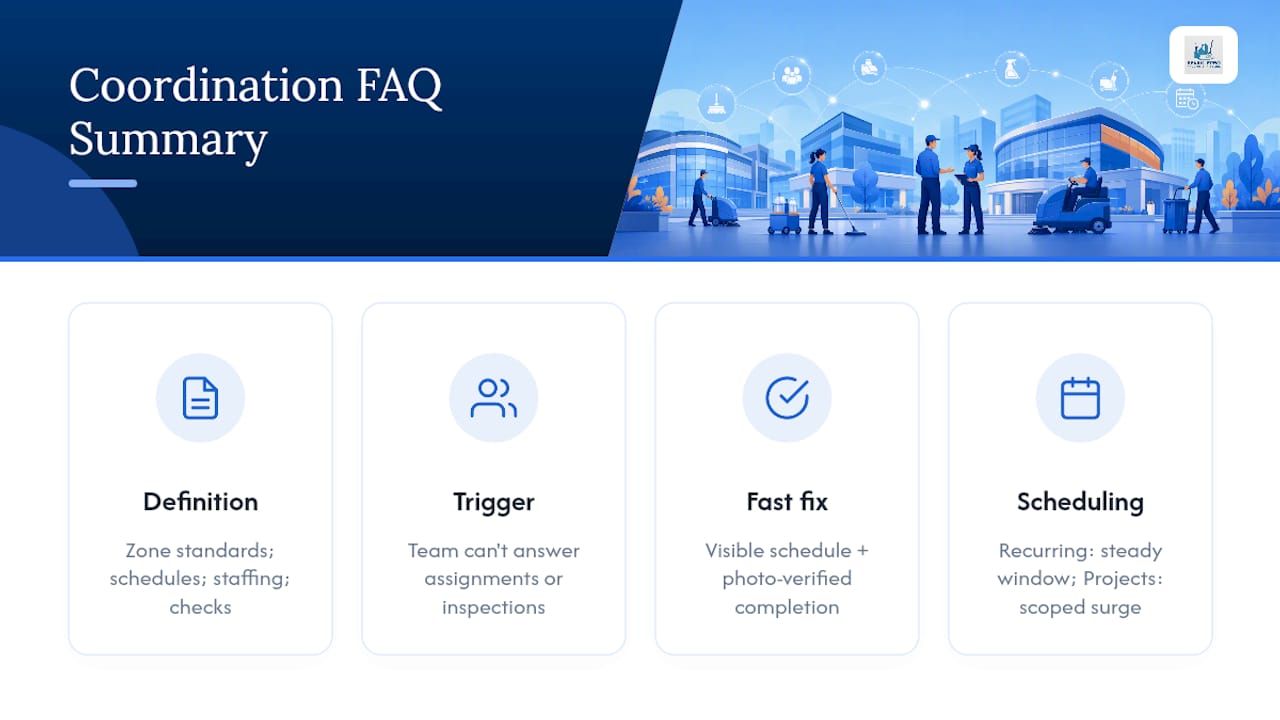
Should recurring janitorial work and deep cleans be scheduled the same way? No. Recurring maintenance needs a stable, repeatable window, while project-based deep cleans need dedicated scope, staffing, and often surge capacity that a recurring schedule can't absorb.
Sources
- Guide to Multi-Site Cleaning Operations | CleanLog
- Cleaning Company Project Management: Schedule, Quality Control
- Housekeeping Project Scheduler Software | FacilityRF
- Coordinate multiple cleaning teams across vacation rental properties — Nowistay
- How to Build a Cleaning Strategy for Large Sites