
Cleaning frequency for large commercial buildings is defined as the scheduled rate at which specific zones receive professional cleaning services, calibrated to occupancy patterns, space usage, and industry cleanliness standards. Property managers who treat all zones equally waste budget on low-risk areas while neglecting high-touch surfaces that drive tenant health complaints and compliance failures. The APPA cleanliness levels (Levels 1–5) give facility directors a recognized benchmarking framework to set defensible frequency targets. Getting the schedule right protects occupants, satisfies lease obligations, and keeps cleaning costs predictable across the full building lifecycle.
How is cleaning frequency determined in large commercial buildings?
Cleaning frequency for large commercial buildings is best determined through a zone-based risk assessment that maps each space by foot traffic, surface type, and sanitary risk. A flat schedule applied across an entire building is the most common and costly mistake facility directors make. A lobby serving 500 people daily needs different treatment than a rarely used conference room on the 14th floor.
The most practical tool for this assessment is a color-coded risk matrix. Red zones cover restrooms, kitchenettes, and high-touch entry points. Amber zones include open office floors, elevator banks, and reception areas. Green zones cover low-traffic storage rooms, server closets, and infrequently used meeting spaces. Each color tier gets a corresponding cleaning frequency, preventing low-value cosmetic cleaning from crowding out sanitary-critical tasks.

Restrooms sit at the top of every risk matrix. Daily restroom service is the minimum standard, covering fixture disinfection, supply restocking, floor mopping, and waste removal. High-traffic buildings or healthcare-adjacent facilities require multiple daily cleanings. Skipping even one scheduled service in a restroom creates compounding contamination risk.
Break rooms and kitchenettes are the most under-serviced non-restroom spaces in commercial buildings. Microbial buildup risk in these areas rivals restrooms, yet many cleaning specs treat them as standard office space. Daily service should cover countertops, sinks, and floors. Weekly service adds appliance interiors and cabinet fronts.
Pro Tip: Audit your break rooms and kitchenettes with ATP (adenosine triphosphate) swab testing quarterly. The results will almost always reveal contamination levels that justify upgrading the cleaning frequency before a tenant complaint forces the issue.
Zone-based frequency assignments by task type:
- Red zones (restrooms, kitchenettes): Daily disinfection of all surfaces, fixtures, and floors; weekly deep clean of appliances and grout
- Amber zones (lobbies, elevators, open offices): Daily vacuuming, trash removal, and surface wipe-down; weekly floor care and glass cleaning
- Green zones (low-traffic offices, storage): Two to three times per week for trash and surfaces; monthly floor care and dusting of high surfaces
- All zones: Periodic deep cleaning quarterly or semi-annually for carpets, HVAC vents, and upholstery
What are the industry benchmarks for commercial building cleaning schedules?
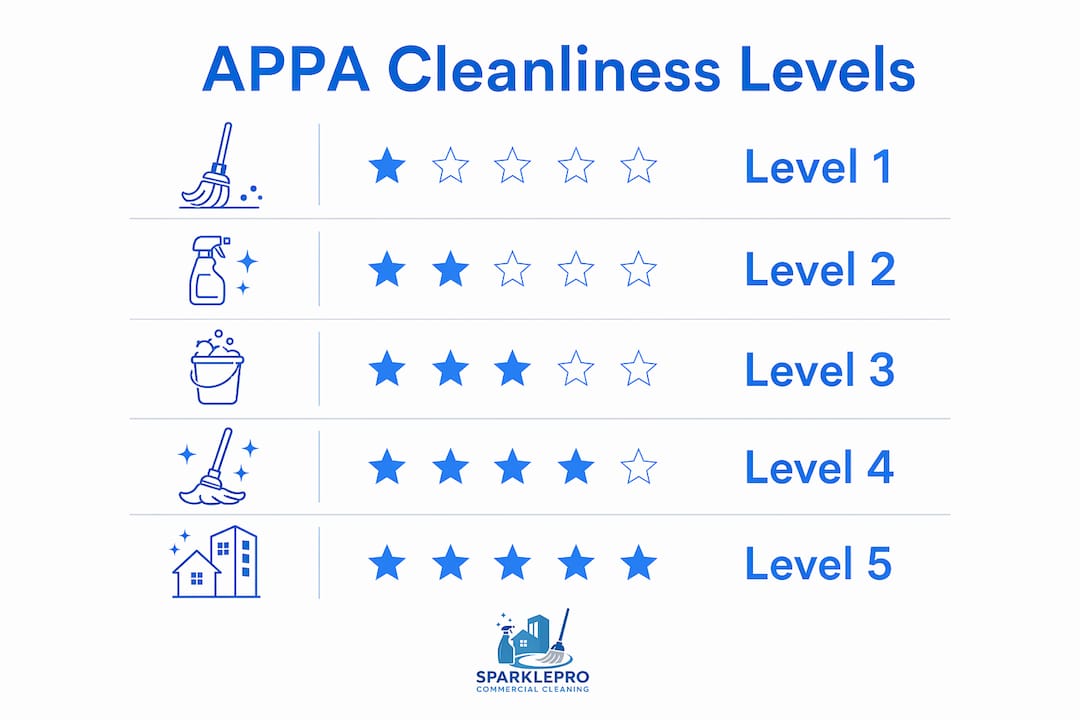
APPA cleanliness levels are the recognized standard for benchmarking cleaning frequency in commercial and institutional facilities. APPA Levels 2 and 3 (Ordinary Tidiness and Casual Inattention, respectively) represent the practical targets for most commercial buildings balancing cost and tenant health. Level 1 (Orderly Spotlessness) is reserved for healthcare facilities, executive spaces, or buildings with high public visibility requirements.
For most large office towers, nightly cleaning service five nights per week forms the baseline, supplemented by daytime porter support during business hours. Monthly cleaning costs for large multi-tenant buildings range from $2,500 to $9,000 depending on building size and service complexity. That range reflects the difference between a basic nightly janitorial program and a full-service model with day porters, periodic deep cleaning, and quality audits.
The table below maps APPA levels to typical cleaning frequency tiers and cost ranges for large commercial buildings.
| APPA Level | Description | Typical Frequency | Estimated Monthly Cost |
|---|---|---|---|
| Level 1 | Orderly Spotlessness | Multiple daily services | Above $9,000 |
| Level 2 | Ordinary Tidiness | Nightly + day porter | $5,000–$9,000 |
| Level 3 | Casual Inattention | Nightly 5x/week | $2,500–$5,000 |
| Level 4 | Moderate Dinginess | 3x/week | Below $2,500 |
| Level 5 | Unkempt Neglect | As-needed only | Not recommended |
Level 4 and Level 5 are not viable for occupied commercial buildings. They create liability exposure, accelerate surface wear, and generate tenant complaints that cost far more to resolve than the cleaning savings justify.
Pro Tip: Use the APPA level framework when writing your cleaning RFP. Specifying "Level 2 cleanliness" gives vendors a defined performance target and gives you a defensible audit standard. Vague specs like "clean and tidy" invite inconsistent service and contract disputes.
How should facility managers schedule and layer cleaning tasks?
Effective cleaning scheduling layers daily, weekly, and periodic tasks to maintain hygiene without overloading staff or budgets. Rolling service models and time-of-day task planning reduce disruption to occupants and improve cleaning effectiveness. A building that receives only one type of cleaning visit regardless of zone or task type will always be either over-cleaned in some areas or under-cleaned in others.
A practical layered schedule for a large office building looks like this:
- Daily tasks (every occupied day): Trash removal, restroom disinfection, lobby and elevator surface wipe-down, kitchen countertop cleaning, and spot-mopping of hard floors
- Weekly tasks (once or twice per week): Vacuuming of all carpeted areas, full floor mopping, glass and partition cleaning, appliance exterior wipe-down, and dusting of desks and horizontal surfaces
- Monthly tasks: High-surface dusting (light fixtures, ceiling vents), interior window cleaning, deep scrubbing of restroom tile and grout, and chair and upholstery spot treatment
- Quarterly or semi-annual tasks: Carpet extraction cleaning, HVAC vent cleaning, exterior window washing, hard floor stripping and refinishing, and full building deep clean
Adaptive scheduling tied to occupancy patterns prevents both over-cleaning and under-cleaning. A building at 40% occupancy during summer months does not need the same nightly service intensity as peak occupancy periods. Contracts should include provisions for scaling service up or down based on documented occupancy data.
Seasonal fluctuations also affect frequency needs. Winter months bring tracked-in moisture and salt, increasing the demand for hard floor care. Spring and fall are ideal for periodic deep cleaning cycles. Planning these cycles in advance prevents reactive cleaning that costs more and disrupts tenants.
Pro Tip: Avoid the trap of applying your highest-frequency schedule to every zone year-round. Audit your green zones annually and confirm they still warrant their assigned frequency. Occupancy changes, tenant turnover, and space repurposing all affect actual cleaning needs.
How do sustainability and technology shape cleaning frequency decisions?
Sustainability requirements and digital monitoring tools are reshaping how facility managers set and adjust cleaning frequencies. Green cleaning products and ESG compliance are now contractually required in many commercial cleaning specifications, not optional add-ons. Facility directors writing RFPs in 2026 who omit sustainability language risk non-compliance with building certifications like LEED or WELL.
Digital tracking tools and building sensors enable real-time monitoring of occupancy and foot traffic, allowing cleaning schedules to respond to actual building use rather than fixed assumptions. A sensor-equipped restroom that logs 200 uses before noon triggers a midday cleaning visit. One that logs 20 uses does not. This approach reduces unnecessary cleaning cycles and cuts chemical and labor costs.
Key technology and sustainability trends affecting cleaning frequency in 2026:
- Occupancy sensors: Real-time foot traffic data drives on-demand cleaning dispatch rather than fixed-time schedules
- Digital inspection platforms: Mobile audit tools replace paper checklists, creating time-stamped records that support compliance documentation
- Autonomous cleaning equipment: Robotic floor scrubbers and vacuums handle large open areas on programmed cycles, freeing staff for high-touch zone work
- Green chemistry requirements: Low-VOC, biodegradable cleaning products are now standard in ESG-aligned contracts
- Performance KPIs: Contracts increasingly specify measurable outcomes (ATP test scores, complaint rates) rather than task lists alone
Cleaning's direct effect on indoor air quality is another reason technology integration matters. Dust and particulate accumulation in HVAC vents and on surfaces directly affects occupant respiratory health, making data-driven frequency decisions a health and liability issue, not just a cost issue.
What are the most common challenges in maintaining optimal cleaning frequency?
Under-servicing high-risk zones is the most common and costly failure in large commercial building cleaning programs. Detailed inspection routines and quality controls are the primary defense against missed tasks escalating into tenant complaints or compliance violations. Without a documented audit process, service gaps accumulate invisibly until they become visible problems.
Common operational challenges and their solutions:
- Scope creep: Cleaning contracts expand informally over time as tenants request additional services. Document every scope change in writing and adjust frequency and cost accordingly.
- Multi-tenant complexity: Mixed-use buildings with retail, office, and common areas require separate frequency specs per zone type. A single building-wide schedule creates gaps in high-use retail areas and over-services low-traffic office floors.
- Staff scheduling around occupancy: Cleaning crews working during business hours create disruption. Time-of-day planning, with heavy cleaning scheduled before 7:00 AM or after 6:00 PM, reduces tenant friction.
- Inconsistent inspections: Inspection frequency must match zone risk. Restrooms and lobbies need daily or shift-based checks. Low-traffic areas can be audited weekly.
- Training gaps: Staff unfamiliar with zone-based protocols default to uniform cleaning across all spaces. Zone-specific training with clear task cards reduces this risk.
The office cleaning guide for property managers published by Sparkleprocommercialcleaning covers these challenges in detail, including how to structure escalation protocols when cleaning standards are not met.
Key Takeaways
Cleaning frequency for large commercial buildings must be set by zone-specific risk, APPA cleanliness level targets, and occupancy data to balance hygiene, compliance, and cost effectively.
| Point | Details |
|---|---|
| Zone-based risk matrix | Assign red, amber, and green zones to focus resources on sanitary-critical areas first. |
| APPA levels as benchmarks | Target Level 2 or Level 3 for most commercial buildings; use Level 1 only for health-critical spaces. |
| Layered scheduling | Stack daily, weekly, monthly, and periodic tasks to cover all hygiene needs without over-servicing. |
| Adaptive frequency | Tie cleaning schedules to occupancy data and seasonal patterns to control costs and maintain standards. |
| Technology and sustainability | Use sensors, digital audits, and green chemistry to meet 2026 ESG requirements and improve efficiency. |
What I've learned from years of cleaning frequency programs
The biggest mistake I see property managers make is treating cleaning frequency as a fixed number rather than a living variable. A schedule written at lease-up rarely reflects the building's actual use two years later. Tenant mix changes, occupancy fluctuates, and high-traffic zones shift as companies reorganize their floors. The managers who maintain the best buildings audit their zone assignments at least once a year and adjust frequencies before problems surface.
Zone-based scheduling also changes the budget conversation. When you can show a building owner that you are spending more on red zones and less on green zones, the total cleaning cost becomes defensible. It is not "we clean five nights a week." It is "we clean restrooms twice daily, lobbies nightly, and storage areas three times a week." That specificity builds trust with ownership and gives vendors clear performance targets.
Sustainability integration is the area where I see the most confusion. Facility directors assume that switching to green chemistry or adding sensor-driven scheduling will increase costs. In practice, adaptive scheduling reduces unnecessary cleaning cycles, which offsets the premium on green products. The net cost difference is smaller than most budgets assume, and the compliance and certification benefits are real.
Post-pandemic expectations have permanently raised the baseline. Tenants now notice cleaning frequency in ways they did not before 2020. A lobby that was cleaned once nightly in 2019 now needs a midday touch-up to meet occupant expectations. That shift is not going away. Build it into your specs now rather than adding it reactively when complaints arrive.
— Sales
Sparkleprocommercialcleaning: custom frequency plans for large buildings
Property managers who need a cleaning program built around zone risk, APPA standards, and occupancy data have a direct path forward with Sparkleprocommercialcleaning.
Sparkleprocommercialcleaning works with facility directors across the country to design cleaning frequency plans that match the actual demands of large commercial buildings. From nightly janitorial service and day porter programs to periodic deep cleaning and green chemistry compliance, every plan is scoped to the building's specific zones and tenant requirements. Performance reporting and inspection documentation are included as standard, giving property managers the audit trail they need for compliance and lease obligations. Facility directors in Delaware can request a custom cleaning assessment to get a frequency plan built around their building's specific needs.
FAQ
What is the minimum cleaning frequency for a large office building?
The baseline for large multi-tenant office buildings is nightly service five nights per week, supplemented by daytime porter support for high-traffic areas. Restrooms require daily service at minimum, with multiple daily cleanings in high-use environments.
What are APPA cleanliness levels and why do they matter?
APPA cleanliness levels are a five-tier benchmarking standard ranging from Level 1 (Orderly Spotlessness) to Level 5 (Unkempt Neglect). Most commercial buildings target Level 2 or Level 3 to balance tenant health, compliance, and cleaning cost.
How does building size affect cleaning frequency and cost?
Larger buildings require more cleaning visits and more staff hours per cycle, which increases monthly costs. Monthly costs for large multi-tenant buildings range from $2,500 to $9,000 depending on size and service complexity.
Why does cleaning frequency vary by facility type?
Facility type determines foot traffic volume, surface contamination risk, and regulatory requirements. Healthcare-adjacent spaces require higher frequency and stricter disinfection protocols than standard office environments.
How can technology reduce unnecessary cleaning visits?
Occupancy sensors and digital tracking tools monitor real-time foot traffic and trigger cleaning dispatch based on actual use rather than fixed schedules. This approach cuts unnecessary cleaning cycles and reduces chemical and labor costs while maintaining hygiene standards.