
Most facility managers assume large-scale facility cleaning is just janitorial work at a bigger building. It isn't. What is large-scale facility cleaning, exactly? It's a specialized program built for facilities with complex logistics, industrial-grade debris, and operational demands that standard cleaning crews simply aren't equipped to handle. This article breaks down the scope, the operational challenges, the compliance requirements, and the best practices you need to run a program that actually works. Whether you oversee a single warehouse or a multi-site commercial portfolio, the details here will change how you think about large facility maintenance.
Table of Contents
- Key takeaways
- What large-scale facility cleaning actually means
- Managing the operational complexity at scale
- Deep cleaning within large facility maintenance
- Compliance standards in large-scale cleaning
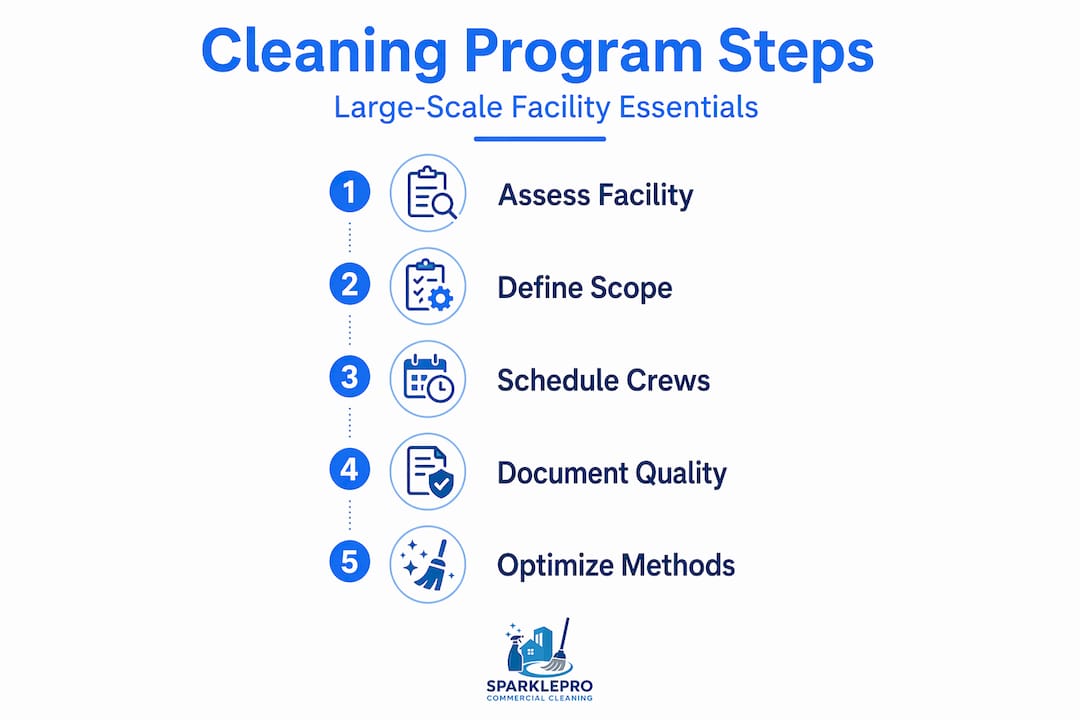
- Implementing and optimizing your cleaning program
- My take on what actually works at scale
- How Sparkleprocommercialcleaning can support your program
- FAQ
Key takeaways
| Point | Details |
|---|---|
| Scale changes everything | Large-scale cleaning covers 50,000 to 500,000+ sq ft and requires industrial equipment, not standard janitorial tools. |
| Systems beat supervision | Standardized SOPs and digital QC tools outperform manual walkthroughs in multi-site cleaning programs. |
| Deep cleans are projects | Quarterly and annual deep cleans must be scoped, scheduled, and treated as standalone facility projects. |
| Compliance is non-negotiable | OSHA standards 29 CFR 1910.22, 1910.141, and 1910.1200 directly govern your cleaning and sanitation obligations. |
| Equipment must match the environment | Under-speccing cleaning equipment leads to inconsistent results even when crews follow procedures perfectly. |
What large-scale facility cleaning actually means
Large-scale facility cleaning is an industrial janitorial program designed for facilities ranging from 50,000 to over 500,000 square feet. That scale introduces complexity that simply doesn't exist in a 10,000 square foot office suite.
The facility types that fall under this category include:
- Warehouses and distribution centers with high-bay racking, loading docks, and constant forklift traffic
- Manufacturing plants with industrial residue, chemical spills, and production floor demands
- Multi-tenant commercial buildings with shared corridors, lobbies, and high-traffic restrooms
- Healthcare and life sciences facilities where sanitation standards carry regulatory weight
- Retail centers and mixed-use properties with diverse surface types and peak-traffic patterns
The cleaning tasks required at this scale go well beyond mopping and trash removal. Typical scope includes concrete and epoxy floor care, high-bay dust control protocols, dock sanitation, and racking or shelving wipe-downs. Each of these tasks requires specific procedures and equipment.
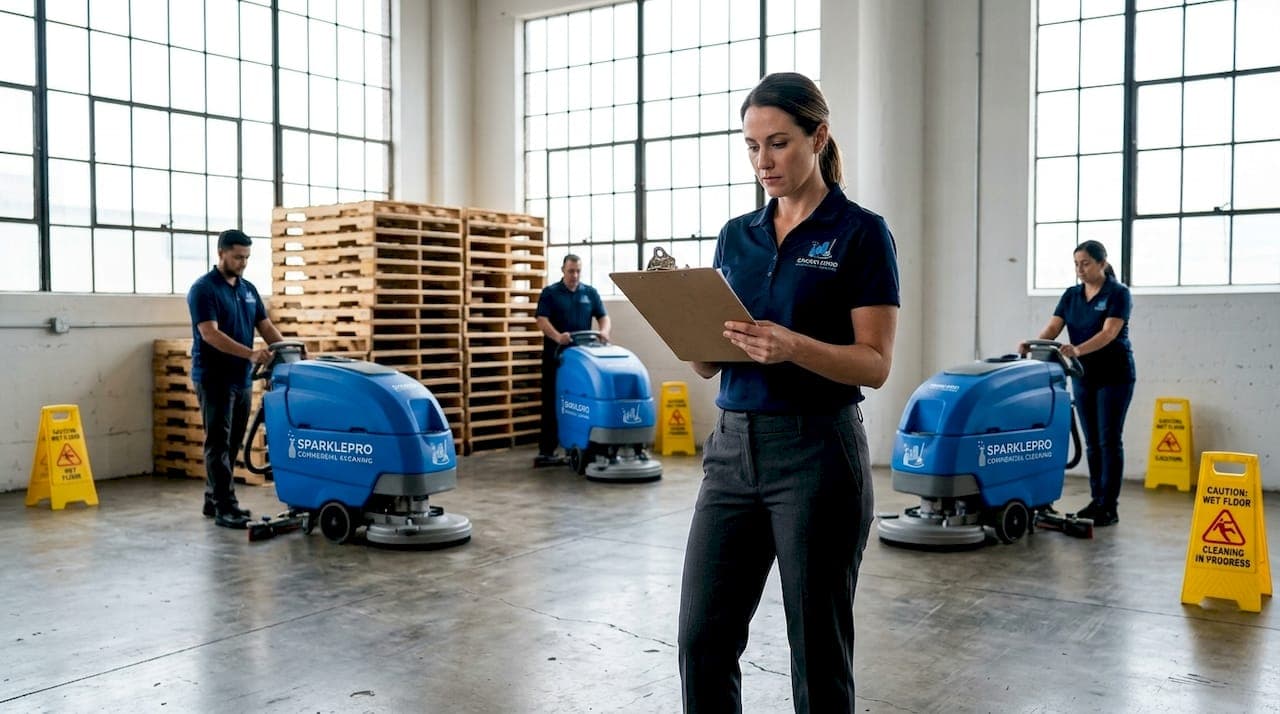
On the equipment side, standard upright vacuums and mop buckets aren't sufficient. Ride-on scrubbers with dual-tank systems separate clean solution from wastewater in real time, which matters when you're covering 100,000 square feet per shift. Under-speccing your equipment leads to inconsistent results even when your crew follows procedures to the letter.
Pro Tip: Before selecting a cleaning vendor for a large facility, ask specifically what equipment they deploy for floor care. If the answer doesn't include ride-on scrubbers or industrial extraction systems for your facility size, the scope won't be met.
Managing the operational complexity at scale
Running a large-scale cleaning program isn't just a bigger version of running a small one. The operational overhead grows disproportionately. Crew coordination, shift handoffs, and turnover management become the primary variables that determine whether your facility stays clean or slowly degrades.
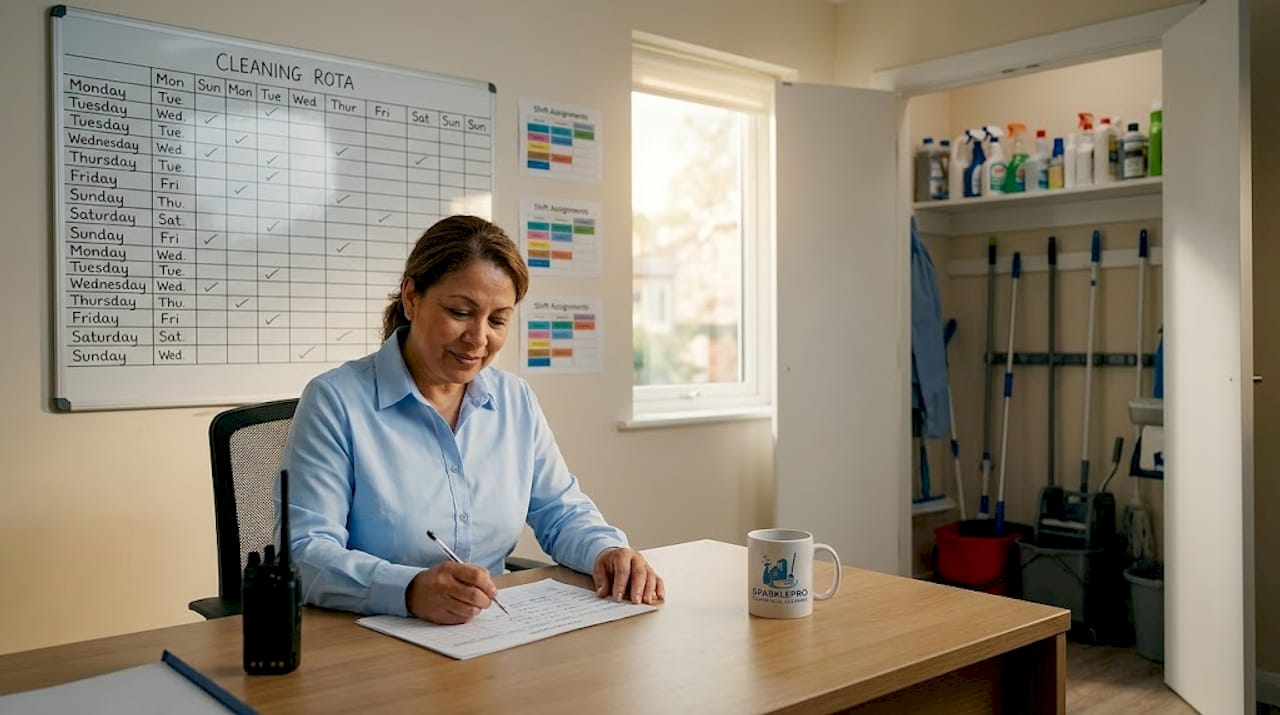
Multi-site cleaning operations require standardized SOPs, centralized scheduling, and evidence-based quality controls. Manual walkthroughs by a supervisor don't scale past 10 to 25 locations. At that point, the coordination overhead exceeds what any individual can track.
The table below shows the core differences between reactive and systems-based cleaning management:
| Management approach | Quality control method | Scalability | Risk level |
|---|---|---|---|
| Reactive (manual supervision) | Owner or manager walkthroughs | Low (plateaus ~20 sites) | High: dependent on individual availability |
| Systems-based (digital QC) | Inspection scoring with photo documentation | High (25+ sites) | Low: auditable and replicable |
Separating crew task completion from supervisor inspection scoring is one of the most effective structural changes a facility manager can make. A crew checklist confirms that tasks were attempted. A supervisor inspection score confirms that tasks were done correctly. Measuring only schedule completion gives false assurance. Measuring quality gives you real data.
Operators who fail to systematize often plateau around 20 sites due to coordination overload. If your program is approaching that threshold, the fix isn't more staff. It's implementing digital SOPs, automated scheduling, and real-time reporting that removes the dependency on any single person's memory or attention.
Pro Tip: Build a continuous recruiting pipeline before you need it. Janitorial labor turnover rates run high across the industry, and losing two crew members at a large facility mid-week will show on the floor by Friday.
Deep cleaning within large facility maintenance
Daily maintenance cleaning keeps a facility functional. Deep cleaning keeps it healthy. Understanding the difference and planning for both is a core part of what is facility cleaning at the large-scale level.
Deep or project-based cleaning is a top-to-bottom facility reset, typically scheduled quarterly or annually, that addresses accumulated grime, pathogens, and deterioration that daily cleaning never reaches. Think of it as a full audit of every surface your maintenance program touches, plus all the ones it doesn't.
Common deep cleaning tasks in large commercial facilities include:
- High-dusting of structural beams, light fixtures, HVAC diffusers, and racking tops
- Floor stripping and waxing or recoating of epoxy and VCT surfaces
- Restroom and locker room resets including grout scrubbing and fixture descaling
- Loading dock deep sanitation addressing residue accumulation and pest deterrence
- Interior glass and partition cleaning above standard daily wipe-down height
One distinction that matters operationally: sanitizing and disinfecting are not the same thing. Sanitizing reduces microbial counts to safe levels for surfaces like food-contact areas. Disinfecting eliminates pathogens to a higher standard, required for healthcare environments and post-illness scenarios. Your deep cleaning scope for commercial buildings should specify which standard applies to which zone.
Deep cleaning must be planned as a project with a defined scope, clear completion criteria, and scheduling during low-traffic periods. Trying to deep clean a warehouse during peak operational hours guarantees that neither the cleaning nor the operations will go smoothly. Map your deep cleans to facility shutdowns, holidays, or night shifts.
Compliance standards in large-scale cleaning
Regulatory compliance in large-scale facility cleaning isn't optional, and it's more specific than most facility managers realize. Three OSHA standards directly govern your obligations.
- 29 CFR 1910.22 (Walking-Working Surfaces): Employers must maintain floors, aisles, and passageways in a clean and dry condition. Accumulation of debris, standing water, or chemical residue on walking surfaces creates both a safety hazard and a compliance violation.
- 29 CFR 1910.141 (Sanitation): This standard covers requirements for toilet facilities, drinking water, food areas, and waste disposal. For large facilities with cafeterias, locker rooms, or production areas adjacent to food handling, this standard carries significant scope.
- 29 CFR 1910.1200 (Hazard Communication): Cleaning chemicals must be properly labeled, and workers who handle them must receive documented training. OSHA hazard communication requirements mean your cleaning vendor's chemical protocols need to meet HazCom standards, not just your own team's.
Compliance documentation serves a dual purpose. It protects you in an audit, and it forces your program to operate with specificity. Vague cleaning schedules and undocumented chemical usage are the two most common gaps that surface during facility inspections. A well-structured cleaning program produces records that demonstrate both consistency and safety.
For facilities operating near construction zones or industrial rooftops, compliance documentation extends beyond the floor level. Every surface and access point that cleaning staff interact with needs to be covered in your safety protocols.
Implementing and optimizing your cleaning program
Getting a large-scale cleaning program right requires more than hiring a vendor and hoping for the best. It requires deliberate design at every layer of the operation.
Start with your scope of work. A detailed cleaning service description defines exactly what "done" looks like for every task, every frequency, and every zone in your facility. Without this, you're evaluating performance against an invisible standard.
Key elements of an effective large-scale cleaning program:
- Zone-based inspection scoring: Zone averages below 2.5 on a 4-point scale should trigger corrective action within 48 hours. Restrooms in high-traffic facilities should be scored every two hours.
- Equipment matched to environment: Ride-on scrubbers for large concrete floors, backpack vacuums for high-racking aisles, and industrial extractors for carpeted zones.
- Digital scheduling and reporting: Real-time visibility into what was cleaned, when, and by whom removes ambiguity and builds accountability.
- Audit-to-scope integration: Every inspection finding should feed into the next cleaning cycle's priorities, not just disappear into a report.
The most common pitfall at scale is treating the cleaning program as a set-and-forget contract. Facilities change. Traffic patterns shift. Seasonal debris increases. Your cleaning program needs a quarterly review process to stay calibrated to current conditions. What worked in January in a distribution center won't work in November when pallet throughput doubles.
My take on what actually works at scale
I've worked with facility managers who run tight, well-documented cleaning programs across dozens of sites, and others who can't tell you the last time their warehouse floor was stripped and recoated. The difference isn't budget. It's how they think about the program.
The managers who struggle treat cleaning as a service they buy and forget. The ones who succeed treat it as an operational system they manage. Manual supervision feels like control, but at 20 or 30 locations, it's an illusion. The moment a key supervisor is out sick, the entire quality standard floats.
What I've seen work consistently: clear SOPs at the task level, digital QC tools that generate scores rather than checklists, and a deep cleaning calendar mapped to the facility's operational rhythm. These aren't complicated systems. They're just disciplined ones.
The other thing worth saying directly: turnover in cleaning labor is a constant. Building your program around individual people rather than documented procedures means you're always one resignation away from a quality drop. Systems absorb turnover. People can't.
The benefits of large-scale cleaning programs built on these principles are measurable. Longer floor life, fewer compliance gaps, and occupant satisfaction scores that actually reflect what your facility looks like. It's not about spending more. It's about spending with intent.
— Sales
How Sparkleprocommercialcleaning can support your program
Sparkleprocommercialcleaning works with facility managers and property owners who need more than a cleaning crew. If you're managing a large industrial facility, a multi-site commercial portfolio, or a property that requires both daily maintenance and project-based deep cleans, Sparkleprocommercialcleaning brings the equipment, protocols, and compliance awareness to match your operational scale.
From commercial cleaning in Massachusetts to large-scale programs across the country, the team at Sparkleprocommercialcleaning operates with documented SOPs, digital quality controls, and scheduling systems designed for facilities that can't afford inconsistency. If you need cleaning services in Washington or regional coverage for a distributed portfolio, the process starts with a site visit and a scope of work built around your facility's specific needs. Reach out to get a quote and see what a properly structured large-scale program looks like in practice.
FAQ
What is large-scale facility cleaning?
Large-scale facility cleaning is an industrial cleaning program for facilities between 50,000 and 500,000+ square feet, requiring specialized equipment, trained crews, and protocols for tasks like floor restoration, high-bay dust control, and dock sanitation. It goes well beyond routine janitorial service in both scope and operational complexity.
How does large-scale cleaning differ from standard janitorial service?
Standard janitorial service covers routine tasks like trash removal, restroom cleaning, and surface wiping. Large-scale facility cleaning adds industrial floor care, racking wipe-downs, high-dusting, and compliance-grade sanitation protocols matched to the size and use of the facility.
How often should large facilities schedule deep cleaning?
Deep cleaning in large commercial facilities is typically scheduled quarterly for high-traffic zones and annually for a full facility reset. These cleans should be planned during off-hours or operational shutdowns to avoid disruption.
What OSHA standards apply to facility cleaning programs?
OSHA standards 29 CFR 1910.22, 1910.141, and 1910.1200 govern walking-working surfaces, sanitation requirements, and hazard communication for cleaning chemicals. Facility managers are responsible for maintaining documentation that demonstrates compliance with all three.
What is the most common failure point in large-scale cleaning programs?
The most common failure is relying on manual supervision instead of documented systems. At scale, coordination overhead exceeds what individual managers can track, leading to quality gaps that show up as compliance violations or accelerated facility deterioration.