
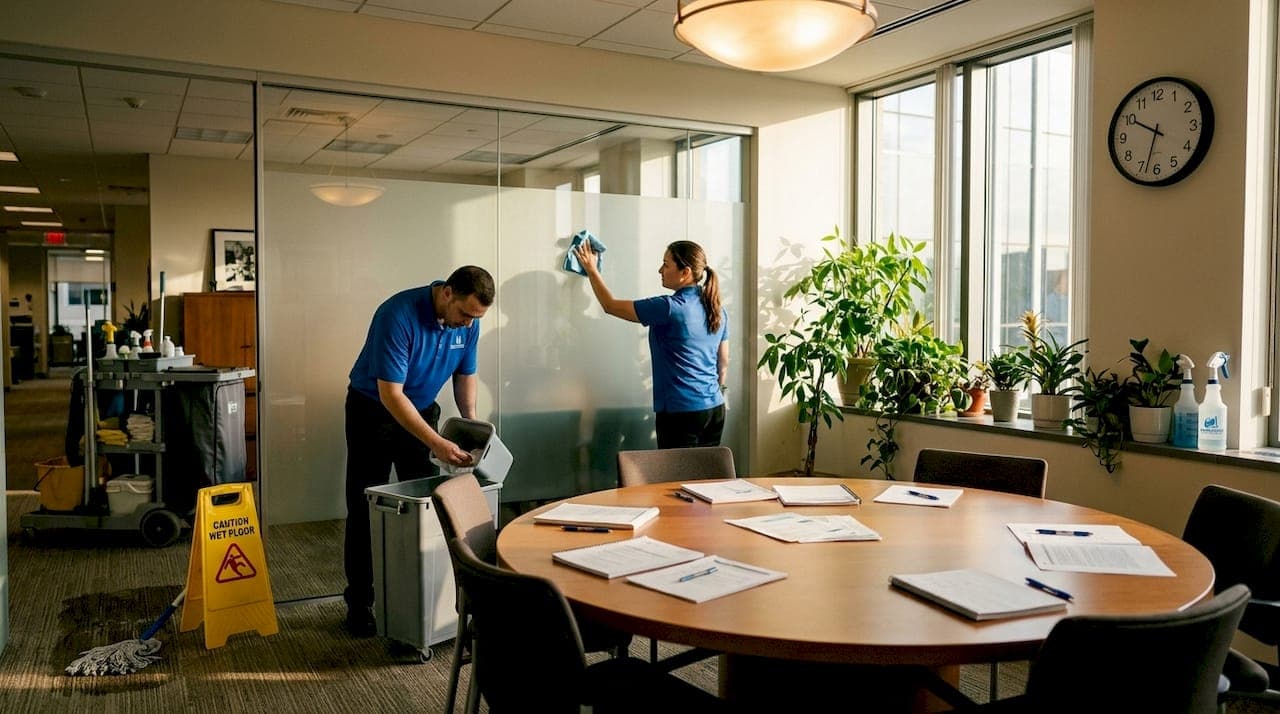
Most property managers assume facility maintenance cleaning means someone vacuums the carpets and empties the trash. That assumption costs buildings real money. What is facility maintenance cleaning, precisely? It is the systematic, protocol-driven practice of keeping a commercial facility safe, sanitary, legally compliant, and operationally sound through scheduled and specialized cleaning activities. This goes far beyond appearances. It covers everything from floor care and restroom sanitation to cross-contamination prevention and regulatory documentation. Get this right and you protect your tenants, your asset value, and your liability exposure all at once.
Table of Contents
- Key Takeaways
- What facility maintenance cleaning actually means
- Key practices and hygiene protocols that actually work
- Facility maintenance cleaning vs. janitorial services
- Benefits that show up in your bottom line
- Building a program that holds up over time
- My honest take on why this keeps getting underestimated
- Professional facility maintenance cleaning from Sparkleprocommercialcleaning
- FAQ
Key Takeaways
| Point | Details |
|---|---|
| More than basic cleaning | Facility maintenance cleaning covers safety, sanitation, legal compliance, and operational efficiency. |
| Cross-contamination is a real risk | About 90% of bacteria transfers from shoes to floors, making strict protocols non-negotiable. |
| Different from janitorial work | Facility cleaning integrates with technical maintenance systems; janitorial work focuses on appearance. |
| Schedules and checklists drive outcomes | Documented cleaning programs reduce liability and protect long-term property value. |
| Technology improves accountability | CMMS platforms track work orders, verify completion, and support continuous improvement. |
What facility maintenance cleaning actually means
The industry term you will encounter most often is integrated facility maintenance, where cleaning functions sit alongside mechanical, electrical, and structural upkeep as a core operational category. Facility maintenance cleaning, as a descriptive phrase, refers specifically to the cleaning component of that broader system.
Facility maintenance includes upkeep of building systems and infrastructure, while cleaning targets hygiene-sensitive surfaces and occupied indoor areas. That distinction matters practically. When an HVAC technician services a rooftop unit, that is mechanical maintenance. When a cleaning technician sanitizes the air handler grilles, drains a condensate pan, and disinfects the surrounding surfaces, that is facility maintenance cleaning doing its part to protect air quality and prevent mold.
The scope covers considerably more ground than most owners realize:
- Floors and common areas: Daily sweeping and mopping, periodic stripping and recoating of hard floors, carpet extraction on a scheduled cycle
- Restrooms: High-frequency disinfection of touch points, grout cleaning, fixture descaling, and restocking supplies
- High-touch surfaces: Elevator buttons, door handles, light switches, and reception counters sanitized on documented schedules
- Windows and glass: Interior glass cleaned routinely; exterior cleaning scheduled seasonally or as needed
- Grounds and entryways: Pressure washing, gum removal, and debris clearing to prevent tracked contamination indoors
- Specialized areas: Server rooms, healthcare suites, food service areas, and loading docks each require task-specific protocols
Reactive cleaning responds to spills or incidents. Preventive cleaning runs on fixed schedules to stop problems before they start. Both are necessary. The most effective facility maintenance programs ensure compliance and safety by combining both types with documented procedures and accountable staff.
Key practices and hygiene protocols that actually work
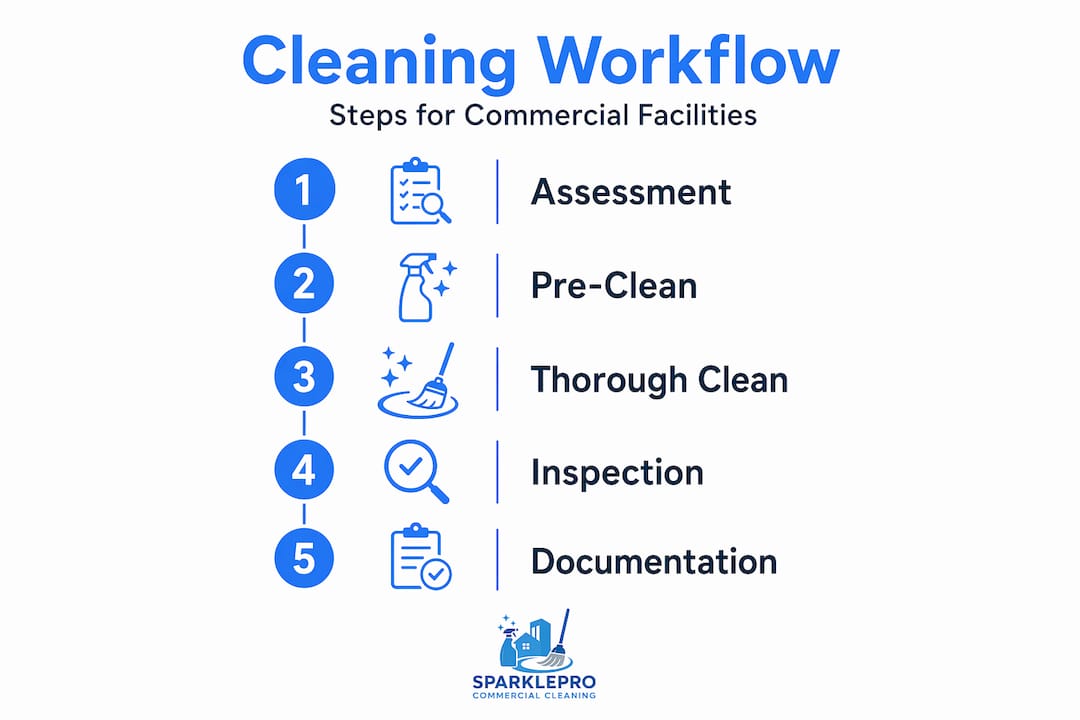
Here is where most commercial facilities lose control. They have cleaning happening, but they do not have cleaning working. The difference is protocol.
Cross-contamination prevention relies on disciplined protocols, training, and accountability more than any single product or tool. Consider the floor problem: about 90% of bacteria transfers from shoe surfaces to floor surfaces within a few steps. That contamination spreads through a building every time someone walks from a restroom into a lobby, or from a loading dock into a break room. No amount of disinfectant spray fixes this without a system behind it.
Building an effective hygiene protocol means following a clear sequence:
- Establish cleaning zones. Divide the facility into low-risk areas (offices, lobbies) and high-risk areas (restrooms, kitchens, medical suites). Cleaning must always flow from low-risk to high-risk zones, never the reverse.
- Color-code your tools. Assign specific microfiber cloths, mops, and buckets to specific zones. Red for restrooms, blue for general surfaces, green for food service areas. This prevents tools from carrying pathogens between spaces.
- Enforce contact time on disinfectants. Insufficient dwell time critically reduces cleaning efficacy, just as much as using the wrong product at the wrong concentration. Read the label, apply the product, and let it sit for the specified duration before wiping.
- Launder microfiber properly. Microfiber laundering and tool segregation are critical steps that many facilities skip. Hot-water machine washing without fabric softener maintains microfiber's electrostatic effectiveness. Used cloths stored with clean ones defeat the entire system.
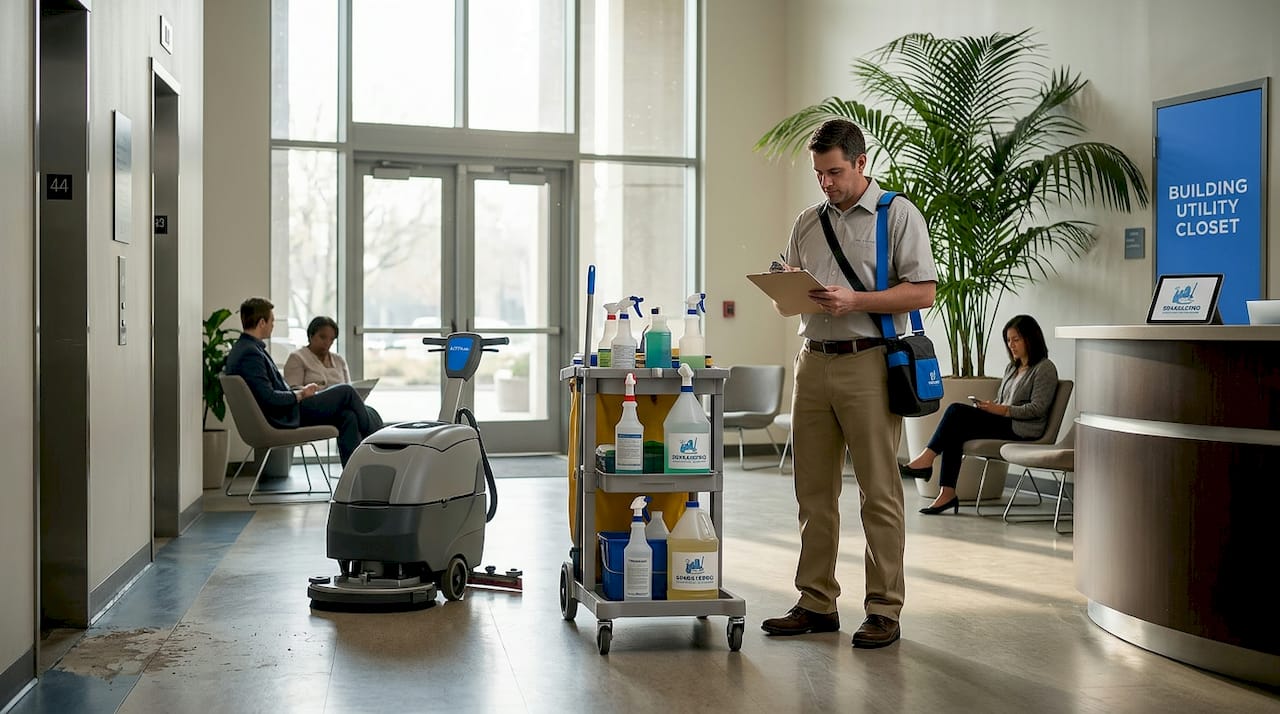
- Document and verify. Inspection logs, ATP testing (a bioluminescence method for measuring surface contamination), and supervisor sign-offs create accountability and catch failures before they become health incidents.
Pro Tip: Run an ATP swab test on your five highest-touch surfaces before and after cleaning for one week. The numbers will tell you immediately whether your protocols are delivering results or just creating the appearance of cleanliness.
Facility maintenance cleaning vs. janitorial services
This comparison causes real confusion for property managers, and the confusion leads to gaps in coverage and cost overruns.
Facility maintenance cleaning differs from janitorial services in scope, standards, and integration with building systems. Janitorial work is largely appearance-focused and reactive: the trash gets emptied, the floors get swept, the break room gets wiped down. Facility maintenance cleaning operates at a higher standard. It integrates with technical maintenance functions, enforces regulated hygiene standards, and contributes directly to compliance documentation.
| Feature | Janitorial services | Facility maintenance cleaning |
|---|---|---|
| Primary goal | Appearance and tidiness | Safety, sanitation, and compliance |
| Frequency | Daily or nightly routines | Scheduled and event-driven protocols |
| Documentation | Minimal | Detailed logs and inspection records |
| Integration | Standalone | Coordinated with maintenance systems |
| Staff training | Basic | Protocol-specific and area-specific |
| Regulatory role | Limited | Direct compliance contribution |
The overlap between these two functions is real. A skilled janitorial crew performing detailed work with proper products and documentation effectively becomes a facility maintenance cleaning team. The distinction is less about who does the work and more about the standards, accountability, and integration applied to it.
For a multi-tenant office building, property managers typically need both: janitorial coverage for daily appearance and facility maintenance cleaning protocols for restrooms, kitchens, and any regulated or high-occupancy spaces. Treating them as interchangeable is where industrial cleaning strategies for facility managers consistently identify budget and performance gaps.
Benefits that show up in your bottom line
Effective facility cleaning programs deliver results you can measure in more than one way. Scheduled cleaning maintenance improves workplace health, appearance, and long-term maintenance costs for commercial properties simultaneously.
Here is what that looks like in practice:
- Reduced liability exposure. Slips, falls, and health incidents in commercial facilities generate expensive claims. A documented cleaning program that proves regular maintenance of floors, entryways, and restrooms is your first line of defense in litigation.
- Higher tenant retention. Tenants notice cleanliness. A building that consistently looks and smells clean, with functioning restrooms and well-maintained common areas, commands higher rents and lower vacancy rates.
- Extended asset life. Floors stripped and recoated on schedule last significantly longer than floors scrubbed once a year. Tile grout cleaned regularly resists mold and structural deterioration. Every cleaning task is also a form of asset protection.
- Regulatory compliance. OSHA, local health codes, and industry-specific regulations (healthcare, food service, childcare) all carry cleaning requirements. Non-compliance carries fines and, in serious cases, facility closure orders.
- Improved indoor air quality. Dust, allergens, and volatile organic compounds accumulate in commercial facilities. Consistent cleaning of HVAC vents, carpets, and hard surfaces directly reduces occupant respiratory symptoms and sick days.
The importance of facility maintenance goes well beyond aesthetics. A clean building is a productive building, a compliant building, and a building that holds its value over time.
Building a program that holds up over time
You can have the right products and a willing team, but without structure, results will be inconsistent. Technology and standardization improve cleaning management and accountability significantly, and the most effective programs for commercial properties integrate those elements from day one.
Start with these fundamentals:
- Create a tiered facility maintenance checklist. Daily, weekly, monthly, and quarterly tasks should each live in a separate schedule. Daily tasks keep the facility presentable. Monthly and quarterly tasks protect assets and comply with regulations.
- Select products matched to surfaces and risk levels. A hospital-grade disinfectant applied to an office desk is overkill and potentially harmful to finishes. A general-purpose cleaner applied to a surgical suite is a liability. Match the product to the environment.
- Train to the task, not just the job title. Staff working in high-risk areas (restrooms, kitchens, healthcare spaces) need protocol-specific training, not generic cleaning orientation. Document that training for compliance purposes.
- Use a CMMS platform. Computerized maintenance management systems let you track cleaning work orders, schedule recurring tasks, and verify completion with time-stamped records. This is standard practice for facilities above 50,000 square feet, and increasingly common in smaller buildings.
Pro Tip: Schedule a formal quarterly audit of your cleaning program. Walk each zone with your checklist, check documentation, and test two or three surfaces with ATP swabs. One audit cycle typically reveals three to five protocol gaps you did not know existed.
For practical examples of how property managers are applying these methods, effective cleaning solutions broken down by property type offer a useful reference point.
My honest take on why this keeps getting underestimated
I have seen facility directors lose significant budget battles because they could not demonstrate the value of a proper cleaning program in financial terms. The work is invisible when it is done right. Nobody notices that the floors were stripped and sealed last month. They absolutely notice when they were not.
What I have learned from working with commercial properties across multiple sectors is that cleaning gets underinvested at exactly the moment it is most needed. When occupancy pressure mounts and costs need cutting, cleaning schedules get stretched. That is precisely when tenant complaints spike, maintenance costs climb from deferred surface care, and liability exposure grows.
The integration piece is where I see the most room for improvement. Property managers who coordinate their cleaning teams with their maintenance teams, sharing inspection data and work order histories, consistently get better results than those running them as separate departments. A floor maintenance technician who flags a failing grout line during a cleaning cycle catches a $200 repair before it becomes a $2,000 tile replacement.
Technology matters here too. Facilities using CMMS platforms with integrated cleaning modules do not just track tasks. They build a documented history that protects ownership during audits, insurance reviews, and due diligence processes. That record has real value. Most managers do not realize how much until they need it.
My take: treating facility maintenance cleaning as a compliance and asset-protection function, not a cost center, changes every decision you make about staffing, scheduling, and investment.
— Sales
Professional facility maintenance cleaning from Sparkleprocommercialcleaning
If you manage a commercial property and want a cleaning program that performs at the standards this article describes, Sparkleprocommercialcleaning delivers exactly that across the country. From routine janitorial schedules to protocol-driven facility maintenance cleaning for regulated environments, the team brings licensed, insured service backed by documented procedures and consistent accountability.
Sparkleprocommercialcleaning currently serves property managers and building owners in Delaware, Massachusetts, Washington, and New Jersey, with nationwide coverage for facilities of every type and size. Whether you need a one-time deep clean, a recurring maintenance program, or post-construction cleaning before tenant move-in, the process starts with a quote and a site visit so the scope is right from day one. Reach out today to get a program built around your property's actual requirements.
FAQ
What is facility maintenance cleaning?
Facility maintenance cleaning is the systematic practice of keeping commercial properties safe, sanitary, and legally compliant through scheduled and protocol-driven cleaning activities. It covers floors, restrooms, high-touch surfaces, and specialized areas, and integrates directly with broader facility maintenance functions.
How does facility maintenance cleaning differ from janitorial services?
Janitorial services focus on daily appearance and routine tidying, while facility maintenance cleaning operates at a higher standard with documented protocols, regulatory compliance functions, and integration with building maintenance systems. Both serve commercial properties, but facility maintenance cleaning carries greater accountability requirements.
What does a facility maintenance checklist include?
A facility maintenance checklist typically separates tasks by frequency: daily tasks like floor mopping and restroom disinfection, weekly tasks like high-touch surface audits and trash area cleaning, monthly tasks like floor maintenance and HVAC grille cleaning, and quarterly tasks like deep disinfection and equipment inspection.
Why is cross-contamination prevention important in facility cleaning?
Cross-contamination is a direct health risk in commercial facilities. Bacteria transfers from shoes to floors at extremely high rates, spreading pathogens through a building with foot traffic. Proper tool color-coding, zone separation, and product contact time protocols prevent this spread.
How do you measure the effectiveness of a facility cleaning program?
ATP swab testing measures surface contamination levels before and after cleaning, providing objective data on protocol performance. Combined with inspection logs, supervisor sign-offs, and CMMS work order records, these tools give property managers a verifiable picture of whether their cleaning program is actually working.