
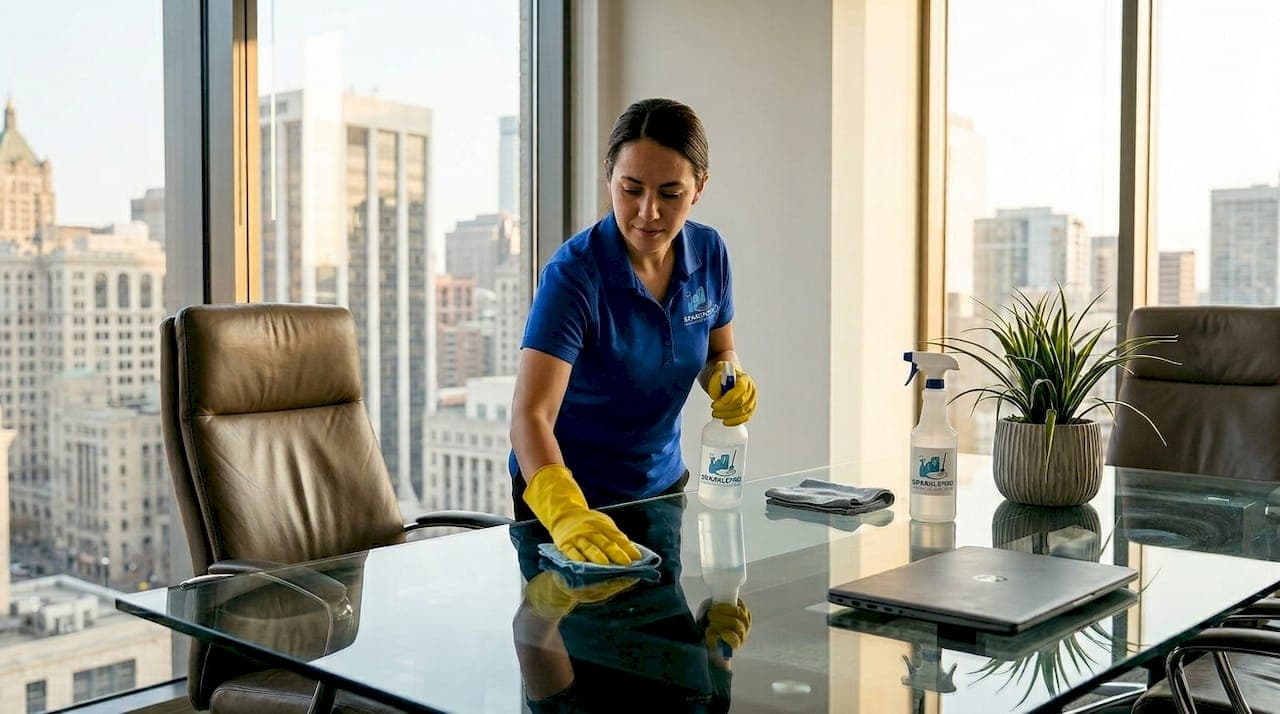
Property managers and facility directors face a decision most treat as routine but rarely examine closely: who actually cleans the building, and what credentials back that work? The role of licensed cleaners goes far beyond mopping floors and emptying trash. It touches liability, chemical safety, regulatory compliance, and the legal obligations that stay with you as the property owner, regardless of who holds the mop. Getting this wrong exposes your facility to fines, lawsuits, and safety incidents that an unlicensed vendor will never absorb on your behalf.
Table of Contents
- Key Takeaways
- The role of licensed cleaners defined
- Safety and compliance responsibilities
- Operational advantages in commercial properties
- Choosing and managing a licensed cleaning service
- My honest take on what property managers get wrong
- Get licensed commercial cleaning that protects your property
- FAQ
Key Takeaways
| Point | Details |
|---|---|
| Licensing means legal accountability | Licensed cleaners carry verified credentials, bonds, and insurance that protect your property and limit your exposure. |
| Liability stays with the property owner | Even when contractors handle cleaning, employer safety duties for COSHH compliance and documentation remain with you. |
| Chemical safety training is non-negotiable | Licensed cleaners must receive hazardous substance training before first exposure, not after an incident occurs. |
| Procurement requires document verification | Vetting a licensed cleaner means reviewing licenses, insurance certificates, risk assessments, and chemical safety registers. |
| Operational value exceeds basic cleaning | Licensed cleaners take on security access, emergency spill response, and performance-accountable service contracts. |
The role of licensed cleaners defined
Not every cleaning company is created equal, and the gap between a licensed provider and an unlicensed one is not a formality. It is a legal and operational divide that directly affects your risk profile.
A licensed cleaning contractor has met state-specific registration requirements, carries the required insurance, and in many states operates under a surety bond. In California, for example, janitorial contractors must register under the Janitorial Contractor Registration Act, which requires a $25,000 surety bond and registration fees of $500 at initial filing with mandatory annual renewal. If you hire an unregistered contractor in California, your exposure does not disappear. You share joint liability for any wage violations or worker claims that contractor generates.
New York has its own registration framework with insurance requirements that most commercial clients enforce contractually. In practice, general liability coverage of at least $1 million per occurrence is expected before a vendor can sign a commercial cleaning contract. These are not suggestions. They are conditions for doing business at the professional level.
Here is where property managers often get tripped up:
- Licensed means the contractor has met state registration or certification requirements specific to janitorial work.
- Bonded means a surety bond is in place to cover theft or employee misconduct on your property.
- Insured means active general liability and workers' compensation policies exist, protecting you if a cleaner is injured on site or damages property.
An unlicensed provider might carry one of these without the others. A fully licensed cleaning operation carries all three and can produce documentation on demand.
Pro Tip: Ask any cleaning vendor to provide their license number, proof of bond, and a current certificate of insurance before signing anything. Verify the license number directly with your state licensing board. This takes ten minutes and can prevent months of legal headaches.
Understanding these distinctions is the first practical step toward cleaning service compliance that protects your building and your occupants.
Safety and compliance responsibilities
Here is something many facility directors do not realize until they are sitting across from a regulator: the cleaning contractor handles the work, but you retain the legal duty of care. Facility managers often assume the cleaning company absorbs all safety responsibility. They do not.
This reality plays out most visibly around chemical safety regulations. In the United States, this falls under OSHA's Hazard Communication Standard. In facilities with international compliance contexts or standards aligned to COSHH frameworks, the same principle applies. Either way, the property owner or employer of record must verify that cleaning contractors have:
- A current COSHH or chemical hazard register covering every product used on site
- Written risk assessments for high-risk tasks like handling concentrated disinfectants or stripping floor coatings
- Documented staff training records showing each operative was trained before working with those substances
- Access to Safety Data Sheets (SDS) for every chemical brought into the building
- A clear incident reporting procedure tied to your facility's safety management system
COSHH Regulation 12 mandates that training must occur before an employee's first exposure to hazardous substances, ideally at day-one induction. Not the second week. Not after the first cleaning shift. Before exposure. Licensed cleaning companies build this requirement into their onboarding. Unlicensed operators frequently do not, and when a chemical incident occurs in your building, the documentation gap becomes your problem.
"Misunderstanding that 'the contractor handles it' is one of the most common and dangerous assumptions property managers make. Legal oversight of contractor safety compliance never transfers away from the employer of record." Source: COSHH employer duties guide
The practical consequence is clear. If a cleaning operative suffers a chemical injury on your property and the contractor cannot produce training records, your facility is exposed. If an inspector visits and finds no SDS binder on site, the citation lands on you. The importance of licensed cleaning services is inseparable from this compliance reality.
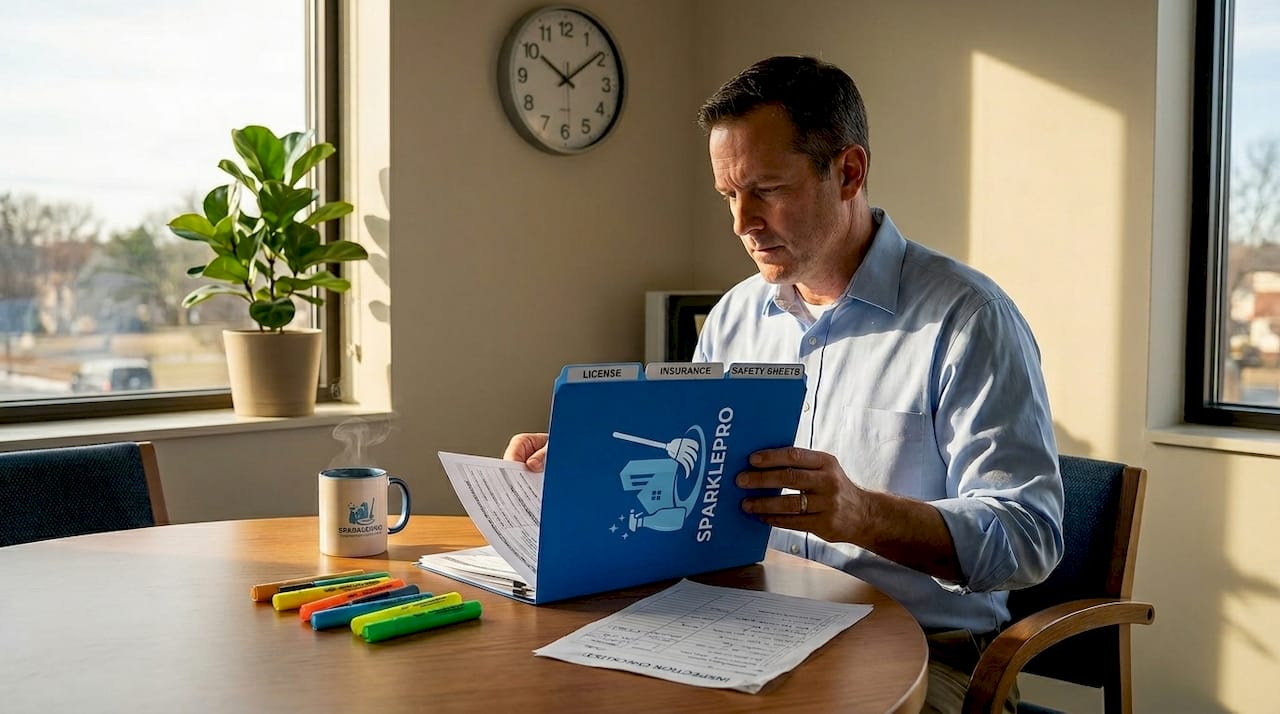
Pro Tip: Build a simple contractor compliance folder for each cleaning vendor. It should hold their license documentation, insurance certificate, chemical register, and training records. Review it at every annual contract renewal, not just at onboarding.
Operational advantages in commercial properties
Beyond credentials, the advantages of licensed cleaning extend into the day-to-day function of your facility in ways that matter operationally, not just legally.
The janitorial cleaning profession has shifted significantly. Trained janitorial work is now a technical discipline, requiring hospital-grade disinfection protocols, specialized equipment operation, and the kind of workforce consistency that affects staff retention and service quality. This evolution means licensed cleaners bring skills to your facility that a day-labor or unlicensed service simply cannot replicate reliably.
Expanded operational roles
Licensed cleaners routinely take on responsibilities that go well beyond scheduled janitorial tasks. Job scopes for licensed cleaning operatives commonly include emergency spill response for body fluids, hazardous materials, and chemical spills. Many also hold keyholding authority and operate building alarm systems, which means they carry genuine security responsibilities during off-hours access.
Comparing licensed vs. unlicensed providers
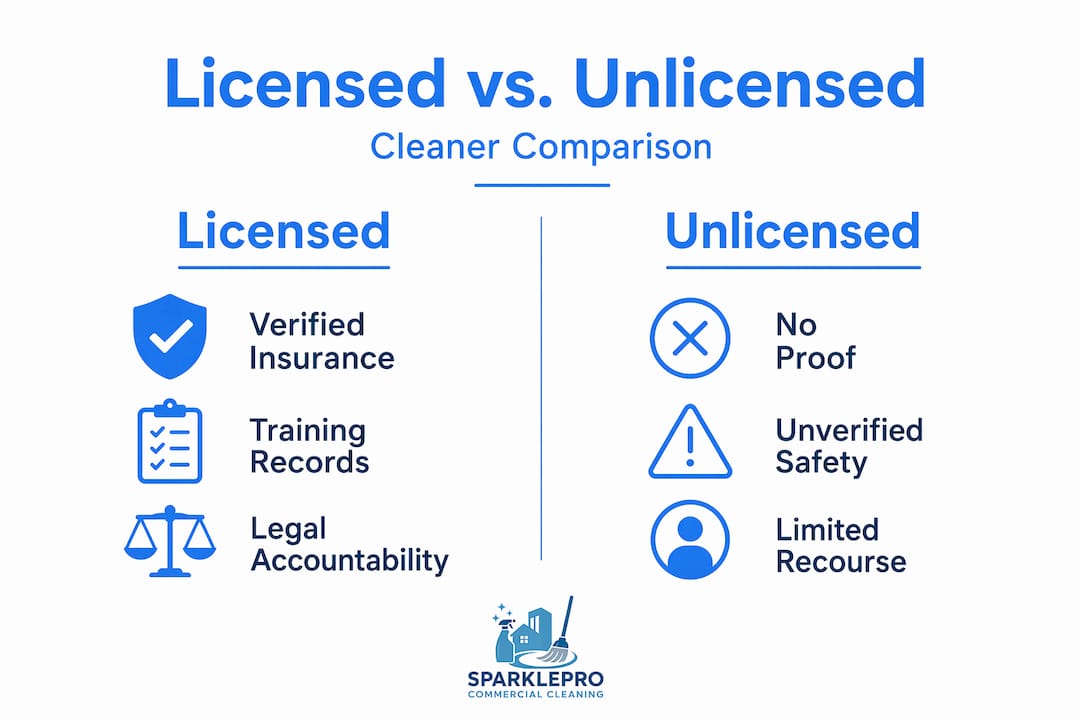
| Criteria | Licensed cleaning company | Unlicensed provider |
|---|---|---|
| Verified credentials | Yes, documentable | Unverifiable |
| Insurance and bond | Required and current | Often absent or lapsed |
| Chemical safety compliance | Trained and documented | Inconsistent at best |
| Emergency response capability | Built into scope | Not typically available |
| Contract accountability | Performance clauses apply | Hard to enforce legally |
| Security access suitability | Screened and bonded staff | Unknown background risk |
- Licensed providers operate under formal contracts with performance benchmarks and remediation clauses if standards are not met.
- Their staff undergo background checks because keyholding and security access demand it.
- Training documentation means you can verify competency, not just assume it.
- They carry the infrastructure to scale services when your facility needs change.
For property managers overseeing multiple buildings or high-traffic commercial environments, these advantages of licensed cleaning translate directly into fewer service failures, faster incident resolution, and cleaner audit trails. You can learn more about how facility cleaning strategies align with operational goals for complex sites.
Choosing and managing a licensed cleaning service
Knowing why hire licensed cleaning companies is one thing. Actually selecting and monitoring the right one requires a defined process.
Start with a structured vetting checklist before any contract is signed:
- Confirm active state registration or licensing and verify directly with the issuing authority
- Request a current certificate of general liability insurance with your facility named as an additional insured
- Obtain their chemical safety register and confirm it covers the specific products they will use on your site
- Ask for training records or a sample training log showing how they document pre-exposure chemical safety training
- Check whether they carry workers' compensation coverage, not just general liability
- Review their emergency response protocols for spills, biological incidents, and after-hours situations
Once a contractor is onboarded, management does not stop at the contract signature. Evaluating cleaning contracts for ongoing quality means scheduling quarterly performance reviews against agreed benchmarks, spot-checking chemical registers when new products are introduced, and confirming that insurance certificates are renewed annually.
Procurement best practices require that you verify not just the company's license but also that their safety documentation is aligned specifically to your site. A generic COSHH register that lists products not used in your facility is not compliant documentation. It is a liability waiting to happen.
Pro Tip: When a licensed cleaning contractor introduces a new product mid-contract, require updated SDS documentation and confirm that any affected staff received fresh training before that product enters your building. This small step closes one of the most common compliance gaps in long-term cleaning contracts.
My honest take on what property managers get wrong
I have worked with property managers across dozens of commercial portfolios, and the pattern I see most often is this: they treat the cleaning vendor decision the same way they treat choosing a landscaping company. Price, availability, maybe a reference. Done.
What I have learned is that this approach works fine until it doesn't. And when it doesn't, it's usually a chemical incident, a workers' comp claim, or a regulatory audit that surfaces the problem. By then, the unlicensed contractor is unreachable and the documentation gaps are yours to defend.
The importance of licensed cleaners is not abstract. It is the difference between a vendor relationship where accountability is shared and enforced versus one where you carry the risk alone. I have seen facility directors face real legal exposure because they assumed the contractor "handled all of that." They did not.
What I respect about the shift happening in this industry is that licensed janitorial work is becoming genuinely skilled and technical. The best licensed cleaners I have worked with bring protocol discipline that rivals any other trades contractor on site. The property managers who recognize this, and pay accordingly, consistently have cleaner buildings, fewer incidents, and far better compliance outcomes.
Stop treating cleaning as a commodity purchase. Treat it as a safety-critical contractor relationship, because legally, that is exactly what it is.
— Sales
Get licensed commercial cleaning that protects your property
When you understand the full role of licensed cleaners, it becomes clear that this is not a decision where cutting corners makes financial sense. The liability, the compliance complexity, and the operational demands of modern commercial facilities require a contractor who brings credentials, documentation, and trained personnel to every site.
Sparkleprocommercialcleaning operates as a fully licensed, bonded, and insured commercial cleaning company serving facilities across the United States, from office buildings and healthcare environments to retail centers and industrial spaces. If your facility is in the Northeast or Mid-Atlantic region, you can explore licensed cleaning services in Massachusetts or review options for commercial cleaning in New Jersey. Every Sparkleprocommercialcleaning contract includes verified compliance documentation, trained operatives, and a service structure built for property managers who need accountability, not guesswork.
FAQ
What does it mean for a cleaning company to be licensed?
A licensed cleaning company has met state-specific registration requirements, which typically include a surety bond, proof of insurance, and registration fees paid to a state authority. In California, for example, janitorial registration is mandatory with annual renewal.
Why hire licensed cleaners instead of independent operators?
Licensed cleaners provide verified documentation, including insurance, training records, and chemical safety registers, that protects building owners from legal and financial liability. Unlicensed operators cannot produce this documentation, leaving you exposed.
Who is responsible for cleaning safety compliance on my property?
You are, even when a contractor performs the work. Property managers retain responsibility for verifying contractor COSHH compliance, training records, and risk assessments under employer duty of care laws.
What insurance should a licensed cleaning company carry?
Most commercial contracts require general liability coverage of at least $1 million per occurrence, plus active workers' compensation coverage for all cleaning staff working on your premises.
How often should I review a cleaning contractor's compliance documents?
Review insurance certificates and chemical safety documentation at every annual contract renewal at minimum. When a contractor introduces new cleaning products mid-contract, require updated Safety Data Sheets and confirm that all relevant staff have completed fresh training before use.