
A green cleaning certification is third-party proof that your cleaning products, service provider, or building program meets a defined environmental and health standard, most commonly Green Seal's GS-42, UL ECOLOGO's UL 2700, ISSA's CIMS, or the criteria referenced by LEED. Commercial, institutional, and healthcare facility managers pursue it to win contracts requiring documented sustainable practices, cut chemical exposure risk, and back up marketing claims with an audit trail instead of a logo. The rest of this guide breaks down which program fits your building, what the process actually costs, and how to prepare for the site visit.
TL;DR:
- Certification demands rigorous documentation, including purchase logs, training records, and SOP adherence, which often outweigh the importance of product selection.
- Green Seal GS-42 certifies service operations and management practices, not individual products, requiring on-site audits to verify actual practices.
- Certification costs include application fees, potential consultant expenses, and ongoing labor to maintain compliance and accurate records.
- Updated standards are tightening chemical restrictions, especially on PFAS and microplastics, and emphasizing better training and documentation.
- Combining product ecolabels like ECOLOGO with service certifications such as GS-42 or CIMS provides a comprehensive green cleaning accreditation, critical for procurement success.
Table of Contents
- What green cleaning certification actually covers
- Green Seal, ECOLOGO, ISSA CIMS, and LEED: what each one actually certifies
- How the certification process works, step by step
- Health, procurement, and marketing value certification actually delivers
- Your implementation checklist before the audit
- Staying certified: what auditors check during renewal
- Comparing rigor, recognition, and industry acceptance
- Where facilities get stuck, and how to get unstuck
- Where the standards are headed
- Why documentation, not products, decides whether you pass
- How Sparkle Pro supports facilities working toward certification
- Sources
What green cleaning certification actually covers
Not every "green" claim means the same thing, and mixing them up costs facility managers time during procurement. A product certification like UL ECOLOGO applies to a specific cleaner or disinfectant. A service certification like Green Seal's GS-42 applies to the janitorial provider or in-house team and how they operate. A program credit, the kind LEED tracks, applies at the building level and often requires both certified products and documented service practices to count.
Auditors across these programs tend to evaluate the same core areas: safer chemical formulations, lower-impact manufacturing or sourcing, water and energy conservation in cleaning operations, and whether staff are actually trained on the procedures they're supposed to follow. That last point trips up more facilities than any product swap.
Certification shows up most often in:
- Class A office buildings competing for tenants who screen vendors on sustainability
- Retail centers and multifamily properties managing high-traffic common areas
- Healthcare and institutional facilities where indoor air quality has regulatory weight beyond marketing
Residential cleaning isn't the target market here. These frameworks are built for commercial and institutional scale, where purchasing records and audit trails matter as much as the products themselves.
Green Seal, ECOLOGO, ISSA CIMS, and LEED: what each one actually certifies
Four names dominate every conversation about green cleaning credentials in the United States, and each one certifies something different.
Green Seal GS-42 certifies the cleaning service, not a single product. It establishes requirements for commercial and institutional cleaning services covering building-specific operating procedures, sustainable purchasing policies, employee training, tenant communication, and equipment standards. A GS-42 audit checks whether your team follows written SOPs, not just whether you bought the right bottle.
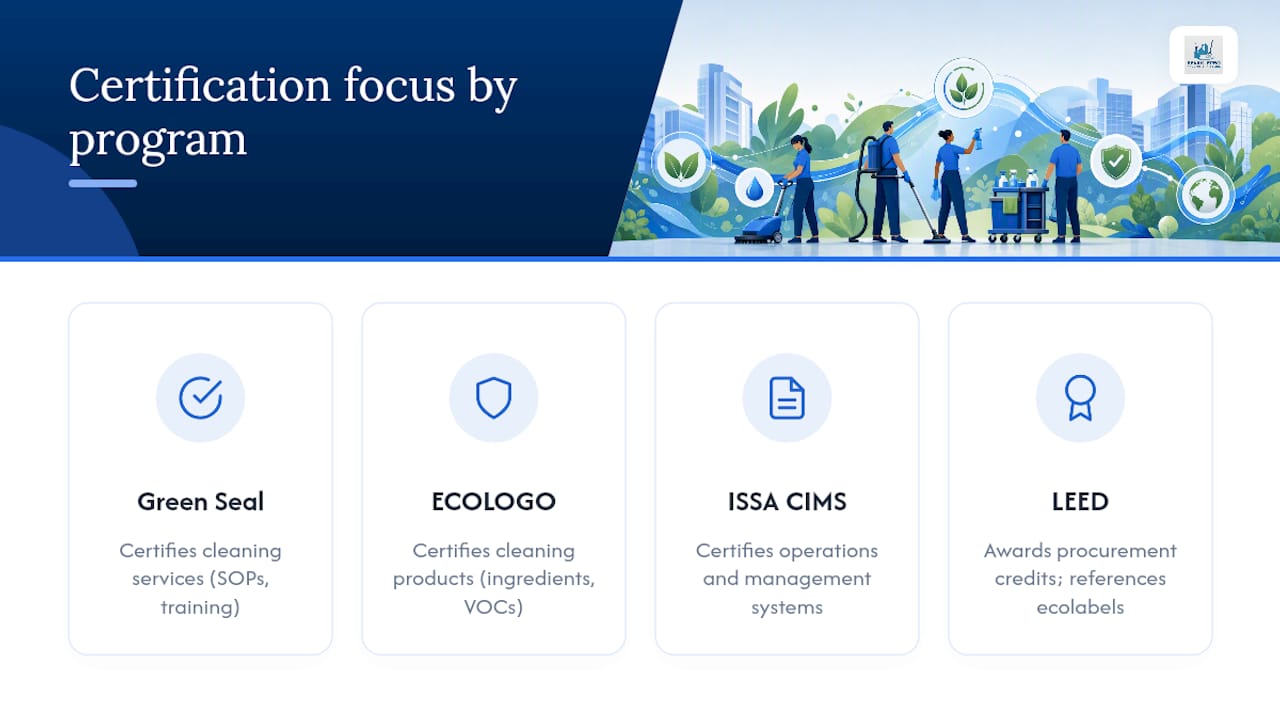
UL ECOLOGO (UL 2700) works at the product level. It sets sustainability and safety criteria for cleaning products, including restrictions on ingredients like PFAS and microplastics, plus updated VOC limits and labeling rules. When a facility manager sees the ECOLOGO mark on a disinfectant or degreaser, that's the standard behind it.
ISSA CIMS (Cleaning Industry Management Standard) certifies operations and management systems, for both contract service providers and in-house custodial departments. ISSA frames it as recognition of environmentally responsible practices built around reduced chemical use, resource conservation, and occupant health, with CIMS acting as the operational backbone.
LEED doesn't issue its own cleaning certification. Instead, USGBC references programs like Green Seal and ECOLOGO to award procurement credits when a building's cleaning products and practices meet defined thresholds.
Here's the practical shortcut: if a property manager is bidding on tenant contracts that specify "certified green cleaning service," look at GS-42 or CIMS. If procurement teams want certified products on the shelf, ECOLOGO does that job. Product ecolabels and service certifications are complementary, not interchangeable, and most LEED-seeking buildings need both.
How the certification process works, step by step
Green Seal's process runs in four stages, and it's a reasonable template for what to expect regardless of which program a facility pursues.
- Prescreen and application. You submit basic information about your operations, service scope, and current products to confirm eligibility before investing further.
- Documentation review. The certifying body examines your written policies, purchasing records, training materials, and standard operating procedures against the standard's requirements.
- Site audit. An on-site visit verifies that what's on paper matches what's happening on the floor, from equipment specs to how staff actually mix and apply products.
- Certification and ongoing monitoring. Once approved, the facility enters a monitoring cycle with periodic reviews to confirm continued compliance.
Pro Tip: Start pulling your purchase orders and training logs before you apply, not after. Auditors weigh documentary evidence heavily, and scrambling to reconstruct six months of records is the single most common source of delay.
Timelines stretch when a facility has multiple locations to audit, incomplete documentation, or products that need substituting mid-review to meet ingredient restrictions. A single-site office building with clean records can move faster than a multi-tenant portfolio still standardizing its supply list.
Costs break into three buckets: application and audit fees paid to the certifying body, consultant or training expenses if you bring in outside help, and the internal labor of maintaining purchasing records and attendance logs, which tends to be the most underestimated line item. That last cost never really goes away. It becomes part of ongoing operations.
Health, procurement, and marketing value certification actually delivers
Facility managers approving a certification budget need more than a green logo to justify it, and the case here is genuinely strong on three fronts.
Health and indoor air quality. Lower-toxicity products paired with trained custodial staff reduce chemical exposure for occupants and cleaning crews alike, a meaningful factor in healthcare and institutional settings where air quality carries regulatory weight, not just tenant preference.
Procurement and contract access. Certification helps purchasing teams meet public procurement requirements and gives your building or service provider a clearer path into RFPs that specify sustainable cleaning as a bid condition. That's not a marketing nicety. For many public-sector and institutional contracts, it's a gate you can't pass through without it.
Operational savings. Consolidating your product list to certified alternatives typically reduces waste and simplifies training, since staff aren't juggling a dozen different chemical protocols across shifts.
Certification also does something subtler: it takes the guesswork out of RFP responses. Instead of describing your practices in prose a skeptical procurement officer has to take on faith, you point to a standard number and an audit date. Read more on why cleaning certifications matter for commercial properties navigating that exact bid process.
Your implementation checklist before the audit
Facilities that pass certification on the first attempt tend to follow a version of this sequence, borrowed from the phased approach state agencies and universities use when rolling out green cleaning programs.
- Write a formal green cleaning policy and name one person accountable for it. Vague ownership is the fastest way to stall a certification effort.
- Audit your current product inventory and map each item against Green Seal or ECOLOGO's approved lists, flagging anything that needs replacing.
- Lock down procurement controls so purchasing can't order off-list products without approval, closing the gap that shows up in most failed audits.
- Schedule staff training, both initial and recurring, and keep signed attendance records. Auditors ask for these first.
- Check your equipment specs. GS-42 requires items like vacuums meeting Carpet and Rug Institute Green Label standards and powered floor equipment with particle capture and decibel limits, specs that get overlooked until audit day.
- Build a documentation binder, physical or digital, with purchase logs, SOPs, and training records organized by date.
This mirrors the phased implementation universities use: groundwork, assessment, product approval, training, then monitoring. A contractor compliance checklist can help structure the documentation side if your facility handles post-construction turnovers alongside routine service.
Staying certified: what auditors check during renewal
Certification isn't a one-time badge. Programs like GS-42 build in periodic monitoring, and the checks during renewal look a lot like the original audit, just with less patience for gaps.
Auditors typically review:
- Product labels against your approved purchasing list
- Purchase order records showing consistent buying from that list
- Training logs with dates, attendees, and topics covered
- Whether SOPs on paper match what staff are doing on the floor
- Equipment condition and specs, particularly vacuum and floor machine standards
The most common finding isn't a bad product choice. It's a paperwork gap: a new hire who never got documented training, or a substitute product purchased during a supply shortage that never got logged. Auditors focus less on marketing claims and more on documentary evidence like purchase orders and training records, which means administrative discipline matters as much as the cleaning itself.
A monthly internal spot check, five minutes reviewing the last few purchase orders and confirming training records are current, catches most of these issues before an external auditor does.
Comparing rigor, recognition, and industry acceptance
Facility managers often ask which certification "counts more," and the honest answer depends on who's reading your RFP response.
Green Seal's GS-42 carries significant weight in public procurement and institutional bids because it certifies the full service operation, not just a product on a shelf. Its on-site audit requirement gives it teeth that a purely paper-based label can't match. UL ECOLOGO, backed by UL's testing infrastructure, carries strong recognition in product specification and is frequently the label procurement teams look for when comparing individual cleaners and disinfectants against each other.
ISSA CIMS occupies a different lane. It's an operations and management standard, so it resonates most with facilities and contractors who want a documented management system rather than a product or single-service label. It's widely respected within the janitorial and building service contractor industry specifically, sometimes more so than among outside procurement officers unfamiliar with ISSA's role in the trade.
LEED doesn't compete with these three. It absorbs them, referencing Green Seal and ECOLOGO criteria to award credits, which means pursuing LEED green cleaning credits without an underlying certification is rarely realistic.
For most commercial facilities, the pragmatic answer isn't picking one. It's pairing a product-level ecolabel with a service-level or management certification, since procurement teams increasingly ask for both and rarely accept one as a substitute for the other.
Where facilities get stuck, and how to get unstuck
The single biggest reason certification efforts stall isn't the standard itself. It's underestimating the documentation burden. Facility teams budget for new products and training sessions, then get blindsided by how much labor goes into keeping purchase logs, attendance sheets, and SOP records audit-ready year-round.
A second common pitfall: partial product transitions. A facility switches most of its cleaners to certified alternatives but leaves a few legacy products in the supply closet, either out of habit or because a specific application (heavy degreasing, for instance) doesn't have a certified equivalent yet. Auditors catch these gaps quickly, and they're one of the more frequent reasons a first application gets sent back for revision.
Multi-site portfolios face their own version of this problem. Standardizing purchasing and training across a dozen buildings run by different property managers takes real coordination, and inconsistency between sites is a recurring audit flag.
The fix for most of this is procedural, not financial: assign one accountable owner, centralize purchasing through an approved vendor list, and treat training documentation as a standing task rather than a pre-audit scramble. Facilities that build these habits into normal operations, rather than treating them as a certification-season project, tend to pass renewal audits with far fewer corrective actions.
Where the standards are headed
Green cleaning certification isn't static, and the direction of change matters if you're planning a multi-year procurement strategy. UL's move to UL 2700 tightened ingredient restrictions on substances like PFAS and microplastics, and updated VOC and labeling requirements, a signal that product-level standards are getting stricter, not looser, as environmental chemistry research advances.
Expect that trend to continue. Regulatory pressure on specific chemical classes rarely reverses once a major certifier moves on it, and facility managers who stick with legacy-approved products risk finding them decertified at the next standard revision.
On the service side, the emphasis on documentation and training is deepening rather than easing. Certifying bodies have leaned harder into audit-based verification over self-reported claims, precisely because greenwashing complaints pushed procurement teams to demand third-party proof. That favors facilities that build strong internal recordkeeping now, since the bar for what counts as sufficient evidence keeps rising.
LEED's reliance on outside certifications like Green Seal and ECOLOGO also means green cleaning requirements will keep evolving in step with whatever changes those programs make, rather than on a separate LEED-specific timeline. Facility managers tracking LEED green cleaning policy updates should watch Green Seal and ECOLOGO's own standard revisions as the leading indicator, since USGBC typically follows their lead rather than setting independent criteria.
Why documentation, not products, decides whether you pass
Most advice on green cleaning certification obsesses over which products to buy. That's the easy part. The harder, less discussed truth is that certification lives or dies on recordkeeping discipline, and facilities that treat it as a procurement project instead of an operational habit tend to fail their first audit or scrape through with corrective actions hanging over them.
The conventional advice, swap your chemicals and you're most of the way there, undersells how much weight auditors put on training logs, purchase records, and SOP execution. A facility with mediocre products but airtight documentation will often outperform one with premium ecolabeled cleaners and sloppy paperwork.
If you're starting from zero, prioritize in this order: name an accountable owner, lock procurement to an approved list, then train staff and log everything. Products come fourth, not first. That sequence runs against instinct, since buying "the green stuff" feels like progress, but it's the sequence that actually survives an on-site audit.
— Sales
How Sparkle Pro supports facilities working toward certification
Sparkle Pro's client process, quote, site visit, scheduled cleaning, and client approval, maps directly onto what certification auditors expect to see: an initial assessment, documented procedures, consistent execution, and sign-off records. That overlap isn't an accident. The same operational discipline that satisfies a property manager also satisfies a Green Seal or CIMS auditor.
For facilities preparing for certification, Sparkle Pro sources approved products, trains custodial staff on documented SOPs, and helps maintain the purchasing and training records auditors request. If your building is weighing certification and wants a site visit to assess where your current program stands, Sparkle Pro serves facilities in Delaware, Massachusetts, and Washington, with nationwide coverage available through Sparkleprocommercialcleaning.
Sources
- GS-42 Commercial and Institutional Cleaning Services - Green Seal
- UL ECOLOGO® Certification for Cleaning Products | UL Solutions
- What Is a Green Cleaning Certification - ISSA