
A completed commercial cleaning job should be approved only when the contractor's completion log, inspection score, timestamped photo evidence, and critical-zone checks all meet the thresholds defined in your contract. That's the acceptance rule. Everything else in this article is the workflow that makes it enforceable.
Before you sign off on any job, confirm these five elements:
- Completion log: Every task on the contracted scope is marked done, with a crew sign-off timestamp.
- Inspection score: The zone-by-zone score meets or exceeds your contract's minimum threshold.
- Photo evidence: Timestamped photos cover restrooms, the entry lobby, high-touch surfaces, and any corrective work.
- Critical-zone checks: Restrooms, food-service areas, and the main lobby pass at or above their zone-specific threshold.
- Open issues: Zero unresolved high-severity deficiencies before approval.
Pass/fail rule: All required tasks completed + inspection average at or above the contract threshold + no open high-severity issues = approved. Any one of those fails, you open a corrective action before releasing payment.
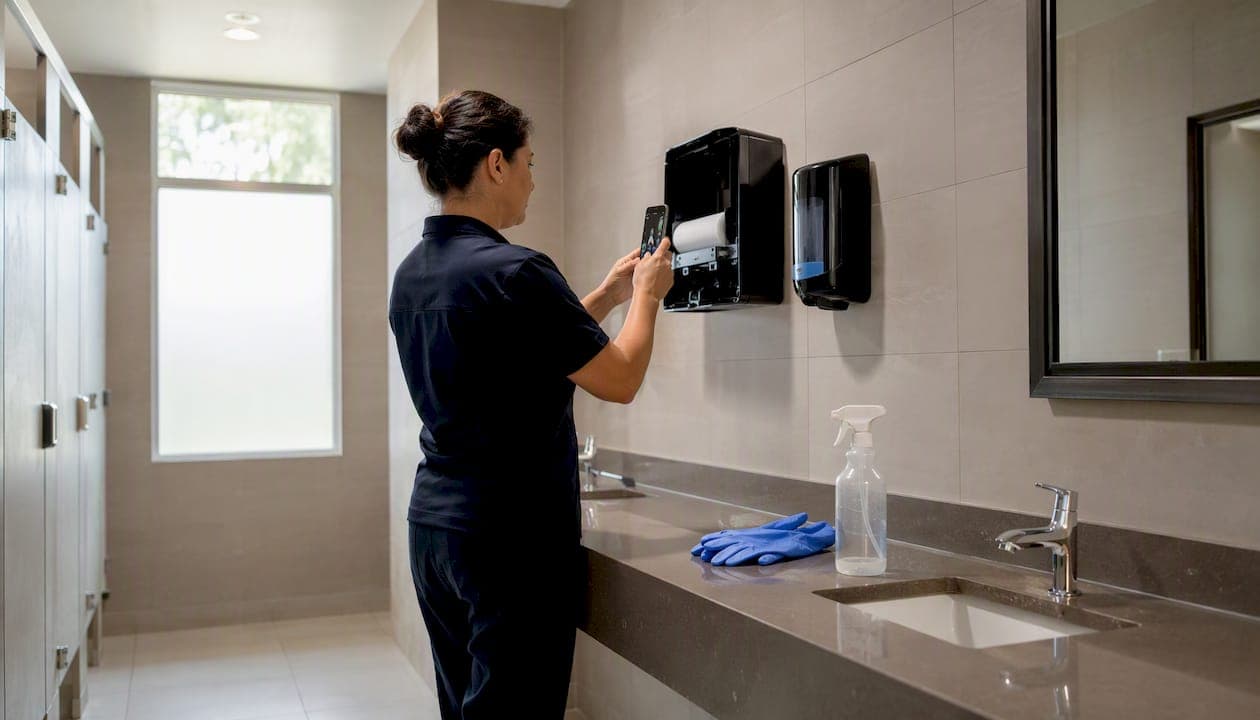
Pro Tip: Photograph the restroom paper dispensers and soap levels on arrival. If they're empty at inspection time, the crew either didn't service them or didn't check before leaving. Either way, that's a corrective action.
Key Takeaways
Approving a commercial cleaning job correctly requires contract-defined KPIs, scored zone inspections, timestamped photo evidence, and a signed documentation package before any payment is released.
| Point | Details |
|---|---|
| Build approval into the contract | Require digital completion reports, photo evidence, and a payment holdback clause before work starts. |
| Use APPA scoring for inspections | Target Level 2 overall; no zone should score below Level 3 on the five-level appearance scale. |
| Track five KPIs weekly | Completion rate and response time first; add inspection score, attendance, and tenant satisfaction as you scale. |
| Require a full documentation package | Completion log, timestamped photos, signed scorecard, and issue log must be attached before invoice approval. |
| Sparkleprocommercialcleaning | Provides contract-ready reporting, digital inspection records, and account management tied to your sign-off process. |
Table of Contents
- How to approve cleaning services before the first crew shows up
- What does a scored on-site inspection actually look like?
- The five KPIs that tell you whether to approve or escalate
- What to collect before you release payment
- Red flags that justify withholding approval
- What the approval process looks like from the contractor's side
- Sparkleprocommercialcleaning handles the reporting so you don't have to
- Sources
How to approve cleaning services before the first crew shows up
The approval process starts in the contract, not on-site. If your statement of work (SOW) doesn't define what "done" looks like, you'll spend every inspection arguing about it.
Require these clauses at minimum:
- Weekly completion reports submitted by the contractor every Monday covering the prior week, with task-level completion data by zone.
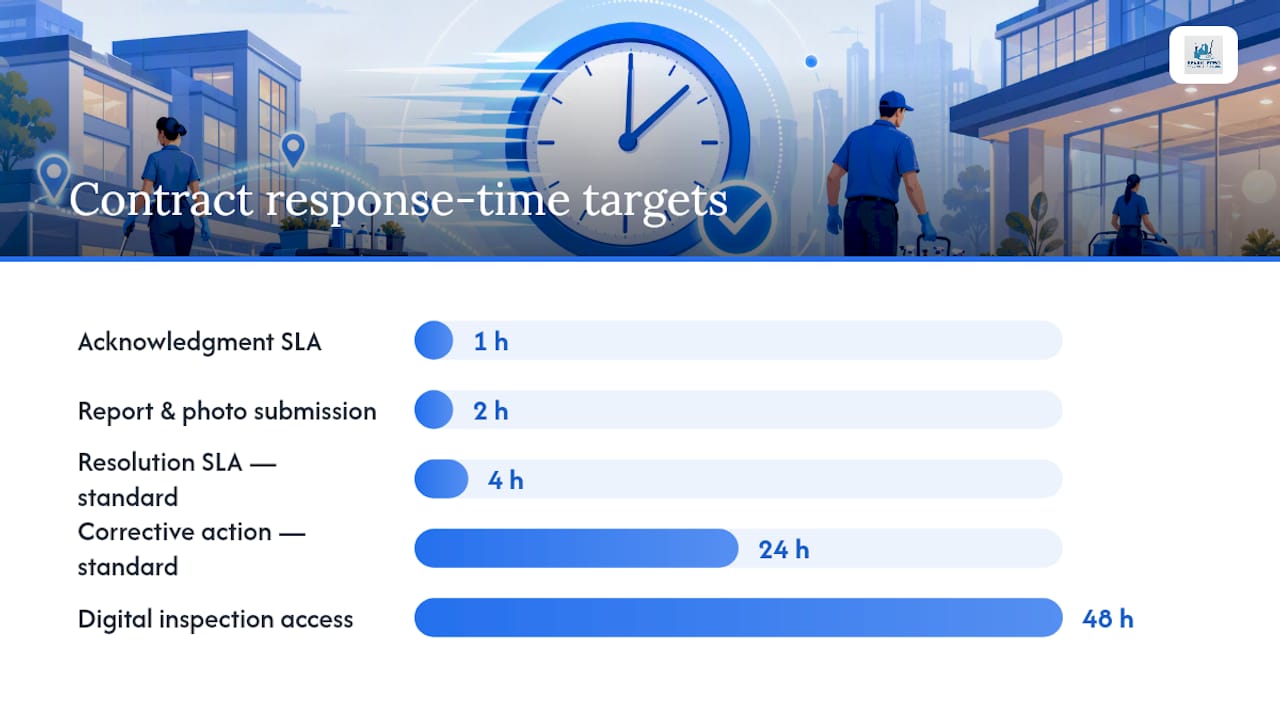
- Digital inspection access: The contractor provides read access to their inspection platform within 48 hours of contract execution.
- Response-time SLAs: Acknowledgment within 1 hour during business hours; standard-issue resolution within 4 hours; urgent issues resolved same-day. These targets come directly from industry performance guidance and belong in the contract verbatim.
- Attendance records: Crew check-in and check-out logs, tied to GPS or NFC, submitted with each invoice.
- Corrective-action windows: Failed items must be remediated within 24 hours for standard deficiencies, 4 hours for critical zones.
- Payment holdback: 10–15% of the invoice held until the signed inspection scorecard and photo package are received.
A sample SOW clause worth pasting in: "Contractor shall submit a digital completion report and timestamped photo package within 2 hours of each service visit. Payment will not be released until the client's designated inspector has reviewed and signed the inspection scorecard."
When a contractor says they use paper only, that's a signal worth taking seriously. Structured digital inspections catch hygiene failures significantly earlier than schedule-only programs, and paper logs can't be audited in real time. Push back: require digital submission or factor the audit cost into your own overhead.
Pro Tip: The single clause that signals operational maturity is dashboard access. A contractor who can give you a live view of their inspection scores has already built the internal QC process. One who can't is likely running on tribal knowledge.
A standardized RFP with scoring across qualifications, scope, pricing, and accountability is also the fastest way to surface whether a vendor actually operates the QC processes they claim during the sales process. Score bidders on each dimension before you sign.
What does a scored on-site inspection actually look like?
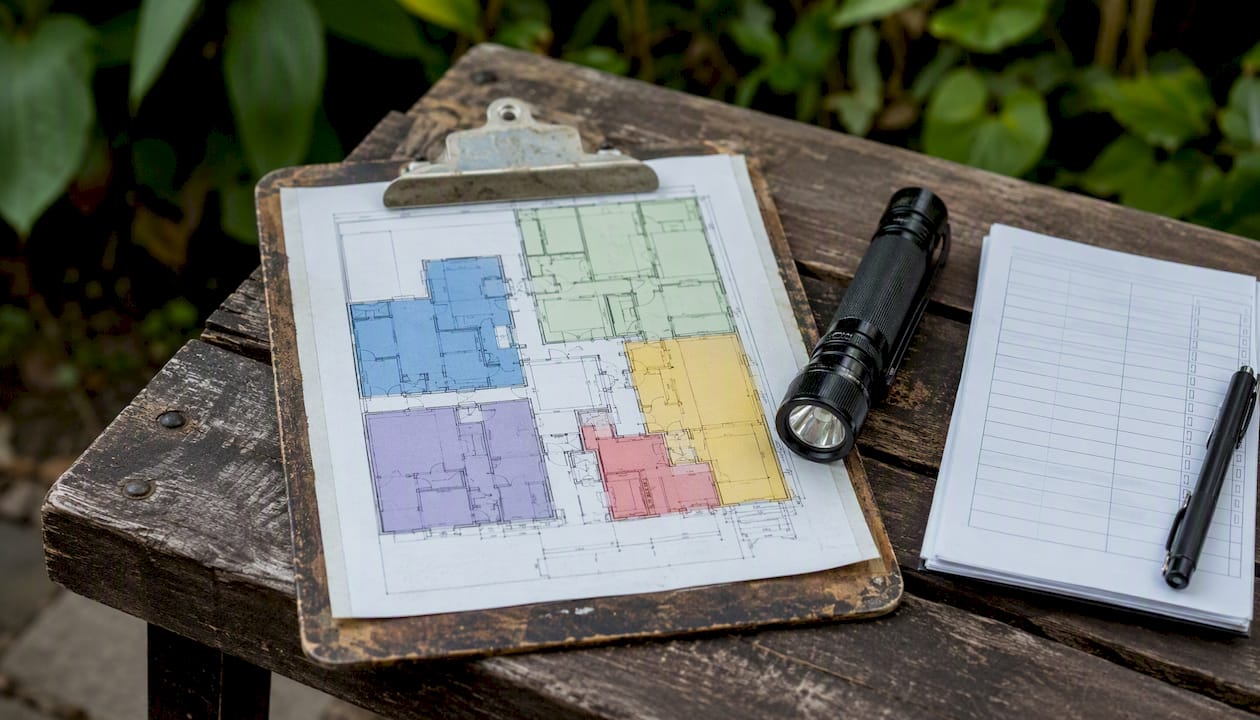
Arrive with the contract's zone checklist in hand. If the job passes, sign off. If it doesn't, open a corrective action before you leave the building.
- Pull the completion log from the contractor's platform or request it on arrival. Confirm every task is marked complete with a timestamp.
- Start with critical zones. Inspect restrooms, the entry lobby, and any food-service areas first. These carry the highest pass thresholds and the shortest remediation windows.
- Score each zone using a 5-level rubric. The APPA appearance level scale is the standard commercial reference: Level 1 is spotless, Level 5 is unacceptable. Target Level 2 overall; no area should score below Level 3.
- Photograph as you go. Capture restrooms (stalls, fixtures, dispensers), lobby floors and glass, high-touch surfaces (door handles, elevator buttons), and any deficiency you're documenting for corrective action.
- Log deficiencies in real time. Note the zone, the issue, the severity (standard vs. urgent), and the timestamp. Don't reconstruct this from memory after you leave.
- Calculate the inspection average. If the score meets the contract threshold and no critical zone is below Level 3, the job passes. If not, issue a corrective work order before leaving.
- Verify corrective work. For any re-service required, schedule a follow-up check within the remediation window and photograph the resolved item.
Zone-based pass thresholds with corrective-action triggers let you set different remediation windows by area. Restrooms, for example, warrant a higher pass threshold and immediate re-service for low scores. Entry lobbies can tolerate a slightly longer window. Define these in the contract, not during the inspection.
Rotate which zones you inspect each week, and you'll have full coverage across the building within a month without spending three hours on-site every time.*
The five KPIs that tell you whether to approve or escalate
Start with two: completion rate and response time. They're leading indicators. Tenant complaints are lagging. By the time a tenant files a complaint, the problem has existed for days.
| KPI | Target | Data Source |
|---|---|---|
| Completion rate | high percentage of contracted tasks completed per visit | Contractor's digital completion log |
| Response time | Acknowledgment within 1 hour; resolution within 4 hours (standard); same-day (urgent) | Contractor's issue tracker |
| Inspection score | Level 2 average; no zone below Level 3 | Inspector's scored checklist |
| Attendance consistency | high proportion of scheduled shifts covered | Contractor's crew attendance log |
| Tenant satisfaction | No open complaints; survey score at or above contract threshold | Tenant survey or property management system |
These five KPIs cover roughly 90% of what matters when measuring a cleaning contractor. Add inspection score and attendance once your completion rate and response time are consistently on target. Tenant satisfaction rounds out the picture.
Keep the weekly scorecard review to 15 minutes. One row per building, five columns, one decision: approve, flag, or escalate. Automate the data pull from the contractor's platform if possible.
Pro Tip: Facility cleaning KPIs work best when the contractor owns the data collection and you own the audit. Your job is to define the targets and verify the numbers, not to build the reporting from scratch. A contractor who can't produce this data independently is a liability.
What to collect before you release payment
Require a single documentation package for every approval:
- Completion log with task-level timestamps
- Timestamped, GPS-tagged photos (restrooms, lobby, high-touch surfaces, corrective work)
- Signed inspection scorecard with zone scores and overall average
- Issue log with each deficiency, severity, resolution timestamp, and re-service photo
- Crew attendance records tied to the service visit
Using one inspection checklist across post-clean spot checks, joint walkthroughs, and monthly SLA reviews keeps issues, corrective actions, and sign-off in a single auditable record. Don't split these across email threads and spreadsheets.
Sign-off template (paste into your SOW or use as a standalone form):
Store the completed package in your property management system or a shared drive folder named by property and service date. Attach it to the corresponding invoice before payment is processed. Retain records for a minimum of two years, or longer if your lease agreements require it.
Pro Tip: Tie the sign-off form directly to your invoice approval workflow. If the documentation package isn't attached, the invoice doesn't move forward. That single process change eliminates most payment disputes.
Red flags that justify withholding approval
Withhold approval immediately if evidence is missing, a critical zone scores below the contract threshold, or an urgent safety or health hazard is unresolved.
Specific red flags to watch for:
- No photo evidence submitted with the completion report
- Paper-only logs with no timestamps or crew signatures
- Repeated inspection failures in the same zone across two or more consecutive visits
- Crew attendance below 98% of scheduled shifts
- Unresolved urgent issues carried over from a prior visit
- Contractor unable or unwilling to provide digital reports
When you hit one of these, the escalation flow is straightforward:
- Issue a corrective work order within 2 hours of the inspection, specifying the zone, the deficiency, and the remediation deadline.
- Request an account manager walkthrough within 24 hours if the issue is systemic or repeated.
- Send formal written notice if the same deficiency appears in two consecutive inspections. Reference the contract clause and the specific SLA breach.
- Apply contractual remedies if the formal notice doesn't produce resolution: activate the payment holdback, reduce the invoice by the value of the unperformed work, or initiate termination per the contract's cure-period terms.
Document every step. The corrective work order, the walkthrough notes, the formal notice, and the contractor's response all belong in the property file.
Pro Tip: A contractor who resists measurement isn't hiding incompetence. They're hiding accountability. Document the refusal in writing, reference the contract clause requiring digital reporting, and escalate per the remediation timeline. That paper trail protects you if the relationship ends.
What the approval process looks like from the contractor's side
The checklists and digital evidence requirements described here aren't bureaucratic overhead. They're what separates a professional cleaning operation from one that runs on good intentions. At Sparkleprocommercialcleaning, we require completion logs, timestamped photo packages, and scored inspections before we consider a job closed on our end. The most common friction during new-account stabilization isn't a dirty building. It's a gap between what the contract says and what the crew was briefed to deliver. That gap closes within the first 30–90 days when both sides are working from the same scored checklist and the same remediation timeline. Disputes drop sharply once the evidence standard is established.
Sparkleprocommercialcleaning handles the reporting so you don't have to
Property managers who've built this approval workflow from scratch know the real cost: hours spent chasing completion logs, reconstructing photo evidence, and arguing over what "clean" means without a scored baseline.
Sparkleprocommercialcleaning delivers contract-ready reporting, digital inspection records, and dedicated account management that handles the acceptance workflow on your behalf. Every service visit comes with a timestamped photo package, a completion log, and a scored inspection tied directly to your sign-off process. No paper logs, no chasing the crew for documentation. For property managers in Massachusetts and across the country, that means faster approvals, cleaner audit trails, and payment disputes that don't happen. Request a quote and get a site visit scheduled this week.
Sources
- How to Measure Cleaning Contractor Performance | CleanLog
- Janitorial Quality Inspection Checklist for Facility Cleaning Audits
Stat to know: Facilities using structured inspection scoring catch hygiene failures significantly earlier than programs relying on schedule completion alone, and digital tools can improve cleanliness scores by up to 25% versus paper-based verification.