

Customer approval in cleaning is the formal process where a client verifies and endorses the quality of work delivered before a service cycle closes. This step is not a courtesy. It is the mechanism that separates consistent commercial cleaning operations from ones that lose clients quietly. 92% of potential commercial clients research cleaning services online before making a decision. That number tells you exactly how much your reputation depends on documented, verifiable proof of quality. For business owners and property managers, understanding why customer approval matters is the first step toward building cleaning contracts that last.
Why customer approval in cleaning defines service quality
Customer approval is the industry term for client sign-off, the structured confirmation that cleaning tasks were completed to the agreed standard. It is not the same as a casual "looks good" at the end of a walkthrough. Formal approval creates a documented record that protects both the property manager and the cleaning provider.
Quality checklist automation with photo verification increases client trust by proving tasks were completed as promised. Paper checklists are unreliable because they depend on memory and honesty without accountability. Digital tools generate timestamped photo reports that show exactly what was cleaned, when, and by whom. That level of documentation removes ambiguity from every service visit.

Structured approval also prevents disputes. When a property manager receives a photo-verified completion report before being asked to sign off, they are reviewing evidence rather than relying on assumption. This psychological shift is significant. Customer approval functions as reassurance confirming custodianship of premises, using photo-verified reports to build confidence before soliciting feedback.
The operational benefits extend further than dispute prevention. Approval processes create a feedback loop that surfaces inconsistencies before they become patterns. A missed restroom on one visit is a minor issue. The same miss across six visits without a feedback mechanism becomes a contract termination.
Pro Tip: Frame the approval request as a reassurance check, not an inspection. Tell clients the report confirms their facility was cared for exactly as agreed. That framing increases response rates and reduces the perception of surveillance.
Here is how automated approval compares to traditional sign-off methods:
| Method | Documentation | Dispute protection | Feedback speed |
|---|---|---|---|
| Verbal sign-off | None | Low | Immediate but unrecorded |
| Paper checklist | Minimal | Moderate | Delayed |
| Digital photo report | Full | High | Real-time |
| Automated approval workflow | Full with routing | Highest | Instant with escalation |
Why timely feedback after cleaning determines retention
Timing is the most underestimated variable in client feedback. Sending approval prompts within 2–4 hours post-service captures more accurate and actionable feedback than sending surveys the next day or later. Clients remain in a task-completion mindset immediately after a service visit. That mindset produces specific, relevant responses rather than vague impressions recalled hours later.
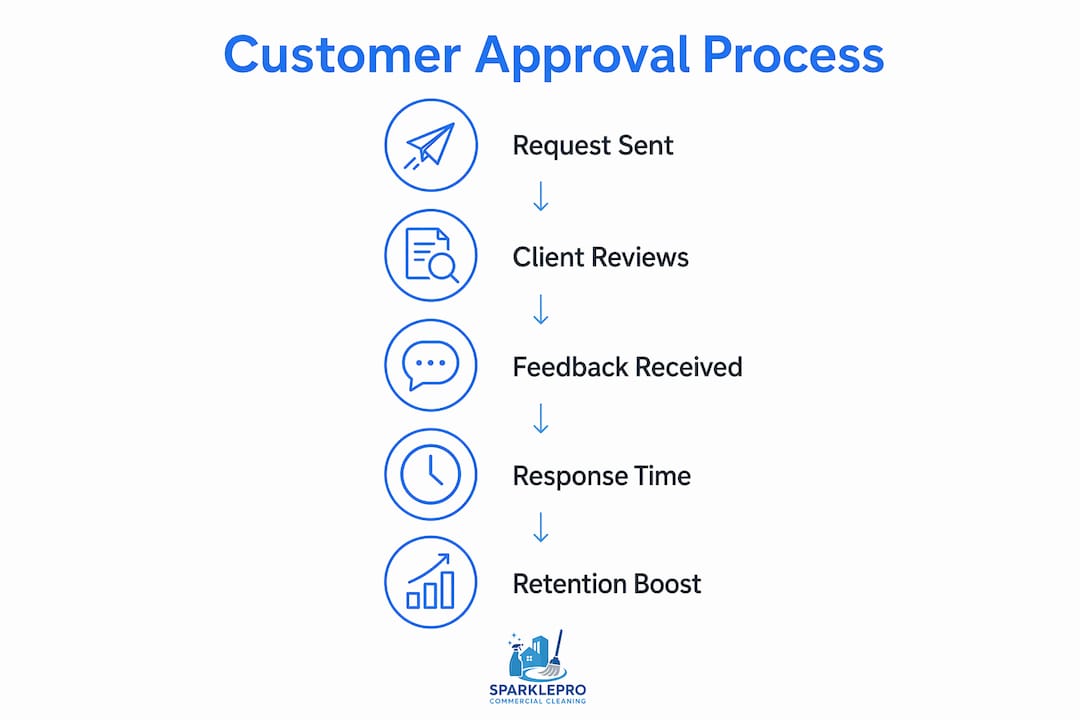
The practical implication is direct. A property manager who walks through a freshly cleaned office and receives a feedback prompt within two hours will respond with concrete observations. The same manager receiving that prompt the following morning is responding from memory, which is less reliable and less useful.
Three timing principles define an effective post-service approval process:
- Send the approval prompt within 2–4 hours of service completion. This window captures peak engagement and task-completion mindset accuracy.
- Keep the approval request to three questions or fewer. Long surveys reduce completion rates. Ask about overall satisfaction, one specific area, and whether any issue needs attention.
- Automate the routing based on the response. Automated two-path approval workflows direct satisfied clients to public reviews and route dissatisfied ones to private complaint channels. This approach improves review volume and recovery rates without violating review platform policies.
Speed of response to negative feedback matters equally. 76% of customers report that a quick response to complaints within 24 hours improves their perception of the cleaning provider. That statistic means a single fast, professional response to a complaint can reverse a client's negative impression before it becomes a cancellation.
Pro Tip: Automate your approval workflow so prompts go out without manual intervention. Automation removes the human delay that kills feedback volume. Even a two-hour delay caused by a busy supervisor cuts response rates significantly.
How customer approval builds trust and reduces client churn
58% of clients churn due to poor communication or inconsistent service. That figure is the clearest argument for formalizing approval processes in any commercial cleaning contract. Most of those departing clients never explain why they left. They simply stop booking.
This is the problem of silent churn. Silent churn occurs when clients quietly stop booking due to unresolved minor issues that were never communicated. Proactive approval and feedback processes surface these issues before they compound. A client who flags a missed area through a structured approval form gives the provider a chance to fix it. A client who says nothing and cancels gives no chance at all.
"Customer approval bridges operational delivery and contract longevity by shifting the client-provider relationship from transactional to transparent partnership." — Facilitate Magazine
Trust is the strongest loyalty driver in commercial cleaning. 73% of repeat customers cite trust and transparency as the top reasons they stay with a cleaning provider. Consistent service quality and structured communication are what build that trust over time.
The benefits of a formal approval process for client retention include:
- Visible accountability. Clients see that every visit is documented and reviewed, not just assumed to be complete.
- Early issue detection. Approval forms catch minor problems before they escalate into contract disputes.
- Relationship depth. Regular structured communication shifts the dynamic from vendor to partner.
- Referral generation. Clients who trust their provider actively recommend them. 85% of commercial clients rely on Google Reviews to assess reliability, and satisfied clients with a clear path to leave a review do so at higher rates.
Negative feedback handled correctly within 24 hours frequently results in increased client loyalty, turning dissatisfied clients into advocates. Prompt and professional issue resolution signals true partnership rather than just vendor compliance.
Practical steps to implement customer approval in commercial properties
Property managers and business owners who want to formalize approval processes do not need to overhaul their operations. The steps below integrate into existing cleaning workflows without adding significant overhead.
-
Set clear expectations before the first service visit. Define what "complete" looks like for each area of the property. Attach this definition to the cleaning contract so both parties agree on the standard before work begins. A well-structured cleaning contract removes the subjectivity that causes disputes later.
-
Establish a communication protocol for every visit. Decide in advance who receives the completion report, how quickly they will receive it, and what the escalation path is for issues. This protocol should be written into the service agreement.
-
Deploy a digital approval tool that sends prompts automatically. Manual follow-up is inconsistent. Automation removes the dependency on individual staff members remembering to send feedback requests. The 2–4 hour window is only achievable with automation.
-
Handle negative feedback within 24 hours, every time. Assign a specific person to own complaint responses. That person should acknowledge the issue, confirm the corrective action, and follow up after the next service visit to confirm resolution.
-
Review approval data monthly to identify patterns. A single complaint is an incident. The same complaint appearing across multiple clients or locations is a process failure. Monthly review of approval data turns individual feedback into operational intelligence.
Pro Tip: When onboarding a new commercial client, send a sample approval report before the first service visit. Showing clients what they will receive builds confidence immediately and sets the standard for every visit that follows.
The cleaning benefits for commercial property managers extend well beyond a clean facility. Structured approval processes protect the property manager's reputation with building owners, tenants, and occupants who expect consistent standards.
Key Takeaways
Customer approval in commercial cleaning is the single most effective tool for reducing churn, building client trust, and generating referrals from satisfied clients.
| Point | Details |
|---|---|
| Formal approval prevents disputes | Photo-verified digital reports create documented proof that tasks were completed as agreed. |
| Timing determines feedback quality | Approval prompts sent within 2–4 hours post-service capture more accurate and useful client responses. |
| Silent churn is the biggest threat | 58% of clients leave due to poor communication, and most never explain why before canceling. |
| Trust drives loyalty and referrals | 73% of repeat clients cite trust and transparency as the top reasons they stay with a provider. |
| Automation scales the process | Automated two-path workflows increase review volume and route complaints to private channels for fast resolution. |
The approval step most cleaning contracts skip entirely
Working with commercial property managers across multiple facility types, the pattern is consistent. The contracts that fail are not the ones with bad cleaning. They are the ones with no structured communication after the cleaning ends. The provider assumes the client is satisfied because no one complained. The client assumes the provider does not care because no one asked.
That gap is where contracts die. I have seen property managers switch providers after years of adequate service simply because a competitor offered a structured approval process that made them feel seen. The cleaning quality was comparable. The communication was not.
The fear of negative feedback is real, and it leads providers to avoid asking altogether. That is the wrong calculation. Structured feedback processes discover hidden dissatisfaction and enable recovery before churn occurs. The client who tells you about a problem is giving you a gift. The one who says nothing and leaves is not.
Technology has removed most of the friction from this process. Automated approval workflows, digital photo reports, and timed survey prompts require minimal setup and run without daily management. The providers who resist automation are the ones still relying on verbal sign-offs and hoping for the best. That approach does not scale, and it does not build the kind of trust that generates referrals.
My honest advice: treat the approval step as the most important part of your service delivery, not an afterthought. The cleaning itself is the product. The approval process is the proof.
— Sales
Sparkleprocommercialcleaning's approach to client approval and quality
Sparkleprocommercialcleaning builds customer approval directly into its four-step service process, from the initial quote through scheduled cleaning to formal client sign-off. Every service visit is designed to produce documented proof of completion, not just a clean facility.
Property managers in Delaware, Massachusetts, New Jersey, and Washington rely on Sparkleprocommercialcleaning for commercial cleaning in Delaware that includes structured reporting and client communication at every stage. The process is built to give property managers and building owners the transparency they need to hold cleaning standards accountable. If you manage a commercial facility and want a cleaning partner that treats approval as a core service step, Sparkleprocommercialcleaning is ready to show you what that looks like in practice.
FAQ
What is customer approval in cleaning services?
Customer approval in cleaning is the formal process where a client reviews and confirms that cleaning tasks were completed to the agreed standard. It typically involves a digital completion report, photo verification, and a structured feedback prompt sent after each service visit.
Why does the timing of feedback requests matter?
Approval prompts sent within 2–4 hours of service completion capture more accurate responses because clients are still in a task-completion mindset. Surveys sent the following day rely on memory and produce less specific, less useful feedback.
How does customer approval reduce client churn?
58% of clients leave cleaning providers due to poor communication or inconsistent service. Structured approval processes surface minor issues before they compound, giving providers the chance to resolve problems before a client decides to cancel.
What is silent churn in commercial cleaning?
Silent churn occurs when clients stop booking without explaining why, usually because minor unresolved issues accumulated over time. Proactive approval and feedback processes prevent silent churn by creating a channel for clients to report issues before they decide to leave.
How can property managers implement a customer approval process?
Property managers should define service standards in the contract, deploy a digital tool that sends approval prompts automatically within 2–4 hours of each visit, and assign a specific person to respond to any negative feedback within 24 hours. Monthly review of approval data identifies patterns that require operational changes.