
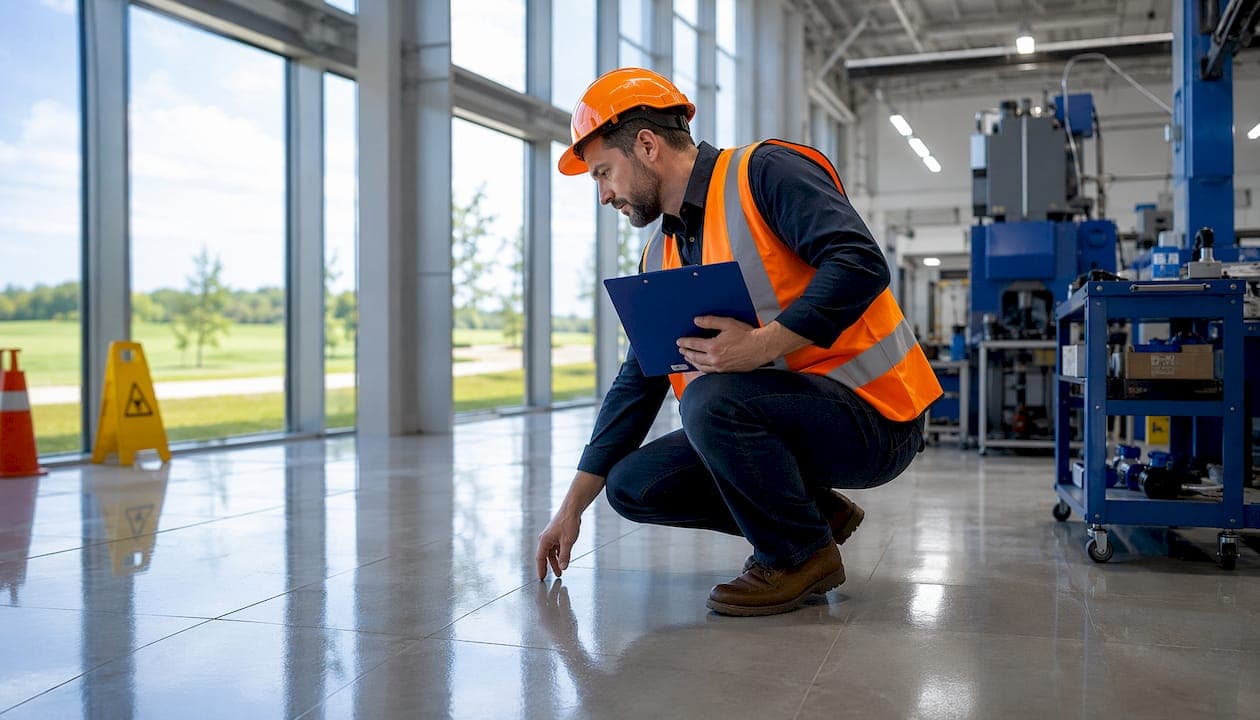
Cleaning your manufacturing floors prevents slip-and-fall injuries, reduces equipment wear, lowers contamination risk, and keeps you on the right side of OSHA 1910.22. Those four outcomes alone justify a formal floor-care program at any plant.
The top operational reasons to clean your facility floors:
- Slip and fall prevention: Wet, oily, or debris-covered floors are the leading cause of workplace injuries in manufacturing environments.
- Equipment reliability: Abrasive dust and grit accelerate bearing and wheel wear, cutting uptime and raising energy costs.
- Product quality: Floor dust redistributes into the air and onto surfaces, creating contamination vectors that compromise finished goods.
- Regulatory compliance: OSHA 1910.22 requires employers to maintain walking and working surfaces in a clean, dry, and sanitary condition.
TL;DR for your next safety meeting: Clean floors reduce injuries, protect equipment, safeguard product quality, and satisfy OSHA. Budget and schedule accordingly.
Table of Contents
- Why clean manufacturing facility floors: the full operational case
- What floor type you have changes everything about how you clean it
- Matching the soil to the right removal method
- How to build an industrial floor maintenance program that actually holds
- Safety protocols and compliance when cleaning industrial floors
- How to choose cleaning equipment and chemicals without getting sold the wrong thing
- The ROI case: what regular floor cleaning actually saves you
- Your implementation checklist: daily, weekly, monthly, and spill response
- Key Takeaways
- The operational pitfalls most plant managers learn the hard way
- When Sparkleprocommercialcleaning makes more sense than in-house cleaning
- Authoritative sources and further reading
Why clean manufacturing facility floors: the full operational case
The safety argument is the easiest to make, but it is not the only one. Clean floors deliver measurable gains across four distinct operational areas, and each one has a dollar figure attached.
Safety. According to the National Floor Safety Institute, floors cause roughly two million slip-and-fall injuries each year in the United States, with wet surfaces among the most common causes in workplace settings. Slip-and-fall incidents translate directly into lost workdays, workers' compensation claims, and OSHA recordables. One critical nuance: the cleaning operation itself can create hazards if floors are left wet or cords are left unsecured. The HSE's Watch Your Step campaign makes this explicit. Effective programs leave floors clean and dry.
Maintenance and equipment life. Dust and grit that accumulate on floors migrate into bearings, conveyor rollers, and HVAC intakes. SKF's bearing performance research shows that cleaner environments reduce the abrasive contamination that accelerates bearing wear and degrades energy efficiency. A plant that sweeps and scrubs consistently spends less on replacement parts and scheduled downtime than one that treats floor cleaning as optional.
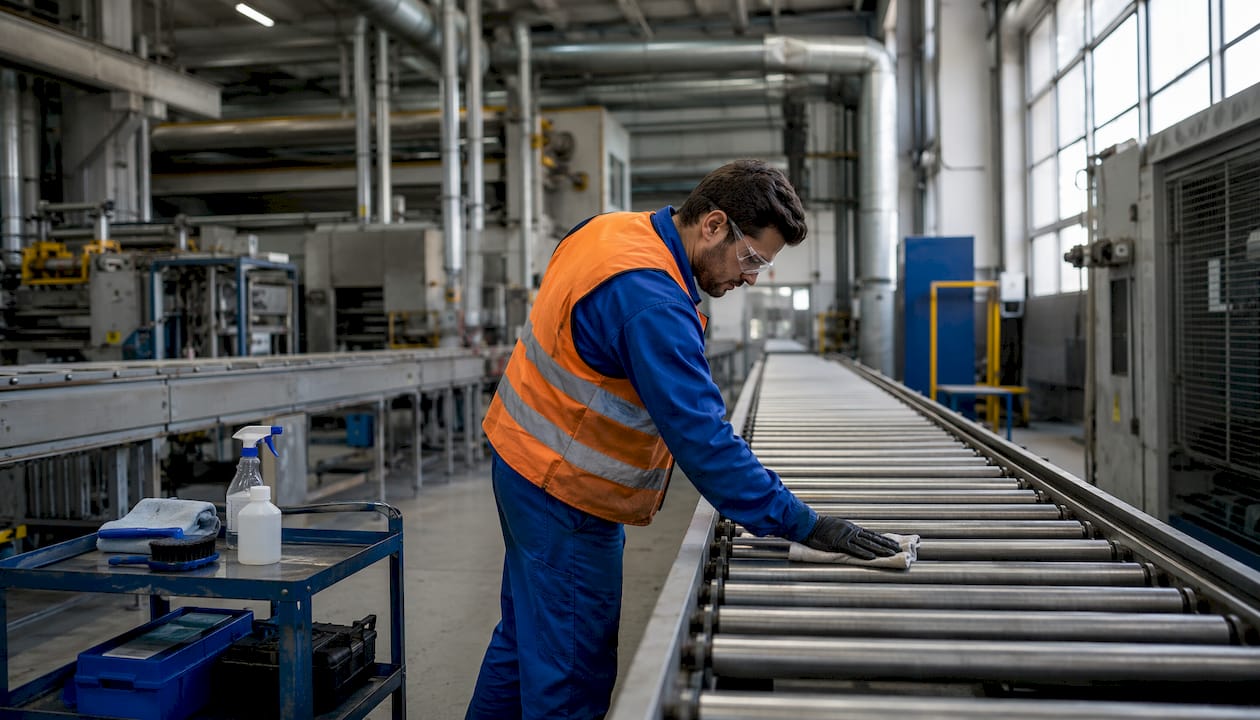
Product quality and contamination control. Floors are among the most contaminated surfaces in any building, yet they are routinely overlooked as a contamination source. Research published in PMC demonstrates that walking over contaminated flooring aerosolizes infectious particles to heights where respiration is possible. In food processing, pharmaceutical, and electronics manufacturing, that is not a theoretical risk. It is a quality-control failure waiting to happen.
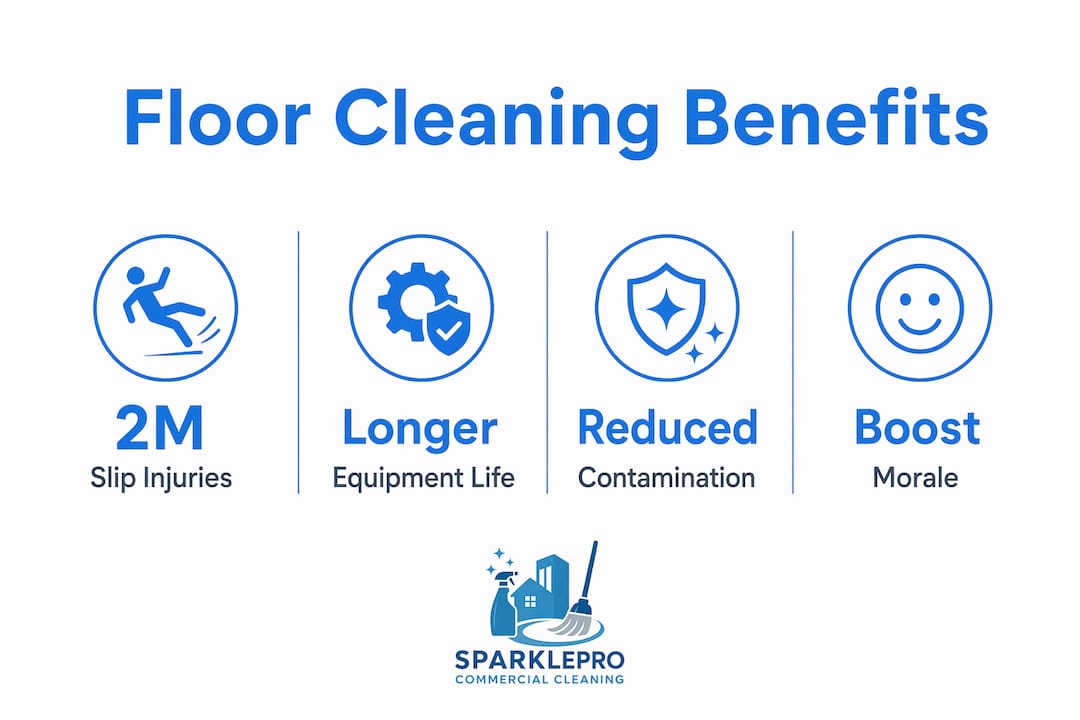
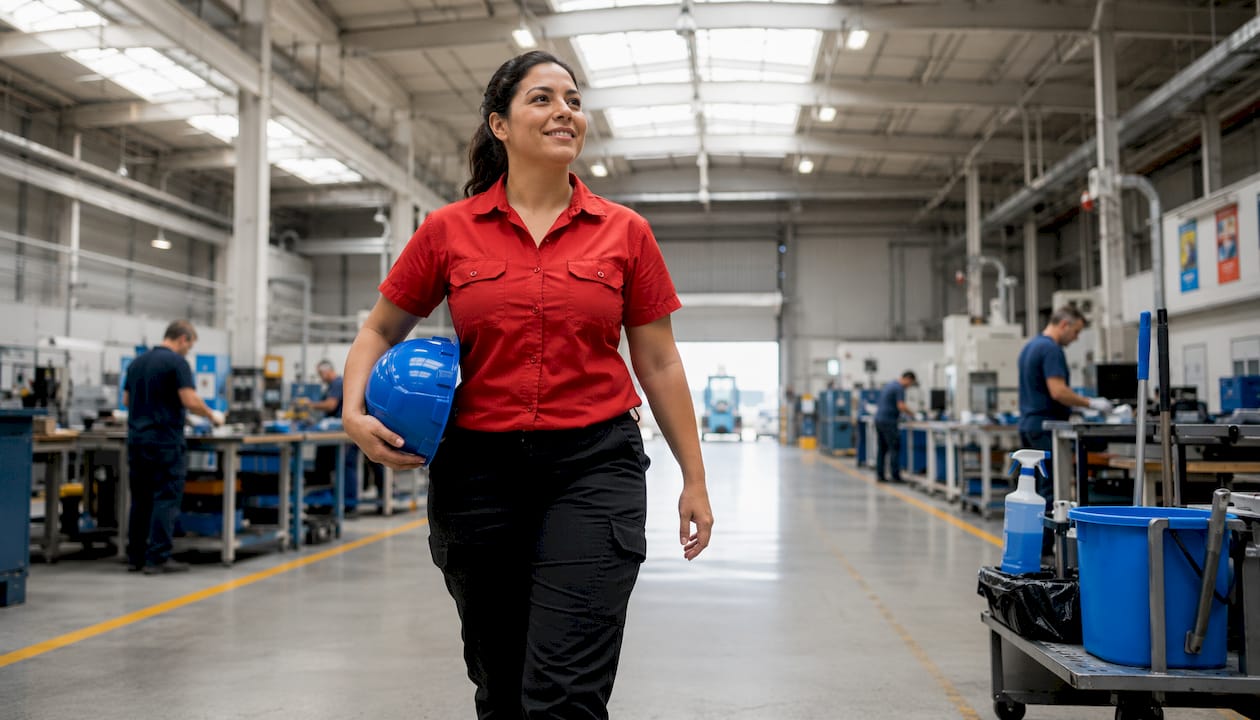
Workforce morale and perception. A visibly clean facility signals to workers that management takes safety seriously. Contractors, auditors, and customers who tour your plant form immediate impressions from the floor up. A grimy floor does not just look bad; it raises questions about what else is being neglected.
What floor type you have changes everything about how you clean it
The wrong cleaning method on the wrong floor shortens surface life, voids coatings warranties, and can actually reduce slip resistance. Here is how the most common industrial floor types differ.
| Floor Type | Primary Vulnerabilities | Recommended Cleaning Approach |
|---|---|---|
| Unsealed concrete | Porosity, dust generation, staining | Daily dry sweep or industrial vacuum; periodic scrubber with neutral-pH detergent; seal cracks promptly |
| Epoxy-coated | UV yellowing, chemical attack, delamination at edges | Soft-bristle scrubber; avoid harsh acids or high-alkaline degreasers; rinse thoroughly |
| VCT (vinyl composition tile) | Grout-line buildup, finish degradation | Damp mop with neutral cleaner; strip and recoat finish annually or as needed |
| Cleanroom / ESD flooring | Particle generation, static buildup, chemical sensitivity | Dedicated mop heads; deionized or filtered water; validated cleaning agents only |
| Quarry tile | Grout porosity, slip resistance loss from grease | Hot-water scrubber; degreaser on grout lines; test friction coefficient after cleaning |
Common concerns across all types:
- Harsh acids strip epoxy and damage grout, reducing slip resistance over time.
- Leaving any floor wet after cleaning trades one hazard for another.
- High-alkaline cleaners on VCT can soften the tile and accelerate wear.
- Cleanroom floors require validated agents; using an unapproved product can compromise certification.
Pro Tip: Before switching cleaning chemicals or methods on any floor, test on a 10-square-foot area and measure the coefficient of friction (COF) before and after. A COF below 0.5 on a dry surface is a slip hazard under OSHA guidance. Document the result and keep it in your maintenance log.
Matching the soil to the right removal method
Every manufacturing floor has a predictable soil profile. Knowing what you are dealing with before you send a crew in prevents rework, surface damage, and new hazards.
Common soils by source:
- Process spills: Oils, hydraulic fluid, coolants, and chemical films from machining or assembly operations. These appear near equipment and workcells.
- Tracked-in grit: Sand, gravel, and metal fines carried in on footwear or forklifts. Concentrated near entry points and loading docks.
- Airborne fines: Metal dust, wood dust, and powder coating particles that settle on horizontal surfaces throughout the shift.
- Biological residues: Food processing and some pharmaceutical environments add organic soils that require sanitizing agents, not just detergents.
The correct removal sequence follows a clear logic: remove loose debris first, then treat the soil, then recover the liquid. Best-practice industrial floor cleaning runs: dry sweep or vacuum loose debris → apply the correct detergent for the soil type → scrub with appropriate pads → rinse and recover → squeegee and dry. Skipping the dry sweep and going straight to a wet scrubber pushes grit into the cleaning solution and redeposits it.
Equipment to consider:
- Walk-behind or ride-on auto-scrubbers for large open areas (choose brush type based on floor hardness and soil type)
- Industrial wet/dry vacuums for debris near machinery where a scrubber cannot reach
- Dry-steam units for grease-heavy areas where chemical use needs to be minimized
Pro Tip: For spot-cleaning oily spills during a shift, use absorbent granules first, sweep them up, then apply a degreaser to the residue and dry the area before reopening it to foot traffic. Mopping an oily spill with water spreads it and creates a larger slip zone.
How to build an industrial floor maintenance program that actually holds
A floor-care program without assigned ownership fails within weeks. The structure below gives you the bones; adapt it to your shift patterns and zone layout.
Program components:
- Zone mapping. Divide the facility into cleaning zones based on soil risk (high-traffic aisles, process areas, loading docks, offices). Each zone gets a frequency and a responsible party.
- Role assignments. Operators handle immediate spill response. The cleaning crew handles scheduled sweeping and scrubbing. Shift leads verify completion and sign off on the log.
- Escalation path. Define what triggers a call to a professional service: a contamination incident, a COF reading below the threshold, or a deep-clean requirement ahead of an audit.
Sample schedule:
- Daily: Dry sweep all aisles and work areas; spot-clean spills immediately; inspect floor drains.
- Weekly: Auto-scrubber run on all hard-floor zones; check and clean floor drain covers; inspect for cracks or coating damage.
- Monthly: Deep scrub with appropriate degreaser; COF friction test in high-traffic zones; review incident log for floor-related near-misses.
- Quarterly: Full facility floor inspection; repair cracks or delaminated coatings; review and update zone map if production layout has changed.
KPIs worth tracking:
- Slip-and-fall incident rate (OSHA recordables and near-misses)
- Downtime attributable to floor-related equipment faults (grit in bearings, drain blockages)
- COF readings by zone, trended over time
- Cleaning compliance rate (percentage of scheduled tasks completed and signed off)
Recordkeeping does not need to be elaborate. A simple paper or digital log with date, zone, task completed, and technician signature gives you the audit trail OSHA inspectors and customer auditors expect. A contractor cleaning compliance checklist can serve as a starting template.
Safety protocols and compliance when cleaning industrial floors
Cleaning creates hazards. That is not a reason to clean less; it is a reason to clean smarter.
OSHA 1910.22 is the baseline. Employers must keep walking and working surfaces clean, dry, and free of hazards. That obligation extends to the cleaning operation itself.
Safety checklist for every cleaning event:
- Post wet-floor signage before any wet cleaning begins and keep it up until the surface is dry.
- Barricade the cleaning zone to redirect foot and forklift traffic.
- Require appropriate PPE: non-slip footwear, chemical-resistant gloves, and eye protection when handling degreasers or sanitizers.
- Review the Safety Data Sheet (SDS) for every cleaning chemical before use; store chemicals per SDS requirements.
- Apply lockout/tagout procedures before cleaning near or under live machinery.
- Secure all equipment cords and hoses to prevent trip hazards during the cleaning operation.
- Verify the floor is dry and signage is removed before reopening the zone.
OSHA 1910.22(a)(1): "All places of employment, passageways, storerooms, service rooms, and walking-working surfaces shall be kept in a clean, orderly, and sanitary condition."
Pro Tip: Add a 90-second floor-safety segment to your daily pre-shift briefing. Cover the cleaning schedule for the day, any zones that will be wet, and the spill-response procedure. Workers who know the plan avoid the hazard; workers who are surprised by a wet floor fall.
For facilities managing hazardous materials, biohazard cleaning compliance protocols add another layer of documentation and PPE requirements that should be integrated into your SOP.
How to choose cleaning equipment and chemicals without getting sold the wrong thing
Vendors will always pitch their top-of-line unit. These criteria keep the decision grounded in your actual needs.
Equipment selection criteria:
- Floor contact method: Disc scrubbers work well on smooth floors; cylindrical brush scrubbers handle textured or grouted surfaces better.
- Water and recovery capacity: Match tank size to your largest single zone so crews are not stopping to refill mid-run.
- Squeegee quality: A worn or misaligned squeegee leaves water behind. Check squeegee replacement cost and availability before buying.
- Operator ergonomics: Walk-behind units suit smaller facilities; ride-on units reduce fatigue in facilities over 20,000 square feet.
- Service footprint: A machine with no local service technician is a liability. Confirm parts availability and response time before purchasing.
Chemical selection criteria:
- pH matched to the soil and floor type (neutral for daily use; alkaline degreaser for oil; acidic descaler for mineral deposits, used carefully)
- Low VOC content, especially for enclosed or poorly ventilated areas
- Biodegradable formulation to support sustainable manufacturing goals and reduce disposal costs
- Slip-residue characteristics: some surfactants leave a film that reduces COF; confirm the product is slip-neutral after drying
- Compatibility with your floor coating or finish
| Equipment Category | Ideal Zone | Typical Throughput |
|---|---|---|
| Walk-behind auto-scrubber | Aisles, small production cells | — |
| Ride-on auto-scrubber | Open warehouse or production floor | — |
| Industrial wet/dry vacuum | Around machinery, tight spaces | Spot and zone work |
| Dry-steam unit | Grease-heavy process areas | Spot and targeted cleaning |
Procurement checklist: warranty terms and duration; local service technician availability; consumables cost (pads, squeegees, filters); operator training included or available; chemical compatibility confirmed by supplier.
The ROI case: what regular floor cleaning actually saves you
The cost of a floor-care program is visible on the budget line. The savings are scattered across maintenance, insurance, and production records, which is why managers underestimate them.
Cost buckets that floor cleaning directly affects:
- Maintenance parts and labor: Bearings, wheels, and conveyor components contaminated by floor grit fail earlier. Routine cleaning reduces friction and wear that otherwise escalates repair costs.
- Unscheduled downtime: A blocked floor drain or a bearing failure caused by abrasive contamination stops a line. Even a two-hour stoppage on a high-volume line carries a significant cost per incident.
- Incident-related costs: Workers' compensation claims, medical costs, OSHA fines, and litigation from slip-and-fall incidents dwarf the annual cost of a cleaning program at most facilities.
- Quality rejects: Contamination from floor dust reaching product surfaces generates rework and scrap. In regulated industries, it can trigger a recall.
Sample ROI calculation template (plug in your local values):
| Cost Category | Without Program (Annual Est.) | With Program (Annual Est.) |
|---|---|---|
| Bearing/wheel replacements | [Your baseline parts cost] | Reduced by consistent cleaning |
| Unscheduled downtime hours | [Your hourly line cost × incidents] | Reduced by preventive maintenance |
| Slip-and-fall claims | [Your incident rate × avg. claim cost] | Reduced by dry, clean surfaces |
| Quality rejects/rework | [Your scrap rate × product value] | Reduced by contamination control |
Run a three-month pilot in your highest-risk zone. Track COF readings, incident reports, and maintenance work orders before and after. The delta in those three metrics is your ROI argument for the next budget cycle. Floor maintenance's role in commercial buildings follows the same logic at scale: consistent care extends asset life and reduces lifecycle costs.
Your implementation checklist: daily, weekly, monthly, and spill response
Post this on your crew board or attach it to your SOP. Adapt the frequencies to your production volume and soil load.
Checklist by timeframe:
- Daily: Dry sweep all aisles and work areas at shift start or end; spot-clean any spills immediately using the correct absorbent and degreaser; inspect floor drains for blockage; verify wet-floor signage is stored and accessible.
- Weekly: Run auto-scrubber on all hard-floor zones; inspect squeegees and replace if worn; check floor drain covers and clean grates; log any cracks, chips, or coating damage observed.
- Monthly: Deep scrub with appropriate degreaser; conduct COF friction test in high-traffic zones and log results; review the incident log for floor-related near-misses; confirm chemical SDS files are current.
- Quarterly: Full facility floor inspection with maintenance team; repair cracks or delaminated coatings before the next quarter; update zone map if production layout has changed; review KPI trends and adjust schedule if needed.
Sample schedule table:
| Task | Daily | Weekly | Monthly | Quarterly |
|---|---|---|---|---|
| Dry sweep aisles | ✓ | |||
| Spot-clean spills | ✓ | |||
| Auto-scrubber run | ✓ | |||
| COF friction test | ✓ | |||
| Deep degreaser scrub | ✓ | |||
| Full floor inspection | ✓ | |||
| Zone map review | ✓ |
Spill response protocol:
- Stop the process or isolate the spill source immediately.
- Contain the spill with absorbent granules or booms; do not spread it with a mop.
- Remove absorbent material and dispose per SDS requirements.
- Apply the correct degreaser or neutralizer; scrub and recover.
- Dry the area completely; verify COF before reopening.
- Record the incident: time, location, cause, materials used, and corrective action.
For continuous improvement, review the checklist quarterly with your production team. Friction test results and incident trends will tell you where to increase frequency before an injury or equipment failure forces the conversation.
Key Takeaways
Clean manufacturing floors reduce injuries, protect equipment, and preserve product quality. Every dollar spent on a structured floor-care program offsets measurable costs in maintenance, downtime, and incident claims.
| Point | Details |
|---|---|
| Safety is the primary driver | Floors cause roughly two million slip-and-fall injuries annually in the U.S.; clean, dry surfaces are the first line of defense. |
| Equipment life depends on floor cleanliness | Abrasive floor dust contaminates bearings and wheels, accelerating wear and increasing unscheduled downtime. |
| OSHA 1910.22 sets the legal floor | Employers must maintain walking and working surfaces clean, dry, and sanitary; documentation supports audit readiness. |
| Match method to floor type and soil | Wrong chemicals or equipment damage coatings, reduce COF, and create new hazards; test before committing to a new approach. |
| Sparkleprocommercialcleaning handles escalation | When a deep clean, contamination incident, or audit deadline exceeds in-house capacity, Sparkleprocommercialcleaning provides licensed, insured industrial cleaning services nationwide. |
The operational pitfalls most plant managers learn the hard way
The most common floor-care failure is not neglect. It is a program that looks good on paper but breaks down in three specific places.
Over-relying on mopping. A string mop on an oily manufacturing floor spreads contamination rather than removing it. The water turns gray, the mop head becomes a reservoir, and the floor looks clean while the COF drops. Auto-scrubbers with proper recovery tanks are not a luxury for production environments; they are the correct tool.
Ignoring the drying step. Cleaning crews under time pressure skip squeegee passes or leave fans off. A wet floor after a cleaning shift is statistically more dangerous than a dirty one because workers assume the hazard has been addressed. The HSE's guidance on slip prevention is unambiguous: cleaning operations that leave floors wet are themselves a cause of slips and trips.
Poor zone ownership. When everyone is responsible for the floor, no one is. Zones without a named owner and a signed log drift toward the minimum. Assigning a specific person to each zone, with a supervisor sign-off, is the single structural change that most improves compliance rates. Crew supervision practices from construction site management translate directly to manufacturing floor programs.
Buying the wrong-capacity equipment. A walk-behind scrubber in a 100,000-square-foot facility means crews are rushing or skipping zones. A ride-on unit in a facility full of tight workcells sits unused. Size the equipment to the actual zone geometry, not the total square footage.
Run a small pilot with friction testing before committing to a new chemical or method across the whole facility. A COF reading before and after the pilot tells you whether the change helped or hurt, and it gives you documented evidence for your safety program.
When Sparkleprocommercialcleaning makes more sense than in-house cleaning
There are four clear triggers that tell you it is time to bring in a professional industrial cleaning service: a contamination incident that exceeds your crew's capability, a scheduled deep clean before a major audit, a production expansion that outpaces your current cleaning capacity, or a floor-coating restoration that requires specialized equipment.
Sparkleprocommercialcleaning operates a straightforward four-step process: you request a quote, the team conducts a site visit to assess zones and soil types, cleaning is scheduled around your production calendar, and you approve the result before the job closes. No guesswork about scope, no surprise add-ons. The service covers industrial spaces, manufacturing facilities, and commercial properties across the United States, fully licensed and insured.
When evaluating any professional cleaning vendor, ask for proof of insurance, a written scope of work, defined performance metrics, and a safety program that addresses SDS compliance and PPE requirements. Sparkleprocommercialcleaning builds those elements into every engagement. If your facility is in the Mid-Atlantic region, the New Jersey industrial cleaning service page is a direct starting point for a quote. Get in touch before the audit deadline, not after.
Authoritative sources and further reading
These references back the claims in this article and are worth bookmarking for your own safety reports and audit documentation.
- HSE Watch Your Step campaign: The UK Health and Safety Executive's guidance on slip and trip prevention, including the dual risk that cleaning operations themselves create. Directly applicable to OSHA-aligned programs.
- SKF bearing performance research: Engineering-level explanation of how floor and environmental cleanliness affects bearing life and energy efficiency.
- Goodway industrial cleaning guide: Practical best-practice framework for treating industrial cleaning as preventive maintenance integrated into asset management.
- SafetyCulture on clean manufacturing: Overview of how clean manufacturing aligns with sustainability and operational efficiency goals.
- Unger USA floor care and safety: Covers OSHA 1910.22 obligations and the connection between floor care and workplace safety programs.
- Argelith USA industrial floor cleaning procedure: Step-by-step procedural guidance for industrial floor cleaning that reduces recontamination and slip residue.
- InnovateFM manufacturing facility benefits: Operational case for routine cleaning schedules, including how cleanliness reveals maintenance issues before they escalate.
- BSCAI floor safety article: Industry perspective on slip-and-fall statistics and the business case for daily floor maintenance in commercial and industrial settings.
- PMC systematic review on floor contamination: Peer-reviewed research on how contaminated floors aerosolize pathogens, directly relevant to controlled manufacturing environments.
- US EPA sustainable manufacturing: Framework for understanding how clean manufacturing practices reduce environmental impact and regulatory compliance costs.
- Multigroup warehouse modernization guide: Partner resource on operational efficiency improvements, including how cleaner environments support better equipment performance and energy use.