
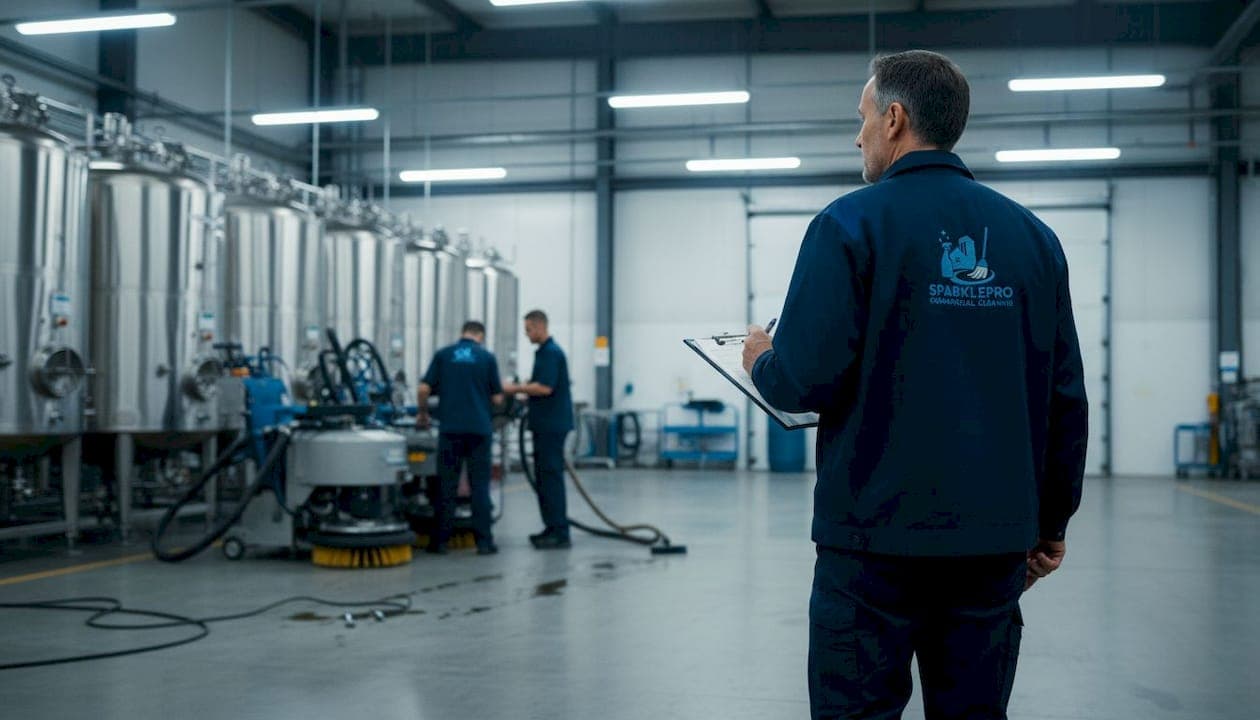
Most property managers assume industrial cleaning is just janitorial work scaled up. It isn't. The contaminants, the risks, the equipment, and the expertise required are categorically different, and treating industrial cleaning like routine maintenance is how facilities end up with contamination events, regulatory penalties, and costly shutdowns. This guide breaks down exactly what industrial cleaning involves, which methods actually work for which environments, and what the smartest facility directors do differently to maintain safety, compliance, and operational continuity in complex, large-scale settings.
Table of Contents
- Defining industrial cleaning: Beyond janitorial services
- Core methods and technologies in industrial cleaning
- Industrial cleaning standards and protocols
- Practical challenges and solutions in industrial cleaning
- Rethinking industrial cleaning: What most guides miss
- Partner with industrial cleaning experts for safer, cleaner facilities
- Frequently asked questions
Key Takeaways
| Point | Details |
|---|---|
| Specialized processes | Industrial cleaning uses unique methods and equipment for hazardous environments. |
| Method selection matters | Choosing the right cleaning approach depends on contaminant type and facility risk. |
| Standards drive quality | Documented protocols and standards reduce cross-contamination and ensure safety. |
| Active management required | Ongoing validation and adaptation are essential for compliance and long-term facility health. |
Defining industrial cleaning: Beyond janitorial services
Industrial cleaning is not a bigger mop and a larger crew. The distinction matters enormously when you're managing facilities that process food, manufacture pharmaceuticals, handle chemicals, or run heavy industrial operations.
Industrial cleaning is specialized, facility-focused cleaning intended for potentially hazardous industrial environments, using appropriate personnel, methods, and equipment to remove industrial contaminants such as residues, grease, chemical buildup, biological waste, and particulates. Janitorial cleaning maintains surface appearance. Industrial cleaning restores operational safety and functional integrity.
Understanding this distinction starts with understanding the environments themselves. A food processing facility carries risks of microbial contamination that can trigger product recalls. A chemical manufacturing plant may deal with reactive residues that require neutralization before removal. A pharmaceutical site may need validated cleaning processes that meet FDA documentation standards. These aren't situations where a standard cleaning crew with standard products can deliver results.
If you want to sharpen your grasp of how industry terms are applied across different contexts, reviewing cleaning industry terminology is a practical place to start.
Key differences between industrial and commercial cleaning:
- Industrial cleaning involves trained specialists, often with certifications in handling hazardous materials
- Methods include high-pressure systems, chemical treatments, and automated processes not used in standard janitorial work
- Industrial cleaning must account for equipment downtime, production schedules, and regulatory compliance
- Contaminants in industrial settings can be biologically active, chemically reactive, or physically hazardous
- Documentation and validation of cleaning results are often legally required in industrial environments
Here's a quick look at how common contaminants map to remediation methods:
| Contaminant type | Typical source | Primary remediation method |
|---|---|---|
| Grease and oil residue | Food processing, manufacturing | Hot water pressure washing, solvent degreasing |
| Chemical buildup | Chemical plants, laboratories | Neutralization agents, specialized solvents |
| Biological waste | Food production, healthcare adjacent | Disinfectants, enzymatic cleaners |
| Particulates and dust | Fabrication, construction adjacent | Industrial vacuuming, HEPA filtration |
| Scale and mineral deposits | Processing tanks, pipes | Descaling agents, hydroblasting |
| Combustible residues | Refineries, energy facilities | Inert gas purging, wet cleaning methods |
"Facilities that blur the line between janitorial and industrial cleaning consistently underestimate their risk exposure. The contaminants are different. The consequences of incomplete cleaning are different. And the skill set required is fundamentally different."
The bottom line: if your facility handles materials that could pose health, safety, or regulatory risk if residues remain, you're operating in industrial cleaning territory, and your approach needs to reflect that clearly.
Core methods and technologies in industrial cleaning
With the definition established, it's crucial to understand the unique methods and technologies at a facility manager's disposal. Not every method fits every environment, and choosing the wrong one doesn't just underperform. It can leave contamination behind or create new safety hazards.
Industrial cleaning methodologies frequently include clean-in-place (CIP), which cleans the interior surfaces of pipes and vessels without disassembly using circulated water, chemicals, and heat with controlled chemistry, time, and flow. It's used widely in food, beverage, dairy, pharmaceutical, and personal care manufacturing because it eliminates the time and contamination risk that comes with manual disassembly.
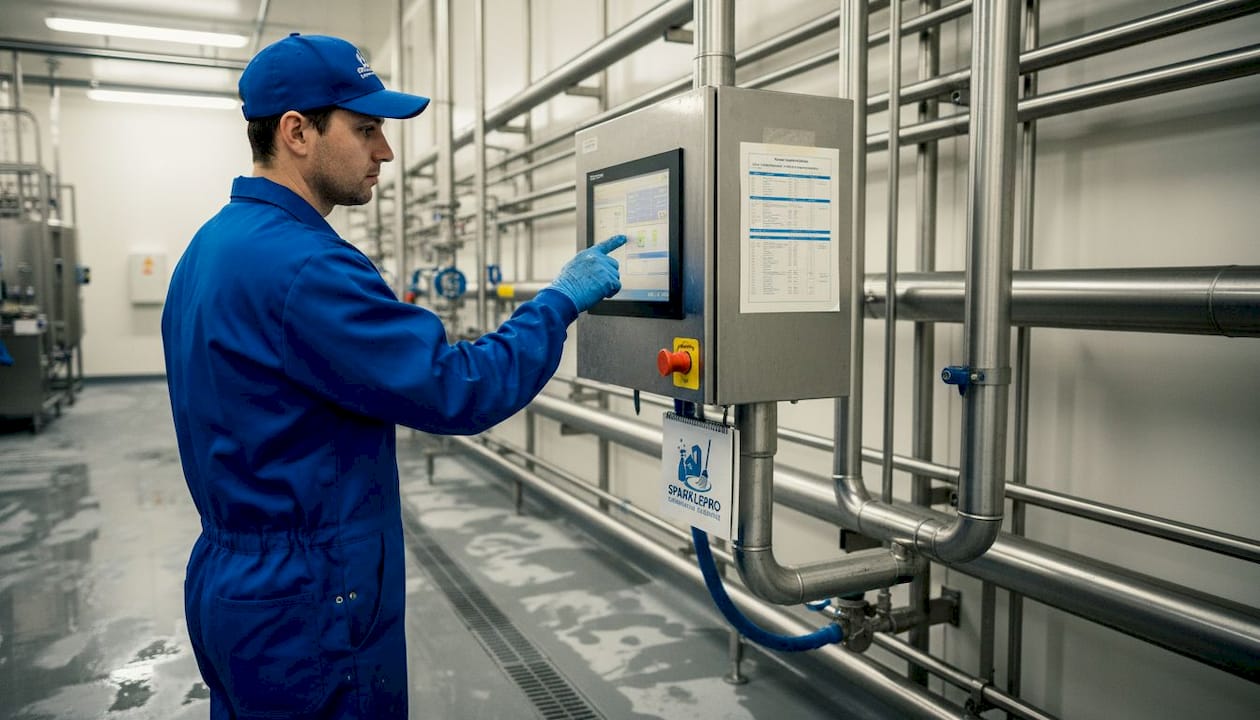
But CIP is one method in a broader toolkit. Here's a comparison of the major approaches:
| Cleaning method | Best application | Key limitations |
|---|---|---|
| Clean-in-place (CIP) | Closed systems: tanks, pipes, vessels | Can miss dead zones, hard-to-reach areas |
| Hydroblasting | Heavy scale, stubborn residue removal | Generates wastewater, risk of surface damage |
| Dry ice blasting | Sensitive equipment, electrical components | Higher equipment cost, requires trained operators |
| Manual intervention | Complex geometry, post-automated cleanup | Labor intensive, inconsistent without protocols |
| Chemical foaming | Large surface areas, vertical surfaces | Requires proper neutralization and rinse validation |
| Industrial vacuuming | Particulates, hazardous dust | Not effective for liquid or viscous contaminants |
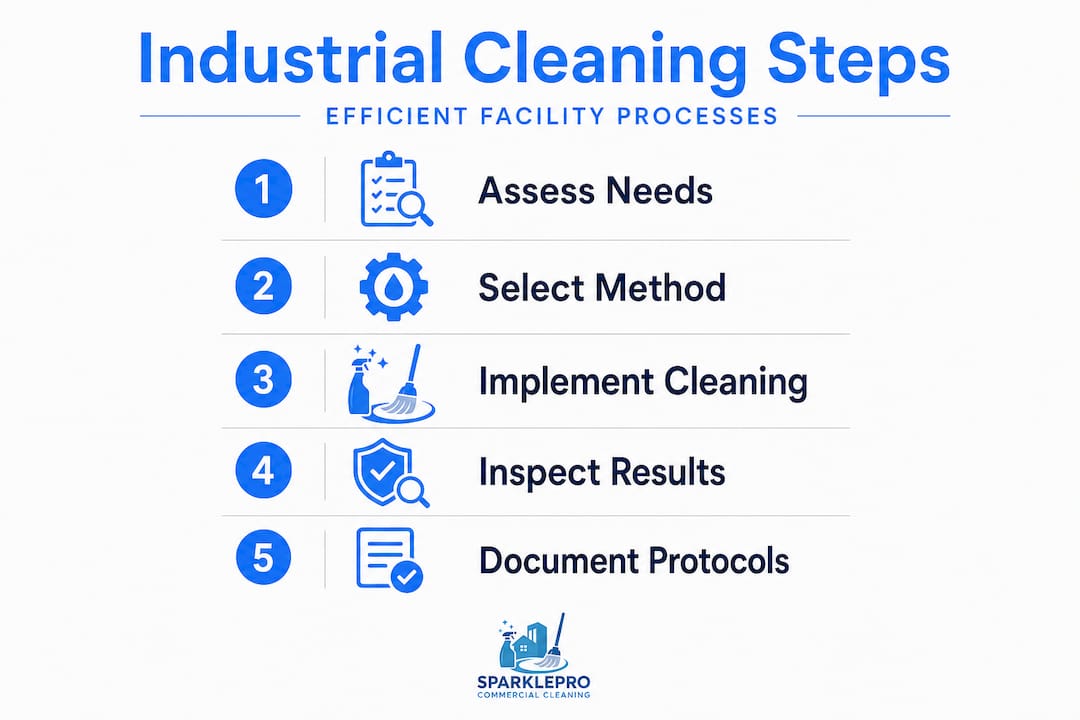
Steps in a typical automated CIP process:
- Pre-rinse with water to remove loose residue and bulk contamination
- Apply cleaning solution, typically alkaline, at controlled temperature and flow rate
- Circulate cleaning solution through the system for a defined contact time
- Rinse thoroughly with clean water to remove all chemical residue
- Apply sanitizer or disinfectant appropriate to the facility's requirements
- Final rinse and verification that chemical levels meet discharge or process standards
For effective cleaning solutions that go beyond these automated systems, especially in facilities with complex layouts, combining automated methods with targeted manual cleaning almost always produces better outcomes than relying on automation alone.
When you're evaluating options, also consider deep cleaning for commercial buildings as a framework for thinking about cleaning intensity, frequency, and outcomes in large-scale environments.
Explore more on clean-in-place systems if your facility operates closed-loop processing equipment and you're still evaluating whether CIP fits your specific contamination risk.
Pro Tip: When automated systems are your primary method, schedule quarterly manual inspections of all dead zones, joints, and T-sections in your piping. Automated monitoring can miss localized buildup in areas where flow velocity drops, which are exactly the spots where microbial colonies or chemical residues accumulate silently over time.
The choice of method should never be based on what's most convenient or cheapest in the short term. Method selection should be driven by the nature of the contamination, the design of the equipment, and the regulatory requirements that apply to your facility.
Industrial cleaning standards and protocols
Understanding the methods is just half the solution. Strict standards and protocols are equally critical for outcomes and safety. Without documented, repeatable processes, even the best equipment and cleaning agents can produce inconsistent results that fail inspections or leave behind hidden risks.
For quality and consistency, many cleaning organizations use structured "standards" defining cleaning sequence, frequencies, tools and equipment, chemicals, and safety protocol expectations. ISSA power clean standards describe these as repeatable, documented cleaning expectations designed to reduce cross-contamination and inconsistent results. When applied to industrial environments, this framework becomes a compliance tool as much as a quality tool.
A strong cleaning standard for an industrial facility isn't a checklist. It's a documented system that specifies what happens, when it happens, who is responsible, and how the result is verified. That distinction separates facilities that pass audits from those that scramble to explain gaps.
Elements every industrial cleaning standard should specify:
- Cleaning frequency by zone or equipment type, tied to contamination risk level
- Precise sequence of cleaning steps to prevent cross-contamination between areas
- Approved chemicals with concentration ranges, contact times, and temperature requirements
- Personal protective equipment (PPE) requirements for each task
- Post-cleaning validation methods and acceptable thresholds
- Record-keeping requirements including dates, personnel, and results
- Escalation procedures for when cleaning outcomes don't meet standards
For a facility director managing multiple buildings or zones, these standards also serve as a management tool. They allow you to delegate with confidence, because the expectation is documented, not just assumed. You can reference standards for managers for a structured breakdown of how to build and apply these frameworks in commercial and industrial contexts.
Consider this real-world scenario: a food manufacturing plant running two production lines with different allergen profiles. Without a documented, sequenced cleaning protocol between production runs, the risk of allergen cross-contact is significant. A structured standard specifying the exact sequence, rinse validation steps, and allergen swab testing eliminates ambiguity and creates a defensible record if a regulatory inquiry ever occurs.
Understanding what property managers must know about cleaning oversight is equally relevant here, since much of what applies to large commercial facilities maps directly onto industrial environments when adapted for the specific hazards involved.
Pro Tip: Don't wait for an audit to discover your protocols are incomplete. Conduct an internal "mock audit" of your cleaning documentation quarterly. Ask your team to produce the cleaning records for any three specific dates. Gaps in documentation are a signal to tighten your record-keeping process before a real inspection identifies the same gaps.
When standards are applied consistently and validated regularly, facilities see measurable reductions in cleaning-related incidents. Variability in cleaning outcomes drops. Regulatory findings decrease. And your team has a clear framework for accountability.
Practical challenges and solutions in industrial cleaning
With standards in place, the next challenge is effective day-to-day execution, especially when things don't go as planned. Industrial facilities are complex, dynamic environments, and even well-designed cleaning programs run into obstacles that require active problem-solving from facility managers.
Automated systems like CIP may fail to clean difficult-to-reach locations, requiring supplementary manual cleaning or changes in cleaning strategy or chemistry. Method selection and validation matter significantly in these edge cases. This is one of the most common gaps between how a cleaning program is designed and how it actually performs over time.
Top pitfalls managers face when overseeing industrial cleaning:
- Over-relying on automation without validating results in dead zones and low-flow areas
- Assuming that because a process ran, cleaning was effective
- Failing to update cleaning protocols when processes, equipment, or chemicals change
- Inadequate staff training on manual cleaning procedures used alongside automated systems
- Poor documentation practices that create compliance exposure during audits
- Ignoring shift handover gaps where cleaning accountability is unclear
- Not adjusting cleaning frequency when production volume or contamination load increases
These pitfalls share a common theme: passive management. The assumption that a system or process will handle things without active verification is where industrial cleaning programs most often fail.
For facilities where ensuring safe commercial spaces is a primary concern, the coordination between automated and manual cleaning systems is worth mapping explicitly in your protocols. Define which tasks require human verification, not just automated logging.
Pro Tip: Validate your cleaning outcomes rather than simply trusting the process ran. Implement ATP (adenosine triphosphate) swab testing on a rotating basis across your facility. ATP testing measures biological residue on surfaces and gives you objective data, not just a completed task log. Most industrial facilities that use ATP testing regularly find at least a few consistently underperforming areas that automated monitoring missed entirely.
Solutions to these challenges often involve a combination of better training, clearer accountability structures, and smarter use of validation tools. Coordinate between automated and manual cleaning by assigning specific team members to verify post-automated cleaning in high-risk areas. Invest in regular retraining, not just initial onboarding. And review your protocols every time equipment changes or a new contaminant is introduced into your process.
Rethinking industrial cleaning: What most guides miss
Most guides on industrial cleaning focus on methods and standards, which are genuinely important. But the most experienced facility directors will tell you the real differentiator isn't what systems you have in place. It's how actively you validate and adapt them.
The most effective approach treats cleaning as a dynamic process, not a fixed program. Facilities evolve. Production volumes change. New equipment is installed. Regulations shift. A cleaning program designed two years ago may not address your current contamination risk accurately, even if it was excellent when it was written.
We've seen this pattern repeatedly: a facility invests in a well-designed CIP system, trains the team, documents the protocols, and then essentially puts the program on autopilot. For a while, everything looks fine. Audits pass. No incidents occur. Then a change in production volume increases contamination load, and suddenly the existing cleaning frequency isn't enough. But because nobody is actively reviewing the program's performance against current conditions, the gap grows quietly until it becomes a problem.
The cleaning benefits for commercial property extend well beyond aesthetics and basic hygiene in industrial settings. They directly affect regulatory compliance, product quality, equipment longevity, and worker safety. Treating cleaning as a core operational function, rather than overhead, changes how you invest in it and how you manage it.
Checkbox thinking is the enemy of industrial cleaning excellence. When the goal is "pass the audit" rather than "eliminate contamination risk," programs stagnate. The most effective facility managers we've worked with schedule regular program reviews, track cleaning outcomes over time, and treat unexpected results as data worth investigating rather than anomalies to explain away. That methodical, curious approach is your strongest defense against contamination events and regulatory penalties.
Partner with industrial cleaning experts for safer, cleaner facilities
Putting practical knowledge into action is easier with specialists who understand your regional and industry-specific needs. The gap between a well-documented cleaning program and one that actually performs under real-world conditions comes down to expertise, and that's where working with experienced industrial cleaning professionals makes a measurable difference.
At Sparkle Pro Commercial Cleaning, we bring specialized industrial and commercial cleaning expertise to facilities across the country. Whether you're managing a complex manufacturing environment or a large commercial campus, our teams are equipped with the methods, certifications, and documentation practices your facility needs to stay compliant and operational. If you're in the Northeast and need proven regional expertise, explore our Massachusetts commercial cleaning and New Jersey commercial cleaning services. Our four-step engagement process means you get a site-specific quote, a facility walk-through, scheduled cleaning, and verified results before any final approval.
Frequently asked questions
How is industrial cleaning different from commercial cleaning?
Industrial cleaning requires specialized personnel, methods, and equipment for hazardous contaminants, whereas commercial cleaning focuses on routine maintenance in less hazardous environments. The risk profile, regulatory requirements, and technical complexity are fundamentally different between the two.
What are common contaminants targeted by industrial cleaning?
Residues, grease, chemical buildup, biological waste, and particulates are typical targets in industrial settings. Each contaminant type requires a specific remediation approach based on its chemical properties and the surfaces it has affected.
What is clean-in-place (CIP) cleaning?
CIP cleans interior surfaces of pipes, tanks, and vessels without disassembly using circulated water, chemicals, and heat. It's widely used in food, pharmaceutical, and beverage manufacturing because it reduces downtime and minimizes contamination risk from manual disassembly.
Why do industrial cleaning standards matter?
Standards define cleaning sequence, tools, frequency, and safety protocol expectations, ensuring cleaning quality, reducing cross-contamination, and maintaining compliance in complex environments. Without documented standards, cleaning outcomes become variable and difficult to defend during regulatory inspections.