
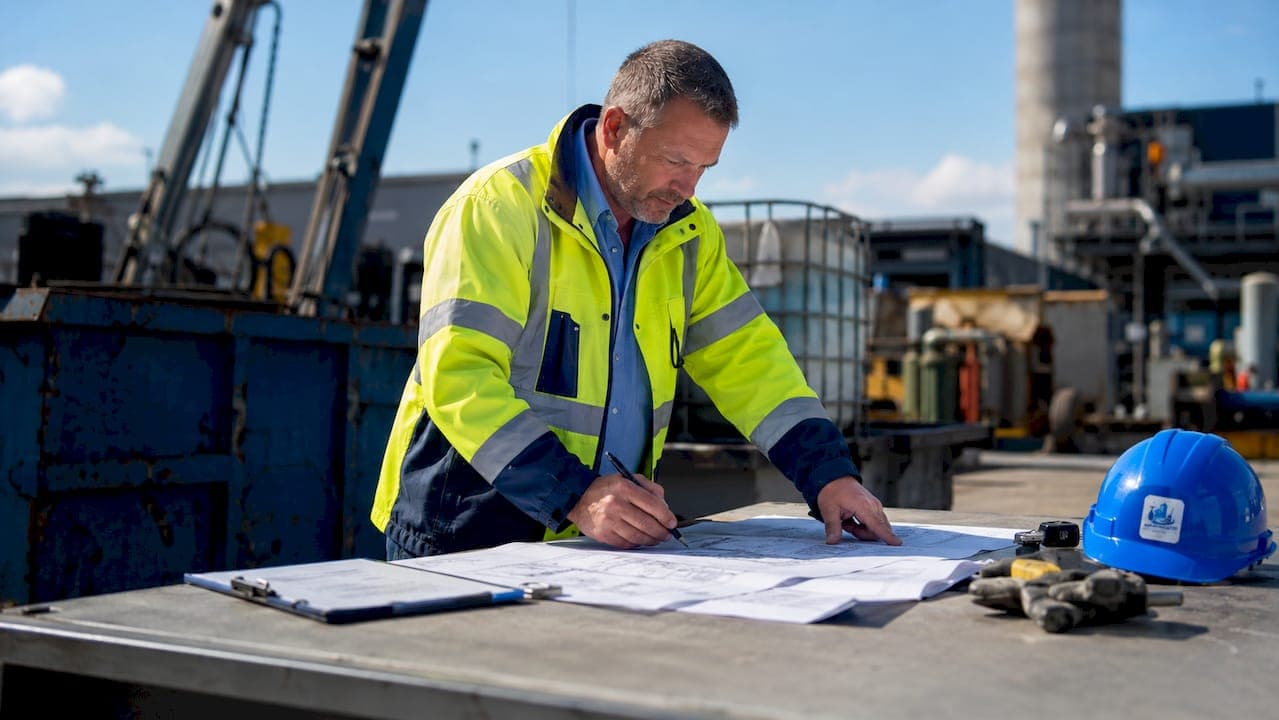
Industrial site cleaning plans are structured frameworks that combine tailored cleaning protocols, safety compliance, and zone-based scheduling to maintain clean, safe, and fully operational industrial environments. For site managers and safety officers, a poorly designed plan is not just an inconvenience. It is a direct path to OSHA violations, unplanned downtime, and preventable injuries. The most effective plans address contamination types, chemical handling, confined-space entry, and shift-integrated scheduling before a single cleaning tool arrives on site. This guide breaks down every critical component you need to build a plan that holds up under inspection and real-world pressure.
1. What a pre-cleaning site assessment must include
Planning must start before the first cleaning tools arrive on site, confirming operational versus isolated areas, contamination types, access routes, permits, and safety arrangements. Without this groundwork, cleaning crews deploy the wrong methods, bring insufficient equipment, and create hazards they were never briefed to expect.
A thorough pre-cleaning assessment covers the following areas:
- Contamination mapping: Identify whether residues are oil-based, sludge, fine dust, chemical compounds, or biological matter. Each type demands a different removal method and PPE specification.
- Zone classification: Separate areas that must remain operational from those that can be fully isolated. Identifying operational versus isolated zones prevents method mismatches and tool shortages during execution.
- Access and permit requirements: Document entry restrictions, confined-space permits, hot-work permits, and any site-specific induction requirements before scheduling begins.
- Emergency arrangements: Confirm first-aid provisions, emergency contact lists, muster points, and spill response kits are in place and communicated to all cleaning personnel.
- Traffic and welfare coordination: Map pedestrian and vehicle movement to prevent conflicts during active cleaning. Confirm welfare facilities, including wash stations and rest areas, meet the scale of the cleaning crew.
Explicit pre-work briefs that specify operational constraints and contamination type produce more controlled and less disruptive cleaning jobs. The brief should be a written document, not a verbal walkthrough. Every supervisor on site should sign off on it before work begins.
Pro Tip: Photograph contamination zones during the assessment and attach images directly to the site brief. Visual records reduce misunderstandings between your team and the cleaning contractor, and they serve as baseline documentation for post-clean verification.

2. How to schedule industrial cleaning to minimize downtime
Zone-based cleaning scheduled into predictable windows such as night shifts, bank holidays, or planned shutdowns prevents disruption and supports 24/7 operation continuity. Scheduling is not a logistics afterthought. It is a core element of every effective site cleanup procedure.
Use the following sequence to build a downtime-minimizing schedule:
- Audit production cycles. Identify natural low-activity windows in your operation. A food processing plant running two shifts has a predictable gap between 2 a.m. and 5 a.m. A warehouse with weekly inventory counts has a recurring quiet window every Sunday morning.
- Assign cleaning zones to specific windows. Never schedule a full-facility clean when a zone-by-zone rotation achieves the same result without halting production.
- Prioritize by contamination risk. High-contamination zones near machinery or chemical storage require more frequent attention. Rotate them into every available window rather than waiting for a scheduled shutdown.
- Build preventative cleaning into shift handovers. Embedding a 15-minute cleaning task at the end of each shift converts cleaning into a maintenance behavior rather than an emergency response.
- Document and communicate the schedule. Post zone schedules in supervisor stations and share them with production leads. Cleaning crews should never arrive without production knowing they are coming.
"Reactive cleaning after problems arise increases urgency and downtime. Structured preventative cleaning plans convert cleaning into maintenance, improving efficiency across the entire operation." — All Things Supply Chain
Embedding zone-based cleaning into routine shift schedules rather than waiting for shutdowns reduces operational disruption in 24/7 industrial sites. The goal is to make cleaning invisible to production, not a competing priority.
3. Chemical handling protocols and safety regulations you must integrate
Every hazardous chemical product used on an industrial site must have an accessible Safety Data Sheet (SDS), and decanting into unlabeled bottles is one of the most common compliance failures inspectors find. OSHA's 29 CFR 1910.22 and COSHH regulations both require documented chemical management, not just possession of the correct products.
Your chemical handling protocol must address these areas:
- SDS folder management: Maintain a physical and digital SDS folder for every chemical on site. Update it whenever a product changes. Inspectors check accessibility first, not just existence.
- Labeled dilution stations: Set up controlled decanting stations with pre-labeled bottles showing concentration, hazard symbols, and product name. This prevents concentration drift and protects workers who did not mix the solution themselves.
- Dilution ratios and dwell time: Correct dilution ratios and full dwell time are non-negotiable for cleaning effectiveness. Premature wiping before the contact time expires reduces disinfectant action to near zero, particularly in temperature-variable industrial environments.
- PPE specification by task: Match gloves, eye protection, respiratory equipment, and footwear to the specific chemical being used. A single generic PPE list for all cleaning tasks is a compliance failure waiting to happen.
- Training documentation: Record every training session with dates, attendee names, and topics covered. Lacking documented PPE and training records is a primary cause of COSHH inspection failures.
| Compliance area | Common failure | Correct practice |
|---|---|---|
| SDS management | Outdated or inaccessible folders | Digital and physical folders updated per product change |
| Chemical labeling | Unlabeled decanted bottles | Pre-labeled stations with concentration and hazard data |
| Dwell time | Premature surface wiping | Timed application per manufacturer and temperature guidance |
| PPE records | No documented training | Signed attendance logs per task and chemical type |
Pro Tip: Assign one person per shift as the chemical compliance lead. Their job is to check SDS currency, inspect labeled bottles, and confirm PPE is task-matched before any cleaning begins. This single role catches the majority of compliance failures before an inspector does.
4. High-risk cleaning operations: what confined-space and tank cleaning require
Tank cleaning requires confined-space entry protocols, zero-energy state validation, continuous atmospheric monitoring, and strict ventilation controls before any worker enters. This is the category of industrial cleaning where planning failures become fatalities.
Follow this sequence for any high-risk confined-space cleaning task:
- Complete a Job Safety Analysis (JSA). The JSA must identify every hazard specific to that tank or vessel, including residual chemical vapors, oxygen displacement risk, and structural entry points.
- Confirm zero-energy state. Lock out and tag out all energy sources connected to the vessel. Verify isolation of electrical, hydraulic, pneumatic, and thermal energy before entry.
- Establish ventilation. Mechanical ventilation must be running and confirmed effective before the first worker enters. Natural ventilation alone does not meet confined-space entry standards for most industrial tanks.
- Conduct atmospheric monitoring. Oxygen levels must read between 19.5% and 23.5%. Lower explosive limit (LEL) readings must stay under 10%. Toxic gas readings must remain below permissible exposure limits (PELs) for all identified substances.
- Maintain continuous monitoring throughout. Continuous gas monitoring avoids false safety assumptions. If a continuous monitor is unavailable, manual checks must occur every 5 to 10 minutes without exception.
- Coordinate with site safety and emergency teams. A trained attendant must remain outside the confined space at all times. Emergency retrieval equipment must be staged at the entry point before work begins.
| Monitoring method | Frequency | Risk level |
|---|---|---|
| Continuous multi-gas monitor | Real-time | Low (preferred) |
| Manual multi-gas check | Every 5 to 10 minutes | Moderate |
| Single-gas spot check | Intermittent | High (not recommended) |
High-risk cleaning tasks fail when atmospheric monitoring is treated as a setup step rather than an ongoing requirement. Conditions inside a confined space change as cleaning progresses. A tank that reads safe at entry can become hazardous within minutes as residue is disturbed. For sites managing industrial fire protection alongside cleaning operations, coordination with fire safety compliance planning adds a critical layer of protection during high-risk tasks.
Key takeaways
Effective industrial site cleaning plans require pre-cleaning assessment, zone-based scheduling, documented chemical compliance, and continuous monitoring for high-risk tasks to protect workers and maintain operations.
| Point | Details |
|---|---|
| Pre-cleaning assessment | Document contamination types, zone classifications, permits, and emergency arrangements before work begins. |
| Zone-based scheduling | Assign cleaning to predictable low-activity windows to protect production continuity on 24/7 sites. |
| Chemical compliance | Maintain current SDS folders, labeled dilution stations, and signed training records to pass OSHA and COSHH inspections. |
| Confined-space monitoring | Use continuous multi-gas monitoring with oxygen between 19.5% and 23.5% and LEL under 10% throughout tank cleaning. |
| Preventative over reactive | Embed cleaning into shift handovers to convert it from an emergency response into a routine maintenance behavior. |
What most managers get wrong about cleaning plans
The single most common mistake I see industrial site managers make is treating the cleaning plan as a document they hand to a contractor and forget. A plan that lives in a folder and never gets updated after the first job is not a plan. It is a liability.
The second mistake is separating cleaning from production planning entirely. When your production scheduler and your cleaning lead do not share a calendar, you get reactive cleans. Reactive cleans cost more, take longer, and create the exact downtime you were trying to avoid. The sites that run cleanest are the ones where cleaning windows appear on the same schedule board as shift changes and maintenance windows.
Chemical compliance is where I see the most inspection failures. Managers assume that having the right products on site is enough. Inspectors do not care that you bought the correct degreaser. They care whether the decanted bottle next to the machine is labeled, whether the SDS is current, and whether the person using it was trained and can prove it. Those three things fail together more often than any single one fails alone.
My recommendation for any manager building or rebuilding their factory cleaning guidelines: start with the pre-cleaning brief, not the cleaning schedule. If you cannot describe your contamination types, your operational zones, and your permit requirements in writing before the crew arrives, the schedule you build on top of that gap will fail in execution. Get the industrial cleaning strategies right at the planning stage, and the execution becomes far more predictable.
— Sales
How Sparkleprocommercialcleaning supports your industrial cleaning program
Sparkleprocommercialcleaning builds customized industrial site cleaning plans that fit your operational schedule, compliance requirements, and site-specific contamination profile. Whether you manage a warehouse in Delaware, a manufacturing facility in Massachusetts, or a distribution center in Washington, Sparkleprocommercialcleaning brings licensed, insured crews with documented chemical safety training and zone-based scheduling expertise. The process starts with a site visit and quote, moves through scheduled execution, and ends with your sign-off. If your current cleaning program is reactive, undocumented, or failing compliance checks, contact Sparkleprocommercialcleaning to build a plan that works from day one.
FAQ
What should an industrial site cleaning plan include?
An industrial site cleaning plan must include a pre-cleaning site assessment, zone classifications, contamination type identification, chemical handling protocols with current SDS records, a zone-based cleaning schedule, PPE requirements by task, and emergency arrangements. Plans that omit any of these components create compliance gaps and operational risk.
How often should industrial sites be cleaned?
Cleaning frequency depends on contamination type, production volume, and regulatory requirements. High-contamination zones near machinery or chemical storage require daily attention, while lower-risk areas may follow weekly or monthly schedules aligned with planned shutdowns or shift handovers.
What are the OSHA requirements for industrial housekeeping?
OSHA 29 CFR 1910.22 requires workplaces to remain clean, orderly, and sanitary, with floors kept dry to reduce slip and trip hazards. The standard applies to passageways, storerooms, and all walking-working surfaces, making daily housekeeping a regulatory baseline rather than a best practice.
What is the biggest compliance risk in industrial chemical cleaning?
The most frequent compliance failure is unlabeled decanted chemical bottles combined with outdated or inaccessible SDS folders. Inspectors under both OSHA and COSHH frameworks prioritize SDS accessibility and correct labeling over the type of chemicals present, making documentation the primary compliance risk.
When is continuous atmospheric monitoring required for industrial cleaning?
Continuous atmospheric monitoring is required for any confined-space cleaning task, including tank cleaning. Oxygen levels must stay between 19.5% and 23.5%, LEL readings below 10%, and toxic gas levels below established PELs. If continuous monitoring equipment is unavailable, manual checks must occur every 5 to 10 minutes throughout the entire operation.