
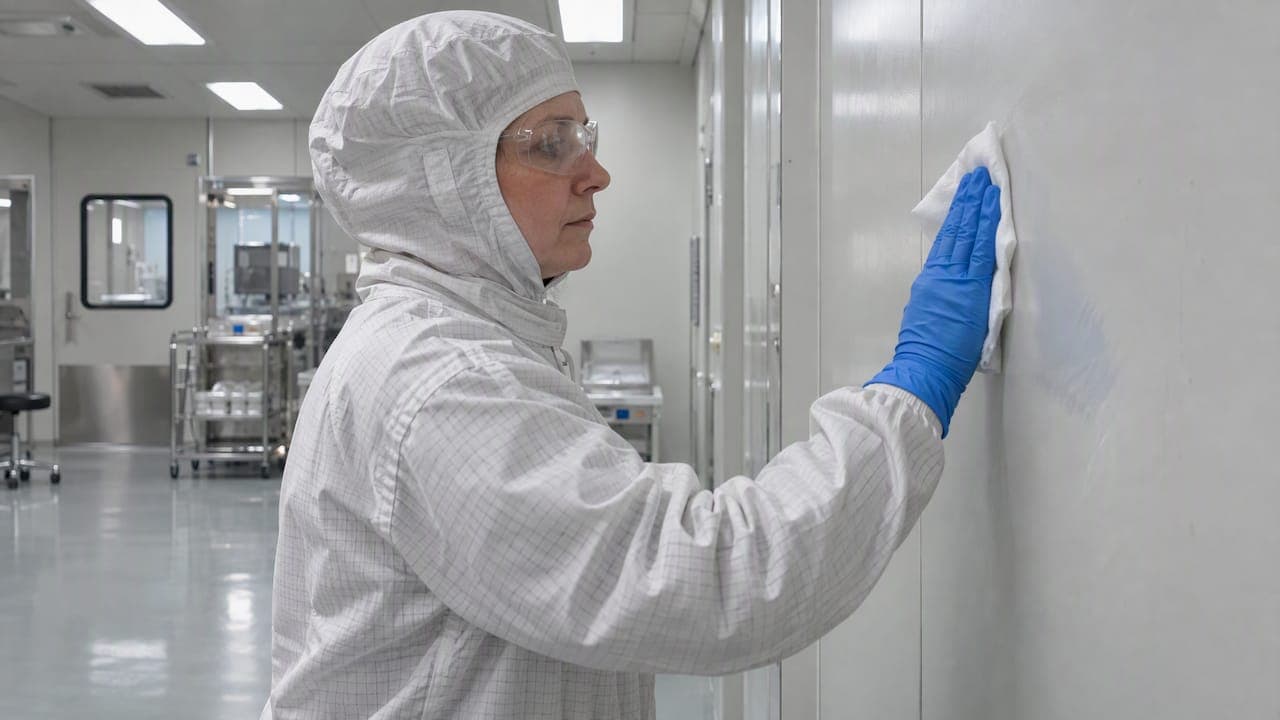
For cleanroom cleaning, consult ISO 14644-13 and validate methods against SCP and SCC targets from ISO 14644-9 and ISO 14644-10. Start by assessing the current contamination level against your target cleanliness class, then select a cleaning method that matches that target and the surface material. Validate the result before you call the job done.
TL;DR:
- Part 9 measures particles from 0.05 µm to 500 µm, while Part 10 checks chemical residue; surfaces may pass one test and fail the other.
- Use low lint wipes on walls, compatible solvents on equipment, and dedicated mops on floors; clean optics only with methods approved for that equipment.
- Use direct wipe or swab analysis for chemical residue and surface particle counts; visual checks serve as proxies between full validations, not replacements.
- Set sampling locations, counts, and frequency for qualification, routine monitoring, and checks after spills or maintenance; record results and investigate marginal passes or failures.
- Keep tools segregated by zone, train and verify cleaners, and review cleaning frequency against monitoring results quarterly to catch schedules that no longer fit.
Table of Contents
- Which parts of the ISO 14644 series govern cleaning and operations
- What ISO 14644-13 requires: SCP, SCC, and method selection
- Cleaning methods and protocols by surface type and cleanliness level
- Validating cleaning results and proving compliance
- Housekeeping, training, and recordkeeping that keep the program auditable
- How a nationwide cleaning provider operationalizes these standards
- Request a site assessment for your controlled environment
- FAQ
- Sources
Which parts of the ISO 14644 series govern cleaning and operations
The ISO 14644 series covers cleanrooms from classification through daily operations, and knowing which part answers which question saves time during an audit or a corrective action review.
- ISO 14644-1 sets airborne particle cleanliness classes and the measurement units behind them, forming the baseline target the rest of the program supports.
- ISO 14644-2 governs ongoing monitoring to confirm a cleanroom still meets its classified state over time.
- ISO 14644-5 addresses operations: gowning, material flow, and the behaviors that keep a classified space in spec.
- ISO 14644-9 and ISO 14644-10 define how to assess surface cleanliness for particles (SCP) and chemical residue (SCC).
- ISO 14644-13 ties those surface metrics directly to cleaning method selection and validation.
Facility teams typically start at Part 1 for classification, move to Part 5 for day-to-day operations, and use Parts 9, 10, and 13 whenever a surface cleaning program needs to be built, defended, or audited. The ISO standard for cleanroom classification remains the reference point for the overall environmental target that the cleaning plan has to support.
What ISO 14644-13 requires: SCP, SCC, and method selection
ISO 14644-13 (Edition 2) gives guidance on cleaning surfaces to reach defined levels of particle concentration (SCP) and chemical concentration (SCC), and it leans on ISO 14644-9 and ISO 14644-10 for how those levels get measured.
SCP measurement under ISO 14644-9 covers particles between 0.05 µm and 500 µm, a wide enough range to catch both fine particulate and visible debris on solid cleanroom surfaces. SCC, defined in Part 10, addresses chemical residue rather than particle count, which means a surface can pass a particle check and still fail on chemical contamination, or the reverse.
Part 13 lays out the method selection sequence in a specific order:
- Determine the surface's initial contamination level before choosing anything.
- Define the target cleanliness level the surface needs to reach.
- Select a cleaning category appropriate to that target.
- Check material compatibility between the cleaning method and the surface.
- Validate that the completed cleaning actually met the target.
Part 13 does not cover how contamination gets generated in the first place or the statistical controls used in some monitoring programs, so it works alongside Parts 9 and 10 rather than replacing them.
Cleaning methods and protocols by surface type and cleanliness level
Method selection depends on what the surface is made of and how clean it needs to be, not on habit or whatever supply happens to be on the cart.
- Floors respond well to dedicated mop systems with low-lint heads and solution changes between zones to avoid spreading contamination from one area to another.
- Walls and ceilings usually need wall-mounted or extended-reach tools with single-use wipes, since reused cloths can redeposit particles on return passes.
- Equipment exteriors call for low-lint wipes and solvents checked for compatibility with housings, seals, and coatings before routine use.
- Optics and sensitive instrument surfaces need the gentlest validated method available, often a dedicated wipe-and-solvent combination approved specifically for that equipment.
A HEPA-filtered vacuum, low-lint single-use wipes, solvents matched to the surface, and a dedicated mop system cover most of a standard cleanroom's needs, but every consumable on that list should have a documented compatibility check before it touches a critical surface. Chemical compatibility failures show up as residue, haze, or material degradation, all of which can push SCC readings out of range even when the particle count looks fine.
Cleaning direction matters as much as the tool. Work from clean areas toward less clean ones, use slow, overlapping motions rather than quick swipes, and keep a tool set dedicated to each zone so a mop used near an entryway never crosses into a controlled core area.

Pro Tip: Color-code wipes, mop heads, and buckets by zone so staff can tell at a glance whether a tool belongs in that room.
Validating cleaning results and proving compliance
A cleaning task isn't compliant until it's measured. ISO 14644-9 and ISO 14644-10 describe both direct and indirect methods for confirming that a cleaned surface meets its target.
- Direct methods include wipe or swab sampling followed by chemical analysis for SCC, and surface particle counts for SCP.
- Indirect methods rely on visual inspection or proxy indicators, useful for routine checks between full validations.
- Sampling plans should specify locations (high-touch points, equipment surfaces, floor zones near entries), sample counts, and frequency: initial qualification, routine monitoring, and event-driven checks after a spill or maintenance visit.
- Acceptance criteria convert the measured SCP or SCC value into a pass or fail against the target level set during method selection.
Keep records of every sampling event, the method used, and the result. A pattern of marginal passes or a single clear failure should trigger corrective action and, in some cases, requalification of the cleaning method itself before routine work resumes.
Housekeeping, training, and recordkeeping that keep the program auditable
Operational controls from ISO 14644-5 and the procedural detail in IEST-RP-CC018 turn a cleaning method into a program that survives an audit.
- Written SOPs covering cleaning schedules, gowning requirements, and entry and exit procedures for cleaning staff.
- Segregated, labeled inventory of cleaning tools and consumables by zone, so cross-contamination risk is controlled by design rather than by memory.
- Documented training and competence verification for every person performing cleaning tasks, with supervision for new staff during their first cycles.
- A clear link between the cleaning log and the broader monitoring program, including a defined trigger for nonconformance review.
IEST-RP-CC018 adds test procedures for setting cleaning frequency and for confirming that a housekeeping program is actually working, not just running on schedule.
Pro Tip: Review cleaning frequency against monitoring data quarterly. A schedule that was right at commissioning can drift out of sync with actual contamination patterns.
For spaces with sensitive equipment, our server room cleaning guidance walks through SOP-level detail that applies the same logic to a narrower set of surfaces.
How a nationwide cleaning provider operationalizes these standards
We use a workflow starting with a quote, site visit, scheduled cleaning, and customer approval. A site visit allows assessment of the current contamination level before recommending a method, reflecting the assessment step Part 13 requires. We provide documentation support for post-construction cleanouts, routine maintenance, and scheduled deep clean events.
Facility teams moving from a new build into occupancy often need this exact sequence, covered in our commercial build cleaning standards guide.
— Sales
Request a site assessment for your controlled environment
We provide the services that make ISO-aligned cleaning programs workable day to day: validated cleaning passes, recurring janitorial contracts, and documentation support that holds up during an audit.
- Coverage with crews who handle environmental and specialized cleaning requirements.
- A straightforward process: request a quote, host a site visit, get a scheduled cleaning plan, and sign off on results.
- Support for post-construction cleanouts, routine janitorial contracts, deep cleans, and disinfecting services in facilities with strict cleanliness requirements.
Cleanroom air handling and surface cleaning work together, and facilities weighing upgrades to their climate control systems may find our partner's office climate control guide useful background before scheduling a cleaning assessment. To get started on your own facility, request a quote or check local availability for a site visit.
FAQ
What is the ISO standard for cleanrooms?
The ISO 14644 series is the standard for cleanrooms, with Part 1 covering air cleanliness classification and later parts covering monitoring, operations, and surface cleaning. ISO 14644-13 specifically addresses cleaning methods and surface cleanliness validation.
Is ISO 7 or ISO 8 better?
Neither classification is inherently better: the right class depends on the process the cleanroom supports, since a tighter class requires stricter particle control and more frequent monitoring than a looser one. Choosing a class means matching the contamination sensitivity of your work to the classification, then building a cleaning and monitoring program that supports it.
What is the latest version of ISO 14644-1?
ISO 14644-1 defines airborne particulate cleanliness classes and the measurement units behind them, and it remains the core classification reference within the series. Check the official ISO listing directly for the current edition before citing it in a compliance document.
What ISO is a class 10,000 clean room?
"Class 10,000" is a legacy term from an older US Federal Standard system, not from ISO 14644. Facilities converting from that terminology should work from the ISO 14644-1 classification table directly rather than relying on an informal conversion.
How often should cleanroom surfaces be tested for compliance?
Testing frequency depends on the cleanliness class and the facility's own monitoring program, with initial qualification, routine checks, and event-driven testing after spills or maintenance all playing a role. IEST-RP-CC018 provides test procedures specifically for setting that frequency.
Sources
- ISO 14644-13:2026 - Cleanrooms and associated controlled environments — Part 13
- IEST-RP-CC018: Cleanroom Cleaning and Sanitization: Operating and Monitoring Procedures