
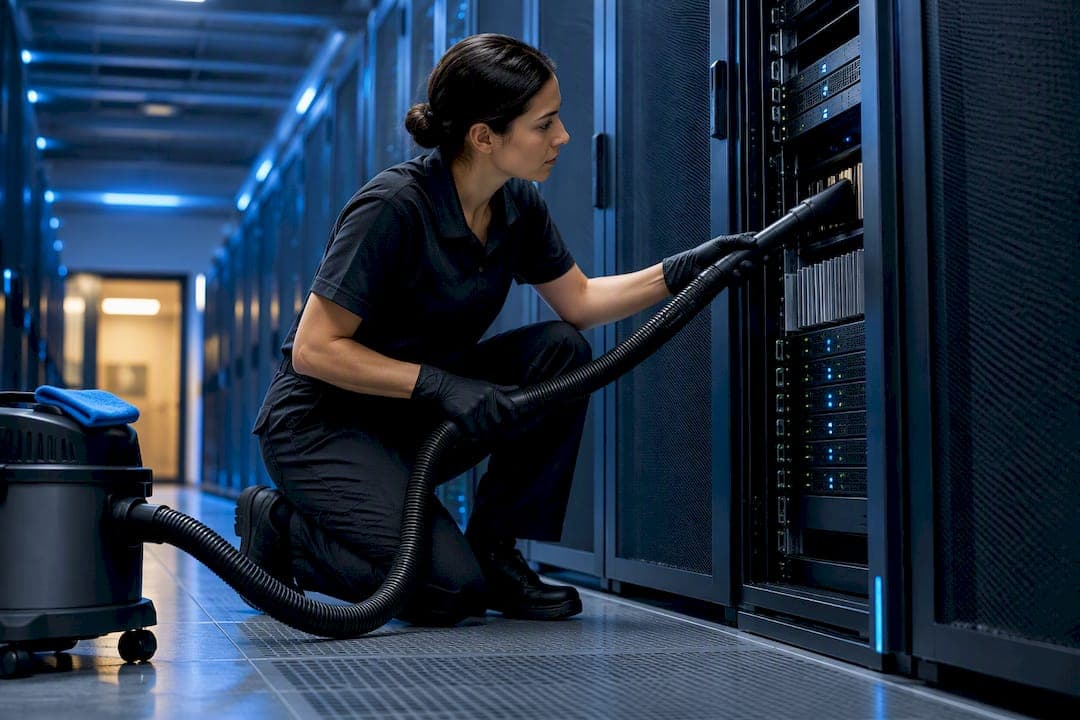
The controlling standards for server room cleanliness are ISO 14644-1 Class 8 for airborne particle limits and ASHRAE's particulate and gaseous contamination guidance for temperature, humidity, and filtration. Meeting them means MERV 8 recirculation filtration, MERV 11 to MERV 13 inlet filtration, HEPA-filtered vacuuming, ESD-safe cleaning agents, and written prevention policies. The first move for any facility manager: check your intake filtration grade today and schedule a particle count before you touch a mop.
TL;DR:
- Ensuring intake filters meet MERV 11 to MERV 13 standards is critical, especially when outside air is pulled in during economizer operation.
- Regular filter pressure monitoring and trap removal prevent unplanned failures, with synthetic filters needing more frequent replacement than glass-fiber media.
- HEPA-filtered vacuums with ESD-safe accessories are essential, while standard vacuums risk recontamination and static damage.
- Frequency of cleaning should be based on risk zones, with high-traffic areas requiring weekly surface cleaning and quarterly deep cleans.
- Conducting quarterly particle counts at rack intake points using ISO 14644-1 methods provides ongoing verification of a clean server environment.
Table of Contents
- Why Server Rooms Need Contamination Control, Not Janitorial Cleaning
- What Cleanliness Targets Should You Design Around?
- Which MERV Filters and HVAC Settings Actually Work?
- What Tools and Methods Are Safe for Cleaning Server Rooms?
- How Often Should You Clean a Server Room?
- How Do You Verify a Server Room Is Actually Clean?
- Prevention Policies That Cut Cleaning Frequency
- Vetting a Server Room Cleaning Provider: What to Put in the SOW
- The Case for Prevention Over Repeated Internal Cleans
- Get a Site Survey Before Your Next Compliance Review
- Standards Worth Keeping on File
- Sources
- FAQ
Why Server Rooms Need Contamination Control, Not Janitorial Cleaning
Wiping down a lobby and cleaning a data hall are not the same skill. Appearance cleaning removes visible dirt. Contamination control targets particles too small to see, the ones that settle on circuit boards, cause static discharge, and clog heat sinks until equipment starts throttling or failing outright.
Dust buildup on components acts as an insulator, trapping heat and pushing hardware toward thermal shutdown. Fine conductive particles can bridge circuit paths and trigger intermittent faults that look like software bugs but are not. A vacuum without proper filtration makes this worse by kicking particles back into the air instead of removing them.
The operational consequences show up fast:
- Reduced airflow across servers, leading to overheating and throttled performance
- False smoke or fire alarms triggered by dust accumulation in sensors
- Static discharge events that corrupt data or damage components outright
- Shortened hardware lifespan from chronic particulate exposure
What Cleanliness Targets Should You Design Around?
ISO 14644-1 Class 8 is the benchmark most data centers use for airborne particle concentration, and it works because it's attainable through standard filtration and access control rather than the cleanroom-grade suites hospitals or semiconductor fabs need.
Temperature and humidity aren't cosmetic details. ASHRAE recommends holding data centers between 18°C and 27°C with relative humidity under 60%. Cross that humidity threshold and dust particles absorb enough moisture to become deliquescent, turning inert grit into a conductive, corrosive film on exposed metal.
That's where ISA-71.04 corrosion classification comes in. It measures reactivity of copper and silver coupons exposed to room air. When gaseous contamination pushes past severity level G1, the fix isn't more sweeping, it's gas-phase filtration added to the air handling system. Skip that step and you're chasing corrosion failures with a rag.
Which MERV Filters and HVAC Settings Actually Work?

ASHRAE's guidance is specific here, with MERV 8 for room air recirculation and MERV 11 or preferably MERV 13 for air entering the space from outside. That gap in ratings matters. Recirculated air has already passed through the room once, so a lighter filter is enough. Fresh intake air carries more variety and volume of contaminants, so it needs the tighter weave.
Air-side economizers, which pull in outside air to cut cooling costs, complicate this. Every economizer hour is an hour of unfiltered outdoor pollutants, pollen, and humidity swings entering your controlled environment unless the inlet filtration is upgraded to match.
- Track pressure drop across filters, not just calendar dates, since rising resistance signals a clogged filter before it fails visibly
- Replace charged synthetic filters more often than uncharged glass-fiber media, since synthetic filters lose efficiency faster over weeks of service
- Add gas-phase filtration only when ISA-71.04 testing shows you need it, not as a default
Pro Tip: *Log filter pressure readings monthly instead of relying on visual inspection alone.
What Tools and Methods Are Safe for Cleaning Server Rooms?
Standard vacuums are the single worst piece of equipment you can bring into a data hall. They re-emit fine particles through their exhaust and generate static charge as air moves across plastic housings and hoses.
- Require HEPA-filtered vacuums rated to capture particles down to 0.3 microns, with sealed collection systems so nothing escapes on the exhaust side.
- Use ESD-safe accessories, grounded hoses and conductive wands, so the vacuum itself doesn't become the discharge source.
- Clean hard surfaces with microfiber cloths and non-dissipative, anti-static cleaning agents rather than standard glass or all-purpose cleaners.
- Place tacky mats at every entry point to pull particulates off shoes and cart wheels before they reach the raised floor.
- Reserve internal chassis cleaning for condition-based triggers, not a routine calendar item. A room with proper filtration and access control rarely needs internal server cleaning at all, and repeated internal cleanings usually point to a design or filtration gap upstream.
How Often Should You Clean a Server Room?
Cleaning frequency should follow risk zones, not a single blanket schedule. High-traffic data halls with frequent staff and equipment movement need attention more often than a locked comms closet that sees a technician twice a year.
- Data halls with regular foot traffic: Weekly surface wipe and floor inspection, quarterly deep clean of raised-floor plenum
- Comms rooms and equipment closets: Quarterly inspection, cleaning triggered by findings rather than the calendar
- Any zone after construction or major hardware install: Immediate particle test and targeted clean before returning to service
A useful heuristic borrowed from cleanroom practice is the 20/10 rule: spend roughly 20 seconds visually scanning a zone for dust accumulation, cable clutter, or filter warning signs, then commit 10 minutes to addressing whatever you find before it compounds. It's not a formal ISO metric, it's a discipline for catching small problems before they become particle-count failures.
How Do You Verify a Server Room Is Actually Clean?
Visual inspection tells you almost nothing about airborne particle counts. ISO 14644-1 particle testing uses a handheld or continuous counter at defined sampling points, typically rack intake level, mid-height, and near the raised-floor return, to get a representative read of the space.
| Testing scenario | Recommended method | Frequency |
|---|---|---|
| Routine verification | Periodic handheld particle count at rack intakes | Quarterly |
| High-density or critical halls | Continuous particle monitoring with trend logging | Ongoing |
| Post-construction or post-incident | Full ISO 14644-1 count before return to service | Immediate, one-time |
Keep dated records of every test. When a vendor or auditor asks whether the room has held its classification, a folder of trend data settles the question faster than any walkthrough.
Prevention Policies That Cut Cleaning Frequency
Prevention beats reaction here. Dedicated staging areas outside the room, a no-cardboard policy, tacky mats at entry points, and controlled access do more to keep particle counts low than any cleaning crew working overtime inside the space.
- Stage equipment and unbox outside the server room, never inside it
- Require footwear or wheel cleaning at the threshold, not just a floor mat
- Document cleaning paths and set a strict cloth-change cadence to avoid redepositing particles
- Log every entry, every inspection, and every corrective action
These controls can be incorporated into documented, repeatable SOPs rather than treating server rooms like any other office space.
Vetting a Server Room Cleaning Provider: What to Put in the SOW
Most cleaning vendors have never worked inside a data hall, and it shows in the tools they show up with. Before signing anything, confirm the provider owns HEPA-filtered, ESD-safe vacuum equipment and can describe, in writing, how they handle filter changes and particle testing.
- Require proof of ISO particle-testing experience or a documented partnership with a testing firm
- Specify zone-by-zone cleaning frequency, methods, and approved products directly in the statement of work
- Build in verification testing after each major clean, plus a defined change-control process for any deviation
- Confirm insurance coverage and background-checked staff before granting access
Pro Tip: Ask a prospective vendor to walk you through their last incident response, a dropped cloth, an accidental static event, anything. How they answer tells you more than their sales sheet.
The Case for Prevention Over Repeated Internal Cleans
Every internal chassis clean is a sign something upstream failed, filtration, access control, or staging discipline. Prevention and monitoring catch contamination before it reaches hardware, which costs less than downtime ever will.
Bring in specialists for scheduled maintenance windows tied to your inspection data, not for emergency calls after alarms start firing.
— Sales
Get a Site Survey Before Your Next Compliance Review
An alternative to a generalist janitorial contractor for server rooms would use crews working from documented SOPs built around HEPA-filtered equipment and ESD-safe methods, not a mop bucket and a hope. That distinction matters when a client's compliance audit turns up dust on a raised-floor tile.
Facility teams juggling multiple sites benefit most from a provider who applies consistent ISO 14644-1 targeted protocols across different locations. We also support the broader building around that server room, from post-construction cleanouts after a fit-out to routine janitorial contracts that keep dust from ever reaching the data hall door.
Request a site survey and quote to get a tailored scope of work built around your zone frequencies, filtration needs, and testing schedule.

Standards Worth Keeping on File
Attach these to every server room SOW so vendors and auditors are working from the same targets.
- ASHRAE gaseous and particulate contamination guidelines, the source for MERV filtration recommendations and gas-phase filtration triggers
- ASHRAE contamination whitepaper covering ISO Class 8 targets and environmental ranges
- ISO/IEC 22237 data center facilities guidance referencing ISO 14644-1 particle classes
- CDC environmental cleaning practice guidance on contact times and systematic cleaning paths applicable to microfiber protocols
Sources
- ASHRAE contamination whitepaper (executive summary) via Dell
- 2011 Gaseous and Particulate Contamination Guidelines for Data Centers (ASHRAE)
- Practice Guidance for Healthcare Environmental Cleaning (AHA/CDC summary PDF)
- DataVac ESD 2-Speed maintenance vacuum with HEPA filter (equipment spec page)
FAQ
What Is the 20/10 Rule for Cleaning?
It's a quick-inspection habit: spend about 20 seconds scanning a zone for dust, clutter, or filter issues, then take 10 minutes to fix what you find before it escalates. It's a practical discipline, not a formal ISO or ASHRAE metric.
What Are the Requirements for a Server Room?
A compliant server room targets ISO 14644-1 Class 8 particle limits and holds temperature between 18°C and 27°C with humidity under 60%. It also needs MERV 8 recirculation filtration, MERV 11 to MERV 13 inlet filtration, and documented access-control policies.
Do Data Centers Need to Be Cleaned?
Yes, but the cleaning has to be contamination-focused rather than cosmetic. Surfaces, raised floors, and air filters all need scheduled attention using HEPA-filtered, ESD-safe equipment, while internal server chassis cleaning stays condition-based rather than routine.
How Often Should a Cleanroom Be Cleaned?
Frequency depends on the zone: high-traffic data halls typically get weekly surface attention and quarterly deep cleans, while lower-traffic comms closets shift to quarterly inspections that trigger cleaning only when needed. Zone-based cleaning schedules can be built into server room contracts.
What Does Server Room Cleaning Cost?
Pricing depends on room size, contamination risk level, and cleaning frequency, so there's no flat rate that fits every facility. Current service details and quote requests are available directly through Sparkleprocommercialcleaning.