
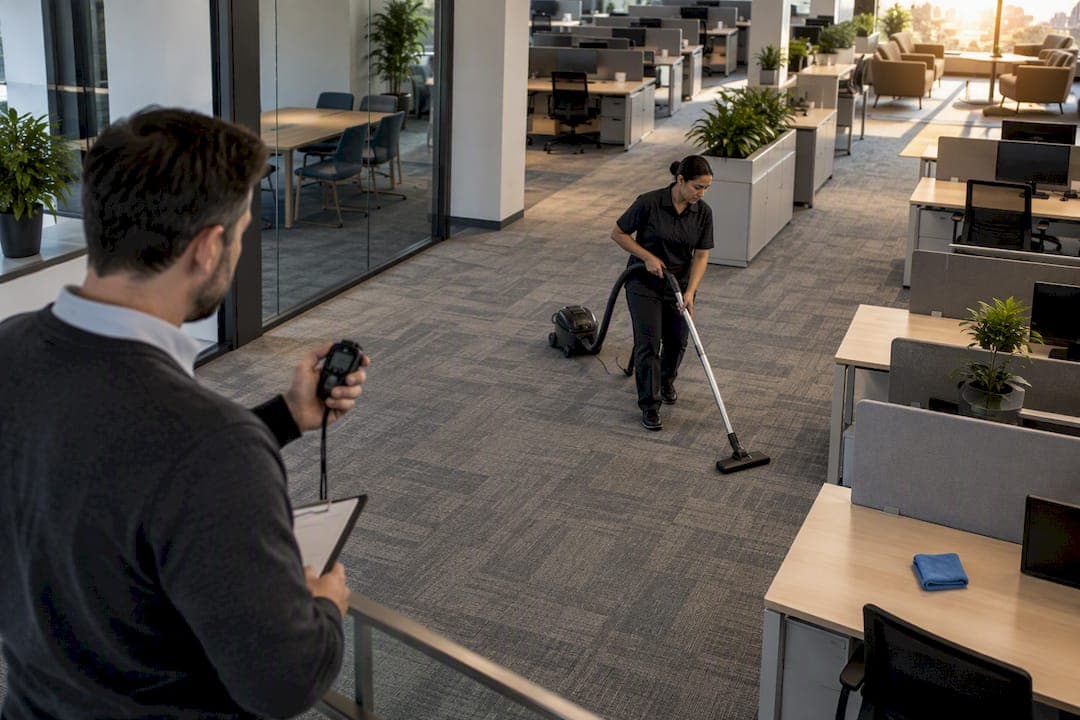
A janitorial production rate measures how much square footage or how many tasks one cleaner completes in an hour, and it's the single number that turns a building's size into a labor cost. Get it wrong by even 10%, and you've misquoted a contract, because labor typically eats 50% to 80% of total janitorial costs. Every bid, staffing plan, and budget conversation starts here.
TL;DR:
- Using accurate, building-specific benchmarks for fixture counts and floor types can prevent underestimating labor time by more than 10 percent.
- Fixed-time tasks like elevator waits and trash-haul distances do not scale with square footage and must be estimated separately to avoid bidding errors.
- Tracking actual hours against estimates monthly improves bidding accuracy by about 5 percent each year, increasing profit margins over time.
- Site visits before quoting help identify fixed-time and fixture items to build more precise, condition-based proposals.
- Production rates measured in tasks or space are starting points; real-world conditions often cause rates to vary by 20 percent or more.
Table of Contents
- What Counts as a Production Rate
- How to Calculate a Production Rate (With a Worked Example)
- What Changes the Rate on Every Real Building
- From Hours to Dollars: Building the Bid
- How Sparkleprocommercialcleaning Applies These Numbers in the Field
- Why Disciplined Measurement Beats Chasing Benchmark Tables
- Get a Rate-Backed Quote Instead of a Guess
- Sources
- FAQ
What Counts as a Production Rate
Production rates come in two flavors, and mixing them up is where a lot of first-time estimators go wrong. Task-specific rates measure minutes per unit, like "3.5 minutes per restroom fixture" or "12 minutes to detail a single-stall bathroom." Comprehensive rates measure square feet per hour for an entire nightly clean, folding vacuuming, trash, dusting, and restrooms into one blended number.
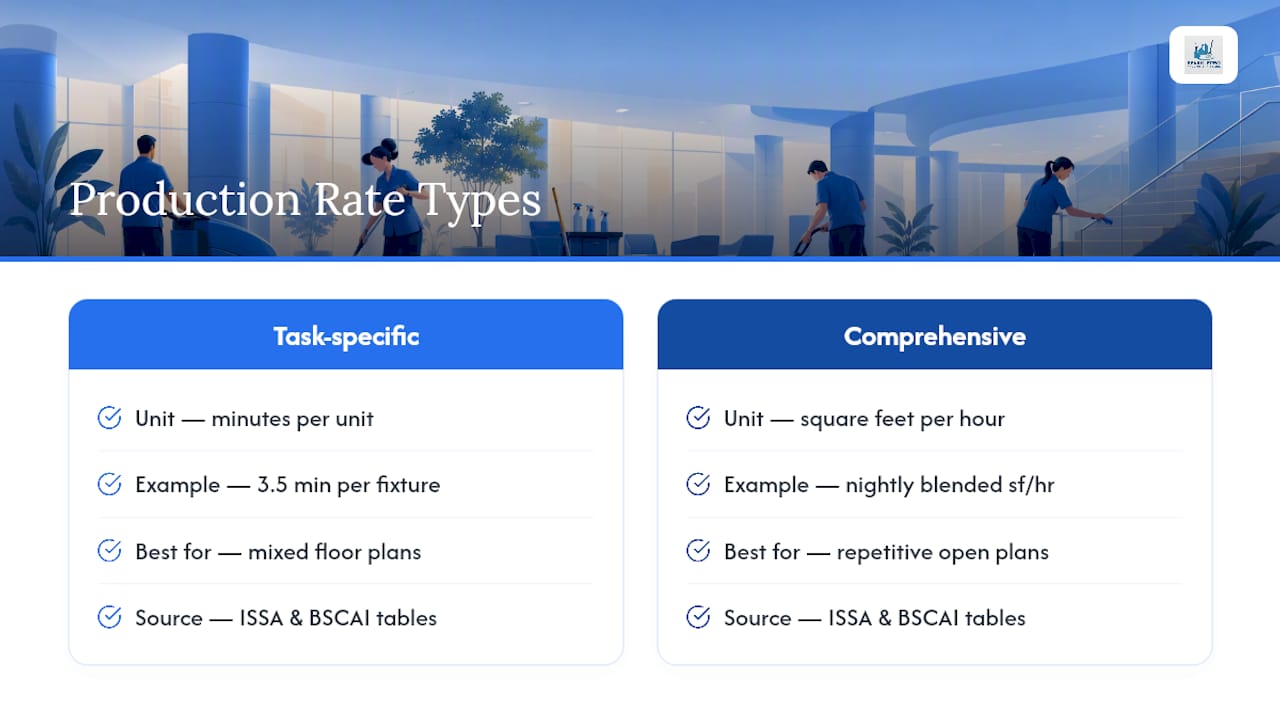
Use task-specific rates when a building has a mixed floor plan, heavy fixture density, or unusual scope, like a medical suite with exam rooms and biohazard protocols. Use a comprehensive sf/hr benchmark when the space is simple and repetitive, like an open-plan office suite with one restroom bank per floor. Both approaches trace back to the same source material: ISSA's cleaning times and BSCAI's estimating guidance build their tables from timed task studies, not guesswork.
How to Calculate a Production Rate (With a Worked Example)
The formula is simple arithmetic once you have a rate: hours = area ÷ (square feet per hour), or in minutes, minutes = (area ÷ rate) × 60. The hard part isn't the math. It's picking the right rate for the space.
Say you're bidding a 25,000 square foot medical office building. Medical space cleans slower than open office space because of exam tables, cabinetry, and infection-control protocols, so a benchmark around 2,600 sf per hour is more realistic than a generic office number, according to Janitorial Manager's estimating guide.
- 25,000 sf ÷ 2,600 sf/hr = 9.6 labor hours per night for the core clean.
- Round up to 10 hours to cover setup and shutdown, not down, since underrounding is how bids quietly lose money.
- Split those hours across one or two cleaners depending on shift-length preferences.
For quick reference, here's how commonly published task and space benchmarks compare:
Small buildings deserve a warning: a 3,000 square foot suite still needs the same restroom setup, trash pull, and drive time as a much larger one, so fixed-time tasks eat a bigger share of the total hour count. Never apply a per-square-foot rate to a small job without adding those fixed minutes separately.
What Changes the Rate on Every Real Building
Published benchmarks are a starting point, not a finished bid. Site conditions push the actual rate up or down, sometimes by 20% or more, and a detailed breakdown of where benchmarks fail points to the same handful of culprits on nearly every job:
- Obstruction density — cubicles, retail fixtures, and equipment slow every pass with a mop or vacuum.
- Floor-type mix — carpet, VCT, polished concrete, and tile each carry different task times.
- Restroom fixture count — more fixtures mean more fixed minutes regardless of square footage.
- Service frequency — nightly cleaning runs faster per visit than a once-a-week deep reset.
- Occupied vs. after-hours service — working around tenants adds courtesy time and interruptions.
- Elevator dependency — waiting for a single freight elevator in a high-rise can cost real minutes per floor.
- Dock and trash-route distance — a long walk to the compactor adds up across dozens of trash pulls.
- Surface condition and consumable restocking — worn floors and empty dispensers both slow the crew down.
Some of these scale with square footage, like floor-type mix. Others are fixed additions regardless of size, like elevator waits or trash-haul distance, and treating a fixed-time factor as if it scales with area is a common bidding mistake. During a walkthrough, count workstations per 1,000 square feet and total fixture counts by type, since those two numbers predict more about real productivity than the building's raw square footage.
Pro Tip: Time the elevator wait and trash-route walk during the actual shift hour you'll be cleaning, not during a daytime site visit. A freight elevator that's free at 2 p.m. can have a ten-minute queue at 10 p.m. when three other tenants are moving out.
From Hours to Dollars: Building the Bid
Once you know labor hours, you need a loaded labor rate, meaning wages plus payroll taxes, benefits, and overhead, to turn hours into a price. You also need a realistic utilization figure, since not every paid hour is billable once you account for training, travel between sites, and no-show coverage.
Here's how the math actually plays out on a bid:
- Calculate labor hours from your production rate (our medical office example: 10 hours per night).
- Multiply by nights per week and weeks per year for annual hours.
- Multiply annual hours by your loaded labor rate to get total labor cost.
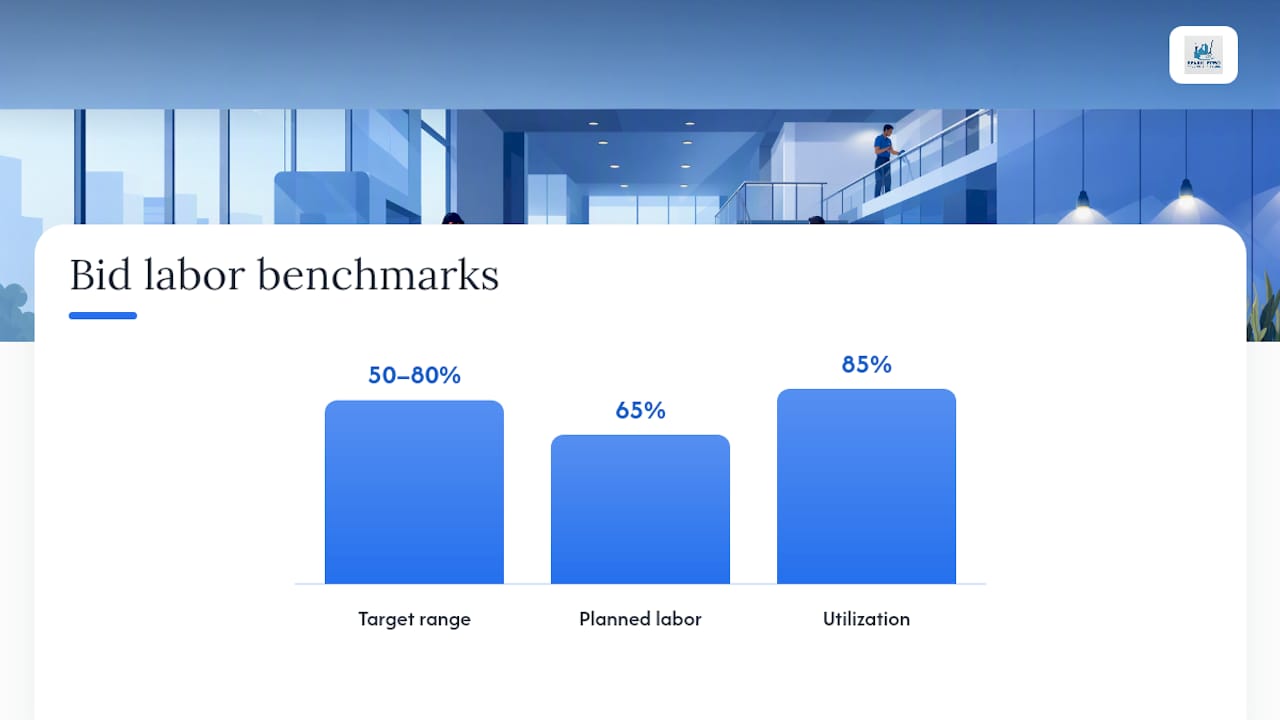
- Divide labor cost by your target labor percentage (commonly landing somewhere in that 50–80% range) to back into total contract price.
- Divide total price by square footage to check your price-per-square-foot against market norms.
A production rate that's off by even 10% doesn't just shave a little margin. If labor is supposed to run 65% of your price and your rate estimate is too optimistic, that 10% error can push actual labor cost past 70%, and now the job is barely breaking even. This is exactly why BSCAI flags production-rate accuracy as a make-or-break factor in competitive bidding. Track actual hours worked against your estimate every month for the first quarter of a new contract, then adjust the rate you use for the next similar building. Utilization benchmarks around 85% billable time are a reasonable planning target for most operators, per CleanerHQ's performance metrics, and they're worth comparing against your own numbers once a contract has a few months of real data behind it. For a fuller picture of how these hourly figures roll into a client-facing quote, see what commercial cleaning really costs.
How Sparkleprocommercialcleaning Applies These Numbers in the Field
Every professional commercial cleaning proposal starts with the same four steps: quote, site visit, scheduled cleaning, and client approval. That site visit exists specifically to catch the fixed-time items a square-footage number can't, restroom fixture counts, trash-haul distance, elevator dependency, before a single hour gets quoted.
Proposals include those fixed-time line items separately from the area-based clean, so clients see exactly what they're paying for. Crews and account managers also track efficiency against the original estimate and re-walk properties on a regular schedule, since a building's floor mix, occupancy, and fixture count all shift over a lease term. For post-construction and post-build jobs specifically, where debris and unfinished surfaces distort every task time, that re-walk discipline matters even more.
Why Disciplined Measurement Beats Chasing Benchmark Tables
Benchmark tables get you in the right neighborhood. They don't tell you what's actually happening on your floors. The operators who protect their margins are the ones who log actual hours against the estimate every month, calculate real efficiency, and adjust the number they use next time.
That habit compounds. A rate that's 5% more accurate on every bid this year is a meaningfully healthier business by next year, not because any single correction was dramatic, but because small, tracked improvements stack. A contractor scorecard built on verified job data does more for your margin over time than another year of memorizing published tables.
— Sales
Get a Rate-Backed Quote Instead of a Guess
Sparkleprocommercialcleaning turns the math in this article into an actual proposal, not a generic per-square-foot number pulled from a table. Every quote ideally starts with a site visit that catches the fixed-time items, fixture counts, trash-haul distance, floor mix, which a benchmark rate alone will always miss, so property managers get a price built on their building's real conditions instead of a national average.
Commercial cleaning services can cover the full range facility managers actually need: routine janitorial contracts, post-construction cleanouts, tenant turn cleans, day porter services, and disinfecting services, typically handled through a process of quote, site visit, schedule, and client approval. If you manage a property in New Jersey, you can see how local crews and site visits work in practice on the New Jersey service page. Ready to trade a guessed number for a walkthrough-backed one? Request a site visit and quote and get a proposal built on your building's actual fixture counts and floor mix, not a generic table.
Sources
For deeper task tables, consult ISSA's Official Cleaning Times, BSCAI's estimating guidance, and APPA's custodial staffing guidelines. Membership in any of these organizations unlocks full task-time tables beyond what's summarized here.
- Commercial Cleaning Production Rates: A Key to Successful Bidding and Estimating
- Janitorial production rates: Where they fail
FAQ
How many square feet can a janitor clean in 8 hours?
At a typical office benchmark of 2,500 to 3,500 square feet per hour, one cleaner can cover a substantial area in an 8 hour shift, though medical space, dense fixtures, or occupied-hours service will reduce productivity.
How many hours does it take to clean a 1,500 square foot house?
Residential cleaning uses different benchmarks than commercial janitorial work, and smaller homes often require a larger share of fixed-time tasks like kitchens and bathrooms compared to what square footage alone suggests.
What is the average turnover rate in the janitorial industry?
Janitorial and building-cleaning roles are widely recognized as high-turnover positions within the broader service labor market, though exact rates vary by region and employer. This volatility is part of why tracking actual production hours against estimates matters. Staffing changes disrupt efficiency until a new crew learns a building's layout.
What is the 20/10 rule for cleaning?
Definitions of this rule vary by source and it isn't a formally published industry standard from ISSA, BSCAI, or APPA. Some practitioners use it informally to describe splitting cleaning time between quick daily maintenance and deeper periodic tasks, but treat it as a rule of thumb rather than a benchmark you'd use in a bid.
Do production rates account for restroom cleaning separately?
Yes. Restroom fixtures are almost always calculated as a fixed-time task, minutes per fixture, rather than folded into a square-footage rate, since fixture count doesn't scale evenly with room size. Sparkleprocommercialcleaning builds these fixed-time items into proposals separately from the area-based clean for exactly this reason.