

The safest way to switch cleaning vendors is a documented plan built around three things: a named transition owner, a 30 to 60 day window with a short overlap period, and a supervised day-one launch. Start now by appointing an owner, confirming your current contract's notice terms, and scheduling a joint walkthrough with both vendors. A printable handover checklist further down covers every artifact you'll need to collect before cutover.
TL;DR:
- The transition plan should designate a single owner responsible for overseeing every step and include a clear, short overlap period of about two weeks for most properties.
- Verify all exit clauses, including notice periods, auto-renewal restrictions, and termination conditions, and document all communications to avoid billing disputes.
- Ensure a comprehensive transfer of keys, access codes, equipment lists, safety data sheets, and compliance documents before the outgoing vendor leaves.
- Conduct supervised day-one operations with detailed photo documentation, clear zone walkthroughs, and regular early QA inspections to set learning benchmarks for the incoming crew.
- Track KPIs such as cleanliness scores, response times, and attendance during the first 30 days, with contractual provisions tying payment approval to successful corrective actions.
Table of Contents
- What to Check in Your Contract Before You Switch Cleaning Vendors
- Building a Janitorial Transition Plan Timeline You Can Copy
- What Documents and Equipment Records You Need to Transfer
- How to Run the Incoming Crew's First Day on Site
- Should You Run an Overlap Period With Both Vendors?
- What KPIs Should You Track in the First 30 Days?
- The Handover Checklist to Use on Cutover Day
- Training New Janitorial Staff Without Losing Institutional Knowledge
- Health and Safety Compliance You Can't Skip During Handover
- Keeping Equipment and Supplies Running Through the Switch
- Author Perspective: The Small Moves That Prevent Big Failures
- How Sparklepro Handles a Managed Janitorial Transition
- Sources
- FAQ
What to Check in Your Contract Before You Switch Cleaning Vendors
Before you notify your current provider, read the exit terms closely. Most janitorial contracts hide their real cost of leaving in three clauses: the notice period (30, 60, or 90 days is common), auto-renewal language that can silently lock you in for another term, and termination-for-cause provisions that require documented performance failures before you can exit early without penalty.
Put your notice request in writing, even if a phone call comes first, and name exactly what you're asking for.
- A written notice letter citing the specific contract clause you're invoking
- A request for a final invoice reconciliation and any credits owed
- A named offboarding contact at the incumbent company
- Confirmation of the last service date and any transition-assistance obligations in the contract
Loop in procurement or accounting early, since they'll need to close out the old purchase order, and keep legal informed if the contract includes exit fees or liquidated-damages language. Save every email. If a dispute over final billing comes up later, that paper trail is your leverage.
Building a Janitorial Transition Plan Timeline You Can Copy
A step-by-step timeline that runs from vendor selection through the first 30-day review is what keeps a janitorial service change from turning into a service gap. Plan backward from your target cutover date, and give yourself the full runway before sending notice.
- Weeks 1 to 2: Finalize vendor selection, sign the new scope of work, and appoint your transition owner.
- Week 3: Send formal notice to the incumbent and confirm the last service date in writing.
- Weeks 4 to 5: Run the joint site walkthrough, transfer documentation, and issue keys and access credentials to the incoming team.
- Week 6: Launch supervised day-one operations with the incoming crew while the incumbent remains on call.
- Weeks 7 to 8: Run the overlap period, then formally cut over.
- Days 30 to 60 post-cutover: Conduct the first full evaluation against your KPIs.
Add one to two buffer weeks for regulated facilities like healthcare campuses, and add a full extra week per site for multi-site portfolios so you can stagger onboarding instead of running it all at once.
What Documents and Equipment Records You Need to Transfer
A clean vendor transition checklist starts with an inventory audit, not a phone call. Before the incumbent walks off site, you need physical control of everything that keeps the building running.
- All keys, fobs, access cards, and alarm codes, logged by location
- A full equipment list, including make, model, and condition of any machines owned by the property
- Current supply inventory counts, so the incoming vendor isn't caught short on day one
- Vendor manuals, safety data sheets, and any facility-specific cleaning protocols
- Certificates of insurance and other vendor compliance documents, filed before the incumbent leaves
Use a shared password vault for any digital access transferred between vendors, and require a signed receipt confirming what was handed over and when. A contractor compliance checklist built around named artifacts, rather than a verbal handoff, closes most of the gaps that cause disputes later.
Pro Tip: Photograph every key ring, access card, and equipment tag before handing anything to the incoming crew. It takes ten minutes and settles almost any "who has what" argument that comes up in week two.
How to Run the Incoming Crew's First Day on Site
Day one sets the baseline for everything that follows, and it needs structure, not improvisation. Photo documentation paired with start and end walkthroughs establishes an objective record that both sides can point to if a quality dispute comes up later.
- Run a pre-visit scope walkthrough with the incoming lead and your facilities representative, confirming zones, frequencies, and priority areas.
- Photograph every area before work begins, timestamped and organized by room or zone.
- Supervise the first full shift directly, taking notes on technique, coverage, and pace.
- Walk the site again at shift end, comparing against the start-of-shift photos.
- Document any gaps in writing immediately, not days later, and send them to the incoming lead the same day.
From there, set a standing QA cadence. Weekly inspections for the first month, biweekly after that, with a simple written report format and a clear escalation path if a zone fails twice in a row. That short supervised shift, backed by photos, is what speeds up corrective actions in the critical first 30 days and keeps disagreements from dragging on.
Should You Run an Overlap Period With Both Vendors?
Yes, and it should last about two weeks for most single-site properties. A documented overlap where the outgoing vendor stays responsible for incidents while the incoming team handles discovery lets the new crew learn the building without any risk of an uncovered shift.
- The incumbent keeps handling live incidents and emergency calls during the overlap
- The incoming crew shadows, learns floor plans and equipment locations, and starts closing minor tickets under supervision
- Supervised handoffs happen at shift changes, with both leads present for at least the first week
Set rollback triggers before you start, not after something goes wrong: repeat failures on the same checklist item, missed response-time KPIs, or access and key problems that go unresolved after 48 hours should all trigger either an extension of the overlap or a temporary revert to the incumbent. Budget the overlap as a short-term insurance cost. Two extra weeks of paying both vendors is far cheaper than a lobby that goes uncleaned for three days.
What KPIs Should You Track in the First 30 Days?
Your first 30 days should be treated as a probation period with real teeth, not a formality. A structured 30-day evaluation window built into the original timeline is what makes the corrective-action process enforceable instead of a shrug.
- Cleanliness scores from scheduled inspections, scored against a written checklist
- Response time to service requests, tracked from ticket to resolution
- Checklist pass rate across all zones, not just high-visibility ones
- Staff attendance and consistency of the assigned crew
Document every failure in writing with a date, location, and photo, and require a corrective action plan with a specific timeline and a follow-up verification date. Build payment gating into the contract itself. Withhold final approval of the first invoice cycle until the corrective actions are verified closed.
Pro Tip: Write the acceptance language into the contract before signing, something like "final approval contingent on satisfactory completion of the 30-day evaluation period." It gives you real leverage if week three goes sideways.
The Handover Checklist to Use on Cutover Day
A formal handover checklist covering named artifacts, returned equipment, and payment gating is standard practice for a reason: it turns a fuzzy handoff into a signed, verifiable event. Print this and walk it item by item on Day 0 and Day +1.
- Outgoing vendor returns all keys, fobs, and access devices
- Outgoing vendor submits a final invoice and any credit reconciliation
- Incoming vendor provides a current certificate of insurance and signed W9
- Incoming vendor confirms staff IDs, the agreed schedule, and initial supply stock
- Both parties sign off on the equipment inventory as accurate
| Handover item | Who confirms it | Verified by |
|---|---|---|
| Keys and access devices | Facilities manager | Signed receipt |
| Certificate of insurance | Transition owner | Filed copy on record |
| Final invoice and credits | Accounting | Reconciled statement |
| Supply inventory count | Incoming crew lead | Walkthrough sign-off |
Keep one escalation contact named on the sign-off sheet itself, so nobody has to guess who to call if something's missing after the incumbent has already left the building.
Training New Janitorial Staff Without Losing Institutional Knowledge
Every building has quirks that never make it into a scope-of-work document. The loading dock code that only works after 6 p.m., the third-floor supply closet that's technically labeled wrong, the tenant who complains if the lobby isn't done by 7:30 sharp. Losing that knowledge during transitioning cleaning staff is what causes most of the friction in month one.
Break the transfer into short, specific sessions instead of one long walkthrough. A teach-back approach, where the incoming crew explains a procedure back to you rather than just nodding along, catches gaps in understanding before they become mistakes on the floor. Record short videos of specialized procedures, floor machine operation, chemical dilution ratios, alarm disarm sequences, so the knowledge survives even after the person who explained it moves on.
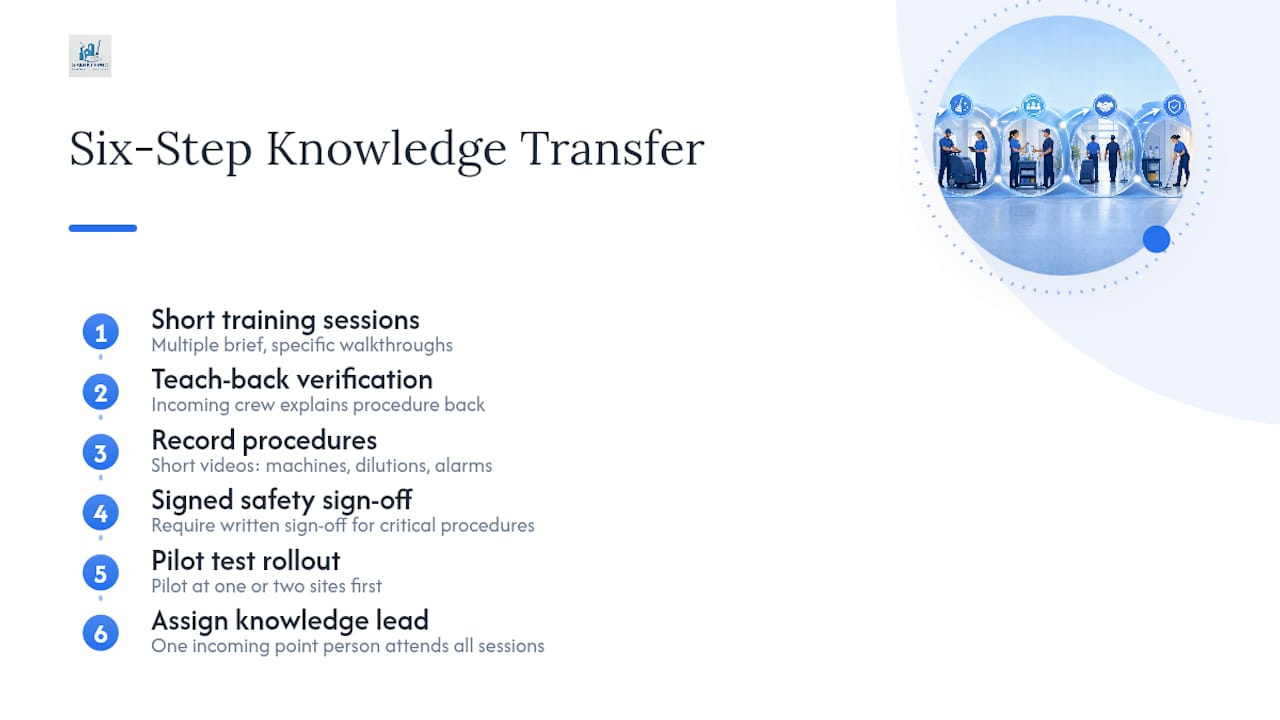
Require signed sign-off on any critical safety procedure, not just a verbal "got it." For larger portfolios, pilot the training approach at one or two sites before rolling it out everywhere. Testing onboarding materials on a small group first surfaces gaps in your training documents while the stakes are still low, and you can fix the materials before forty sites are running on a flawed process.
Assign one point person on the incoming team as the institutional-knowledge lead. That person should sit through every teach-back session and become the go-to reference once the incumbent is gone for good.
Health and Safety Compliance You Can't Skip During Handover
Safety compliance during a vendor change is where most of the real liability sits. If the incoming crew doesn't have current safety data sheets, doesn't know your chemical storage protocols, or hasn't been briefed on facility-specific hazards, you're exposed the moment they start working, not weeks later when an incident finally gets reported.
Confirm SDS binders are physically transferred and current, not just referenced verbally. Verify the incoming vendor's crew has documented training on chemical handling, blood-borne pathogen exposure if the site includes restrooms or healthcare zones, and lockout/tagout procedures for any equipment they'll operate. Get proof of OSHA-required training on file before the first shift, not after.

Healthcare facilities, cleanrooms, and any site with regulated waste streams need an extra layer of scrutiny. Confirm the incoming vendor's environmental service credentials match what the outgoing vendor had on file, and don't assume equivalence. Reviewing safety and equipment requirements in detail before day one prevents the awkward scenario where a compliance gap gets discovered during an inspection instead of during your own audit.
Document every safety briefing in writing, with a signature from each crew member. If OSHA or a facility inspector ever asks for proof of training, "we told them verbally" isn't an answer that holds up.
Keeping Equipment and Supplies Running Through the Switch
A transition that nails the paperwork but leaves you short on floor machines or trash liners in week two still counts as a failure. Equipment and supply continuity deserves its own line item in the plan, not an assumption that the new vendor will "figure it out."
Confirm upfront whether equipment stays with the building or leaves with the outgoing vendor. Buffers, extractors, and auto-scrubbers are often owned by the property, but not always, and finding out on day one is too late. Get a written equipment list with condition notes before the incumbent leaves, and have the incoming vendor sign off on that same list during the walkthrough.
Supply chain continuity matters just as much. Ask the incoming vendor how they source paper products, chemicals, and liners, and confirm their lead times before cutover, not after a shortage hits. A facility management plan that assumes supplies will simply appear on schedule is the same plan that runs out of hand soap during a leadership tour.
Build a 60-day buffer stock into the transition budget if your building runs on tight supply margins, retail centers and healthcare facilities especially. That buffer covers you if the new vendor's ordering system has a hiccup in its first cycle, which happens more often than most facilities managers expect.
Author Perspective: The Small Moves That Prevent Big Failures
Timing is underrated. Avoid switching vendors during your region's high-demand season, spring pollen cleanup, or year-end retail traffic, when everyone's stretched thin and a rough patch gets misread as vendor failure instead of bad timing.
The single biggest predictor of a smooth switch isn't the contract language. It's whether one person owns the transition and runs a weekly steering check-in. Photo baselines, teach-back verification, and short supervised shifts cost almost nothing and catch most problems before they become disputes.
— Sales
How Sparklepro Handles a Managed Janitorial Transition
A professional commercial cleaning service is designed for a handoff like this guide describes: with a structured onboarding workflow and a 30-day QA window built into new engagements to reduce risk during cutover.

Getting started follows a straightforward four-step process: request a quote, host a site visit so the team can scope your building firsthand, get on the schedule, and sign off once the work meets your standard. That structure mirrors the overlap and evaluation approach covered above, minus the burden of managing two vendors yourself. Facilities managers running an onboarding schedule built around early baseline metrics tend to catch issues faster in month one, and Sparkleprocommercialcleaning's day-one documentation and QA checks are designed around that same principle.
If your building is in Delaware, request a site visit and quote for your property to see how a managed transition would run for your specific facility.
Sources
- Switching Commercial Cleaning Companies Without Disruption
- The MSP Transition Checklist: How to Switch Providers Without Downtime | Virteva
- Handover to New Vendor Sample Checklist
FAQ
What Should Be Included in a Transition Plan?
A complete janitorial transition plan includes a signed contract review, a week-by-week timeline, a documentation and equipment handover checklist, a supervised day-one launch, an overlap period with defined rollback triggers, and a 30-day KPI evaluation before final acceptance.
Can You Provide an Example of a Transition Plan?
A typical example runs six to eight weeks: two weeks for vendor selection and contract signing, one week for formal notice, two weeks for documentation transfer and walkthroughs, a two-week supervised overlap, and a 30-day evaluation window before the new vendor is fully accepted.
How Do You Create a Transition Plan?
Start by naming a single transition owner, then build a timeline backward from your target cutover date, covering contract notice, documentation handoff, a supervised overlap, and a defined evaluation period with measurable KPIs. Some commercial cleaning providers structure new client onboarding around this sequence, including a 30-day review.
How Long Should the Overlap Period Last?
Two weeks works for most single-site commercial properties, giving the incoming crew time to learn the building while the outgoing vendor remains responsible for incident response. Larger or regulated facilities often need three to four weeks.