

The most effective step-by-step cleaning plan for property managers follows five phases: define the scope of work (SOW), set measurable quality standards and SLAs, lock in pricing and contract terms, run a structured procurement, then operate with scheduled audits and a clear escalation path.
- Define what gets cleaned (SOW matrix: areas × tasks × frequency)
- Set measurable quality standards, inspection scoring, and SLA thresholds
- Choose a pricing model and write contract terms that prevent scope drift
- Run procurement: RFP, mandatory walkthroughs, scored evaluation, award
- Operate with communication rhythms, issue logs, and quarterly reviews
Key Takeaways
A complete step-by-step cleaning plan for property managers requires a written SOW matrix, measurable SLAs with cure periods, a scored procurement process, and a 30-60-90 onboarding audit before the contract reaches steady state.
| Point | Details |
|---|---|
| SOW matrix first | Map cleanable square footage and build an areas × tasks × frequency matrix before issuing any RFP. |
| Two SLAs to start | Set a minimum inspection score (85 pass threshold) and a cure window (24–48 hours) as your first two enforceable SLAs. |
| Mandatory walkthroughs | Require every bidder to walk the facility and return a marked-up floor plan with their proposal. |
| 30-60-90 audit discipline | Run scored inspections at Day 30 and Day 60; any score below 85 triggers a written corrective action plan. |
| Sparkleprocommercialcleaning | Implements SOW matrices, SLA-backed inspection scoring, and 30-60-90 onboarding across nationwide commercial properties. |
Table of Contents
- How does a step-by-step cleaning plan actually work for property managers?
- Step 1: Define exactly what gets cleaned
- Step 2: How do you set quality standards that vendors must meet?
- Step 3: How pricing works and what contract terms protect you
- Step 4: Procurement — the five questions to answer before you award
- Step 5: Operating the contract day to day
- SOW templates and daily, weekly, and monthly cleaning checklists
- Onboarding a new contractor and running the 30-60-90 audits
- When should you call in specialized cleaning?
- What good looks like from a nationwide commercial cleaner
- Sparkleprocommercialcleaning supports your plan from day one
- Sources
How does a step-by-step cleaning plan actually work for property managers?
The plan works because it forces decisions in the right order. Most quality problems trace back to a scope that was never written down, or an SLA that was never defined. Fix the upstream document and the downstream problems shrink.
According to Facility Management Insights, a practical sourcing process must answer five questions before award: what gets cleaned, how well it must be cleaned, how pricing works, how issues get corrected, and who can safely be in your building. Every section of this guide answers one of those five.
Step 1: Define exactly what gets cleaned
Cleanable square footage is not the same as gross area. A 50,000 sq ft office building may have 32,000 sq ft of cleanable space once you subtract mechanical rooms, elevator shafts, and tenant-excluded zones. Map those zones first.
Build the SOW as a matrix: areas down the left, tasks across the top, frequency in each cell. A standardized SOW matrix makes bids comparable and prevents scope drift from the first day of service.
Core areas to include in every commercial SOW:
- Restrooms (fixtures, floors, dispensers, partitions)
- Lobbies and common corridors (floors, glass, high-touch surfaces)
- Breakrooms and kitchenettes (appliances, counters, sinks, trash)
- Open office and workstation areas (desks, phones, keyboards on request)
- Conference rooms (tables, chairs, whiteboards, AV equipment surfaces)
- Stairwells and elevator cabs
- Loading docks and service corridors (frequency varies)
Sample SOW matrix structure:
Pro Tip: Require every bidder to mark up a floor plan during their site walkthrough and return it with their proposal. A vendor who cannot identify your mechanical room or your tenant-excluded zones has not actually priced your job.
Step 2: How do you set quality standards that vendors must meet?
Inspection scores are the backbone of any enforceable SLA. A pass/fail checkpoint system, scored on a 100-point scale, converts subjective complaints into objective contract triggers. Set a minimum inspection score as a pass threshold for routine service; scores below a defined lower limit on multiple consecutive inspections should trigger a formal cure notice.
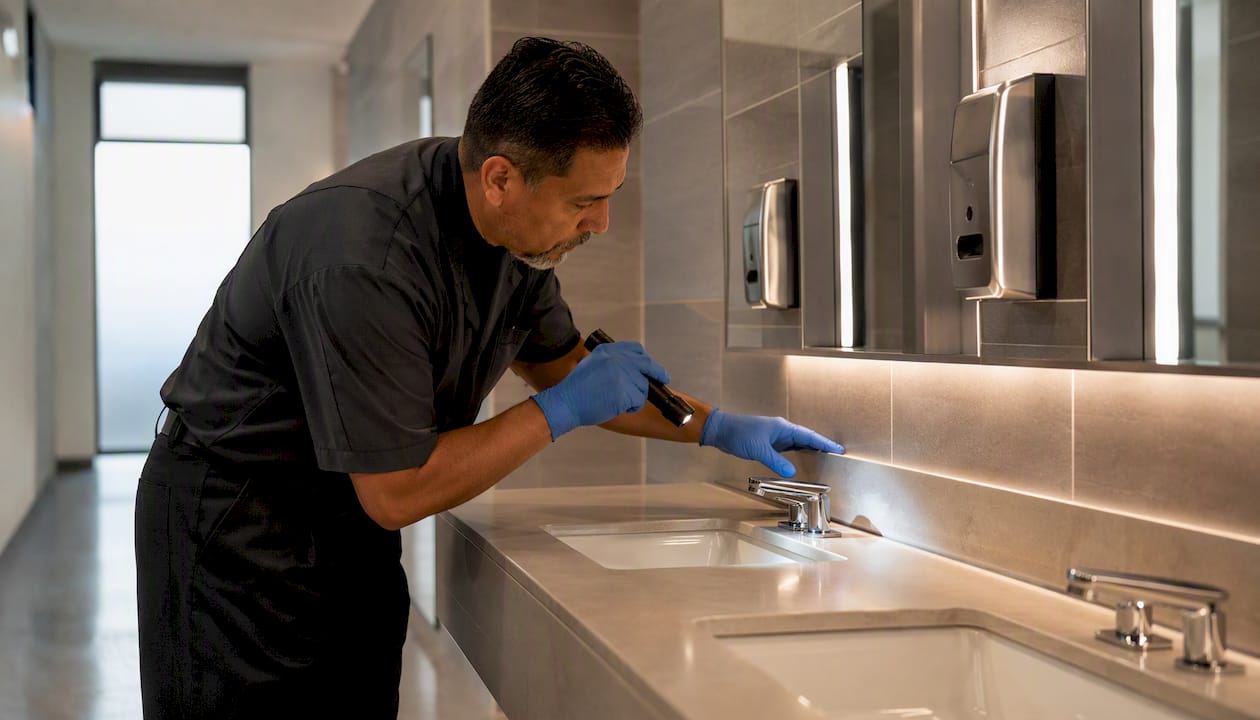
Combining scheduled supervisor walkthroughs with randomized spot checks and photo documentation is the most reliable way to prove consistency and shorten dispute resolution.
Sample inspection scoring rubric:
| Score range | Status | SLA action |
|---|---|---|
| 90–100 | Exceeds standard | No action required |
| 85 | Meets standard | Document and monitor |
| 75 | Below standard | Written notice; 48-hour cure |
| Below 85 | Fail | Formal cure notice; remediation within 24 hours |
Key SLA clauses to include:
- Acknowledgment window: vendor must confirm receipt of a complaint within 2 hours
- Cure period: corrective re-clean within 24 hours for a critical miss, 48 hours for routine
- Repeat-miss threshold: two fails in any 30-day period triggers a performance review meeting
- Credit mechanism: missed service not cured within the window earns a prorated invoice credit
Pro Tip: Schedule one supervisor walkthrough per week and run at least two unannounced spot checks per month. Vendors who know inspections are random maintain standards between scheduled visits.
Step 3: How pricing works and what contract terms protect you
Three pricing models cover most commercial cleaning contracts. Per-square-foot pricing works well for large, uniform spaces like open offices or retail floors. Flat monthly fees with a labor and supply breakdown suit multi-zone properties where the scope is stable. Hourly or crew-based pricing fits variable-frequency work like post-construction or periodic deep cleans.
Pricing model comparison:
| Model | Best fit | Watch for |
|---|---|---|
| Per square foot | Large, uniform spaces | Excludes specialty tasks |
| Flat monthly fee | Stable multi-zone scope | Scope creep without change orders |
| Hourly/crew-based | Variable or one-time work | Runaway hours without a cap |
Contract terms every property manager needs:
- COI requirement: vendor names your facility as additional insured before day one
- Supplies ownership: specify who owns chemicals and equipment on-site
- Renewal and termination: 30-day written notice minimum; auto-renewal opt-out clause
- Change-order triggers: any scope addition over a defined threshold (e.g., a new floor or a post-flood cleanup) requires a written change order with a price and timeline before work begins
- Response-time commitment: written into the body of the contract, not just the proposal
Step 4: Procurement — the five questions to answer before you award
A defensible janitorial RFP evaluates every bid against the same criteria — scope, qualifications, pricing structure, and accountability — and requires a COI naming the facility as additional insured before the first service date. The single biggest mistake is specifying frequency without scope.
RFP package checklist:
- SOW matrix (areas, tasks, frequencies, exclusions)
- Pricing sheet template (unit rates, supply costs, extras)
- COI sample showing required limits and additional insured language
- Site constraints memo (access hours, security protocols, restricted zones)
- Proposal form with mandatory fields (staffing plan, supervision ratio, W-2 vs. subcontract)
Requiring every bidder to walk the facility before pricing is the highest-leverage filter in procurement. A vendor's questions during the walkthrough reveal how accurately they understand the job.
Sample vendor scoring matrix:
Procurement timeline: Issue RFP → 5-day walkthrough window → proposals due → 3-day evaluation → reference checks → award → onboarding kickoff.
Pro Tip: Ask each vendor what they noticed during the walkthrough that was not in your RFP. The ones who caught something real are the ones who priced it correctly.
Step 5: Operating the contract day to day
Communication rhythm matters as much as the contract language. Request a brief daily completion report for high-frequency services, a weekly ops check-in for issue tracking, and a quarterly business review (QBR) to assess trend data and adjust scope.
Escalation path and timelines:
- Occupant complaint logged in the issue tracker (timestamp required)
- Vendor acknowledgment within 2 hours
- Remediation completed within the cure window (24 or 48 hours per SLA)
- Closure confirmed with photo documentation
- Two unresolved misses in 30 days trigger a performance review meeting
- Three misses in 60 days trigger a formal cure notice with a 10-day response deadline
Operational controls to maintain:
- Supervisor site visits: minimum once per week, logged and dated
- Substitute staffing: vendor must notify you before sending a substitute crew
- COI renewal: track expiration dates; require updated certificate 30 days before expiry
- Access control: maintain a signed key/badge log; revoke access within 24 hours of contract end
A baseline photo library and documented issue log make disputes over missed service objective and shorten resolution time considerably. Bring issue log data into every QBR so one-off misses become visible as trends before they become contract failures.
SOW templates and daily, weekly, and monthly cleaning checklists
Downloadable checklists and inspection forms let facility teams attach operational expectations directly to the contract and make payment conditional on documented completion.
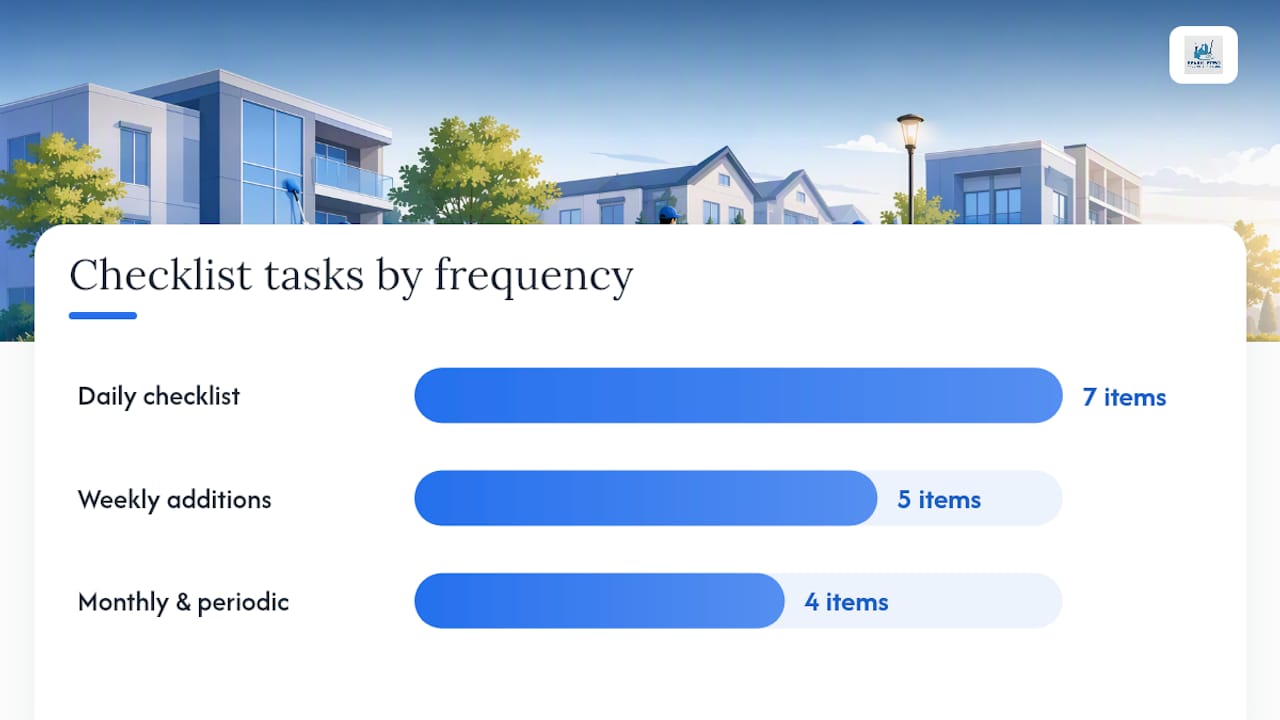
Sample daily checklist (restrooms and lobby):
- Empty all trash and replace liners
- Disinfect toilets, urinals, sinks, and counters
- Restock soap, paper towels, and toilet paper
- Mop restroom floors with disinfectant solution
- Sweep and mop lobby floors
- Wipe lobby glass doors (interior and exterior)
- Sanitize elevator buttons and lobby door handles
Sample weekly additions:
- Vacuum all carpeted areas
- Dust horizontal surfaces (windowsills, ledges, partition tops)
- Clean breakroom appliance exteriors
- Wipe conference room chairs and table bases
- Spot-clean interior glass partitions
Monthly and periodic items:
- High-dust (ceiling vents, light fixtures, tops of cabinets)
- Floor care: specify floor type, finish schedule, and approved equipment in the SOW to prevent cost disputes
- Deep-clean breakroom appliances (interior microwave, refrigerator)
- Pressure-wash building entry and loading dock (quarterly)
For multifamily properties, add tenant move-out cleaning as a separate line item with its own checklist and acceptance sign-off. For healthcare-adjacent spaces, add disinfection protocols and approved chemical lists as attachments.
Onboarding a new contractor and running the 30-60-90 audits
A structured onboarding plan with early check-ins and a baseline audit in the first 30–90 days prevents most long-term performance problems.
30-60-90 onboarding milestones:
- Day 1–7 (Startup): Kickoff meeting, COI on file, keys and badges issued, cleaning closet stocked and inventoried, product approvals signed, supervisor introductions completed
- Day 8–30 (Shadowing): Property manager or facility director accompanies supervisor on two walkthroughs; daily completion reports reviewed; any scope gaps documented
- Day 31–60 (Baseline audit): Formal scored inspection using the rubric from Step 2; results shared with vendor in writing; any score below 85 triggers a corrective action plan
- Day 61–90 (Handover): Second scored audit; if both audits pass, transition to normal operating cadence; if not, extend the review period by 30 days
Baseline audit template criteria:
Pro Tip: Run the baseline audit at the end of the first full service week, not after the first night. One clean does not reveal patterns; a week of data does.
When should you call in specialized cleaning?
Specialty triggers fall into four categories: post-construction debris, bloodborne pathogen or biohazard events, HVAC contamination or mold remediation, and healthcare-adjacent or cleanroom needs.
Certification and insurance checklist for specialty vendors:
- OSHA Bloodborne Pathogen training (29 CFR 1910.1030) for biohazard events
- Respirator fit-test documentation for HAZMAT or mold work
- Higher COI limits (typically $2M general liability minimum for remediation work)
- State-specific contractor license where required
- Construction cleaning safety compliance documentation for post-construction scopes
Specialty event triage flow:
- Assess: identify the trigger type and affected zone
- Isolate: restrict access to the affected area immediately
- Notify: alert your insurer and building security before authorizing any cleanup
- Authorize: issue a written change order or a separate specialty contract before work begins
Use a change order for a one-time event within an existing vendor relationship. Use a separate specialty contract when the scope, certification requirements, or liability exposure falls outside your routine cleaning agreement.
What good looks like from a nationwide commercial cleaner
The property managers who get the most consistent results are not the ones with the longest contracts. They are the ones who set the inspection cadence in writing before the first service date and actually run it.
The most predictable cause of quality drift on multi-site accounts is supervision gaps, not crew skill. When a supervisor covers too many sites, walkthroughs get skipped. The fix is contractual: require a minimum supervisor-to-site ratio and log every visit. A nationwide provider maintains consistency across regions by standardizing the inspection form and the escalation path, not by hoping local crews perform uniformly.
One corrective-remediation sequence worth noting: a facility director at a mixed-use property flagged three consecutive restroom misses in the issue log. Because the log existed, the pattern was visible in under two weeks. The vendor received a formal cure notice, reassigned the supervisor, and passed the next two inspections. Without the log, the same situation typically runs for two to three months before anyone escalates. The issue log is not paperwork. It is the mechanism that makes the SLA real.
Sparkleprocommercialcleaning supports your plan from day one
Property managers who have built the SOW matrix, set the SLAs, and run the procurement still need a vendor who can actually execute the plan at scale.
Sparkleprocommercialcleaning delivers nationwide commercial cleaning across offices, retail centers, multifamily properties, industrial facilities, and healthcare-adjacent spaces. The engagement follows four steps: quote, site visit, scheduled cleaning, and customer approval. Every engagement includes a documented SOW aligned to the matrix format in this guide, measurable SLAs with inspection scoring, and a 30-60-90 onboarding plan. Post-construction cleanouts, tenant move-out cleaning, disinfecting, and day porter services are all within scope. Request a quote or schedule a site visit for your property in Massachusetts, Washington, or Delaware and get a baseline audit scheduled within the first 30 days.
Sources
- Secure High-Quality Commercial Cleaning Contracts – Facility Management Insights