
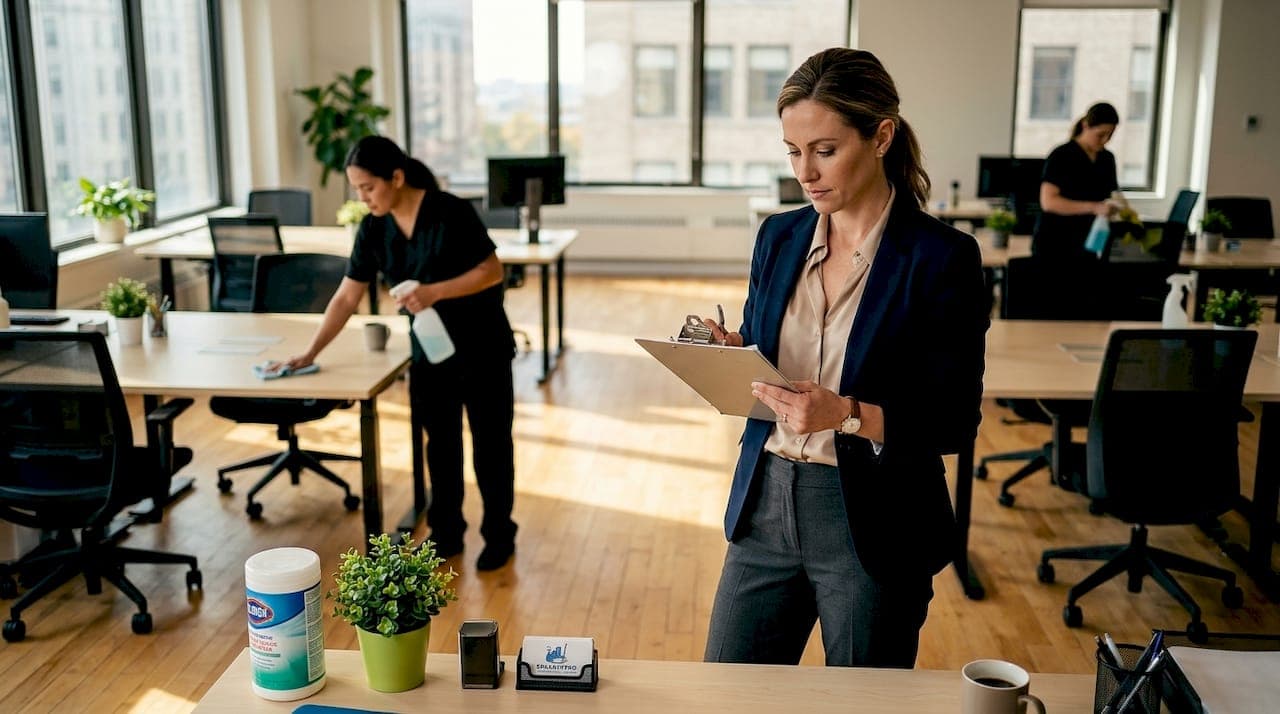
Open office cleaning strategies are not one-size-fits-all. The shared surfaces, constant foot traffic, and overlapping workstations that define modern open offices create hygiene risks that traditional cleaning approaches simply miss. When dozens of employees share keyboards, conference phones, and coffee machines, germs travel fast and illness spreads faster. This article gives you a practical, prioritized framework for keeping your open office genuinely clean, from choosing the right tools to building the policies that make cleanliness stick every single day.
Table of Contents
- Key takeaways
- 1. Open office cleaning strategies: building your evaluation framework
- 2. Daily disinfection of high-touch surfaces
- 3. Strategic placement of hand hygiene stations
- 4. Robotic and automated tools for floor maintenance
- 5. Comparison of manual vs. automated cleaning methods
- 6. Building and enforcing a clean desk policy
- 7. Scheduled deep cleaning and its role in your routine
- 8. Addressing overlooked germ hotspots
- 9. Maintenance practices that sustain long-term cleanliness
- My honest take on open office cleaning
- How Sparkleprocommercialcleaning supports your open office cleaning program
- FAQ
Key takeaways
| Point | Details |
|---|---|
| Target high-touch surfaces daily | Desks, keyboards, and shared equipment carry far more bacteria than most managers realize. |
| Combine manual and automated methods | Pairing microfiber disinfecting with robotic floor tools cuts time without sacrificing coverage. |
| Enforce a clean desk policy | Clutter-free desks allow cleaning staff to disinfect fully and consistently every shift. |
| Schedule deep cleaning regularly | Weekly or biweekly deep cleans address furniture, electronics, and areas daily routines miss. |
| Engage employees as partners | Staff hygiene habits and professional services together produce the best long-term results. |
1. Open office cleaning strategies: building your evaluation framework
Before you buy supplies or assign schedules, you need a framework for deciding what your office actually requires. Not every cleaning tip for open offices applies equally to a 20-person startup and a 300-person corporate floor.
Start by defining your priorities across six criteria:
- Coverage of high-touch surfaces. Does your current approach address keyboards, door handles, elevator buttons, and shared monitors, not just floors and trash bins?
- Frequency. Cleaning schedules vary based on office size and usage, but most high-touch and common areas benefit from daily attention.
- Sanitation efficacy. Understand the difference between cleaning (removing visible dirt), sanitizing (reducing bacteria to safe levels), and disinfecting (killing pathogens). Open offices often need all three at different frequencies.
- Disruption to workflow. Cleaning during business hours requires quiet tools and minimal intrusion. After-hours cleaning allows more thorough work.
- Cost and staffing. Automated tools cost more upfront but reduce ongoing labor. Manual methods scale with staff size.
- Environmental impact. Green products protect air quality and reduce chemical exposure for employees who sit feet away from cleaned surfaces.
You also need clear policies alongside these criteria. A clean desk policy reduces clutter and gives cleaning staff full surface access. Sickness protocols, such as staying home with symptoms, directly reduce the pathogen load your cleaning routine has to manage.
2. Daily disinfection of high-touch surfaces
This is the non-negotiable foundation of any open office sanitation plan. Office desks carry 400 times more bacteria than a toilet seat. That number should permanently change how you think about desk cleaning.
Microfiber cloths combined with disinfectants effectively remove viruses and kill bacteria across desks, monitors, keyboards, and phones. Assign color-coded cloths to different zones so that the cloth used on restroom surfaces never touches a workstation.
Make disinfecting wipes and sanitizer spray accessible at every workstation cluster, not just in the kitchen. When employees can grab a wipe in 10 seconds, they actually do it. This turns individual desks into self-maintained zones between professional cleaning visits.
Pro Tip: Stock single-use wipe dispensers at printer stations, conference room entry points, and reception desks. These are the highest-traffic zones and the ones employees overlook most often.
3. Strategic placement of hand hygiene stations
Hand hygiene is one of the most cost-effective open office sanitation techniques available. Combining employee hand-washing habits with professional cleaning measurably reduces illness rates in office environments.
Place hand sanitizer dispensers at every entry and exit point, beside every shared device (printers, copiers, coffee machines), and at conference room doorways. The goal is to remove friction. If someone has to walk to a sanitizer station, they will skip it. If it is mounted beside the device they just used, they will use it.
Touch-free dispensers matter here. Shared pump bottles become germ vectors themselves if employees touch the same pump repeatedly throughout the day.
4. Robotic and automated tools for floor maintenance
Floors in open offices accumulate crumbs, dust, and tracked-in debris at a rate that manual vacuuming alone struggles to keep up with. Robotic vacuum and mop devices use smart navigation and strong suction to maintain floors effectively with minimal disruption to staff.
The practical advantage for office managers is scheduling. You can run robotic floor cleaners during lunch breaks or at the end of the day without pulling a janitor away from higher-priority tasks. Many models integrate with building management apps and send completion reports, which simplifies compliance documentation.
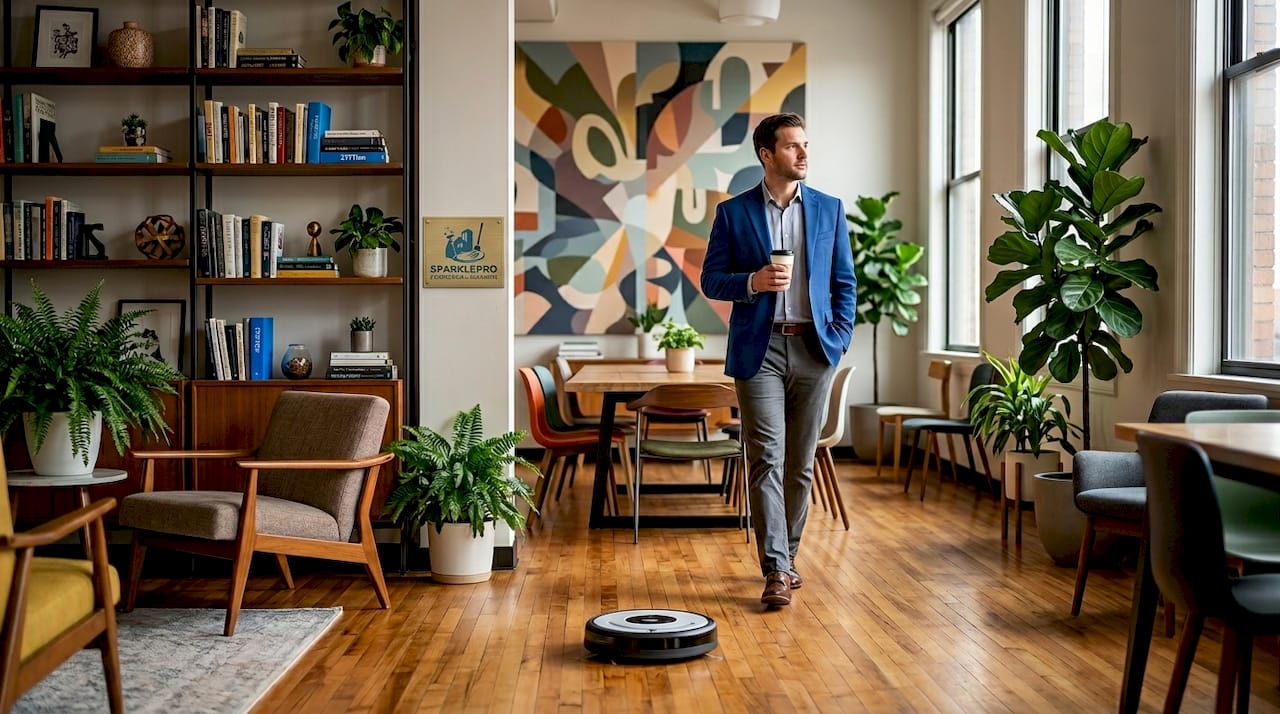
Robotic tools work best as supplements to, not replacements for, weekly manual vacuuming of high-pile carpets and corner areas that smart navigation sometimes misses.
5. Comparison of manual vs. automated cleaning methods
Choosing between manual and automated approaches involves trade-offs across several dimensions. The table below gives you a clear side-by-side view.
| Factor | Manual cleaning | Automated/robotic cleaning |
|---|---|---|
| Upfront cost | Low | Medium to high |
| Ongoing labor cost | Higher | Lower over time |
| Surface coverage | High (with trained staff) | Moderate (floors, flat surfaces) |
| Disruption to staff | Moderate to high | Low |
| Flexibility | High (adaptable in real time) | Limited to programmed routes |
| Best for | Targeted disinfection, high-touch areas | Floor maintenance, large open areas |
| Environmental footprint | Varies by product choice | Generally lower (efficient use) |
The most effective workspace cleaning method for most offices is a hybrid approach. Use automated tools for floors and repetitive tasks. Reserve manual cleaning for disinfecting workstations, shared electronics, and restrooms. A property manager cleaning guide can help you build a combined schedule that accounts for your specific layout and headcount.
6. Building and enforcing a clean desk policy
A clean desk policy is not just about aesthetics. It is a direct enabler of better disinfection. When workstations are cluttered with papers, personal items, and equipment, cleaning staff cannot reach the full desk surface. Partial disinfection is worse than you think because it creates a false sense of cleanliness.
Roll out the policy with clear written guidelines, storage solutions (like drawer organizers and personal lockers), and a defined end-of-day routine. Employees should clear personal items from the desk surface before leaving so that overnight cleaning crews can disinfect the entire top.
Pair the policy with visible access to wipes at each station. When employees know cleaning is expected and easy, participation rates climb. Signage near workstations reinforces the expectation without requiring constant management intervention.
7. Scheduled deep cleaning and its role in your routine
Daily disinfecting handles the surface layer. Deep cleaning addresses what accumulates underneath it. Upholstered chairs, keyboard trays, monitor bases, cable management trays, and desk drawer handles all collect dust and bacteria that regular wipe-downs miss.
Schedule deep cleaning biweekly for high-density open floor plans and monthly for lower-traffic areas. Each session should cover:
- Full disinfection of all workstation components including chair arms and backs
- Cleaning of shared kitchen equipment, refrigerator handles, and countertops
- Restroom disinfection beyond daily maintenance
- Air vent dusting and light fixture cleaning
- Carpet or hard floor deep treatment
For network and cable areas, structured cable and network closet cleaning is a step most offices skip entirely. Dust buildup in these spaces affects equipment performance and creates a serious fire hazard.
Pro Tip: Add a monthly "spot audit" to your calendar. Walk the office with a checklist and physically check chair backs, monitor bases, and shared equipment. What you find will tell you exactly where your daily routine has gaps.
A solid office cleaning checklist tailored to open layouts is the most practical way to standardize these sessions and hold cleaning staff accountable.
8. Addressing overlooked germ hotspots
Most cleaning routines focus on the obvious: desks, floors, and restrooms. But high-touch surfaces beyond common areas include chair backs, shared whiteboards, and coffee machines that often go weeks without disinfection.
Here is where open offices get blindsided:
- Chair backs and armrests. Employees lean back, touch armrests constantly, and rarely think of chairs as germ surfaces. They are.
- Conference room technology. Shared video conferencing remotes, speakerphones, and touch-panel screens collect bacteria from every hand that uses them.
- Whiteboard markers and erasers. Shared office supplies pass between dozens of hands daily without a single wipe.
- Elevator buttons and stairwell railings. These sit outside the standard janitorial zone but see more contact than most indoor surfaces.
- Personal items on shared surfaces. Water bottles set on shared tables, phone cases placed face-down on desks, and headphone-wearing employees who never clean their headsets are all overlooked vectors.
During illness outbreaks or flu season, increase disinfection frequency for all of these items to twice daily. Green cleaning products can handle this increased load without overwhelming the office with harsh chemical odors, and eco-friendly professional cleaning approaches are increasingly standard among reputable service providers.
9. Maintenance practices that sustain long-term cleanliness
Good open office cleaning strategies collapse without the maintenance habits that keep them running day to day. Here are the practices that make the biggest difference over time:
- Post weekly cleaning reminders in shared communication channels. A brief Friday message reminding staff to clear desks and dispose of food takes 30 seconds to send and prevents Monday morning messes.
- Empty trash bins regularly, even when they are not full. Partial bins left over the weekend generate odors and attract pests.
- Track cleaning supply inventory on a two-week cycle. Running out of wipes or sanitizer on a Wednesday breaks the entire system.
- Conduct quarterly cleaning policy reviews. Office layouts change, headcount shifts, and what worked six months ago may not fit today.
- Integrate professional deep cleaning on a schedule that your in-house routine cannot match. Trained staff with commercial-grade equipment cover what daily routines miss, especially for safe commercial space maintenance.
Pro Tip: Designate a cleaning liaison in each department. This person does not do the cleaning. They report issues, reinforce expectations with their team, and communicate needs to facilities. It distributes accountability without adding to your workload.
My honest take on open office cleaning
I have watched office managers spend significant money on professional cleaning services and still end up with a workplace that feels grimy by Wednesday. The problem is almost never the cleaning crew. It is the absence of a culture that treats cleanliness as a shared responsibility.
The offices I have seen maintain genuine long-term hygiene are the ones where the manager treats the cleaning program the way a good coach treats a team. Clear expectations, consistent reinforcement, visible accountability, and genuine follow-through. The cleaning schedule is not a back-office administrative document. It is a living part of how the workplace operates.
The unexpected benefit nobody talks about? A visibly clean office changes how employees feel about the company. People take better care of spaces they are proud of. When the kitchen is spotless, employees are more likely to wipe down the counter after using it. When workstations look cared for, employees show up differently. Cleanliness compounds.
The offices that struggle are the ones that treat cleaning as an invisible service that happens after hours. Make it visible, make it participatory, and the results will outlast any single service contract.
— Sales
How Sparkleprocommercialcleaning supports your open office cleaning program
Running a consistent open office cleaning program is one thing. Sustaining it through headcount changes, seasonal illness spikes, and shifting floor layouts is another challenge entirely. Sparkleprocommercialcleaning works with office managers across Delaware, Massachusetts, Washington, and beyond to deliver commercial cleaning plans built around your specific layout and schedule.
Every engagement starts with a site visit and a custom quote, so your plan fits your actual office, not a generic template. Sparkleprocommercialcleaning uses eco-friendly, commercial-grade products and deploys fully trained, insured staff on schedules that work around your team. Whether you need recurring janitorial service, biweekly deep cleaning, or specialized disinfecting during illness season, there is a plan that fits.
FAQ
How often should high-touch surfaces be cleaned in open offices?
High-touch surfaces like desks, keyboards, and shared equipment should be disinfected daily, with some high-traffic areas addressed twice daily during illness outbreaks or flu season.
What is the most effective cleaning method for open office floors?
A hybrid approach works best. Use robotic vacuum and mop devices for daily maintenance and schedule manual deep cleaning weekly or biweekly to cover edges and high-pile carpet areas.
How do you enforce a clean desk policy without pushback?
Pair the policy with accessible storage solutions and easy-to-reach cleaning supplies at each workstation. When compliance is convenient rather than inconvenient, most employees cooperate without conflict.
What are the most overlooked germ hotspots in open offices?
Chair backs, shared conference room technology, whiteboard markers, elevator buttons, and personal items placed on shared surfaces are consistently the most neglected high-contact points in open office environments.
When should an office bring in professional cleaning services?
Professional cleaning is most valuable for scheduled deep cleaning sessions, illness outbreak response, and any task requiring commercial-grade equipment or products that in-house routines cannot replicate.